To forge a new "growth pole", is Guangzhou going to "replicate" Shanghai this time?
Guangzhou is benchmarking Shanghai, and this time it has set its sights on the "northern region".
Not long ago, the "Recent Implementation Plan for Guangzhou's Territorial Space (2026-2030)" was officially issued. The plan reaffirms the previously proposed planning layout of "One Belt, One Axis, Three Cores and Four Poles". It is worth noting that in the plan for the "Northern Growth Pole", it specifically proposes to "benchmark against Shanghai's 'Oriental Hub', link Baiyun Airport and Nansha Port, and plan to build a 'Southern Hub'".
This is a substantial "upgrade" for both the Northern Growth Pole and the entire city of Guangzhou. The northern part of Guangzhou has long been left blank in the city's development strategy. In 2021, the Northern Growth Pole was first established thanks to the presence of Guangzhou Baiyun International Airport, with the expectation of driving Guangzhou to break through through the aviation sector and promote industrial transformation. In the past five years, the Northern Growth Pole has been prioritized for planning almost every year. Even so, the vision of the "Southern Hub" still seems unprecedented.
One reason is that its benchmark, the Oriental Hub, is built based on Pudong International Airport, and its high-level positioning is reflected in all aspects: it is backed by the Leading Zone for Socialist Modernization Construction in Pudong New Area; in 2024, the State Council approved the "Overall Plan for the Construction of Shanghai Oriental Hub International Business Cooperation Zone", which has created the world's first and China's only zero-time-difference global unobstructed business district, recognized as a key layout serving the national strategy of high-level opening-up to the outside world.
Benchmarking against the Oriental Hub, what can Guangzhou learn from Shanghai? What does the construction of a "Southern Hub" mean for Guangzhou?
Overtaking
Guangzhou's aviation-centered planning comes at an opportune time.
According to CADAS transportation big data, from January to June this year, Guangzhou Baiyun Airport recorded a passenger throughput of 43.291 million passengers, ranking first in China, followed closely by Shanghai Pudong Airport with 42.672 million passengers.
This top ranking is quite hard-won. From 2020 to 2023, Guangzhou Baiyun Airport ranked first in passenger flow for four consecutive years, before the top spot was taken back by Pudong Airport in 2024, which shows the fierce competition between the two. This year, with the continuous recovery of international (regional) routes at Pudong Airport, Guangzhou Baiyun Airport still managed to regain the leading position, and the reasons behind this are worth paying attention to.
Infrastructure upgrading is considered the key. Last year, Terminal 3 and the fifth runway of Guangzhou Baiyun Airport were put into use simultaneously, pushing the terminal design capacity to 140 million passengers, with the production capacity greatly improved and fully released. In addition, 14 new international passenger and cargo routes were added in the first half of this year, greatly enhancing the passenger flow carrying capacity.
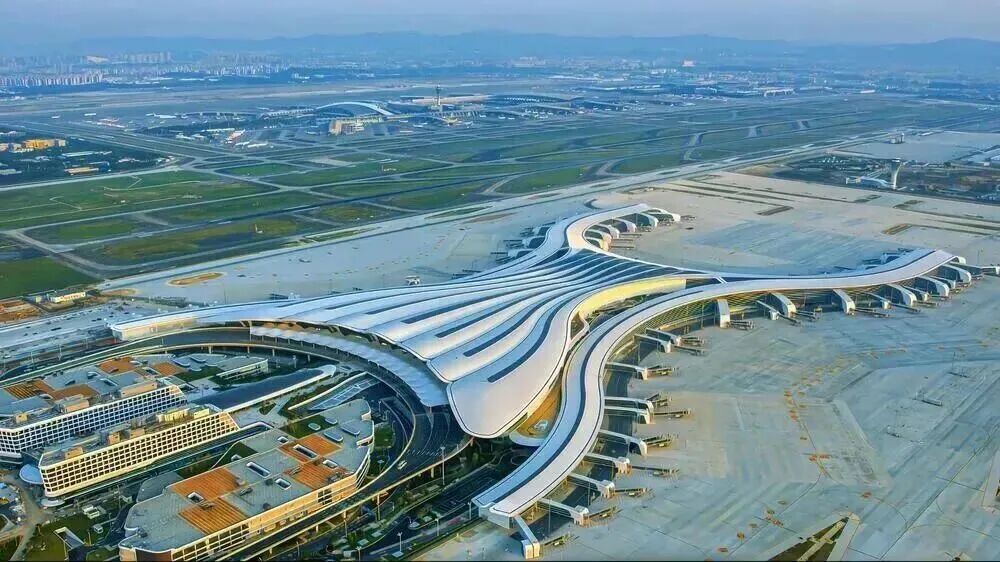
Terminal 3 of Guangzhou Baiyun International Airport Photo Source: Nanfang Daily
In a sense, this has also built up the strength for Baiyun Airport to compete with Pudong Airport. Wang Guowen, director of the Institute of Logistics and Supply Chain Management of the China (Shenzhen) Comprehensive Development Institute, once pointed out in an interview that for the whole of this year, the gap between the two airports is expected to remain relatively small; in the long run, there is a certain time difference in the competition between the two sides, and Baiyun Airport has taken the lead in hardware and production capacity.
With passenger flow on a par with Pudong Airport, hub economy has naturally become the next direction for Guangzhou Baiyun Airport to catch up.
For a long time, the development of the surrounding areas of Guangzhou Baiyun Airport has faced the problem of "large port, weak industry, small city". The Baiyun and Huadu districts where it is located have long been considered to have lagging urban construction and a distinct "suburban" image. As early as 2024, the "Industrial Development Plan for Guangzhou Northern Growth Pole (including Airport Economic Zone) (2023-2035)" proposed to benchmark against advanced regions such as Shanghai Hongqiao, and promote the Northern Growth Pole to iterate and upgrade from a "transportation hub" to an "economic hub", and then to an "open hub".
The latest benchmark that Guangzhou has targeted, the Oriental Hub, is exactly the new solution put forward by Pudong Airport for the hub economy. As a brand-new concept that first appeared in public reports in 2022, the Oriental Hub is considered to focus on solving the past problem that the traffic flow of transportation hubs "passes through without staying", so that more people flow, logistics and capital flow can settle locally. At present, the pilot zone has attracted enterprises such as Boston Scientific and JD Industry Development to settle in.
According to the relevant person in charge of its operator, the Oriental Hub will target more export-oriented cross-border enterprises. How to face the global market is another urgent problem to be solved for Guangzhou Baiyun Airport.
Another variable facing Guangzhou Baiyun Airport is the new Guangzhou Airport under construction. According to the current development of dual-airport cities, the operation of the second airport will inevitably lead to traffic diversion, leaving Baiyun Airport with increasingly tight time. According to the existing division of labor, Baiyun Airport will continue to focus on building an international hub, while the new airport will focus on serving the regional economy and cargo transportation, making Pudong Airport undoubtedly a more suitable "role model".
Gap
However, compared with the rapidly narrowing traffic gap, the difference between Guangzhou Baiyun Airport and Pudong Airport in the field of hub economy is more difficult to bridge.
Cargo transportation is more closely related to the hub economy. Last year, the cargo and mail throughput of Guangzhou Baiyun Airport reached 2.439 million tons, still ranking second in China, while Pudong Airport steadily ranked first with 4.091 million tons, with a gap of "one order of magnitude" between the two.
Behind this is the shortcoming of the airport economy. In 2023, when participating in the compilation of the "Implementation Opinions on Supporting Huadu District to Build Guangzhou Northern Growth Pole", the Guangzhou Planning Institute once released an analysis article pointing out that the industrial scale of Guangzhou's airport economy is relatively small, and it is not strongly linked with local manufacturing industries.
It cited data at that time pointing out that the added value of the airport economy of Guangzhou Baiyun Airport is less than 50 billion yuan, only 13% of that of London Heathrow Airport, 24% of that of Shanghai Pudong Airport, and 31% of that of Dallas Fort Worth Airport, which still has a large gap compared with airports of the same magnitude. Among them, the output value of airport-related manufacturing industries such as electronic information, biomedicine and precision equipment only accounts for 5% of the regional industrial output value, while the proportion exceeds 30% in airport economic zones such as Shenzhen Bao'an and Shanghai Pudong.
In addition, although the Pearl River Delta is the main source of goods for Baiyun Airport, the products of enterprises in the northern part of Guangzhou, including automobiles and spare parts, fashion products, optoelectronic and acoustic products, are mainly transported by road and sea, with weak linkage with the airport.
In a sense, this is not only the difficulty for Guangzhou to build the Northern Growth Pole and even create the "Southern Hub", but also the reason for this initiative.
The Baiyun and Huadu districts where Guangzhou Baiyun Airport is located are in the northern part of Guangzhou, which has never been listed as the main direction of Guangzhou's urban development.
At the beginning of this century, Guangzhou took the lead across the country to introduce the first strategic plan among China's large cities — the "Outline of the Overall Strategic Concept Plan for Guangzhou's Urban Construction". It first proposed the strategy of "expanding south, restraining north, advancing east and linking west", and later adjusted it to "expanding south, optimizing north, advancing east and linking west". The "optimizing north" at that time was interpreted as a "strategic reserved space". By 2019, with the introduction of the Guangdong-Hong Kong-Macao Greater Bay Area initiative, under the trend of "developing towards the bay", the urgency of "expanding south" was further enhanced, and the northern region once again waited for the right opportunity.
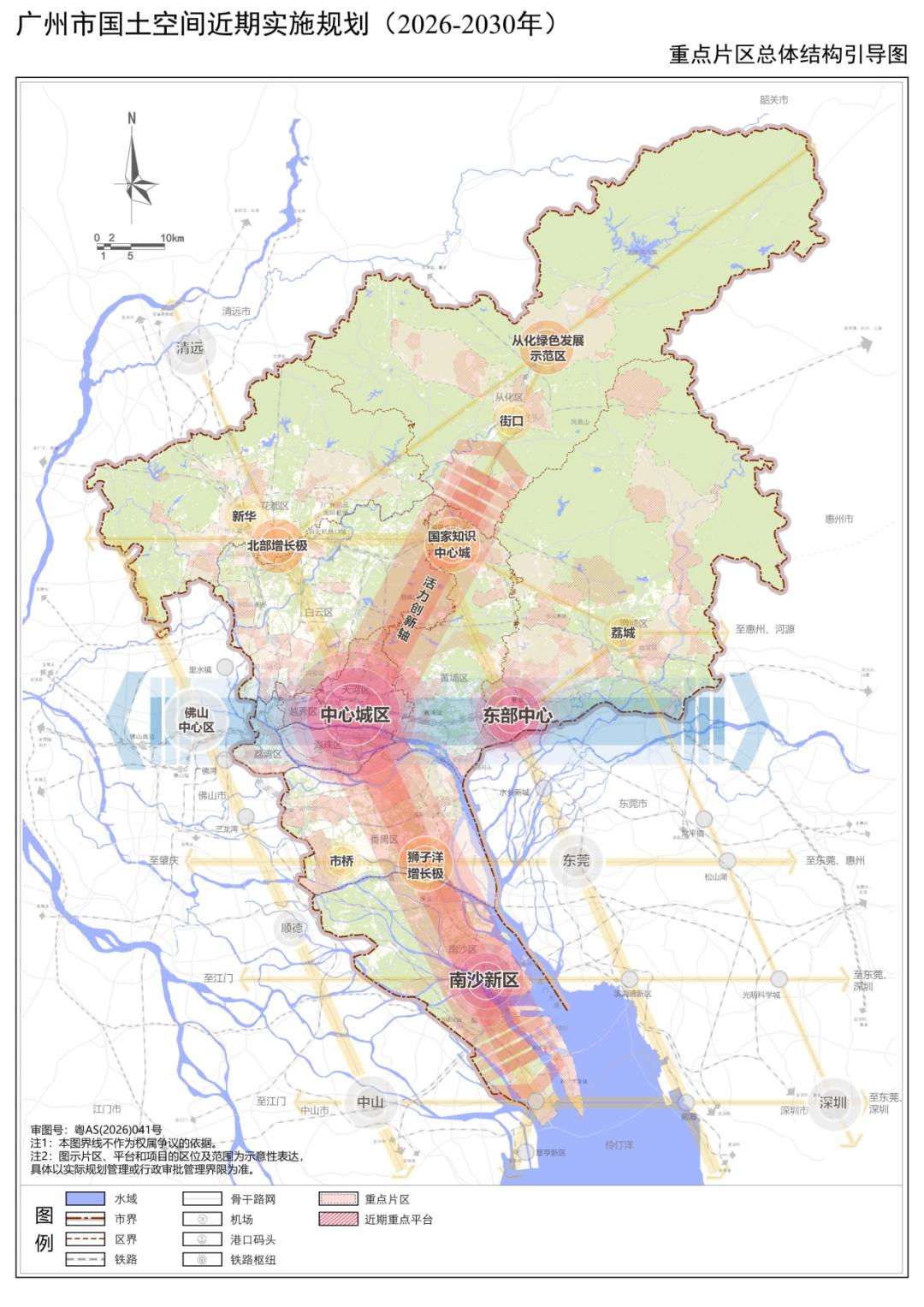
Photo Source: the newly issued "Recent Implementation Plan for Guangzhou's Territorial Space (2026-2030)"
In 2021, the goal of Huadu building "an important bearing area for population and economy and an economic growth pole in northern Guangzhou" was written into the outline of Guangzhou's 14th Five-Year Plan. Afterwards, the goal of the Northern Growth Pole was continuously improved and expanded to some areas of Baiyun. There is a view that "Guangzhou needs a new growth pole. It should not and cannot ignore the vast hinterland of urban development, and must make use of the northern region whose regional development level remains to be improved to coordinate coordinated development and cultivate new growth points."
The airport-centered airport industry has become the breakthrough for the development of the Northern Growth Pole. Contents such as "taking the airport as the leader" and developing airport-adapted economy frequently appear in various plans of the Northern Growth Pole, and the newly planned key areas such as the International Business Cooperation Zone, International Commercial Port, Airport Digital Intelligence Port, and North Station Business District are all expected to become carriers for the development of the airport economy.
Path
Benchmarking against the "Oriental Hub", the hub economy is only the first step.
In fact, among a number of "first" descriptions, the Oriental Hub stands out for a breakthrough arrangement concerning "people": it is the first specific policy zone in China targeting "maximum convenience for cross-border movement of people".
Compared with other "inside the border but outside the customs" supervision zones that mainly target goods, the Oriental Hub International Business Cooperation Zone takes the lead in expanding the "first-tier liberalization" system to natural persons. Overseas personnel can enter the zone visa-free with the invitation and filing certificate, and can also quickly apply for a "port visa" in the zone to leave the zone and enter the country.
Yu Ling, Lead Partner of Economic Consulting Services at EY (China) Enterprise Consulting Co., Ltd., once analyzed in an interview that the Oriental Hub builds a super hub through the agglomeration and radiation of high-end factors, and its core value lies in realizing the transformation from physical flow to economic energy. Among them, the movement of people is the core breakthrough, which can drive the smooth flow of production factors such as technology, capital and even data.
In this sense, the fundamental reason why the "Oriental Hub" is called a hub does not lie in transportation, or even only in economy and industry. It is the exploration of rules and the promotion of institutional and mechanism innovation that make it worthy of the name of "Oriental Hub".
In contrast, Guangzhou, which aims to build a "Southern Hub", what new connotation does it need to inject into the "hub" concept?
Not long ago, the north plot of the first development zone of Guangzhou International Commercial Port, located in the northwest area of Guangzhou Baiyun Airport, was officially listed. Previously, the Municipal Party Committee has held many meetings to deploy and plan this project, and the Secretary of the Municipal Party Committee and the Mayor have inspected it successively, which shows the local government's high attention to this project. According to local media reports, Guangzhou International Commercial Port is positioned as a professional, intelligent, one-stop, hub-type large-scale physical trade platform, which is regarded by the outside world as the Guangzhou version of "Yiwu International Trade City".
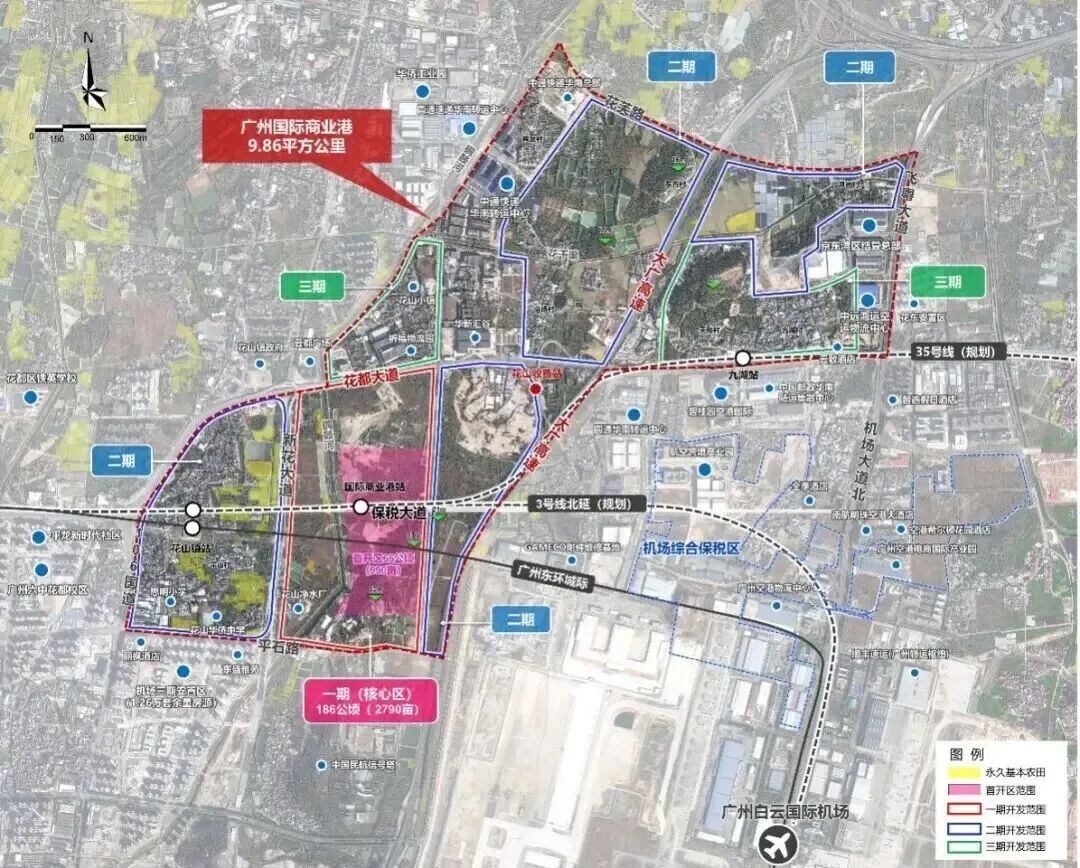
Photo Source: Huadu Guangzhou Official Account
Behind this are the pain points of Guangzhou's manufacturing industry. For example, a proposal from the Guangzhou Municipal Committee of Jiu San Society at the 2026 Guangzhou Two Sessions analyzed that as an important part of Guangzhou's manufacturing industry, the transformation of Guangzhou's professional markets still has shortcomings. Most markets remain at the low value-added OEM and wholesale links, failing to highlight the advantages of an international hub and supply chain center, with weak industrial collaborative innovation and international operation capabilities, and no scale effect and full-chain ecosystem formed.
The outside world expects that the International Commercial Port can become a commercial "hub", refer to Yiwu's systematic integration capabilities, build the entire market into a public service platform, and build a full-chain integrated system of trade service capabilities.
For Guangzhou, the millennium-old commercial city, this is also an important path for transformation to a "hub". Last year, Guangzhou University and the Social Sciences Academic Press jointly released the "Guangzhou Blue Book: Analysis and Prediction of Guangzhou's Economic Situation in China 2025", pointing out that in the Greater Bay Area, Guangzhou is transforming from a "major manufacturing town" to a "hub center", relying on airports, high-speed rail hubs, Nansha Pilot Free Trade Zone and other resources to form a hub-type economic space of "agglomerating domestically and radiating globally".
It is worth looking forward to whether under the construction goal of the "Southern Hub", Guangzhou can truly realize the re-integration of global manufacturing resources and fulfill the long-cherished wish of "rebuilding a new Guangzhou".
This article is from the WeChat official account "City Evolution Theory", written by Yang Qifei, and authorized for release by 36Kr.