Starting from RMB 9,800, the humanoid robot that transforms according to different tasks
When your game stutters, you swap in a new graphics card; when you run out of RAM, you add an extra memory stick. A custom-built PC can keep up with evolving usage demands by replacing and adding components. What if robots could work the same way? You could install a single arm first, then add a mobile chassis later when you need it to perform movement-based tasks.
On September 14, BlueBot Embodied Intelligence launched the Mantis Standard, a modular wheeled humanoid robot nicknamed "Xiaobai", with a starting price of 9,800 yuan. It integrates the design concept of "one brain for multiple forms, truly modular" into the product: modules such as the robotic arm and chassis can be used independently, or recombined according to different tasks. This gives users an extra option — buy only the parts you need right now, and add new capabilities to the robot later as your work requirements change.
01 Assemble a robot the same way you build a custom PC
To understand the modular design of "Xiaobai", you can start with one of its robotic arms.
Mounted on a desktop, this arm works as a standalone device for grabbing experiments, operation teaching and data collection. If your research further involves mobile pick-and-place tasks, you can combine the robotic arm with the chassis, so the original arm can be put to use for new work. When two coordinated hands are required, users can also choose the corresponding dual-arm configuration.
In this process, the original equipment can be retained and become the foundation for further expansion.
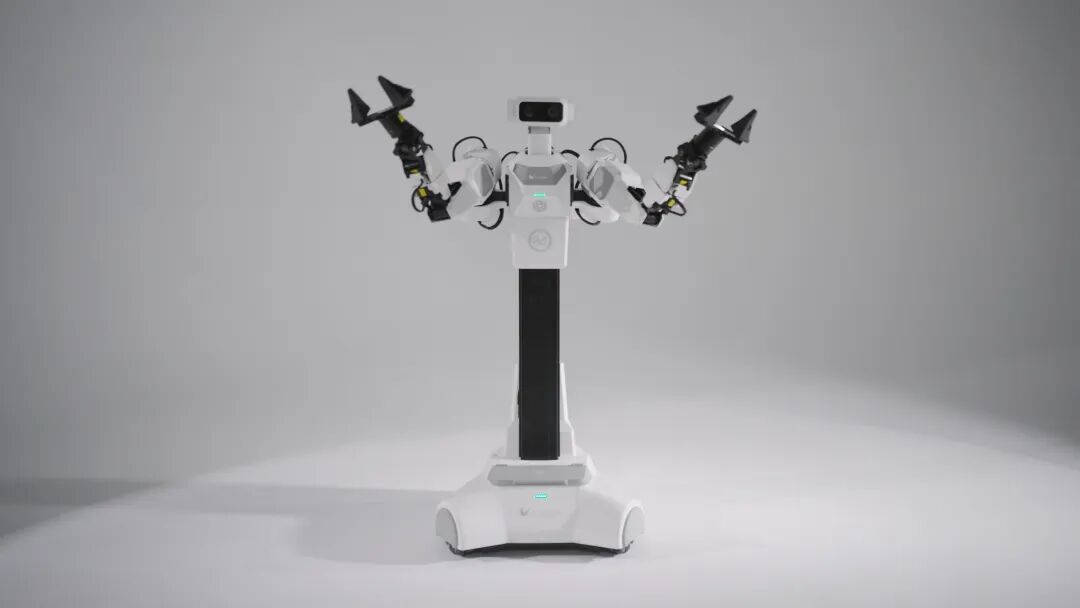
According to the design of BlueBot Embodied Intelligence, the robotic arm, chassis, body, sliding stage and head of Mantis Standard are all independent functional modules, which are mechanically and electrically connected through quick-mount interfaces. Each module has its own purpose, and can be combined into new forms, while users can also expand third-party devices as needed.
For teams that are new to embodied intelligence, this purchasing model is easy to understand: first define the task you want to complete, then select the corresponding equipment. If you only need to do desktop experiments at the moment, configure the device around desktop tasks; when you really require movement capabilities, then consider adding a chassis. The budget follows the progress of the project, and every step corresponds to clearer, more specific demands.
Users who have already purchased the full machine can also recombine their existing modules to apply them to other tasks. Of course, after switching to a new configuration, installation, debugging and adaptation are still required, but your existing equipment gets more chances to be reused.
Some capabilities are only confirmed as necessary when the project reaches a certain stage. The modular design allows users to make purchasing decisions later.
This flexibility is especially valuable for teams whose research directions are still under exploration and whose application requirements are not yet fully determined.
02 It can "transform" its configuration, and is more capable of performing practical work
"Xiaobai" has a highly recognizable appearance: a white body, a head similar to a gimbal camera, a wheeled chassis at the bottom, and two prominent robotic arms. Its design focus is also very straightforward — arrange the daily work scenarios that the robot needs to handle around movement and upper-limb operation capabilities.
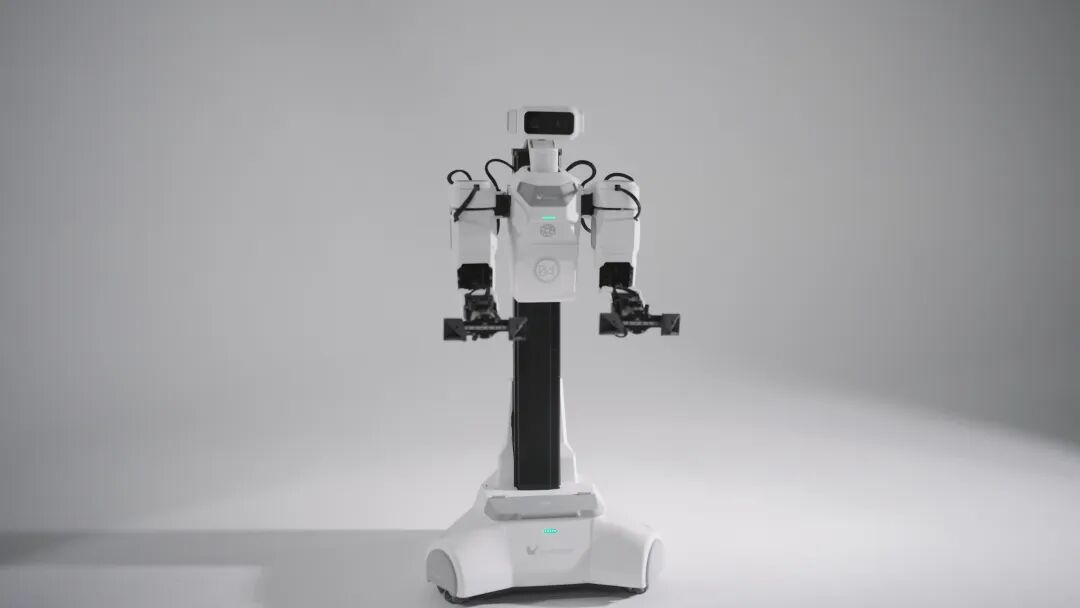
Take object pick-and-place as an example: the robot first moves to a suitable position, then adjusts the arm posture, approaches the target object, grabs it and puts it down. For scenarios with flat ground where work is concentrated around desktops and workstations, the wheeled chassis takes charge of movement, while the dual arms are responsible for specific operations. The Standard adopts an omnidirectional wheel design, which makes it convenient for the robot to adjust its moving direction according to the target position.
According to BlueBot Embodied Intelligence, the single arm of the Standard has 7 degrees of freedom, and the payload of a single arm is 7kg. The former means the arm has more room to adjust its posture, and can choose the optimal approach angle around the position of the object; the latter provides the hardware specification for the weight of the operation target. For specific tasks, further configuration and debugging are required combined with the shape of the object, end effector and operation range.
The arm needs to reach the target position, and the operation process also needs to be clearly visible. The Standard is equipped with 4K 60fps binocular vision for environment observation, teleoperation and data collection, and supports adding other sensors and wrist cameras. Binocular vision helps judge spatial distance, while the wrist perspective can be closer to the operation area. The head adopts a 3-axis gimbal structure, which also meets the need to keep the field of view stable when the robot is moving.
These configurations lay a practical working foundation for the multiple forms of "Xiaobai". However, after the hardware is combined, there is one more step: to enable different "body" configurations to obtain corresponding control capabilities.
This is where the "one brain for multiple forms" concept works. The Standard is equipped with BlueBot Embodied Intelligence's self-developed BW-Brain, which carries the "Wormhole" series of embodied intelligence foundational models, and is compatible with different robot forms. For specific work, the team has also organized existing functions into callable skills, making it easy for developers to continue arranging tasks.
For users, the more perceptible part is its supporting teleoperation and development tools. Through the "Quantum" teleoperation system, operators can wear VR devices to control the robot, complete teaching demonstrations, and record data during the operation process.
For example, to make the robot pick up an object on the table and place it at a designated position, the operator can first control it to complete the whole process. The collected data is then used for model training, after which developers deploy the model to the robot, observe the execution results, supplement data and continue to adjust. Teleoperation and autonomous execution are different processes, but the former can provide training materials for the latter.
The Standard also provides tools such as development interfaces, simulation and open-source model adaptation for teams to use according to their own research directions. After getting the robot, users can continue to teach it, adjust it, and conduct repeated tests around specific tasks. For a device oriented to scientific research and secondary development, this feature is as important as the payload of the robotic arm and the clarity of its vision system.
03 True cost-effectiveness is calculated based on the full life cycle
With a starting price of 9,800 yuan, the first thing that catches people's attention is the low entry threshold. When the equipment is actually put into laboratories and work sites, users will also care about several other investments: how much it costs to add new functions, whether the development work can be continued, and whether it is convenient to handle failures when they occur.
The modular design of Mantis Standard also takes all these issues into consideration.
Scientific research funds need to be used in line with experimental arrangements. When a method is still under verification, the team can first carry out research with a configuration that meets current demands; when preliminary results are obtained, then decide what capabilities to add. In this way, subsequent purchases can be based on clearer requirements, and advance investment in functions that are not needed for the time being can be reduced.
Secondary development teams also calculate their time investment. Familiarizing themselves with a set of control interfaces, building data collection processes, and mastering model training and deployment methods all take effort. By expanding equipment within the same product system, developers can continue to use familiar tools, and only make adjustments for newly added modules and new tasks. The experience accumulated in the past can continue to play a role.
Application exploration in commercial services and light industry is more suitable to start from a specific link. For example, if an enterprise wants to verify whether the robot can undertake a certain item pick-and-place task, it can first select the corresponding configuration and build the process around this link, and observe its performance on site. When the requirements are further clarified, then evaluate whether to add movement capabilities, or apply it to more complex operations.
Starting from a small task means every expansion step has a more specific basis. Whether the robot can adapt to the height of the workbench, the operation target and the on-site space can also be gradually clarified in the verification process.
Maintenance is also part of the usage cost. Independent functional modules make it easy to troubleshoot problems, replace parts and perform repairs. For users, how to deal with equipment failures and how quickly the device can be put back into work are all factors worth considering at the time of purchase.
Therefore, "easier to use, more comprehensive, more affordable" must ultimately be implemented in how users use the equipment every day. A robot can continue to deliver value after purchase only if it can complete current tasks, can be expanded when requirements increase, and has a clear maintenance process for subsequent issues.
What "Xiaobai" provides is exactly a choice that allows investment to expand step by step: start with the current work first, then add new capabilities according to the next-step requirements.
04 From competition arenas to workbenches: Embodied intelligence is moving toward popular accessibility
Behind this product is a robotics team originating from Xi'an. BlueBot Embodied Intelligence was established in 2025 through the transformation of scientific and technological achievements from Xi'an Jiaotong University. Its founding team is composed of master and doctorate robotics researchers from Xi'an Jiaotong University and senior industry engineers.
Before the Standard, the Mantis Pro had already been put into practice for specific operation tasks. In August 2025, it won the bronze medal in the mixed material sorting event at the World Humanoid Robot Games. This achievement is a concrete footnote to the Mantis series' focus on upper-limb operation capabilities. The Pro accumulated practical task experience through competitions, and the newly launched Standard further considers the different demands in scientific research, development and application exploration: some users need a single arm, some need dual-arm collaboration, and others need a complete mobile operation platform. Enabling more users to find a suitable configuration has become a key direction of this new product launch.
The starting price of 9,800 yuan gives "Xiaobai" the chance to be understood and tried by more people. But how long it can be used, and how far it can support a project, still needs to be seen in subsequent practical use.
When a robotic arm originally used for desktop grabbing is recombined and adapted to continue participating in mobile operations, the value of modular design becomes very intuitive: the equipment used in the previous experiment still has a place in the next work.
The robot evolves with the tasks, and ultimately moves forward together with the people who use it. When new ideas come up for the project, your existing equipment can still be put to good use — this is the tangible value that Mantis Standard aims to bring to users.
This article is from the WeChat official account "Core Intelligent Headline", author: Mian Mian, editor: Maya, published with authorization from 36Kr.