Collective limit-up, is the US stock market sending a big gift package?
When trading opened on September 15, the cybersecurity sector of China's A-share market hit full limit-ups collectively.
Newstec opened at the limit-up price of 28.45 yuan, notching its fourth consecutive trading limit, with total market capitalization rising to 4.86 billion yuan.
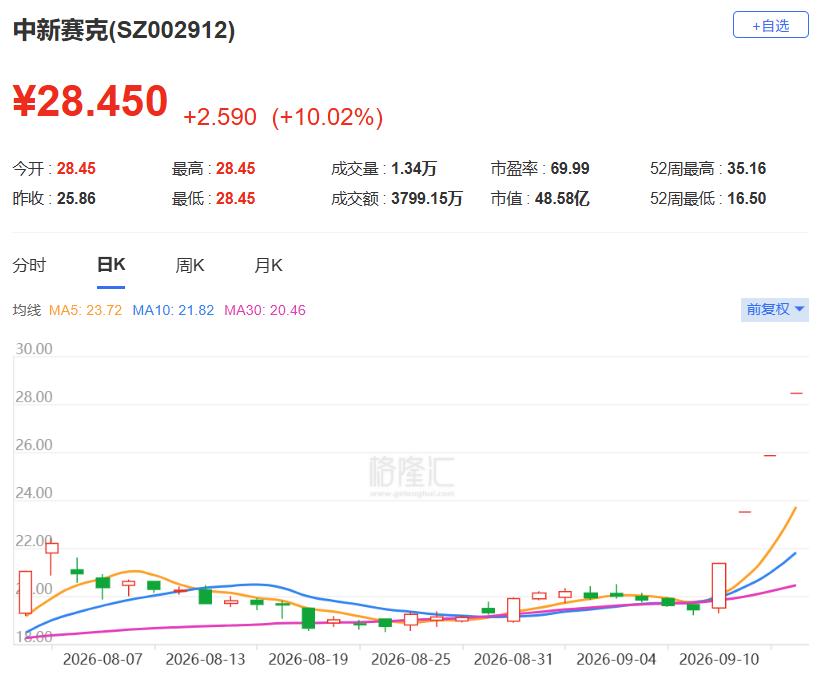
Qiming Information, Bohui Technology followed suit and hit limit-up at the call auction. Tianrongxin, Yongxin Zhicheng, Zhongfu Information, Haohan Depth, and AsiaInfo Security also rallied, sending the cybersecurity concept index sharply gap-up at opening.
This marks the second consecutive trading day that the cybersecurity sector sees a widespread limit-up surge. On the previous trading day, Yongxin Zhicheng and Newstec hit the 20% limit-up, while Tianrongxin, Guoan Co., Ltd., and Qiming Information also closed at their respective limit-ups.
The direct trigger of this market rally came from the other side of the Pacific.
In the early hours of Beijing time on September 15, the cybersecurity sector of the US stock market saw a collective skyrocketing surge.
The Global X Cybersecurity ETF closed up 10.66% at $44.31 on the single day, marking the largest one-day gain in the ETF's history.
CrowdStrike closed up 13.8% to refresh its all-time high, Zscaler soared 16.52%, and Palo Alto Networks closed up 13.09%.
Dario Amodei, CEO of Anthropic, recently published a long article titled "We Must Slow Down the Frontier", stating straightforwardly that the AI industry needs to slow down the development of new models and set aside time to complete safety alignment.
He put forward a chilling judgment that without control, in 6 to 12 months, a group of AI agents may be capable of taking control of the entire Internet through continuously running botnets, potentially causing hundreds of billions of dollars in losses.
More critically, after the post was published, Sam Altman of OpenAI and Elon Musk of xAI successively publicly expressed their support for the view.
Such a rare consensus of putting safety first among competitors has almost never happened in Silicon Valley.
In China, policy signals are equally intensive.
On September 11, the Ministry of Industry and Information Technology issued the "Implementation Plan for the Special Action of 'AI + Software'", explicitly proposing that by 2028, the promotion and application of intelligent programming tools will cover 20,000 software enterprises above designated size. The plan specifically lists "enhancing the security guarantee capability in the software field" as one of its six key tasks, requiring "promoting security with intelligence, combining prevention and treatment" in the development link, and "highlighting controllable behaviors and full traceability" in the product link.
On September 14, the National Cybersecurity Publicity Week kicked off across China, with its opening ceremony held in Jinan. The forums are set up under the "1+15" structure, which will release the 3.0 version of the "AI Security Governance Framework" and the 2026 AI-empowered Cybersecurity Application Test Results.
The intensive rollout of policies has rapidly heated up the market's expectations for the cybersecurity industry.
Industrial data also provides underlying support for this round of market rally.
According to statistics from Frost & Sullivan, the overall size of China's data security market reached 29 billion yuan in 2025, is expected to hit 32.3 billion yuan in 2026, and is projected to climb to 50.9 billion yuan by 2030, with a compound annual growth rate of about 12.1% from 2026 to 2030.
Globally, Mordor Intelligence estimates that the size of the AI cybersecurity market reached 30.9 billion US dollars in 2025, and is expected to rise to 86.3 billion US dollars by 2030, with a compound annual growth rate as high as 22.8%.
If we take a longer timeline, the logic behind this round of cybersecurity rally has actually undergone a reversal.
At the beginning of 2026, the rapid improvement of cutting-edge large model capabilities once triggered the concern that "AI Agent will subvert the software industry", and the cybersecurity sector was suppressed for a quite long period of time.
However, as Anthropic granted directional access to a small number of institutions to the Claude Mythos model with strong attack capabilities through Project Glasswing, investors began to realize a counterintuitive fact: the stronger AI is and the more automated attacks become, the stronger the willingness of enterprises to pay for security, and the deeper the moat of leading security enterprises will be.
Back to Newstec, the company has repeatedly emphasized in its announcements that its AI application products are still in the initial stage of commercialization, and the revenue generated from such products accounts for no more than 2% of its total operating revenue in the first half of 2026.
Meanwhile, the latest rolling price-earnings ratio of the company is as high as 494.16 times, while the average price-earnings ratio of the software and information technology service industry it belongs to is only 58.31 times, indicating a significant deviation in valuation.
The fundamental data is also not optimistic: the company's operating revenue in the first half of the year was 235 million yuan, and its net profit attributable to shareholders was a loss of 129 million yuan, with a year-on-year decline of over 86%.
The long-term logic for cybersecurity remains solid, and the release of AI security demand has indeed just started. But between a stock that has notched four consecutive limit-ups and a company that is still in the early stage of transformation, there may be much more than just a few limit-ups in distance.
This article is from the WeChat Official Account "Gelonghui APP" (ID: hkguruclub), authored by Gejila, and republished by 36Kr with authorization.