The state has injected a massive 5 trillion yuan, and this 70-year-old long-overdue debt is finally about to be paid off.
Are the city's "underground blood vessels" about to face a major test?
The 15th Five-Year Plan for Urban Renewal issued by the State Council in May this year proposed that about 5 trillion yuan will be invested in the next five years to carry out large-scale construction and renovation of around 770,000 kilometers of underground pipeline networks.
What does this figure mean?
It means that in the next five years, an average of 2.7 billion yuan will be invested in the underground pipeline network every single day, and the total mileage of the renovated pipeline network can circle the earth for almost 19 times.
In the plan, it is also listed as one of the national key strategically deployed "Six Networks", on a par with the water network, new power grid, computing power network, new-generation communication network, and logistics network.
How can old water pipes buried underground be mentioned in the same breath as the most cutting-edge computing power and communication networks?
Behind this is a 70-year outstanding debt that is finally going to be paid off.
01
Why is the country so urgent about the renovation of the underground pipeline network?
A very straightforward reason is: time waits for no one.
In its "Frontline Investigation" program this year, CCTV followed up on an inspection of Wuhan's underground pipeline network, and recorded a worrying scene:
When the pipeline robot went down underground, the footage it sent back showed that the bottom of a sewage pipe was mostly blocked by silt, with its actual drainage capacity less than half of the designed level.
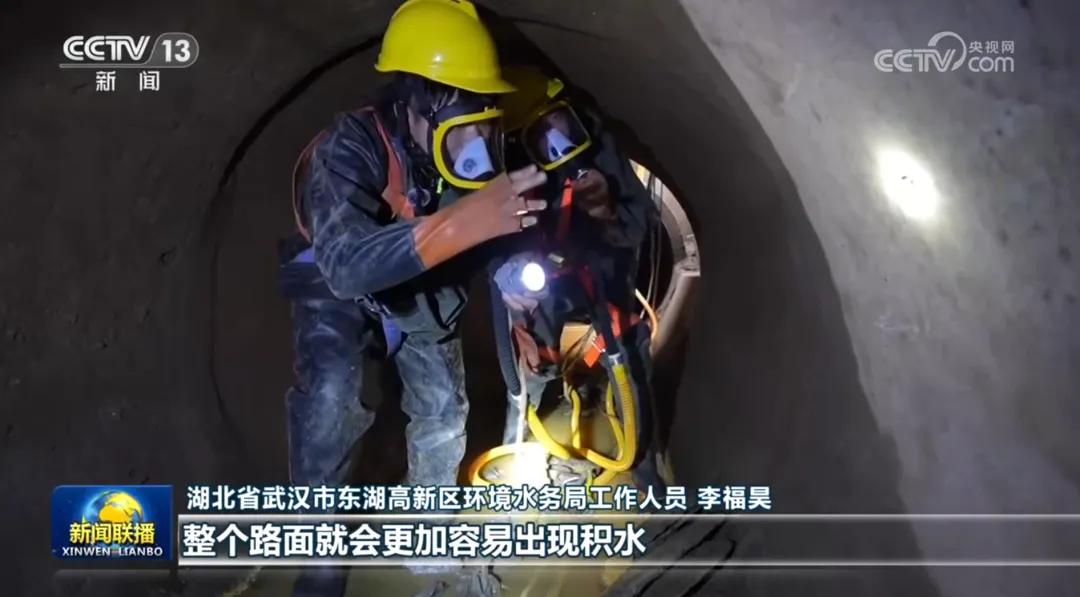
CCTV "Frontline Investigation" - Pipeline robot enters the well to inspect Wuhan's underground pipeline network (Source: CCTV News)
After a city-wide inspection in Wuhan, 5,610 drainage pipes with various defects were identified.
Note that this is Wuhan, a city where the Yangtze River and Han River meet, known as the thoroughfare of nine provinces, and one of the cities in China that most urgently needs drainage systems.
Across the country, the total length of urban drainage pipeline networks has reached 993,600 kilometers. According to a survey by experts from Tsinghua Tongheng, about half of them cannot meet the flood control standard of "once in two years".
How on earth did this debt come about? It all starts with the drainage standards set in the early days.
Back then, the drainage standard designed for Wuhan was calculated based on a rainstorm of 33 millimeters per hour. Shi Yajun, deputy chief engineer of Wuhan Municipal Design Institute, said that this standard is no longer sufficient today - short-term heavy rainfall of 30 to 60 millimeters per hour can occur several times a year now.
The standards are still stuck in the past, but the rain is no longer what it used to be. The gap between the two may easily lead to urban waterlogging.
In the early days of the People's Republic of China, we had almost no technical foundation, and the Soviet model was the only reference. From 1953 to 1957, this set of practices was introduced into urban planning. Major cities such as Shenyang, Nanjing and Guangzhou were directly guided by Soviet experts, and the relevant standards were later adopted by many cities.
The problem is that the Soviet Union has a cold and rainy climate, and its drainage standards were calculated based on the average precipitation in Moscow. However, China is located in a monsoon climate zone, where heavy rainstorms in summer pour down like buckets, which is completely a different scenario.
In the 1960s and 1970s, both fiscal revenue and construction materials were in short supply. People used whatever was available: drainage ditches, brick-built culverts, cement pipes, and clay pipes. Many facilities that are considered "over-aged" today were buried during that period.
The real problem emerged during the urban expansion period after the reform and opening up.
Construction speeded up in the 1980s, and nearly 200,000 kilometers of cast iron pipes and cement pipes were laid underground while buildings were being constructed. Later, the urbanization rate rose from 30% to 66%, hundreds of millions of people moved into cities, and cities kept expanding year by year.
It only takes one year to complete a building above the ground, but underground pipes have to be laid one by one, and the construction speed cannot keep up at all. With hundreds of millions of people moving into cities first, the pipeline network can only be used while being renovated, a process that has lasted for more than 40 years.
There is a priority rule in urban construction called "above ground first, then underground":
People have to move in first and make the city operate. The underground pipeline network is buried in the soil, invisible and intangible, and its construction is far more complicated than above-ground projects, so its progress is naturally slower.
In 2013, the State Council issued a document requiring the completion of the rain and sewage diversion project within 5 years, and the establishment of a drainage and waterlogging prevention system within 10 years.
This work is still ongoing to this day. The underground pipeline network is a system that affects the whole body when one part is moved. It often requires digging up roads that are already full of buildings, and coordinating multiple pipelines for water, electricity, gas, heating and communication, which cannot be rushed.
In 2010, the Ministry of Housing and Urban-Rural Development conducted a special survey on waterlogging prevention in 351 cities across the country. The results showed that between 2008 and 2010, 62% of the cities had experienced waterlogging, and 137 cities had experienced waterlogging more than three times. Among the cities that encountered waterlogging, 74.6% had a maximum water accumulation depth of more than 50 centimeters.
However, water half a meter deep is enough to make a car stall and break down.
02
The outstanding debt has not been paid off yet, and the rainfall pattern has already changed.
In July 2026, a severe rainstorm hit the central and southern parts of Shenyang, with an average rainfall of 346.8 millimeters in the urban area. Several rainfall indicators directly broke the extremes recorded since 1951 when complete meteorological records were available.
Even the Taklamakan Desert, a byword for aridity, encountered a heavy rainstorm. In June 2026, Hotan on the southern edge of the desert received 64.7 millimeters of rainfall in 24 hours, which exceeded the total annual precipitation of the local area in normal years, breaking the record since the meteorological station was established.
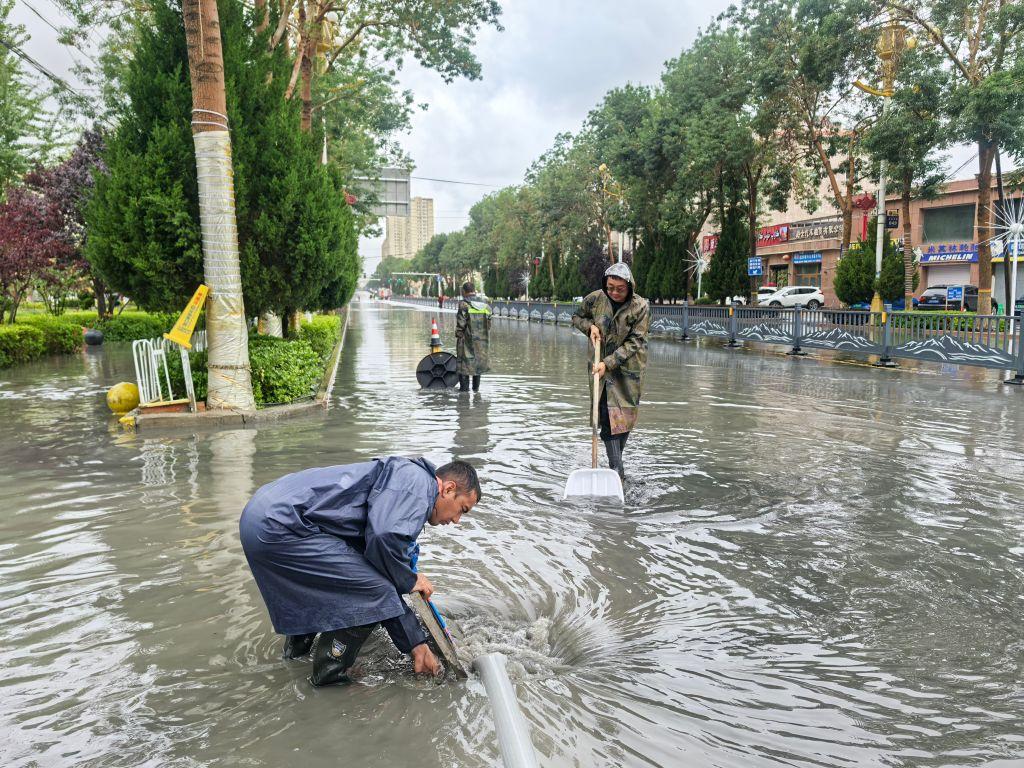
Rare heavy rain hits Hotan on the southern edge of the Taklamakan Desert (Source: China Meteorological Administration)
Although this cannot be simply attributed to one single cause, there is an increasingly important common background: global warming superimposed with El Niño is pushing up the frequency and intensity of extreme weather events.
According to the monitoring of the National Climate Center, for this round of El Niño, the sea surface temperature in the key sea area of the central and eastern equatorial Pacific was 2.64℃ warmer than the normal level in the first half of August. It is expected to reach its peak from November to December, and will most likely become the strongest El Niño on record.
Before that, such super El Niño events occurred in 1982, 1997 and 2015 respectively.
Climate expert Ding Yihui once reminded that we have entered a period with a significant increase in extreme weather events, and we will have to live in such a background for the next few decades.
Why is that?
There is a very simple physical law:
For every 1℃ rise in the global average temperature, the atmosphere can hold about 7% more water vapor. The same amount of water that used to pour down in a whole day now falls in just a few hours.
Using old designs to cope with new rainfall patterns is a test placed in front of every city.
03
The 15th Five-Year Plan for Urban Renewal provides the exact answer to this test.
Among the "Six Networks" of national key deployment in the 15th Five-Year Plan, the urban underground pipeline network occupies one seat: the water network, new power grid, computing power network, new-generation communication network, urban underground pipeline network, and logistics network.
The underground pipeline network is the most "fundamental" one among the six networks: the other five are the nerves and muscles of the city, while the pipeline network is the blood vessel - if the blood vessel is blocked, no matter how developed the nerves are, the whole system cannot function properly.
This year alone, the ultra-long-term special treasury bonds have allocated 160 billion yuan specifically for pipeline network renovation, 25 billion yuan more than last year.
This is just the beginning. In the next five years, about 770,000 kilometers of underground pipeline network will be constructed and renovated across the country, with a total investment of about 5 trillion yuan - the total mileage on the map can circle the earth for almost 19 times, with an average daily investment of about 2.7 billion yuan.
2.7 billion yuan is invested every day in a place that ordinary people can hardly see. The determination behind this move is extremely strong.
Moreover, this time, the Ministry of Housing and Urban-Rural Development requires "inspection before renewal, no renewal without inspection". All prefecture-level cities and county-level cities will carry out full-scale urban inspections, using pipeline robots, sonar and periscopes to figure out all the problems underground first.
A number of provinces have built provincial-level urban lifeline supervision platforms, and the operation status of the underground pipeline network can be monitored in real time for the first time.
Suzhou Industrial Park spent six to seven years laying the underground pipeline network completely before starting to build buildings when it was established in 1994; the sewers of Paris took more than 100 years to complete, and they are still in good use today.
However, history did not give such a window of opportunity to most Chinese cities. They can only renovate the underground system on the go, under the feet of the already densely built high-rise buildings.
What we are ultimately pursuing is never a huge number, but the bottom line of the city where people will no longer be caught off guard when the next rainstorm comes.
References:
1. Official website of the Chinese Government | How urban renewal will be carried out in the next five years! Explanations from four relevant departments
2. CCTV.com | More than 5 trillion yuan! The renovation of urban underground pipeline network has become a key driver for "expanding effective investment and stabilizing economic growth"
3. Wuhan Water Bureau | CCTV Focus · News Broadcast praises Wuhan Water Affairs: Innovatively solving the difficulties in underground pipeline network renovation
4. Chinanews.com | Frontline Investigation: Underground pipeline network is accelerating its upgrading to make the city's "infrastructure" more solid
5. CCTV.com | From 2008 to 2010, 62% of China's 351 cities experienced waterlogging
6. China Meteorological Administration | Expert interpretation: El Niño is about to reach "super strong" level, understand it scientifically and respond in advance
7. Guangming Online | The rainstorm that just hit Shenyang is the strongest one since 1951
This article is from WeChat Official Account "TrendInsight", Author: Nuan Dong, Editor: Zi Buyu, published with authorization from 36Kr.