Brain-computer companies, pursuing forced, premature growth that ends up being counterproductive.
We are in an era that is being rapidly transformed by technology.
Hot fields including AI, robotics and gene editing are redefining "human beings" to a certain extent.
The brain-computer interface track stands out particularly evidently in terms of the capability to "transform human beings". It carries multiple narratives at the same time, including cure, enhancement, connection and immortality, any of which is enough to support the imagination space of a trillion-level market.
While the robotics track is drawing regulatory attention and unsubstantiated rumors are spreading everywhere, brain-computer interface enterprises with less mature technologies and business models have also started their sprint towards IPOs one after another.
Financing Boom
This year, the capitalization process of the brain-computer interface track has accelerated significantly. Earlier this month, non-invasive enterprise Xuli Innovation completed tutoring filing with the Shanghai Regulatory Bureau of the China Securities Regulatory Commission, officially launching its IPO process on the Science and Technology Innovation Board, with Huatai United Securities as the tutoring institution.
This is the third brain-computer interface enterprise that has taken a key step towards IPO, following BrainRegen's IPO application on the Science and Technology Innovation Board being accepted and BrainCo Technology submitting its listing application to the Hong Kong Stock Exchange in confidential form.
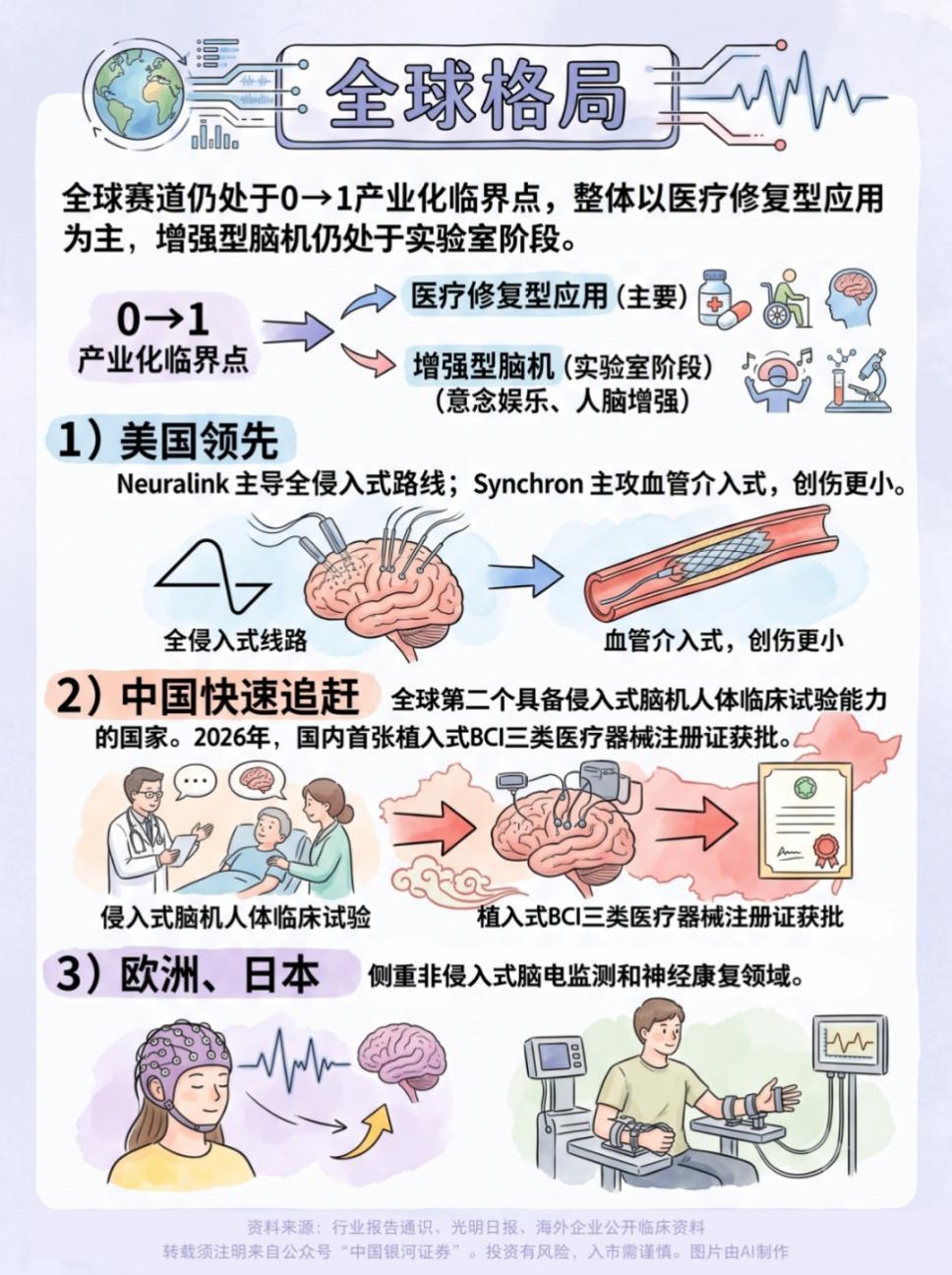
Among the three enterprises, BrainRegen has the most advanced listing progress. In March this year, its "implantable brain-computer interface hand motor function compensation system" was approved for marketing by the National Medical Products Administration, becoming the world's first invasive brain-computer interface medical device to obtain a registration certificate. In June, the company's IPO application on the Science and Technology Innovation Board was accepted, with a planned fundraising of 2.5 billion yuan.
The technical route of Xuli Innovation is mainly non-invasive, and its products focus on limb movement disorders, consciousness and cognitive disorders, neurodevelopmental disorders and other conditions caused by central nervous system injuries.
The company completed a B+ round of financing of 160 million yuan in January this year, completed a C round of financing of several hundred million yuan in February, and completed IPO tutoring in September, with a very fast pace of capital operation.
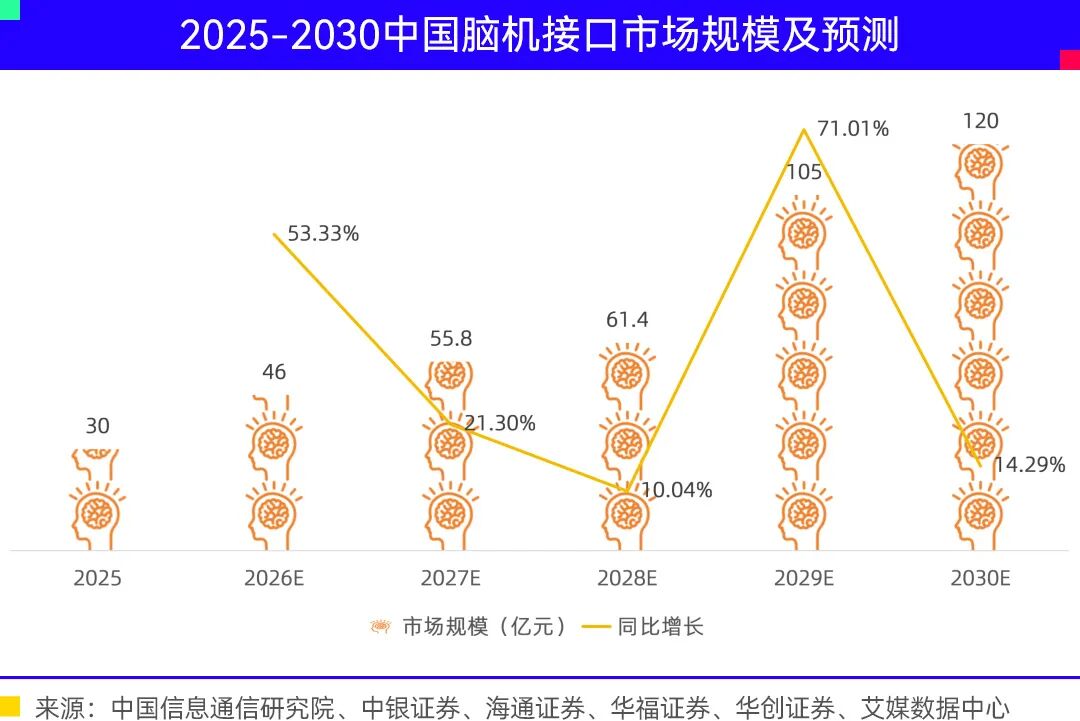
In fact, the financing enthusiasm in the primary market of the brain-computer interface track this year is quite staggering. The financing amount in Q1 has exceeded the total of 2025, and the total financing in the first half of the year exceeded 60 cases, with the total amount breaking through 7 billion yuan.
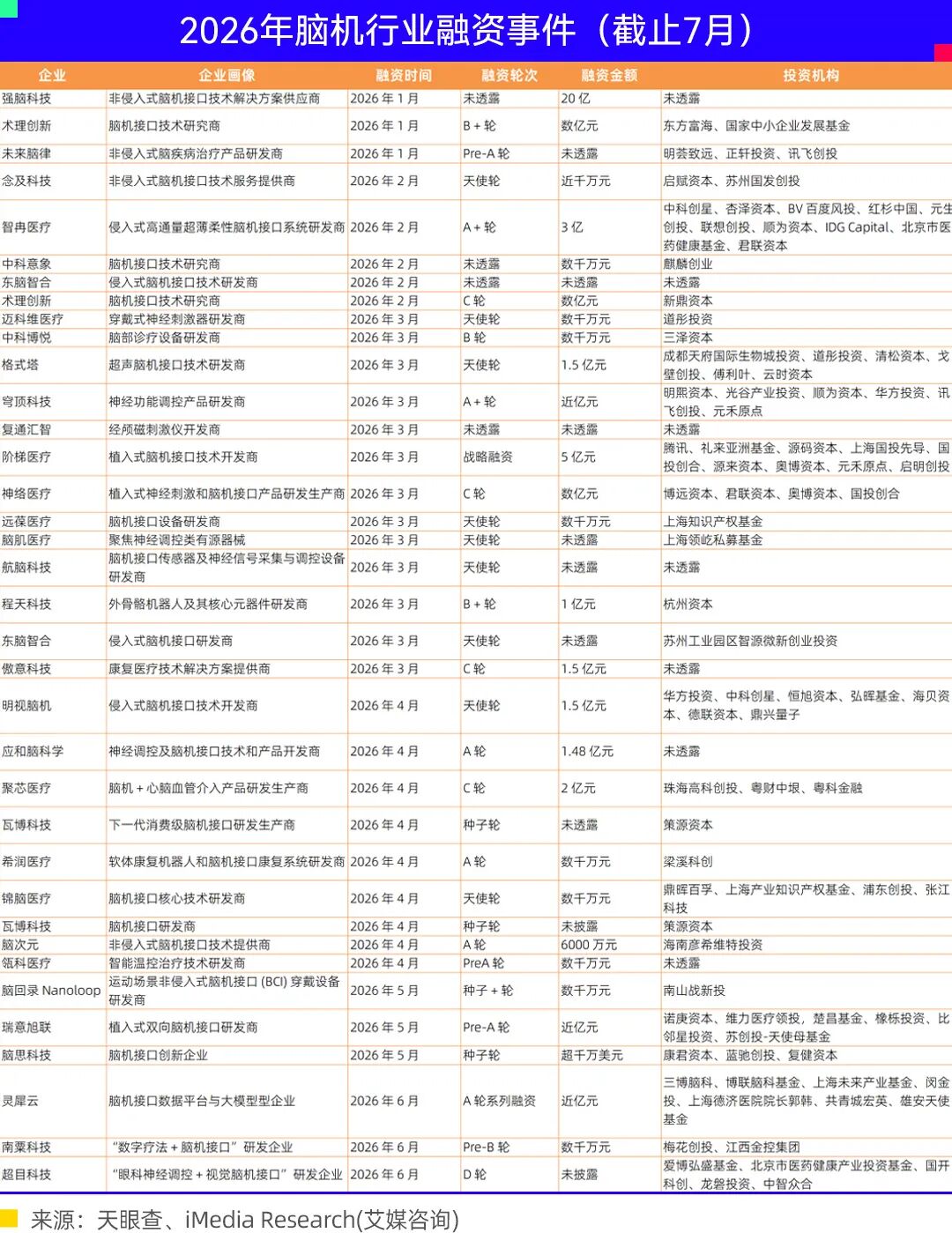
Among them, the B+ round financing amount of BrainCo Technology is as high as 2 billion yuan, refreshing the record of the largest single financing in the domestic brain-computer interface field.
Stepped Medical obtained 500 million yuan in strategic financing led by Alibaba and followed by Tencent, which is the first joint layout of Alibaba and Tencent in the brain-computer interface field.
What is even more remarkable is that Gestalt Technology, which was just established in 2026, has completed two rounds of financing successively within half a year and obtained 570 million yuan in financing even without any products or clinical data.
Brain-computer interface is a typical money-burning track. Leading enterprises have long relied on equity financing to survive. Catalyzed by national policies, enterprises and investment institutions have formed a mutually beneficial partnership.
However, investment institutions are not philanthropists. Taking BrainRegen as an example, the company has a valuation adjustment mechanism agreement with investors, which stipulates that if the company fails to be listed by the end of 2028, the founding shareholders will bear the repurchase pressure alone, and the listing valuation shall not be less than 5 billion yuan, and the financing amount shall not be less than 500 million yuan.
In a sense, IPO has never been an optional choice for brain-computer interface enterprises.
Public Attention Mismatch
A thought-provoking phenomenon is that the most sought-after brain-computer interface enterprises in the capital market have limited public attention for their products in the mass market.
BrainRegen holds the world's first invasive registration certificate, but according to its prospectus, the approved invasive product "has not yet contributed revenue", and more than 70% of its operating revenue comes from the sales of the company's electroencephalogram acquisition system.
The core function of this system is to capture, amplify and record the weak electrical signals generated by the brain, and convert them into data that can be analyzed and used. Its main buyers are top domestic universities and scientific research institutes, tertiary hospitals and rehabilitation institutions, and it often serves research needs.
Compared with BrainRegen, Xuli Innovation's product line is more directly oriented to clinical treatment and rehabilitation, and its business model is to generate revenue by providing brain-computer interface rehabilitation equipment and solutions to hospitals.
At the 2026 World Artificial Intelligence Conference, Xuli Innovation also exhibited products including the brain-computer interface motor nerve function remodeling product suite, brain-computer interface electrical stimulation therapeutic apparatus, brain-computer interface digital therapy platform and electroencephalogram acquisition and analysis system.
BrainCo Technology's products cover a wider range of application scenarios and more user groups, including hospitals, schools, robotics companies and individual consumers.
In the field of medical rehabilitation, BrainCo Technology has flagship products such as intelligent bionic hands and bionic legs, which can help people with disabilities complete various fine movements; in the field of consumer health, BrainCo Technology has products such as the Easleep Deep Sea Dolphin brain-computer intelligent sleep instrument and FocusZen headband, focusing on sleep improvement and stress management.
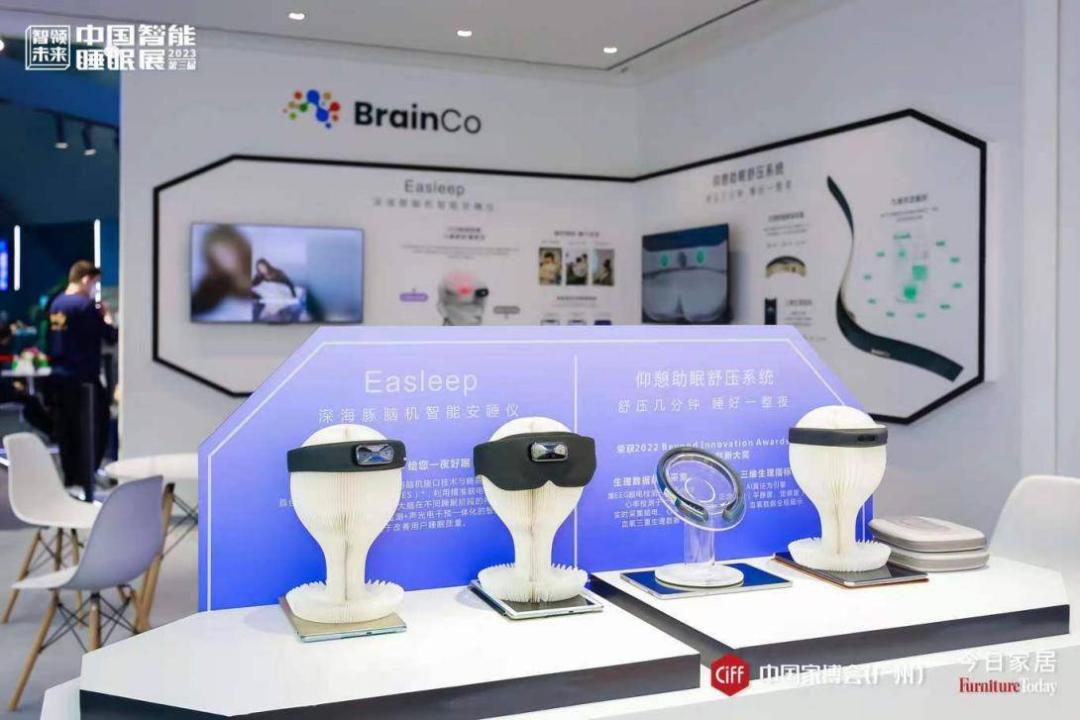
In fact, up to now, the consumer health field that takes sleep and meditation as the entry point is exactly the field of brain-computer products with the highest public attention and the most mature commercial implementation, almost without exception.
In 2025, the shipment volume of consumer-grade headbands for sleep improvement and stress relief reached 1.8 million units, accounting for 47% of the total market shipment volume. In Q2 of this year, the global quarterly sales volume of sleep intervention devices exceeded 2 million units for the first time.
Such brain-computer products are mainly based on non-invasive technical paths, and their product forms (headbands, earphones, patches) are closer to ordinary consumer electronics, with low user decision-making costs and easier purchase conversion. Although their prices are concentrated in the range of 1,000 to 5,000 yuan, 10 to 20 times that of traditional sleep aid products, they have still become new favorites in the market.
However, these products with higher public attention and relatively better consumer base are often considered unable to tell attractive stories such as "next-generation computing platform" in the capital market narrative, so it is difficult for them to obtain the same level of valuation premium as invasive enterprises.
Lessons from the Past
Behind the public attention mismatch lies the mismatch in financing and investment functions between China's primary and secondary markets.
The narrative logic of invasive brain-computer interface redefines the underlying interface of human-computer interaction, with a trillion-level market imagination space, and there are clear milestones such as Class III certificates from the National Medical Products Administration and clinical trial endpoints, which make all kinds of capital have the urge to "take a big gamble".
The narrative of non-invasive brain-computer interface is more like making a better hardware in existing scenarios. For capital, it has a clear ceiling and the competitive pattern is too easy to predict, and it lacks the spotlight of Sino-US competition and domestic substitution, so its attractiveness and valuation premium are relatively small.
But the robotics industry has just provided a warning reference — under the circumstance that the main customers are only large research institutes rather than the general public, what support can the valuation have even if the enterprise goes public quickly?
Then, what kind of brain-computer product form is more likely to survive and achieve profitability? Judging from the current progress, the semi-invasive/interventional route is worthy of focused attention.
The research report of Southwest Securities points out that semi-invasive implantation outside the dura mater or in blood vessels balances signal quality and risks, and is expected to take the lead in achieving commercial explosion in the field of paralysis rehabilitation, and is more suitable for consumer-grade iteration needs in the long run. BrainRegen's NEO system belongs to such products.
In the field of consumer health, the more competitive form may not be a cooler headband, but daily devices that seamlessly integrate electroencephalogram sensing into users' existing wearing habits, such as earphones, earplugs and glasses, making the value of brain-computer products additive rather than substitutive, which greatly reduces the education cost and decision-making cost for users.
In the longer term, the competitiveness of consumer-grade brain-computer interfaces will depend on whether they can evolve from "monitoring" to "intervention". Simply telling users "your concentration is decreasing" has limited value; only when it can trigger acoustic or micro-current intervention in real time when detecting inattention and form a closed loop, can it create real user stickiness.
Perhaps the "flesh and blood suffering, mechanical ascension" is also a future that will eventually come, but before that, the competition for the first brain-computer interface listed company must respect the law of market development, otherwise the damage to this track will be too great.
Final Notes
After power battery and new energy vehicle companies were listed on a large scale, the entire industry achieved explosive development. Of course, this was also supported by large-scale policy support. We can feel the whole process of policy promotion + capital assistance + industrial surge + consumer payment, and the entire industrial chain including consumers have benefited to varying degrees.
In the historical period when artificial intelligence is developing rapidly as an industry, policy promotion has once again played a key role, and capital's optimism and betting are more fanatical than in the new energy era.
AI products are becoming more and more mature, and users' usage habits are gradually being formed. However, the problem is that so far, except for programming and some office scenarios, the entire artificial intelligence industry still lacks sufficient profitable monetization channels. Related enterprises represented by Zhipu AI and Minimax were highly favored by capital, but then there was an obvious cooling down.
The situation in the robotics field is more complex than that of AI applications. Capital is even more fanatical than in the stage of large AI models. Countless capitals have made large-scale heavy positions in the early stage of industry development. The listing of Unitree once pushed the industry bubble to its peak, and soon after listing, its market value was cut in half.
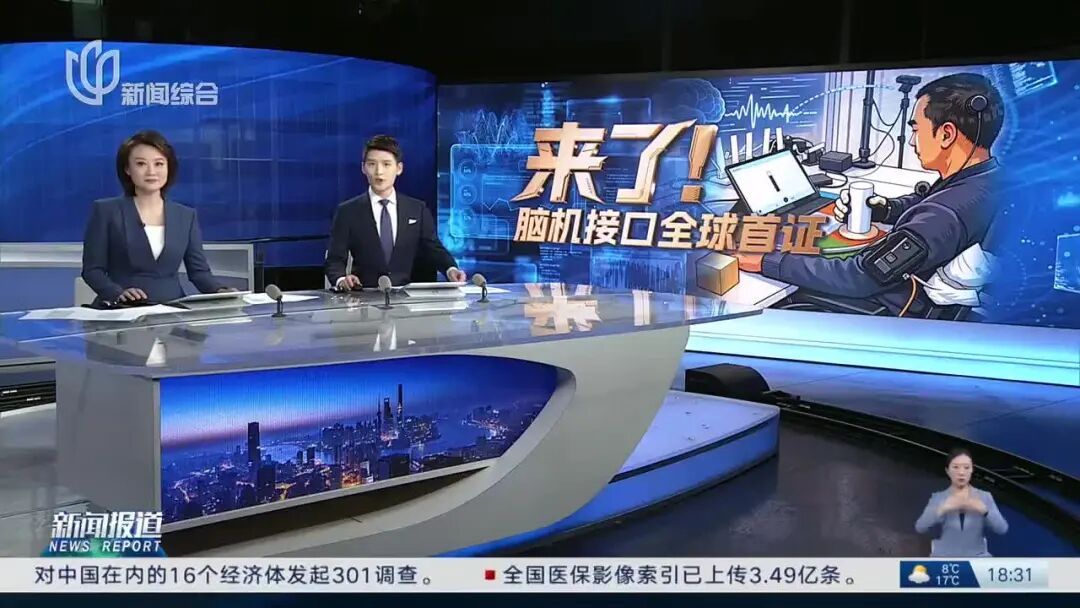
The development of brain-computer interface companies is at a more early stage than robotics, especially for invasive ones. But relevant listing news has been spread many times. Both the policy level and the capital level are promoting some companies in this field to explore listing, even though the whole industry is still at a very early stage of commercialization.
It can be seen that from new energy vehicle companies to robotics companies, and then to brain-computer interface companies, the speed of financing and listing of technology companies is accelerating, and the visible hand and the invisible hand are jointly promoting the rapid development of these industries.
From the perspective of policies and industries, it is understandable to cultivate and develop emerging industries; from the perspective of capital, it is inevitable for them to invest in advance, profit in advance and exit in advance to pursue profits; from the perspective of practitioners, they have obtained more capital and policy support, and have larger living space. Apart from needing to face operational requirements and pressures, they generally benefit more.
From the perspective of retail investors, there is one more speculation direction and some targets, which seems to meet their demand for chasing more cutting-edge market hotspots. Without considering subsequent losses, this is also a clear demand.
Compared with "respecting the laws", for all market entities, tangible benefits are more practical. Things that benefit multiple parties are easier to proceed smoothly, even if all negative impacts will spread implicitly unconsciously.
This article is from the WeChat official account "Giant Tide WAVE", written by Xiaoyulu Yu, edited by YANG Xuran, and published with authorization from 36Kr.