AI giants have set their sights on "financial workhorses"
After Louis finalized the framework, he fed the materials to the AI and activated several self-built Skills. In just a few hours, a relatively complete research report aligned with his ideas was generated. For the same task, he spent the entire 2020 Mid-Autumn Festival holiday writing it.
Louis has 10 years of experience in the financial industry, having worked as an industry researcher and product manager. He participated in the design of national-level financial systems, oversaw the full stack of derivatives trading and back-office settlement systems, and has a thorough understanding of the entire workflow of the financial sector. His sense of this efficiency improvement is now shared by every financial practitioner, as AI giants are collectively entering the financial industry.
IDC data shows that in 2025, the growth rate of China's generative AI market for the financial sector reached 90.4%, making it one of the industries with the fastest AI adoption. This year, the pace has continued to accelerate.
In May, Anthropic released 10 financial Agent templates in one go; in August, Google Cloud launched the Gemini for Financial Services edition. The most intensive moves came in the past month: on September 3, Tencent launched the financial version of WorkBuddy, which claims to have been deployed in more than 100 financial institutions including CICC, SDIC Securities, and China Taiping since March this year; on September 7, Qwen announced its access to more than ten institutions including Industrial Securities, E Fund, and ZhongAn Insurance. On September 10, OpenAI launched the financial version of ChatGPT, which was developed with the participation of Morgan Stanley and embedded with financial data from PitchBook, LSEG and other providers. During the same period, news that Alibaba Cloud was conducting internal testing of its AI investment research tool Qovest also spread across the industry.
Within two months, four major tech giants entered the market one after another. AI can be implemented in many industries, so why are these giants focusing heavily on finance right now? What exactly has AI changed in the financial sector, and what has it failed to change for so long?
01. Why are giants flocking to AI finance right now?
The natural fit between finance and AI has long been a consensus across the industry.
Finance is one of the most digitalized sectors, with a massive volume of structured text data. On the demand side, the 2025 Statistical Yearbook of China Securities Depository and Clearing Corporation shows that the number of A-share investors has exceeded 250 million, 99.76% of whom are individual investors. Data disclosed by the Shanghai Stock Exchange shows that more than 12 million new accounts were opened in the first quarter of 2026 alone. On the asset side, there are more than 42,000 securities registered and deposited by China Securities Depository and Clearing Corporation, with the total market value of Shanghai and Shenzhen stock exchanges reaching nearly 138 trillion yuan. On the content side, 5,469 listed companies publish tens of thousands of periodic reports every year, coupled with daily announcements and real-time news, forming a market with text processing volume counted in hundreds of billions of characters.
With high information density, the daily work of financial practitioners is almost entirely information transfer and intensive calculation, which is exactly where AI excels. According to Louis, in the past, researchers needed to cooperate with coding colleagues to build quantitative models and complete coding tasks. Now, as long as they have product thinking and input their ideas into AI, the AI will handle code generation and information retrieval, greatly shortening the R&D cycle.
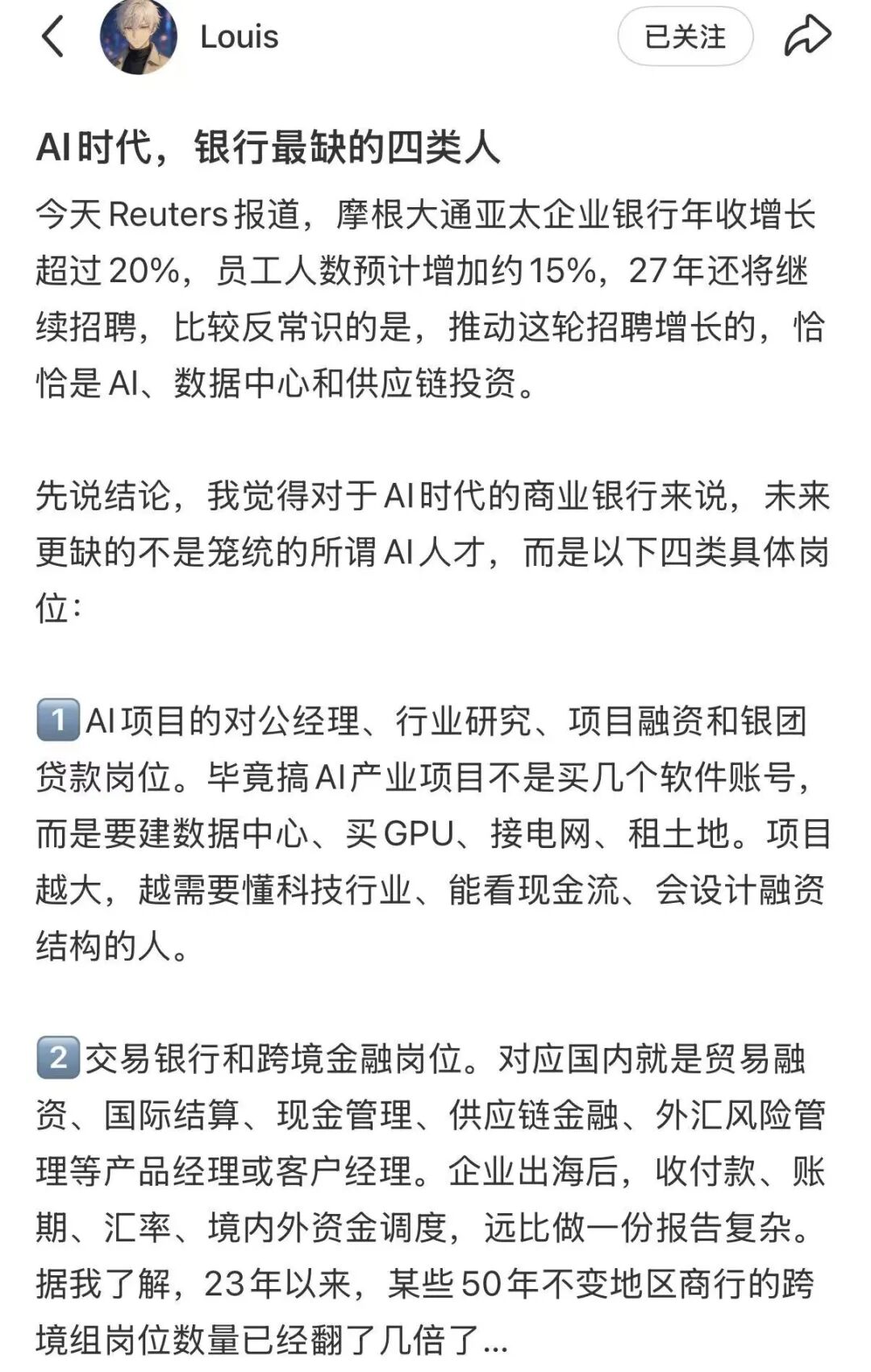
Thoughts shared by Louis on social media platforms
But this fit is only the foundation, and the real bottleneck has always been technology. This year, two major problems have finally been solved.
The first is the controllability of hallucinations. The financial industry requires zero hallucinations, traceability, and audit trails for AI, which was once considered an impossible requirement but is now being gradually addressed. At the model level, in the summary fact consistency test of the Vectara Hallucination Leaderboard, the hallucination rate of leading vertical financial models has been suppressed to below 2%. At the engineering level, RAG (Retrieval-Augmented Generation) has become the standard configuration for B-end products, restricting models to answer questions only based on the data sources provided by institutions. At the product level, Agent templates and workbenches leave traces of every call, turning hallucinations from unacceptable risks into locatable and auditable errors.
"Financial customers do not pursue a zero hallucination rate. They care more about whether errors can be detected and located," said a founder in the financial AI field. In engineering practice, this is supported by three layers of safeguards: the retrieval layer only accesses specified data sources; the generation layer requires every conclusion to be attached with citations; the audit layer keeps full records of the input, output and citations of every call. Zhao Yongguo (Octo), an investment analyst at a leading VC with a bachelor's and master's degree from Renmin University of China, added that the key to the acceptance side is "traceability": every conclusion is linked to its source, and users can click to view which research report or annual report it comes from.
The second breakthrough is Agent technology. With controllable hallucinations, AI is allowed to enter the industry, but to truly replace human work, Agent is essential.
Octo believes that "in the era of chatbots, AI is essentially a search tool that cuts documents into data blocks, retrieves them by keywords, and assembles answers. It only improves efficiency without substantive changes, but Agent can close the loop of the entire workflow. Taking the industry research of fund companies as an example, the structure of industry-factor-weight-methodology is nested layer by layer. Only through the collaborative work of multiple sub-Agents can the entire research framework be digitalized by AI. After the closed-loop capability is established, the financial industry confirms for the first time that this technology is truly usable. This is the real inflection point for the collective entry of giants into the market."
The last driving factor is the huge market space. IDC data shows that in 2025, the market size of China's generative AI platforms and application solutions for the financial industry reached 1.74 billion yuan, and it will increase to 11.35 billion yuan by 2029. In comparison, this scale is not very large: in the same year, the AI medical application software market reached 3.54 billion yuan, about twice the size of the financial AI market. However, the 90.4% growth rate of financial AI firmly places it in the first echelon of industry applications. Part of the high growth rate comes from the low base (only 914 million yuan in 2024), but the low base is only an amplifier. The real driving force is the concentrated release of demand.
More importantly, financial institutions can afford the cost. Octo calculated an account: "The annual fee for one external data account is as high as tens of thousands of yuan, and a medium-sized fund company will purchase hundreds of such accounts. There are also a large number of positions with low skill requirements but high labor costs that perform repetitive work, which brings the most realistic ROI for AI replacement."
With data, technology and capital all ready, the giants are pouring into the market at the same time.
02. Three development paths: from selling capabilities to seizing entry points
Domestic and international giants have entered the financial AI market one after another, but their approaches are completely different. The product forms can be divided into three categories, corresponding to three business models: selling tools, selling systems, and seizing traffic.
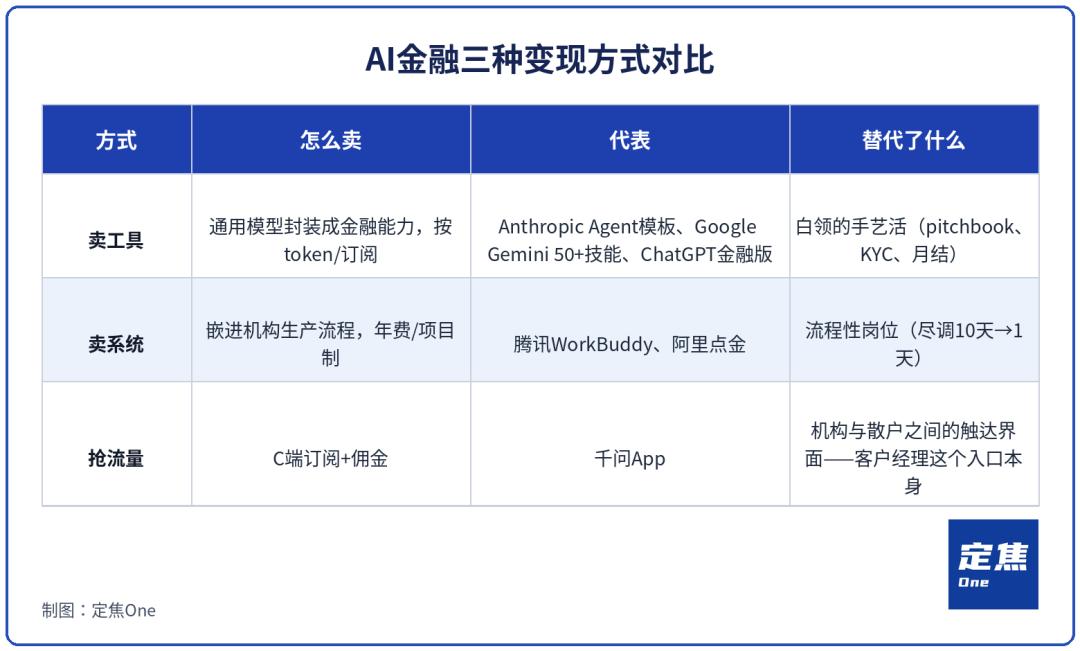
The first path is to build AI into tools that financial practitioners can use conveniently.
The first batch of landing products package general models into a set of professional financial capabilities. For example, the 10 Agent templates released by Anthropic turn repetitive tasks such as writing prospectuses, conducting customer background checks, building financial models, and reconciling accounts at the end of the month into ready-to-use templates, while connecting to authoritative databases such as S&P and Moody's to allow AI to directly access data when answering questions. Google's Gemini for Financial Services and OpenAI's financial version of ChatGPT follow a similar model: cloud subscription services, while integration and process transformation are completed on the customer side.
Such products solve the most trivial and standardized daily work of financial practitioners: finding data, organizing materials, building preliminary models, updating tables, etc. Their advantages are the fastest deployment, the lowest user threshold, and the easiest way to expand coverage. But this path is also the most likely to fall into homogenization: skills can be replicated, models can be replaced, and data connections can be migrated. For giants, this is more like seizing the first entry point of financial AI, while cultivating user habits and accumulating usage data. The truly high-value part lies ahead.
The second path is the workbench, which embeds the entire AI system into the production process of the financial industry.
This layer is far more heavyweight than "tools". AI begins to enter the business systems of banks, securities firms, and insurance companies, accessing permissions, data, approval processes and internal workflows, and finally undertakes a complete set of work.
The financial version of Tencent WorkBuddy falls into this category. Its financial version is divided into four workbenches for corporate finance, retail finance, investment research and consulting, and individual customer operation. Vendors deploy the system on site and cooperate with financial institutions such as CICC, Ping An Bank, and China Taiping to polish the products. Processes such as corporate credit due diligence have begun to use AI to shorten processing time. The entire system is deployed on the internal network of the institution, and the model, data and audit links all remain within the institution's own security perimeter. Alibaba's similar product follows the same strategy.
The advantage of this path comes precisely from its heavyweight nature: once AI enters the core workflow, customers are very reluctant to replace it. The permission system, data interfaces, employee training, audit records, and internal system adaptation all need to be rebuilt. For AI vendors, this means a longer sales cycle and higher delivery costs, but also higher unit price per customer and stronger customer stickiness. This path puts the vendor's enterprise service capabilities to the greatest test.
The third path is to push AI to the user entry point of financial services.
For example, the Qwen App directly integrates institutions such as securities firms, fund companies, insurance companies, and futures firms into a consumer-facing AI entry point. Users can check market quotes, read research reports, and obtain financial services provided by institutions within one App. For financial institutions, this means an additional channel to reach users; for AI platforms, it means competing for the entry point where users manage their money every day.
This path has the greatest room for imagination, as it directly connects users and financial services. Once users form usage habits, AI platforms may gain the distribution right of a large number of financial demands. But it is also the most difficult path among the three: internal enterprise AI mainly solves efficiency problems, while consumer-facing financial AI also needs to deal with responsibility, license compliance, and trust issues.
Therefore, the commercial value of the three paths has different focuses. In terms of current maturity, the first path is the easiest to achieve rapid growth, the second path is the most likely to precipitate long-term value, and the third path puts the platform's user scale and financial service capabilities to the greatest test. This also explains why giants do not bet on the same product. For Anthropic, Google, and OpenAI, embedding professional financial capabilities into models is the fastest way to enter institutions; Tencent and Alibaba have stronger expertise in enterprise services and localized deployment, making it easier for them to cut in from the workflow; Alibaba's Qwen can also leverage the user scale of its App to seize the consumer-facing entry point of financial services.
No matter which path they take, if giants want to deepen this business, they cannot avoid two problems.
The first challenge lies in the upstream: core data is still controlled by third parties.
The authorization and statistical caliber of market quotes, financial reports, announcements, and research reports have long been controlled by data vendors such as Wind, Tonghuashun, Tongdaxin, Bloomberg, Moody's, and S&P. The current change is that AI vendors are beginning to use MCP and various connectors to integrate the data access capabilities that were previously hidden in professional terminals into Agents. Anthropic cooperates with Moody's, Google teams up with S&P, and WorkBuddy accesses Tongdaxin. These are not technical preferences, but because without these connectors, they cannot obtain more professional data. Models can be iterated quickly, but data authorization, data caliber, and historical accumulation are impossible to replicate overnight.
The second challenge lies in the downstream: financial institutions themselves are also building AI products.
Large financial institutions are very reluctant to hand over all their core capabilities to external vendors. Soochow Securities has independently developed Xiucai GPT, using locally deployed DeepSeek-R1 for investment consulting, research report generation, and risk identification; CICC distills the research methods of senior analysts into skill packages; Guotai Junan, GF Securities, Guosen Securities, and CITIC Construction Investment Securities have all built their own agent matrices; Longbridge chooses full-stack independent R&D from the underlying layer to the application layer, and then exports its capabilities to external parties.
Therefore, AI finance is not a business that giants can win immediately after entering the market.
03. AI has entered the financial industry, but has not yet touched its core
The three paths solve the problem of how AI enters financial institutions, but the actual situation on the work floor is different.
According to Louis, the current financial AI that has brought obvious efficiency improvement to frontline practitioners is mainly in the fields of industry research and trading, and is concentrated in relatively basic links.
"The financial industry is a huge machine, and industry research and trading are only one of its engines." He also pointed out a neglected fact: the most original form of the financial industry is bank deposits and loans, but no financial AI product can cover the entire cycle of lending and deposit services. The full coverage of securities, funds, futures, and insurance that giants repeatedly emphasize, in practice, only plays an auxiliary role in the most core links such as credit approval, risk assessment, and compliance decision-making.
Octo provided confirmation from the employer's perspective: "What AI can most easily replace now are interns and junior researchers. The work of interns is to collect and organize data, listen to meetings and write meeting minutes; junior researchers have a little basic research capability, but their output is essentially the general public cognition of the industry. For general AI, there are enough public samples of these contents for learning, and relatively clear workflows to break down."
Source / pexels
The most valuable part of finance often occurs after information has been fully organized. For example, when the same set of macroeconomic data is placed in front of several researchers, some may judge that the industry is about to reverse, while others may think it is just a short-term fluctuation. These judgments do not rely on the public information itself, but on the comprehensive understanding of industry cycles, company operations, trading environments, and past experience.
A more realistic problem is that the unique perspectives and know-how (practical experience, lessons learned from mistakes, operational skills, internal practices) held by a small number of people will never be handed over by institutions to any external vendor. This explains why the coverage of AI is still limited: AI can handle work that relies on universal cognition, but the most valuable work in finance is precisely the non-universal part.
In addition to the limited coverage, data privacy is another major barrier.
The hallucination rate has been reduced, but the red line of data security still exists. A financial practitioner clearly categorized information: "Unpublished financial data, internal reports, and board meeting materials are all sensitive information and cannot be provided to AI."
From this perspective, AI has entered the workflow of the financial industry, and peripheral work has begun to be taken over by AI, but core judgment is still firmly in the hands of humans.
Giants are currently working to reshape this industry. Players with deep layout may become the indispensable infrastructure for institutions, while players with shallow layout may be replaced at any time