Former Qualcomm Algorithm R&D Manager Crosses Over to AI Computing Board Inspection, Secures Nearly 100 Million Yuan Strategic Investment | 36Kr Exclusive
Source / Enterprise
This article is about 2500 words, with an estimated reading time of 5 minutes
Author | Ou Xue
Editor | Yuan Silai
36Kr has learned that Shenzhen Camview Vision Technology Co., Ltd. (hereinafter referred to as "Camview Vision") has recently completed a nearly 100 million yuan Pre-A round of financing. This round is led by Nanjing Jingzhida Qingyuan Investment Fund, with participation from Chuanshang Fund and existing shareholder Qingyuan Capital, while China Venture Capital serves as the exclusive financial advisor. The funds will be mainly used to expand the R&D and operation teams, increase production capacity to cope with the explosive growth of orders, and develop next-generation products and technology platforms.
Founded in Shenzhen in 2019, Camview Vision is a high-tech enterprise focusing on high-end general semiconductor optical inspection equipment. Most of its core team graduated from Xi'an Jiaotong University and Huazhong University of Science and Technology. Zhang Hui, the founder and CEO, has nearly 20 years of experience in algorithm chipization and productization. He previously worked at Qualcomm in charge of chip algorithm R&D, then co-founded the intelligent driving company Forward Vision as CTO, which was acquired by a listed company in 2019. The team has three core competencies: chip-side algorithm development, intelligent driving visual perception, and precision equipment implementation.
In 2019, after Zhang Hui and his team exited from the acquired intelligent driving company, they began to look for new business directions. At that time, a neglected structural opportunity in the market caught his attention: the global high-end PCB inspection equipment market has long been monopolized by four listed companies: Applied Materials' Orbotech (now KLA), Taiwan's Murox Technology, and Taiwan's Eletech, whose combined annual revenue exceeds 3 billion yuan.
At the same time, the explosion of AI computing power is driving the PCB industry to upgrade towards high-order HDI and IC substrates, with increasingly finer circuits, more layers, and higher density of micropores. Traditional 2D inspection methods can no longer meet the requirements of 3D defect inspection.
The explosion of demand stems from the upgrading of inspection standards brought by AI computing power infrastructure. Zhang Hui observed: "In the past, 3D inspection of high-end PCBs was mainly carried out by sampling in the laboratory, with only one board sampled for a single part number. Now NVIDIA requires every single board to be inspected in 3D, and the inspection scope has changed from sampling to full inspection."
The previous technical accumulation of the Camview Vision team perfectly overlaps with this demand. Zhang Hui told 36Kr: "The core of intelligent driving is to identify vehicles, pedestrians and lane lines based on visual perception, and it also involves the fusion of vision and LiDAR depth maps. The AOI inspection for high-end semiconductors is evolving from 2D to 3D, and the AI algorithms and multi-sensor fusion experience we accumulated in intelligent driving can be migrated to this scenario."
The team spent the first three years cooperating with equipment companies to provide core algorithm solutions to supplement their equipment engineering experience. In 2022, they officially launched self-branded equipment, and in 2024, they achieved large-scale order signing and mass delivery.
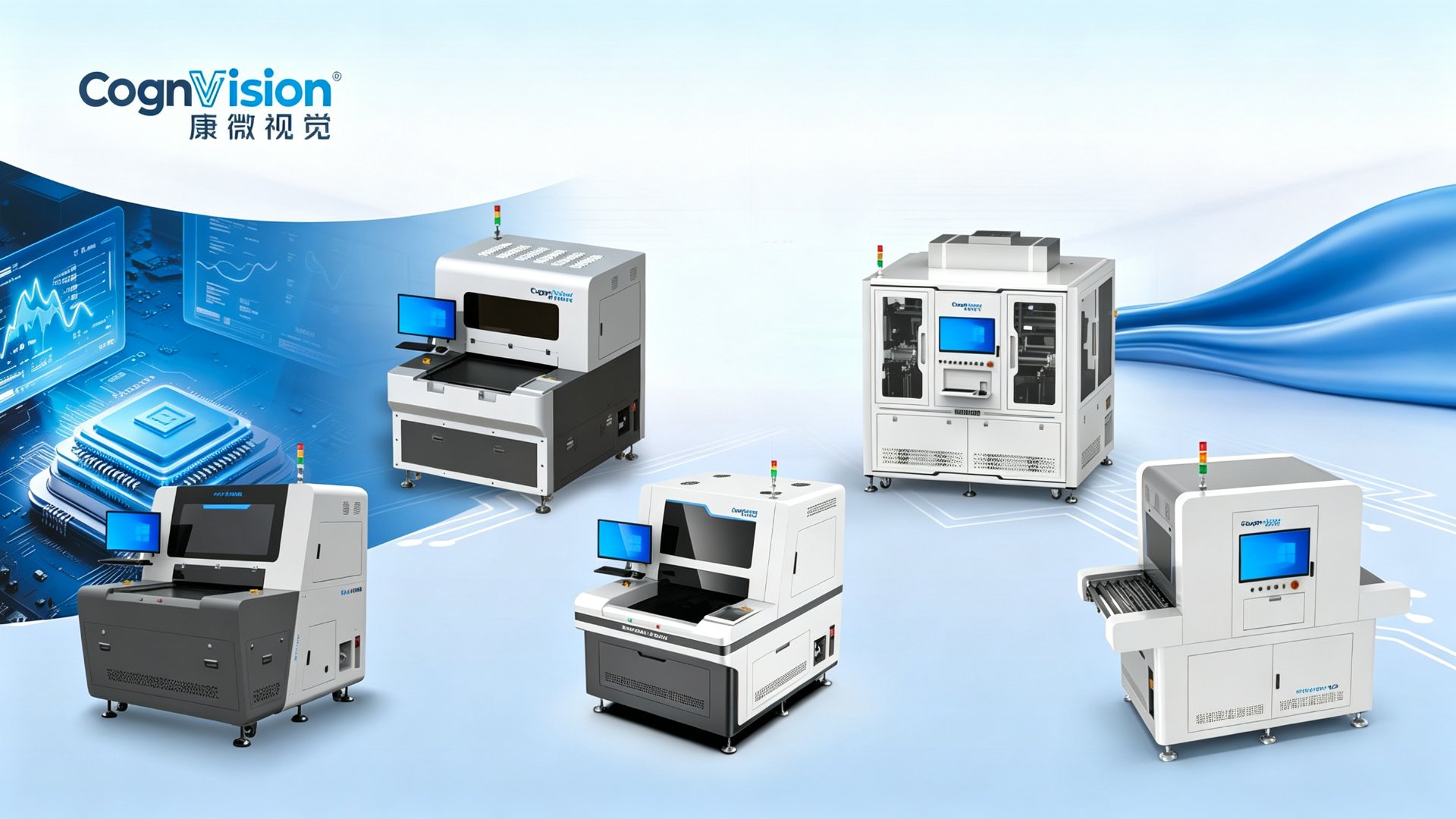
At present, Camview Vision's core product line covers four major directions: pure 3D AOI, 2D+3D Hybrid AOI, micropore inspection equipment and finished product appearance inspection equipment. The most differentiated competitive advantage is its 2D+3D hybrid imaging technology.
Previously, the industry usually used 2D AOI and laboratory-grade 3D equipment separately, but Camview Vision innovatively introduced the line-scan spectral confocal sensor originally applied in the semiconductor field into high-end PCB inspection, which can complete the inspection of apparent defects (such as ink discoloration and color difference) and 3D morphology (such as step difference and depression) on one single device, with basically matching efficiency.
Zhang Hui explained: "In the past two or three years, new 3D sensors have emerged, whose speed and accuracy can match those of 2D sensors, which allows us to turn laboratory equipment into production line equipment."
In terms of AI application, Camview Vision is fundamentally different from the common "plug-in" AI solutions on the market. Most third-party AI companies only use deep learning as a plug-in at the back end of AOI equipment for defect re-inspection, while Camview Vision embeds self-developed AI frameworks in the entire inspection chain from data parsing, feature extraction to defect classification, including the TempDCF network based on template differential fusion, and the DHNM framework for active negative sample mining. In terms of specific performance indicators, the 3D inspection accuracy can reach ±1 micron, the detection rate exceeds 99.9%, and the false detection rate is controlled within 5%.
According to Zhang Hui, the company's 2026 revenue is expected to achieve several times of year-on-year growth. At present, the company has entered the supply chain of many domestic 100-billion-yuan level listed PCB companies, and its end customers cover global leading technology companies such as NVIDIA, Google and Huawei.
Regarding the market competition pattern, Zhang Hui believes that Camview Vision has gone beyond the simple stage of domestic substitution. "In the segmented field of AI computing power boards, we are not catching up with overseas manufacturers, but have created a generation gap. After years of iteration with leading customers, our equipment is several times faster and several times more accurate than previous products, with more competitive prices." In his view, AI computing power infrastructure not only drives the demand for equipment quantity, but also reshapes the technical threshold of inspection equipment, which is exactly the opportunity window for new players with native AI capabilities.
Talking about the further impact of AI computing power upgrading on the industry, Zhang Hui said that on the basis of high-end PCB inspection, Camview Vision is expanding its innovative technology to the inspection of other core AI computing power devices to bridge the gap between customers' fully upgraded inspection demands and the capabilities of traditional equipment. At present, the corresponding products have been developed in fields such as optical module inspection.
The following is an edited excerpt of the conversation between 36Kr and Zhang Hui, founder of Camview Vision:
36Kr: What is the core barrier of Camview Vision?
Zhang Hui: First of all, it is the data and scenario accumulation brought by first-mover advantage. We are deeply bound with leading customers in AI computing power board inspection and carry out rapid iteration, and the speed and accuracy of our equipment have formed a generation gap with competing products. Secondly, we have full-stack self-development capabilities, from optical modules, motion control to AI algorithms, all of which are independently mastered by us. Thirdly, we have mass production delivery capabilities. The high-end PCB production line has extremely high requirements for equipment stability, and we have passed the strict verification of leading customers and achieved continuous repurchases, which cannot be replicated in the short term.
36Kr: How much has AI technology changed the semiconductor inspection industry?
Zhang Hui: The change is structural. Traditional AOI is based on expert systems and logical rules. Facing increasingly complex boards, the false positive rate and missing detection rate rise sharply. We use AI for feature extraction and target detection from the bottom layer, and the framework is completely native to deep learning. In addition, the demand for AI computing power itself is forcing the upgrading of inspection equipment. Customers like NVIDIA have made full inspection the standard, and traditional equipment cannot meet the requirements of such magnitude and accuracy at all, which is our opportunity window.
36Kr: What are the main challenges in the next stage?
Zhang Hui: The biggest challenges we are currently facing are concentrated in two aspects. The first is the test of delivery capacity. Facing the explosive growth of orders, ensuring stable supply is our top priority. Our current annual production capacity is about 200 units, and the production line is already running at nearly full load. To this end, we plan to expand the annual production capacity to 500 units, which is expected to be completed within three years, and the production line will remain in Shenzhen. The second is the in-depth expansion of products and markets. On the R&D side, we will continue to improve the performance of AI computing power board inspection equipment, consolidate the advantage of technical generation gap, and on this basis, penetrate into world-class customers such as Japan's Ibiden and the three major substrate giants in Taiwan.
At the same time, we will rely on the semiconductor industry resources of the lead investor Jingzhida Qingyuan Fund to extend to the advanced packaging inspection field with higher technical barriers. At present, we are cooperating with a South Korean technical team to jointly develop inspection solutions for advanced packaging scenarios such as HBM. On the market side, we plan to gradually increase the proportion of overseas revenue from the current 10% (mainly covering Taiwan, South Korea, Southeast Asia) to about 30%, and truly realize the leap from "domestic substitution" to "global leading".
Investor's View:
The lead investor of this round, Jingzhida Qingyuan Fund, said: We are firmly optimistic about the new opportunities of inspection equipment under the background of AI computing power hardware iteration. As the key to the yield of AI servers, high-order HDI and IC substrates, their micropore and circuit inspection and measurement accuracy directly determine the upper limit of the reliability of the whole board. Camview Vision is a rare domestic full-stack solution provider for high-order HDI/IC substrate 3D-AOI, which is the first in the world to break through the most difficult 3D pattern filling inspection, and is also one of the very few equipment manufacturers that meet the full-board full inspection requirements of leading AI hardware manufacturers. It has fully achieved curve overtaking of overseas giants and has been recognized by many leading PCB enterprises. We will continue to empower the company in technical iteration, ecological collaboration and large-scale development, and help the company further enter the cutting-edge tracks such as optical module inspection and Wafer 3D inspection, to open up a broader growth ceiling.