Conversation with Chen Xingru, President of Emotiv China: The commercialization of non-invasive brain-computer interface in China has only just begun | UNDERSTAND KNOW-HOW

"Workplace Bonus" (ID: ZhiChangHongLi)
The New Frontier of Brain-Computer Technology · 01
The Truth of Commercialization: ToB Clients, Consumer-Grade Products and "Brain Gym" · 02
Teams, Organizations and "Slow Variables" · 03
In 2026, brain-computer interface (BCI) finally ushered in its "policy dividend year".
Endorsed as a "future industry" in the government work report, the entire track secured 64 financing deals totaling 7.253 billion RMB in the first half of the year. BrainCo alone raised 2 billion RMB, Neuracle is sprinting for IPO on the Sci-Tech Innovation Board, and Neuralink's valuation has long exceeded 10 billion USD. Even at the World Robot Conference (WRC), brain-controlled humanoid robots became the most crowded exhibition area: BrainCo released a brain-controlled robot training platform, Fourier Intelligence demonstrated a brain-controlled humanoid robot, and the combined force of "BCI + Embodied Intelligence" ignited the entire industry.
Amid all this hustle and bustle, Emotiv is a low-key and somewhat alternative presence.
According to the company, this Silicon Valley-based firm founded in 2011 has world-leading data accumulation in the field of non-invasive EEG: it has accumulated more than 100 million minutes of EEG data, with over 20,000 papers on Google Scholar citing its devices, serving more than 4,000 research institution clients worldwide, and holding a 67% market share in Europe and the United States.
In August 2026, three days after the WRC concluded, Chen Xingru, President of Emotiv China, received a call from *Workplace Bonus*. Last March, Emotiv just obtained its business license under the name of "Beijing Emotiv" and completed local registration in Haidian District, Beijing. Prior to that, Emotiv operated in China and overseas through a distributor model for ten years. In 2026, the company officially launched a new round of large-scale financing: with a valuation of 2 billion USD, it plans to raise 250 million USD (equivalent to about 1.7 billion RMB at the current exchange rate). This is also the first large-scale global financing in the 15 years since the company was founded.
For Emotiv, China is a brand new high-potential market. Chen Xingru's main work in recent months is to build industry ecosystems, establish cooperative relationships, customize enterprise neurotech solutions, promote large-scale BCI integration across various industries, and popularize related concepts among consumers.
Chen Xingru's resume is also quite special in the extremely technical BCI track. She holds a postgraduate degree from Columbia University, a bachelor's degree in Economics/Anthropology from the University of Rochester, and has 15 years of experience in PE/VC on Wall Street. She is deeply familiar with the Sino-US PE/VC tech venture capital circle. With a solid private equity background and years of in-depth research in the consciousness/artificial intelligence field, she leads this world's most influential non-invasive BCI company to enter China, fully supports the development layout of China's BCI industry, and contributes to the global BCI revolution.
During the conversation, Chen Xingru switched naturally between Chinese and English, and was full of enthusiasm when talking about "flow state" and "brain gym".
Her understanding of BCI technology naturally carries the "narrative sense" of an investor. In addition to revealing that she is in contact with some well-known Silicon Valley giants for data cooperation, her description of the four generations of human-computer interaction evolution (keyboard - touch screen - voice control - brain control) is as smooth as a business plan, showing a structured thinking unique to investors.
But we are also clear that the real situation of the non-invasive BCI track in China is that policies, capital and concepts are all hot, but commercial implementation is still a long way to go. Emotiv has the world's most extensive data accumulation, with 300,000 hours of pre-training data (42 times that of LaBraM's 7,000 hours). In China's competitive landscape, its current marketization stage is not about "whether it has the technology", but about "how to convert technology into products, how to find scenarios for products, and how to generate revenue from scenarios".
For young people who are considering entering the BCI track, Chen Xingru offers a possibility: the Chinese entry of a global platform has just opened its door, and is welcoming talented and skilled young people from all relevant industries.
The following is the transcript of our conversation with Chen Xingru, edited by the editorial team of *Workplace Bonus*.
The New Frontier of Brain-Computer Technology
Domestic BCI financing was very hot in the first half of 2026, and you are currently raising 250 million USD. Why now? How do you plan to use this sum of money?
Chen Xingru : Yes, this round is our first large-scale financing. The valuation of 2 billion USD is benchmarked against global AI, BCI and big data companies of the same scale. As the world's earliest enterprise engaged in non-invasive BCI, Emotiv has accumulated a large number of commercial and civilian scenarios, and has cooperated with the world's top 4000 research institutions, schools, medical institutions and Fortune 500 companies. In the past 10 years, we are one of the few enterprises in the global industry that have achieved commercial revenue.
Many domestic enterprises of the same type are still in the relatively early stage, having just obtained basic R&D funds from financing, with no revenue generated and no large-scale product sales. We have been self-sufficient with positive cash flow for the past 10 years. Most domestic companies in the industry may stay in the "spending money" stage for many years, which makes us very different from them.
The new financing will be mainly used for global market expansion (especially the Chinese market), building the world's most powerful Large Brain Model (LBM), team building, new product R&D, larger-scale cross-industry marketization, entering the consumer end, and popularizing the toC and toB applications of BCI products.
A signal released at this year's WRC is that robots may be one of the largest implementation scenarios for BCI technology. Do you currently have a brain-controlled robot platform? Do you have plans to carry out formal cooperation with Chinese robot companies?
Chen Xingru : As one of the world's earliest BCI technology enterprises, Emotiv demonstrated mind control and BCI technologies (such as brain-controlled drones and robots) at TEDxAI and major international exhibitions 10 years ago. Later, we directly accessed our brain control platform and technology in different scenarios around the world — hospitals, rehabilitation centers, disabled children, and ALS patients.
At the 2024 Paris Paralympic Games, the Emotiv EPOC X EEG headset became the core component of the BCI system in the 2024 Paris Paralympic Torch Relay. Nathalie Labrégère was born with cerebral dyskinesia, and she used her brain to control an exoskeleton arm during the Paralympic torch relay, becoming the focus of attention. Using the Emotiv EPOC X EEG headset paired with the Multimodal Cognitive AI Agents developed by Inclusive Brains, Nathalie operated the Orthopus exoskeleton arm mounted on her Permobil smart wheelchair. Her facial expressions were tracked by a camera, bringing a new dimension to assistive technology.

● During the 2024 Paris Paralympic Torch Relay, torchbearer Nathalie used the Emotiv EPOC X EEG headset paired with Inclusive Brains' AI Agents to operate the exoskeleton arm mounted on her smart wheelchair.
Emotiv's cooperation with Chinese robot companies will start this year. At present, we have established initial connections with the Beijing municipal government, embodied intelligence companies under the administration of Haidian District, and some robot companies based in Shenzhen, and we will gradually carry out corresponding cooperation in this field.
The industry is undergoing a paradigm shift — from "the brain controls every joint" to "intention layer" recognition. Robots are becoming smarter on their own, and BCI only needs to be responsible for "telling the robot to pass the water cup to me", leaving the rest to the robot. Does this new paradigm of recognizing human intention layer benefit non-invasive EEG or put it at a disadvantage?
Chen Xingru : Overall, it is definitely a benefit. A very important part of BCI technology is called Active BCI. In the past 10 years, BCI mostly stayed in Passive BCI — passively collecting brainwaves for commercial analysis and assisted medical diagnosis.
With the rapid development of AI in the past few years, we can now combine with robots and brain control devices, whether it is playing games, controlling vehicles, adjusting sound, light and electric effects, or even performing fine movements. The most important thing behind this is algorithms and large models.
The pre-training duration of data accumulated by Emotiv in the past 10 years is 300,000 hours, and we have accumulated more than 100 million minutes of EEG data covering multiple races, cultures, regions and age groups, especially the EEG data collection of healthy human brains. No one can match this amount for now, and the device has high data collection accuracy, so commercial, scientific research, medical, and even toC consumer product users are more willing to use our equipment and data analysis software platform.
What is the value of these data for large model companies?
Chen Xingru : At present, the four types of data used for large model pre-training in the human world — text, pictures, videos and sounds accumulated over thousands of years — have almost reached their limit. Many scientists and computer scientists believe that the LLM path has reached its peak. Scientists represented by Li Feifei have begun to explore world models and develop Physical AI.
The two most missing dimensions in this path are brain data and tactile data. As a result, large model companies such as OpenAI and Gemini have recently approached us to discuss cooperation related to human brain data — they also realize the importance of human brain data for training world models.
Emotiv ranks first in the world in terms of human brain data, healthy human brains, and data diversity. Our data covers more than 220 countries, different races and ages, and most of the samples are data of healthy human brains, not just collected from conventional hospital cooperation.
But academic citations are usually different from industrial standards. The accuracy controversy of non-invasive EEG has always existed — high noise and low spatial resolution. Have you encountered relevant obstacles when cooperating with the industrial circle?
Chen Xingru : The two paths are in a gradual relationship. Invasive technology does have higher accuracy, but its threshold is too high, and its stability, safety and ethics are not acceptable to everyone. Non-invasive devices are easy to wear, with high safety performance, covering healthy people, so their commercial implementation will be faster. Devices such as ear-mounted and head-mounted ones are lighter than Vision Pro.
The Truth of Commercialization: ToB Clients, Consumer-Grade Products and "Brain Gym"
You once said that in the commercialization of the China region, To B is the main line. What is the progress of the cooperation with car companies, game companies, beauty brands and other parties that you are negotiating this year? Have you signed NDA or developed demos?
Chen Xingru : We are currently in large-scale docking and negotiation with various domestic industries, and we are also carrying out multi-dimensional cooperation and promotion. For the previous integration, adaptation and application of BCI knowledge and BCI technology in various industries, we bring the experience of commercialization projects in Europe and the United States in the past few years.
Car companies are currently in the exploration stage, which is almost the industry with the longest technical implementation path. For example, the car companies we are connecting with have an R&D cycle of 1-3 years, involving production lines and in-vehicle intelligent systems, so end users may see brain control devices on cars in 1-3 years — but the project started two years ago. We observe that many domestic automotive laboratories, such as Audi, Chery, BYD, FAW, etc., have begun to pay attention to BCI this year, and want to know in which aspects BCI can be combined with automobiles.
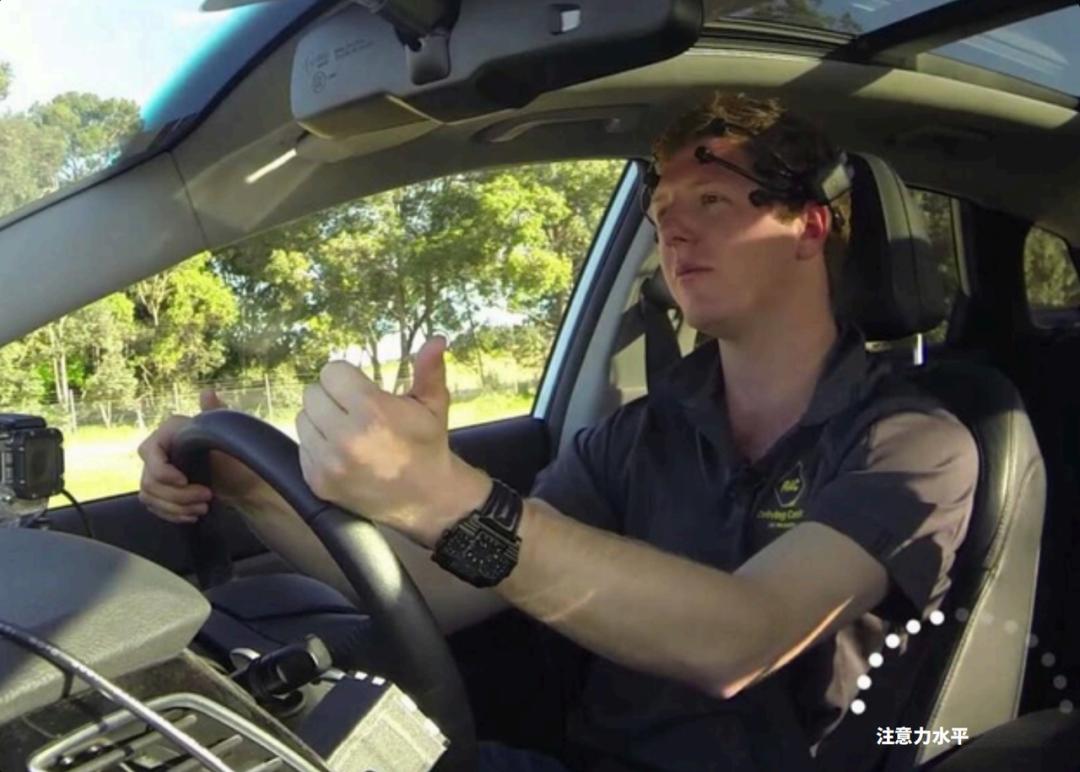
● iEmotiv uses machine learning algorithms to detect the driver's attention and fatigue levels. When the driver's attention drops, the vehicle will automatically slow down.
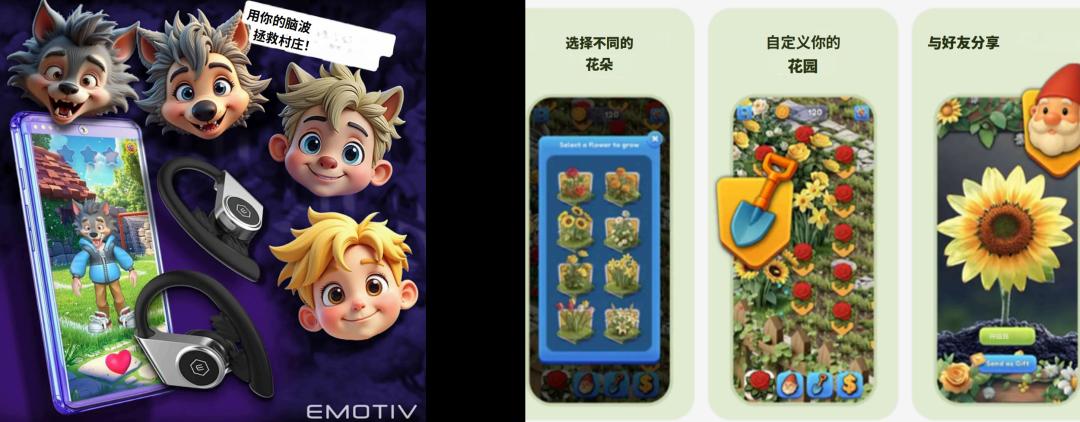
● Emotiv Play: *Hearts & Heal* (left) and *Mindful Garden* (right)
The game sector will be much faster. Our internal R&D and testing are completed, and the products will be launched in a few months. In terms of cooperation process, we will first sign NDA (Non-Disclosure Agreement) to share technologies with each other and open ports. You can now directly download two cooperative games on Apple Store: *Hearts & Heal* and *Mindful Garden*.
In the field of "Neuromarketing", Nielsen IQ is our largest client — it covers the widest range of neuromarketing scenarios and has the largest user demand, purchasing a large number of our products every year, and its partners are all Fortune 500 companies. At present, we have signed cooperation with some consumer goods marketing PR/advertising companies in China, as well as other large consumer goods, fashion brands, food and beverage enterprises, covering hundreds of clients in different fields such as electronics, home appliances, beauty, accessories, film and TV short dramas.
Does the China region have independent pricing power? Compared with competing headphones priced at 499 USD, what are the differences of your MN8?
Chen Xingru : We work closely with the headquarters, and the pricing is jointly determined with the headquarters — the price is consistent in all regions around the world, please refer to the official website (emotiv.com) for the standard.
Our products focus on the level of focus and stress. Paired with a mobile APP, after connecting, you can see your mental state throughout the day just like using an Apple Watch. Too much red means you are very stressed all day, purple means you are using your brain at high intensity, so you know you need to relax — green and dark green represent a relatively relaxed state. Users can track their data every month and every year, compare with the statistical distribution of people in the same age group around the world, and understand their brain health activity level.
The price of our toC products is between 2000 and 3000 RMB. The latest R&D product is expected to be priced at around 2000 RMB, which is basically in line with the price of high-end domestic headphones, or the range that consumers are willing to pay for and try in AI