Energy storage cannot save photovoltaic giants
Is it the second growth curve, or the second loss pit?
128.6 million kilowatts.
This is the new record of China's installed photovoltaic power generation capacity by the end of July 2026. China's energy landscape has reached a historic inflection point, photovoltaics have for the first time surpassed coal power to become China's largest power source.
14.812 billion yuan.
This is the total loss recorded by the five leading photovoltaic module giants, namely LONGi Green Energy, Tongwei Co., Ltd., JinkoSolar, JA Solar Technology, and Trina Solar, in the first half of 2026.
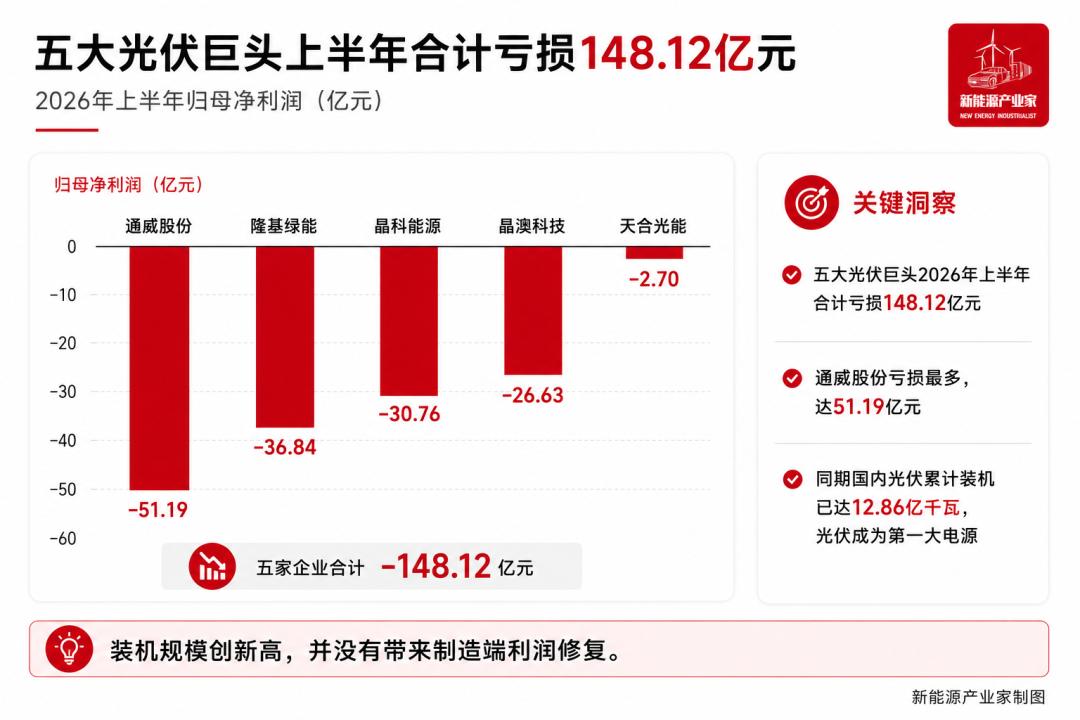
On one side is a historic victory, on the other side are still glaring losses.
This is probably the most contradictory, most darkly humorous scene in China's photovoltaic industry today. The netizen's line "using shareholders' money to bring cheap photovoltaics to the whole world" has been materialized at this moment.
An even more brutal figure is that in the past two years, the total headcount reduction of 139 publicly counted photovoltaic enterprises in the industry has exceeded 220,000 people, which is equivalent to the population of a medium-sized town. There are reports that a certain photovoltaic enterprise plans to lay off 10,000 people by the end of 2026.
After falling deep into the mire, photovoltaic enterprises have set their sights on the seemingly promising lifeline — energy storage.
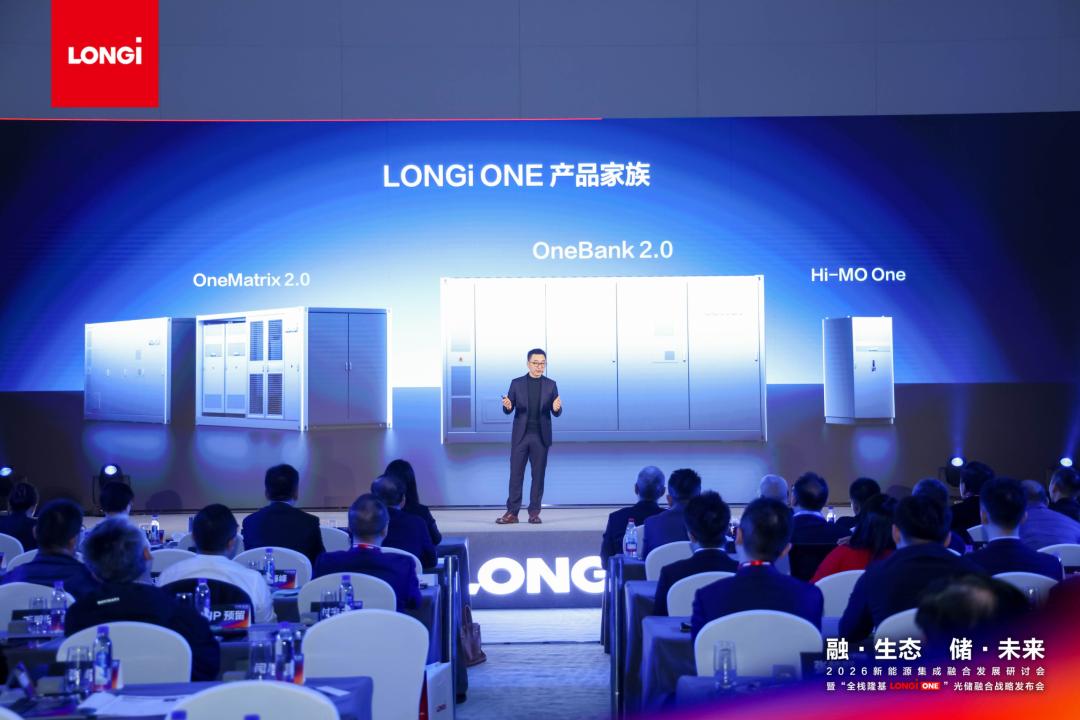
After acquiring Control Power Technologies, LONGi put forward the concept of "Full-stack LONGi" to increase its layout in the energy storage track
Since last year, the story of "solar-storage integration" has been widely spread, and energy storage cabinets have been placed in the most central positions at major exhibitions. Except for Tongwei, all photovoltaic giants have made large-scale layouts in energy storage, directly pushing it to the position of the "second growth curve".
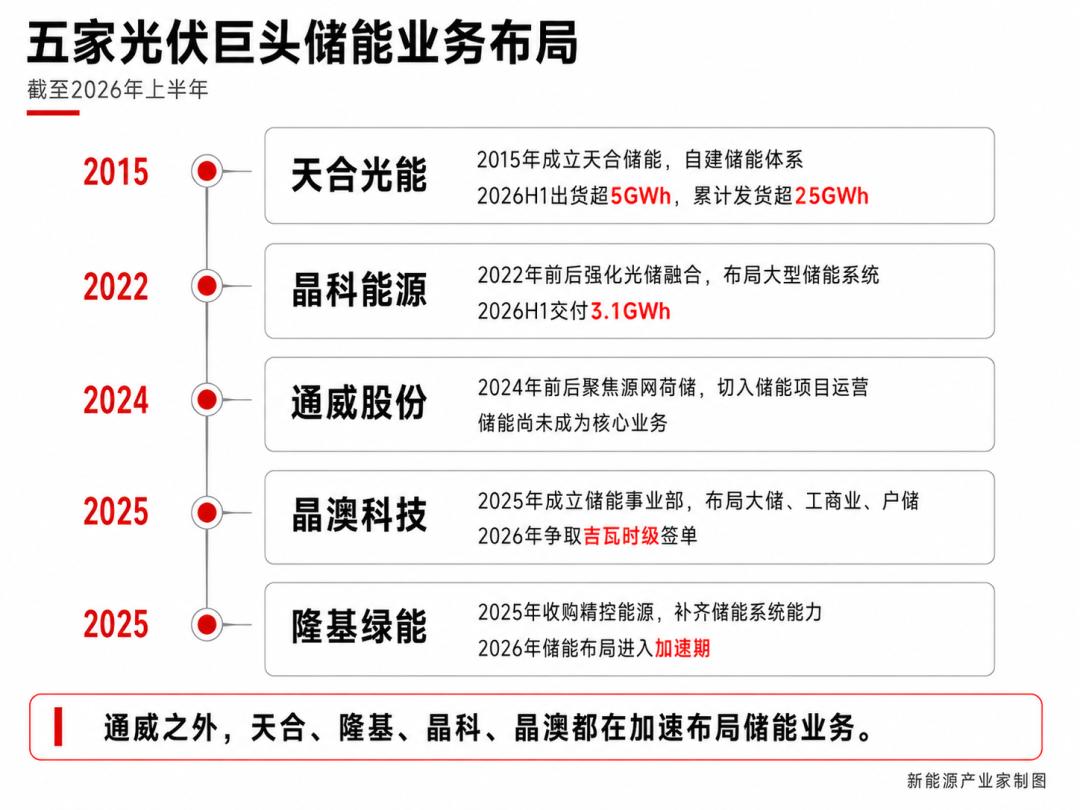
The logic seems perfectly smooth: photovoltaic power generation must be equipped with energy storage to achieve full consumption; and photovoltaic customers and energy storage customers are highly overlapping groups.
But the problem is exactly that, when energy storage is really placed in the position of expectation for profit recovery, many photovoltaic enterprises find that it is more like a new battlefield that requires continuous investment and continuous tuition payment, rather than a medicine that can stop bleeding immediately.
Can energy storage really save the photovoltaic giants?
At least at this current point in time, the answer is no.
01 The second growth curve has first turned into the second bleeding loss pit
To judge whether energy storage can save photovoltaics, you only need to calculate two accounts clearly:
First, how much money is energy storage making right now;
Second, how much more money needs to be invested continuously to earn these profits.
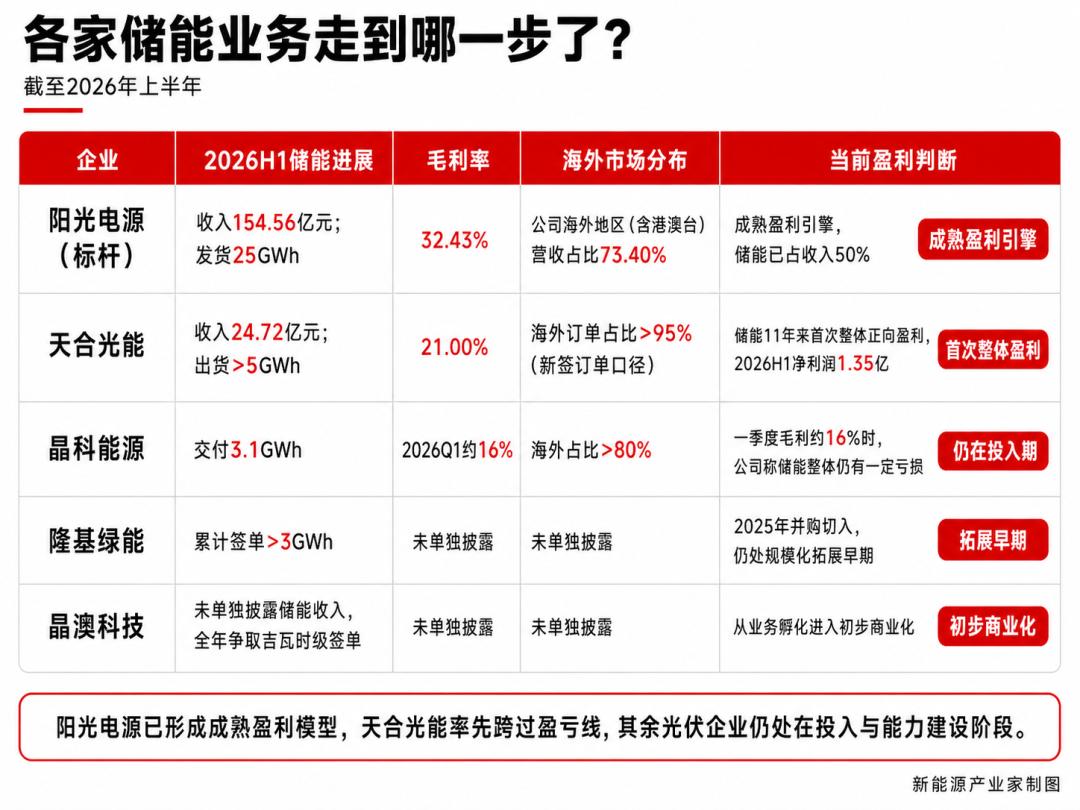
Looking through the semi-annual reports of photovoltaic giants, Trina Solar is undoubtedly the most suitable sample for stress testing among module enterprises.
It is one of these giants that bet on energy storage systematically the earliest, invested the most heavily, and laid out the most comprehensive capabilities. It started to deploy in 2015, covering the whole industrial chain from cells, BMS, PCS, EMS to system integration. By the end of June 2026, its cumulative global shipment of energy storage systems has exceeded 25GWh.
Then look at the financial data:
In 2025, Trina Solar's energy storage business revenue was 4.28 billion yuan, and the shipment of energy storage systems reached 7.91GWh;
In the first half of 2026, its energy storage revenue further increased to 2.472 billion yuan, a year-on-year increase of 92.27%, the shipment exceeded 5GWh, a year-on-year increase of 188%, the gross profit margin also rose to 21%, and the net profit reached 135 million yuan.
This 135 million yuan shows that after more than ten years of efforts, Trina Solar has finally achieved overall profitability in this business. But in the same period, Trina Solar's non-recurring net profit attributable to shareholders recorded a loss of 2.89 billion yuan, a figure far from filling the gap left by its main business.
If we compare it with Sungrow Power, a truly mature player in the energy storage field, the gap is even more obvious.
In the first half of 2026, Sungrow Power's energy storage system revenue reached 15.456 billion yuan, with shipments of 25GWh and a gross profit margin of 32.43%. Trina Solar's energy storage revenue is only about one-sixth of Sungrow's, and its gross profit margin is more than 11 percentage points lower.
This is not only a gap in scale, but the absolute profit margin that deserves more attention.
By comparison, we will find that "shipment volume below 10GWh + gross profit margin of 15%-20% for overseas energy storage business" adds up to a more like a "danger zone":
This volume and gross profit level do not mean making money, because the gross profit of energy storage must first cover a set of globalized expense system that is heavier than the photovoltaic module business.
The expense rate at the company level can also help us understand this point. In the first half of 2026, Trina Solar's total four expenses including sales, management, R&D and finance reached 4.377 billion yuan, accounting for 13.69% of its operating revenue; Sungrow Power's total four expenses reached about 5.343 billion yuan, accounting for 17.28% of its operating revenue.
These are all calibers at the overall company level, which cannot be mechanically subtracted directly from the gross profit margin of energy storage, but they at least show the magnitude of costs that a global energy equipment company has to bear for R&D, sales, financing and delivery.
What's more, the after-sales cost of energy storage is heavier than that of modules: long-term quality assurance, local service teams, spare parts, system commissioning, overseas certification, insurance and guarantees all need to be paid in advance before the order is actually fulfilled.
It should be noted that the gross profit margin of some high-value overseas projects of Sungrow can reach more than 50%, while more than 80% of Trina Solar and JinkoSolar's orders come from overseas, but they are still struggling in the danger zone.
In other words: module enterprises still do not have the profitability of leading energy storage enterprises even in the markets where they are most likely to make money.
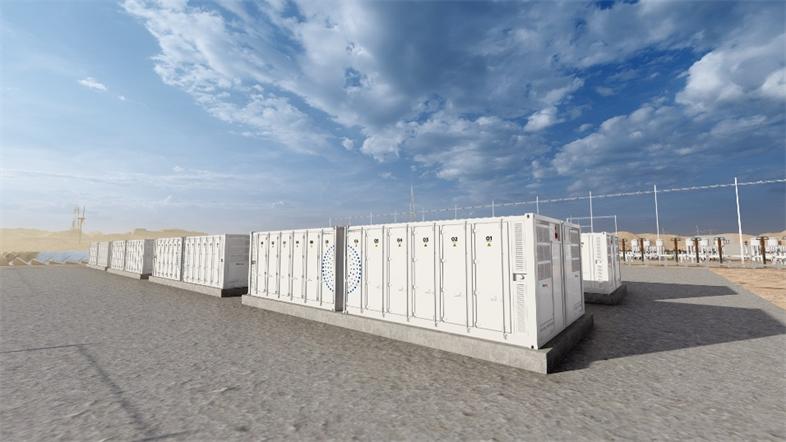
In 2025, Trina Solar's annual energy storage shipment exceeded 8GWh, with overseas shipments accounting for more than 60%; by the first half of 2026, this proportion has climbed to about 95%; Trina Solar is actively moving to more profitable markets
Not to mention, in terms of cost control, regardless of global top giants like Sungrow, compared with energy storage enterprises that have survived the extremely fierce domestic price competition, photovoltaic module enterprises have no advantage at all.
Taking Higreen Power as an example, its gross profit margin in the first half of 2026 is about 21.08% — almost the same as Trina Solar, but its net profit attributable to shareholders can reach 632 million yuan.
It is worth noting that Higreen's main battlefield is still the domestic market, which is recognized as "unprofitable". Although Higreen has extended its business model to power station operation, the cost control capabilities of the two sides can also be clearly seen.
Therefore, when photovoltaic enterprises enter the energy storage track, they will eventually be caught in a pincer attack from two sides:
They want to earn high profits in overseas markets, but lack sufficient brand and system capabilities;
They want to compete on cost in the domestic market, but cannot beat the mature energy storage players that have already stood out from the fierce competition.
Speaking of this, it is not that Trina Solar is not working hard. In fact, Trina Solar is already the hardest-working one among these giants, and the energy storage business of other enterprises is still in the stage of "dragging down overall performance".
The earliest and hardest-working player has only barely started to make small profits.
This reflects a common fact behind it:
Energy storage can become the future development direction of photovoltaic enterprises, but in the short term, it can hardly become a cash machine to solve the current predicament of photovoltaic enterprises. Even to some extent, it is becoming a new capital consumption item.
Because the timing when photovoltaic giants march into the energy storage track on a large scale is itself full of contradictions.
The development of any second growth curve requires a premise: the first curve can provide sufficient, long-term and stable cash flow. As the saying goes, your company must first have a "money printer" business.
Because the second growth curve is essentially a long-term investment. It requires enterprises to allow trial and error, spend time cultivating teams, and continuously invest in R&D and market expansion.
But today's photovoltaic enterprises are in the opposite stage — they enter a red ocean track that also requires heavy capital investment to seize market share when they are suffering the most severe losses.
Both growth curves need blood transfusion:
The first curve — photovoltaic business. Although it is losing money, enterprises cannot stop operation at will. Technology routes including BC, TOPCon, HJT, perovskite tandem, and the upgrading of existing production lines all require continuous capital investment.
During the three most aggressive capacity expansion years from 2021 to 2023, LONGi's capital expenditure calculated according to the cash flow statement reached about 19.2 billion yuan.
The second curve — energy storage business. It seems to have higher growth, but it also requires investment before getting returns. Even if they do not produce cells by themselves, to develop large-scale energy storage projects overseas, they need to build product R&D, global certification, project delivery, local sales, local after-sales and long-term warranty capabilities in advance.
The investment of Sungrow Power can be used as a reference. In the first half of 2026 alone, the company's R&D expenses reached 2.095 billion yuan, and sales expenses reached 2.13 billion yuan. They do not all belong to the energy storage business, but this precisely shows that the capabilities of global system-oriented energy companies do not "grow out" suddenly from a single production line, but are built through years of continuous investment in R&D, channels and service networks. Latecomers who want to catch up with this set of capabilities must pay the tuition fee first.
The semi-annual reports of the photovoltaic giants themselves clearly record this "tuition fee".
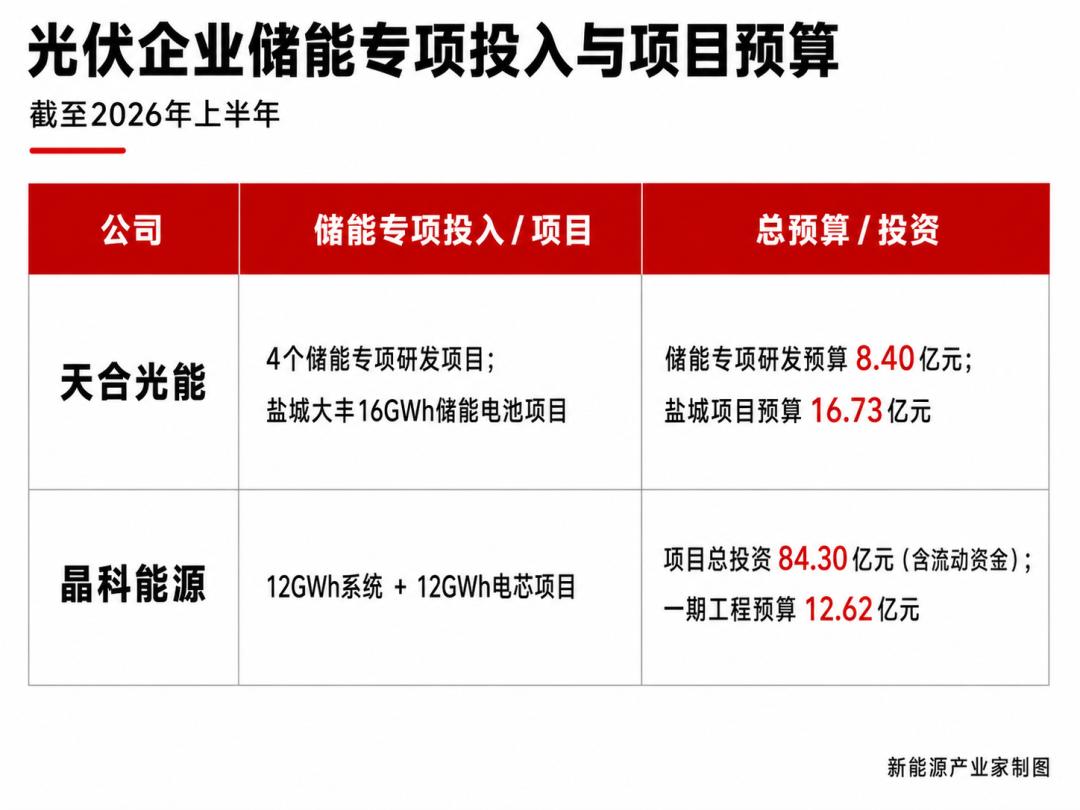
Trina Solar earned 135 million yuan of net profit from its energy storage business in half a year, but at the same time, the clearly disclosed energy storage R&D and production capacity construction are still continuously investing hundreds of millions of yuan in this track.
The problem is, how much more capital can the photovoltaic giants afford to invest?
From 2024 to the first half of 2026, in two and a half years, the five companies including LONGi, Tongwei, JinkoSolar, JA Solar and Trina Solar have recorded a total net loss of over 70 billion yuan, eating up nearly half of their total cumulative profit of 164.4 billion yuan from 2016 to 2023.
If we mechanically extrapolate forward at the average loss rate of the past two and a half years, the remaining historical profits will be exhausted in about three more years.
A relatively unlucky salesperson who entered the photovoltaic industry in 2023 told us that this industry is getting more and more depressed. "We used to have fixed team building activities every week, later the reimbursement rules became very strict, and now we even have to avoid normal meal times when inviting customers to dinner."
If production capacity cannot be cleared out quickly, external financing will become more and more difficult. When the main business continues to lose money and the second growth curve has not generated sufficiently high profits, the capital market will reprice the growth story.
A very symbolic case is GL Ventures and LONGi.
In December 2020, when the photovoltaic industry was still in its most prosperous stage, GL Ventures invested 15.841 billion yuan at a price of 70 yuan per share to acquire 6% of LONGi's shares from Li Chunan, becoming the second largest shareholder overnight. By the first quarter of 2026, GL Ventures no longer appeared in the list of LONGi's top ten shareholders.
After losing nearly 10 billion yuan, GL Ventures admitted defeat and withdrew its investment.
What's more troublesome is that the photovoltaic main business has not really completed the capacity clearance process.
LONGi has relatively strong capital reserves, holding more than 50 billion yuan of monetary funds on its books, with an asset-liability ratio of about 66%, which is also relatively low among several leading enterprises. But it is actively slimming down, reducing costs and deleveraging, which fully shows that this winter is