Trump plans to roll out a $5,000 payout, yet Americans may not have much to cheer about: prices are rising, and the Federal Reserve may be forced to raise interest rates.
As the midterm elections approach, Trump is back to making empty promises again.
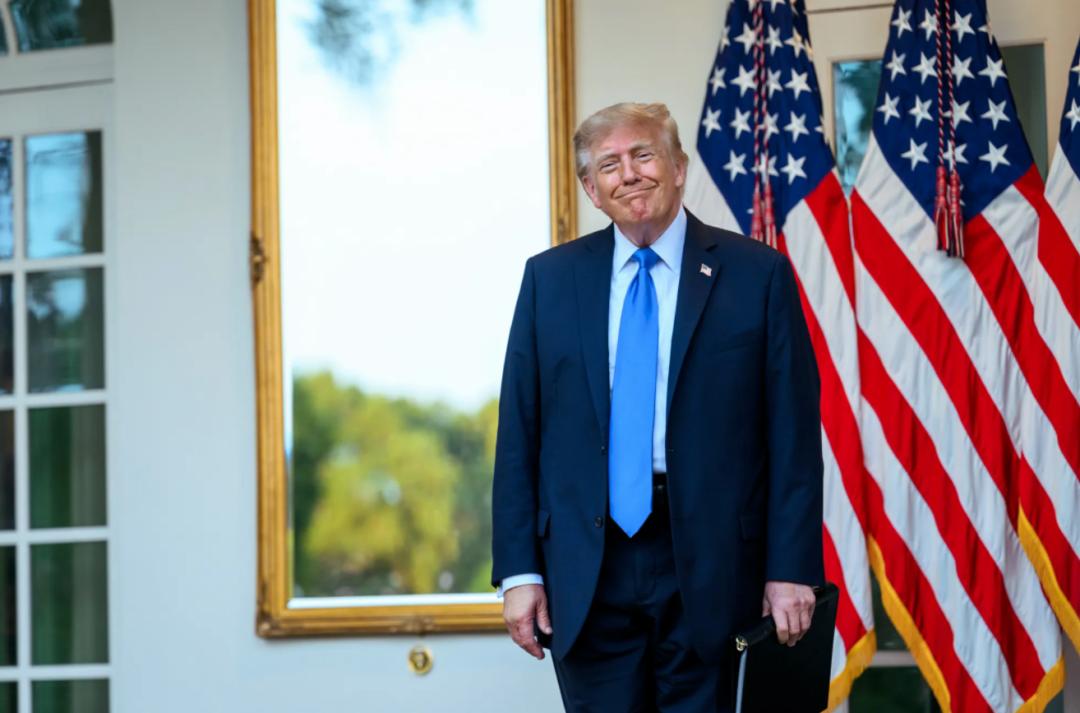
According to CCTV World News, US President Trump posted on social media platforms on local time September 11, making the promise for the 3rd consecutive day: if the Republican Party retains control of Congress in the November midterm elections, each adult in the US will receive a payment of 5000 US dollars (equivalent to about 34,000 RMB).
Source: Social media
He called the sum of money "Trump Dividend", saying that it is similar to the dividends listed companies distribute to their shareholders, while the money must be spent within the United States.
This remark was warmly cheered by his supporters, but the Democratic Party dismissed it, claiming that it was nothing more than an empty promise.
In response to this, Yang Delong, chief economist of Qianhai Kaiyuan Fund, told a reporter from Time Weekly that Trump's move is to seize the initiative in the US midterm elections in November, and the "direct cash handout" also reflects his businessman's way of thinking.
The total cost of this plan exceeds 1 trillion US dollars, while the United States is currently facing the huge national debt pressure of over 40 trillion US dollars. Can Trump's "high-stakes gamble" succeed?
Where does the money come from?
According to the latest US census data, there are approximately 270 million adult residents in the United States now. Calculated based on this figure, Trump's cash handout plan will cost 1.35 trillion US dollars (equivalent to about 9 trillion RMB).
This figure accounts for 18% of the US federal government's 2025 budget, and is even higher than the US military expenditure in the same period (which accounts for 13% of the federal government's budget).
This is no small sum. However, where will the money come from?
Trump himself did not specify how the funds for this commitment would be raised, but US Vice President Vance stated that the money may come from tariff revenue.
From the current situation, the revenue brought by the US government's tariff hike policies is very likely to be far from enough to cover this sum of money.
Source: Social media
According to CCTV News, data shows that in 2025, the total revenue the US federal government obtained from tariffs was about 264 billion US dollars. By August 2026, the US Customs and Border Protection (CBP) and the Department of the Treasury have refunded about 100 billion US dollars to importers and enterprises, accounting for about 60% of the total tariff collected.
No matter whether the tariffs are refunded or not, this revenue is far lower than the amount of money Trump promised to hand out. Unless other sources of funds can be found, the fund will eventually most likely be borne by the US government itself.
However, according to People's Daily, as of September 10, the total debt of the US federal government has exceeded 40 trillion US dollars. This figure is nearly 10 trillion US dollars higher than the total GDP of the United States in 2025, which translates to a per capita national debt of about 116,000 US dollars for every American.
It can be said that even if Trump really manages to give 5000 US dollars to every adult in the United States, he cannot offset this huge debt.
Facing the doubts, the White House stated in a statement: "The naysayers and opponents have always been underestimating President Trump. With the continuous support of the American people, President Trump will continue to deliver tangible results."
The Federal Reserve will bear all the costs
Compared with the cash handout, American economists are more worried that this move will worsen the US fiscal budget and inflation problems.
Erica York, an economist at the Tax Foundation, said she would be "extremely surprised" if the US Congress approved the relevant proposal: "This will be one of the worst ways to spend money. We are on an extremely unsustainable path, and the fiscal deficit is only expected to keep expanding."
By the end of July, the fiscal deficit of the US federal government for the current fiscal year had reached 1.799 trillion US dollars, exceeding the full-year deficit of the 2025 fiscal year. It is estimated that by the end of the current fiscal year (the end of September), the fiscal deficit will reach about 2 trillion US dollars.
Meanwhile, economists generally believe that the US government's direct cash handout will mechanically increase market demand without increasing the supply of goods and services. This imbalance between supply and demand will bring new pressure to inflation.
The current inflation level in the United States is already at a relatively high position. On the evening of September 11 Beijing time, data released by the US Department of Labor showed that the US Consumer Price Index (CPI) rose by 0.4% month-on-month in August, and the year-on-year increase remained at 3.4%.
At the same time, the escalating conflict between the US and Iran has pushed the international crude oil price to break through the 100 US dollars per barrel mark.
"Trump's promise makes no economic sense at all," said Brian, a professor of economics at Boston College. At present, the US-Iran conflict is still ongoing, international oil prices are still rising, and trade tensions with countries such as Canada are also continuously escalating.
"At this point, if we increase spending on the supply side, it will only make the problem worse," Brian analyzed. "This is like scooping water into a boat while drilling a hole in the bottom of the boat."
Another American economist Heather holds the same view: "Cash handouts can only bring short-term benefits, but will lead to a lot of long-term pain afterwards. It will exacerbate inflation and further push up the borrowing costs of houses, automobiles, credit cards and enterprises."
The US economy has already suffered losses from "direct cash handouts" before.
During the COVID-19 pandemic, the US government also launched economic assistance programs for individuals, which were carried out in three rounds with a total amount of 814 billion US dollars. According to a study by the Federal Reserve Bank of St. Louis, this program directly pushed the inflation rate up by an additional 2.6 percentage points.
Of course, even after making such a "high-stakes gamble", Trump may not necessarily win the midterm elections. As things stand now, the Republican Party is at risk of losing its majority in both the House of Representatives and the Senate.
According to Xinhua News Agency, Trump's latest approval rating has dropped to 33%, the lowest level during his current presidential term. The respondents opposed his imposition of new tariffs on Canadian goods and the prolonged unresolved conflict with Iran, and are also dissatisfied with the soaring oil prices and rising cost of living.
Guosheng Securities believes that in this year's midterm elections, inflation has become the biggest pressure for the Republican Party. The institution predicts that the probability of the Democratic Party controlling the House of Representatives is 85%, and the control of the Senate is still undecided.
US media predict that in this year's midterm elections, the seat gaps in both houses of Congress will be very narrow, and the final result may be determined by the seats of a few fiercely contested constituencies.
Faced with Trump's arbitrary "empty promises", all of this will probably end up being borne by the Federal Reserve.
According to Xinhua News Agency, market analysts believe that the stickiness of US inflation and the rise of core inflation indicators mean that the Federal Reserve is facing pressure to raise interest rates.
Heather said: "The Federal Reserve should raise interest rates in September, because the risk of persistently high inflation has risen. At the end of the day, prices are still rising."
The Fed's next interest rate meeting will be held on September 15-16. According to the prediction of CME Fed Watch, the probability of the Federal Reserve raising interest rates by 25 basis points in September has soared from the previous about 71% to about 90%.
However, Yang Delong also pointed out to the reporter from Time Weekly that Trump may not support this interest rate hike.
In fact, Trump himself is a supporter of interest rate cuts or even zero interest rates. "Previously, Trump has repeatedly attacked the interest rate hike policies of former Fed Chair Powell. After Powell's term ends in May 2027, he will appoint Wash as the new Fed Chair, and it is imaginable how much pressure Wash will be under." Yang Delong also pointed out that in fact, Trump has also publicly stated on many occasions recently that the Federal Reserve should cut interest rates immediately and lower the benchmark interest rate to 1%.
Having to support cash handouts while keeping inflation stable, can the Fed withstand the pressure this time?
This article is from the WeChat official account "Time Weekly" (ID: timeweekly), written by Ma Huan, edited by Liang Li, and published with authorization from 36Kr.