The pressure on Lens Technology goes far beyond the sluggish mobile phone sales.
■ Why did profits drop sharply?
■ The pressures on consumer electronics and the breakthrough point
■ Which new growth track will achieve large-scale revenue first?
Lens Technology, an enterprise in Apple's supply chain, has released a financial report showing obvious operational pressure.
In the first half of 2026, Lens Technology recorded an operating revenue of 28.866 billion yuan, down 12.42% year on year. This is a rare decline in its revenue.
The most well-known label of Lens Technology is "consumer electronics supply chain enterprise". Starting from mobile phone glass cover plates, and growing into an important supplier in the global intelligent terminal industrial chain, Lens Technology seized the golden period of the rapid development of smartphones.
Since 2014, among all semi-annual revenues, only the 2016 and 2022 periods saw a decline. During the 2022 decline, the company achieved full-year growth with a higher growth rate in the second half of the year.
Given the 12.42% year-on-year drop in semi-annual operating revenue, it remains uncertain whether the assessment target of 15% full-year revenue growth set in the equity incentive plan can be achieved.
The profit decline is even more significant. In the first half of the year, the attributable net profit of Lens Technology reached 577 million yuan, down 49.52% year on year; the non-recurring profit and loss deducted net profit was 278 million yuan, down 70.45% year on year. Meanwhile, the gross profit margin of Lens Technology rose by 2.21 percentage points to 16.43%.
How to understand the financial indicators with different trends? Now that the smartphone market has entered a mature stage, how long can the past growth model relying on mobile phones continue? Can new businesses smoothly take over the growth momentum?
01 Why did profits drop by half?
The sharp decline in Lens Technology's profits comes from the superposition of several factors.
Among them, the impact of exchange rate changes on the financial level is the most direct influencing factor. Lens Technology has a large overseas business scale, with overseas revenue accounting for more than half of the total revenue in 2025, and some businesses are settled in US dollars.
The exchange rate is an uncontrollable factor that can only reduce risks through hedging and other methods. Therefore, in the first half of 2026, the phased appreciation of RMB against the US dollar put Lens Technology under great exchange pressure.
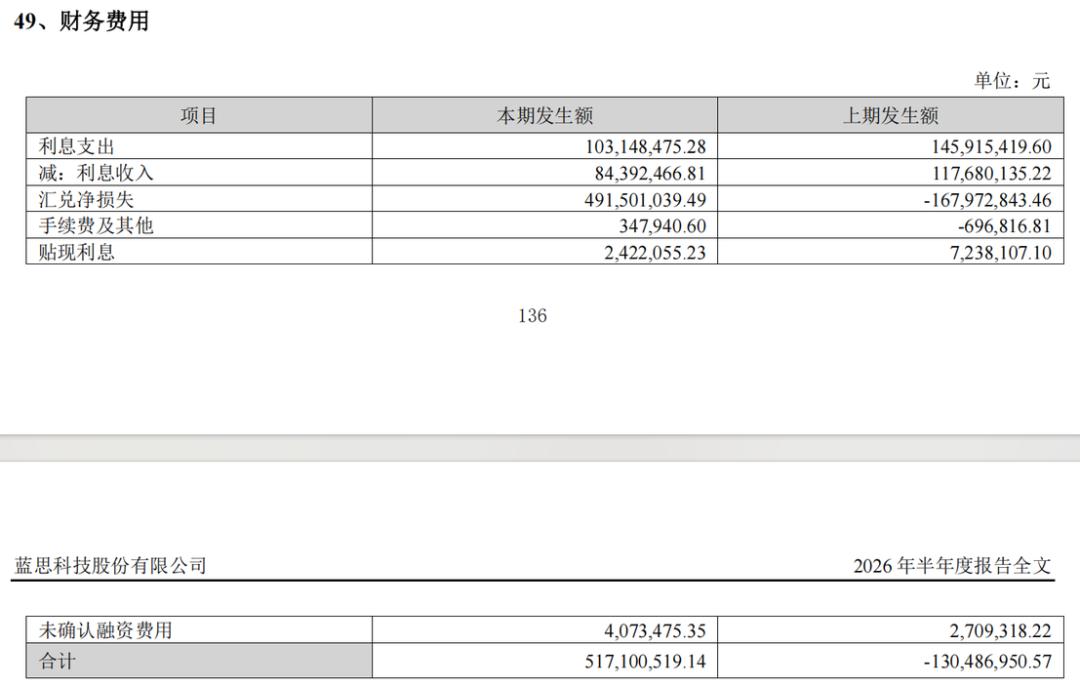
The semi-annual report shows that financial expenses rose from -130 million yuan in the same period of last year to 517 million yuan, a sharp year-on-year increase. Among them, the exchange loss was about 492 million yuan.
Assuming that the exchange gain generated in the first half of 2026 is the same as that in the first half of 2025, which is 168 million yuan, then indicators such as operating profit and net profit will turn from a sharp decline to growth or remain flat.
Another pressure comes from asset impairment.
In the first half of the year, the asset impairment loss of Lens Technology reached 437 million yuan, up 21.58% year on year, which mainly came from the inventory depreciation reserve. As of the end of the first half of 2026, the inventory scale reached 7.933 billion yuan, up 14.4% compared with the beginning of the year.
But from a longer-term perspective, the fundamental reason why Lens Technology's profits are vulnerable to impact is that the profit margin of its manufacturing business itself is not high.
In the past 10 years, the highest gross profit margin of Lens Technology was about 30%. With the maturity of the smartphone industrial chain and the expansion of low-value-added assembly business, the gross profit margin has gradually come under pressure. In the first half of 2026, the company's overall gross profit margin was 16.43%, which is still at a relatively low level even with a 2.21 percentage point year-on-year increase.
If we define "gross profit minus sales, management, R&D and financial expenses" as core profit to observe operating quality, the core profit margin of Lens Technology in the first half of the year was only 3.6%. This means that individual factors such as exchange rate, inventory and cost changes may have a significant impact on profits.
This is also one of the reasons why Lens Technology adjusted its business structure in the first half of this year.
Affected by factors such as the price rise of memory chips, Lens Technology voluntarily reduced some low-value-added assembly businesses, and introduced higher-value-added assembly businesses such as action cameras. The revenue side was under pressure as a result, but the gross profit margin of the consumer electronics sector increased by nearly 3 percentage points, and the overall gross profit margin also benefited from this rebound.
In other words, Lens Technology is trading part of its scale for profit quality, which is the "reducing volume and improving quality" orientation set in the semi-annual report.
For Lens Technology, short-term profit fluctuations are not the biggest challenge. The real problem is: after the growth of consumer electronics slows down, can the company find new sources of growth, and at the same time make higher-value businesses gradually replace the past scale-dependent manufacturing model.
02 Core business consumer electronics: Can quality improvement make up for volume reduction?
Consumer electronics business is still the largest source of revenue for Lens Technology, but this core sector that once drove the company's rapid growth is entering a new stage.
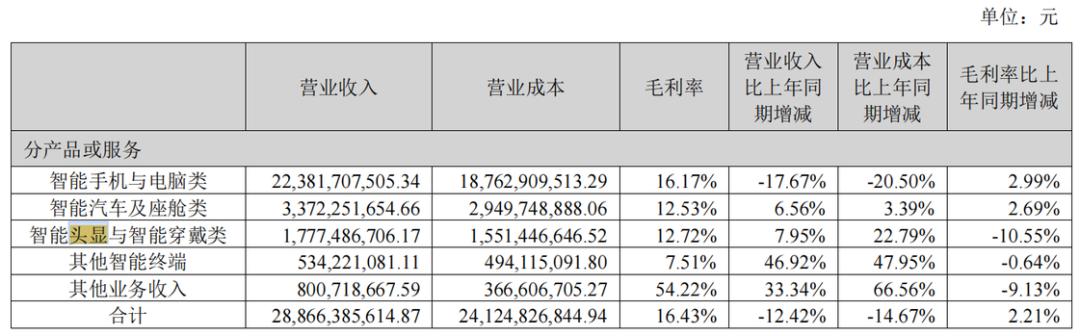
In the first half of 2026, Lens Technology's smartphone and computer business recorded revenue of 22.382 billion yuan, down 17.67% year on year, accounting for 77.54% of the total operating revenue.
This decline first comes from the overall pressure on the smartphone industry.
In the past few years, the smartphone market has moved from the stage of rapid growth to the stage of stock competition. Consumers' phone replacement cycle has been extended, and terminal brands are facing increasing growth pressure. IDC data shows that global smartphone shipments in the first quarter of 2026 decreased by 4.1% year on year, and the second quarter decreased by 6.7% year on year.
A widely recognized factor that can drive users to replace their phones is AI. Mobile phone manufacturers have taken end-side AI as an important selling point of new products, hoping to stimulate consumers to upgrade through functions such as intelligent interaction and image enhancement.
But on the other hand, the impact brought by AI has also been transmitted to the cost side.
With the growing demand for AI servers, the supply-demand relationship in the global memory industry has changed, and the rise in memory prices has begun to affect the consumer electronics industrial chain. For mobile phone manufacturers, memory chips are an important part of BOM cost, and the cost increase ultimately needs to be redistributed between terminal prices and supply chain profits.
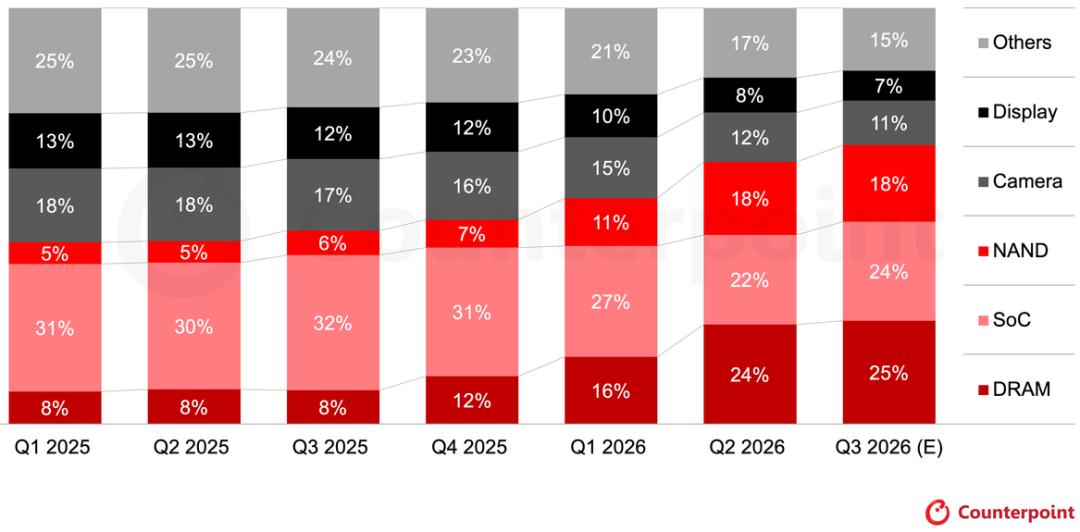
Recently, many mobile phone manufacturers have begun to adjust product prices, but whether the price increase can be accepted by consumers, or whether the AI experience can be a reason for consumers to pay for the price increase, still needs further verification.
For Lens Technology, the problem is that it does not hold the initiative in this price transmission chain.
From the window protection glass in the feature phone era, to the cover glass and structural parts in the smartphone era, and then to the assembly business, Apple has been an important support for Lens Technology in the process of gradually entering the supply chain of global top brands.
Apple not only brings stable large-scale orders, but also helps suppliers build globally leading manufacturing capabilities. But at the same time, terminal brands like Apple also have strong discourse power.
In the consumer electronics industrial chain, brands control product definition, terminal selling prices and market channels, while suppliers mostly play the role of manufacturing and technical cooperation.
When the price of terminal products rises, component enterprises may not be able to increase their income synchronously, but if the terminal price rise suppresses demand, component enterprises will most likely suffer losses.
Lens Technology's solution is to develop more customers, and improve the supply pattern and enhance value through technological upgrading and process improvement.
From the perspective of customer structure, the revenue proportion of the company's largest customer (widely recognized as Apple in the market) has dropped from a high level in the early stage to about 45% as disclosed in the 2025 annual report. At the same time, the company continues to expand other terminal customers and enter emerging fields such as AI glasses and smart wearables.
Among them, smart head-mounted displays and smart wearables are the extension of the company's consumer electronics capabilities to new terminals. In 2025, this business achieved revenue of 3.978 billion yuan, with a gross profit margin of 19.91%, which is at a relatively high level among all business segments. In the first half of 2026, the smart head-mounted display and smart wearable business recorded revenue of 1.777 billion yuan, up 7.95% year on year, accounting for 6.16% of the total operating revenue.
Smart head-mounted displays and wearable devices are more about the expansion of consumer electronics categories, while foldable screens increase the value of a single device through form upgrading.
Compared with traditional smartphones, foldable screens have higher requirements for materials and manufacturing processes. Products such as UTG ultra-thin flexible glass, glass support plates, PET functional films and 3D glass cover plates have higher technical difficulty, and can also increase the value of a single device for suppliers.
Lens Technology previously disclosed that it has supplied UTG ultra-thin flexible glass, glass support plates, PET functional films and 3D glass cover plates for the foldable models of its large North American customer, and started mass shipment at the end of the second quarter.
But foldable screens also face practical challenges.
On the one hand, Lens Technology has certain technical barriers in specific processes, for example, the UTG yield rate exceeds 95%. This barrier can bring a bargaining window during the introduction period of new categories. However, Apple generally adopts the "dual supplier + mutual bidding" strategy for core components, which will compress the time and space for premium.
On the other hand, the rise in memory prices equally affects the BOM cost of bar, curved and foldable screens. Higher product value ultimately needs to be based on consumers' willingness to pay for it. The latest observation window is the sales performance of Apple's first foldable screen phone.
IDC predicts that global foldable screen phone shipments in 2026 will be about 22.9 million units, up 12.6% year on year. The growth rate looks good, but the overall scale is still small. Counterpoint data shows that foldable screens currently only account for about 2% of the global smartphone market, and the cumulative shipments are expected to exceed 100 million units by the end of 2026.
In the past, Lens Technology gained scale relying on the growth of smartphone sales. In the future, it needs to achieve growth relying on high-end products, complex processes and higher single-device value. But even after completing this step, consumer electronics still cannot completely get rid of the terminal cycle.
03 What stage has the new growth curve reached?
Outside of consumer electronics, Lens Technology is constantly expanding its business boundaries, including automotive, AI-related businesses and TGV glass substrates, to outline the growth curve for the next stage.
At present, these new businesses are still in different stages.
Among them, the automotive smart cockpit business is the largest business segment outside consumer electronics.
In the first half of 2026, Lens Technology's smart vehicle and cockpit business recorded revenue of 3.372 billion yuan, up 6.56% year on year, accounting for 11.68% of the total operating revenue. Different from the trend of continuous improvement in revenue scale, the gross profit margin of this business is not stable, which was about 20% in 2022, dropped to 7.22% in 2025, and was 12.53% in the first half of 2026, up 2.69 percentage points year on year.
The advantage of the smart vehicle and cockpit business is that it has a high degree of matching with the manufacturing capabilities accumulated by Lens Technology in the past.
Lens Technology entered the consumer electronics supply chain relying on glass processing, precision structural part manufacturing and mass production capabilities. Products such as cockpit displays, automotive glass and structural parts also require high-precision manufacturing, high reliability and strong supply chain management.
The automotive industry also has its own characteristics. The certification cycle of automotive parts is longer, and the vehicle model development rhythm is different, which means that Lens Technology needs to penetrate slowly. However, once entering the supply system, the order stability is usually stronger. At present, Lens Technology has cooperated with many domestic and foreign automakers, and is promoting the mass production and delivery of products such as laminated window glass.
If the automotive business represents the implementation of manufacturing capabilities in mature industries, then AI servers may be the direction with greater medium-term growth elasticity for Lens Technology.
With the rapid development of the artificial intelligence industry, the demand for computing power infrastructure construction continues to rise, and new market opportunities have emerged in links such as AI server structural parts, liquid cooling heat dissipation and server storage.
Focusing on AI servers, Lens Technology is laying out directions including cabinet structural parts, liquid cooling heat dissipation systems and server storage. The Dongguan Songshan Lake Park has completed relevant capacity expansion and customer verification, and further supplemented its capabilities in the AI server structural parts and liquid cooling fields through industrial investment; enterprise-level SSD has achieved mass shipment, and HDD glass hard drives have also entered the verification and delivery stage.
AI servers can also reuse the capabilities accumulated by Lens Technology in the consumer electronics business, but the reused capabilities are only the foundation for entry.
The core difference lies in the certification barrier. Only a few enterprises in the world hold NVIDIA RVL supplier certification, and the verification cycle lasts from 6 to 18 months, covering quality system, technical capability and production capacity audit, which is not a threshold that can be crossed simply by relying on precision manufacturing capabilities. Therefore, Lens Technology chose to acquire Yuanshi Technology to indirectly obtain NVIDIA RVL certification instead of building it on its own.
In terms of product requirements, AI servers are oriented to data centers and need to operate stably for a long time. The requirements for sealing, durability and safety of liquid cooling heat dissipation are much higher than those of consumer electronics structural parts. The product form has expanded from small precision parts in mobile phones to cabinet system integration, and also involves a brand new technical domain.
But once crossing the certification threshold, the growth elasticity of AI servers may be greater.
Other smart terminals represent Lens Technology's advance layout for the next generation of smart hardware direction.
The semi-annual report shows that the revenue of other smart terminal businesses was 534 million yuan, up 46.92% year on year, among which embodied intelligent robots are the key direction. The company is promoting the layout around dexterous hands, joint modules and complete machine assembly, and has cooperated with enterprises such as Fourier Intelligence, and related products have achieved mass delivery.
There are obvious differences in business models between the robot business and Lens Technology's consumer electronics manufacturing.
The consumer electronics business faces a small number of top large customers, provides large quantities of highly standardized products, and adopts a mature OEM model. It is characterized by stable order scale and strong predictability, but the bargaining power of OEMs is relatively weak.
The humanoid robot industry is still in its early stage, and the product form, standards and demands