Why can there only be one Hefei in China?
In the past few years, a group of "new upstarts" vastly different from those in the last round of the Internet era have emerged in China's capital market. If Tencent, Meituan, Alibaba and Pinduoduo represent the wealth of the previous generation, today's most sought-after companies are increasingly from "hard technology" fields such as semiconductors, artificial intelligence, robotics, and commercial aerospace.
Behind companies like Cambricon, ChangXin Memory Technologies, and Unitree Robotics, there are not only entrepreneurs and venture capital, but also the growing presence of national strategies, local industrial funds and state-owned asset platforms. In the mobile Internet era, the shadow of local government industrial funds was barely seen among the shareholders of those sought-after companies.
The geographical distribution of these "new upstarts" is also quite interesting. Beijing and the Yangtze River Delta are particularly eye-catching: Beijing is home to artificial intelligence and commercial aerospace industries, Shanghai and Suzhou have the semiconductor sector, Hangzhou boasts the robotics industry, and Hefei has developed its industrial layout from BOE, NIO all the way to ChangXin. In contrast, the Pearl River Delta, which once represented the vitality of China's technology and manufacturing industries, has barely had a say in this round of narrative.
This certainly cannot be simply interpreted as a decline in the technological strength of the Pearl River Delta. Shenzhen still hosts a group of China's most competitive enterprises such as Huawei, Tencent, BYD, DJI, and Mindray. What has really changed may not be that enterprises in certain regions have suddenly become more innovative, but that the way local governments in China organize industries has changed, and the way the capital market rewards enterprises has also changed.
A very good starting point for understanding this change is to compare Shenzhen Venture Capital Group and the "Hefei Model".
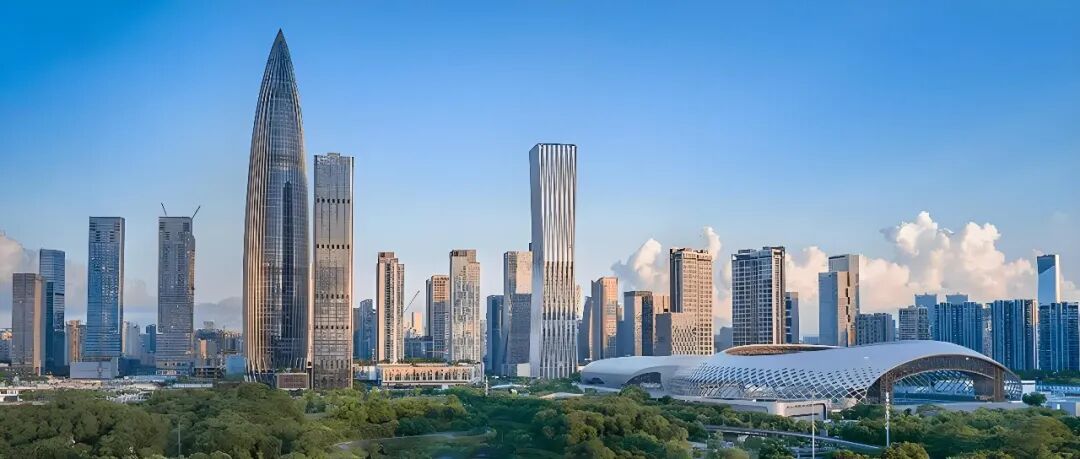
Shenzhen Venture Capital Group — founded in 1999, whose largest shareholder is the Shenzhen State-owned Assets Supervision and Administration Commission.
The Misunderstood "Hefei Model"
When talking about local governments making industrial investments today, Hefei is the first thing that comes to most people's minds.
Several well-known investments in BOE, NIO, and ChangXin have earned Hefei praises such as "China's most powerful venture capital institution". Especially for NIO, when the enterprise was in trouble back then, Hefei's state-owned capital made a bold bet, and the subsequent sharp rise in market value made the widely spread story that "the government is better at investing than VCs".
But this statement may have got the concept wrong from the very beginning, because what Hefei does is not venture capital, and Hefei municipal government has denied many times that it is engaged in venture capital. As for what it actually is, we will reveal it gradually in the following content.
If you want to find a state-owned background venture capital institution in the true sense in China, Shenzhen's Shenzhen Venture Capital Group may be a better example.
The essence of venture capital is not to love risks, but to manage risks through portfolio investment. It acknowledges a most basic fact: in the face of technological innovation, no one really knows who will succeed. Precisely because no one knows the result, VCs need to invest in dozens or even hundreds of companies, allowing many of these projects to fail. As long as a few enterprises become super winners, the returns are enough to cover the losses of other projects, which is the Power Law of venture capital.
Therefore, diversified investment is the most important principle of venture capital. Typical risk diversification strategies include:
Quantity diversification, that is, a venture capital fund usually invests in many start-ups to smooth fluctuations; stage diversification, balancing risk and return characteristics by allocating projects in different financing stages;
Industry diversification, allocating funds across different industries; time diversification, where the fund makes investments in batches over several years to mitigate "vintage risk", and relies on experienced general partners to grasp market cycles;
Geographical diversification, hedging regional risks such as politics and economy in a single market through global layout, even though the advantages of local post-investment management need to be weighed.
Shenzhen Venture Capital Group basically follows this logic. However, it should be pointed out that today's Shenzhen Venture Capital Group does not simply take the "money of Shenzhen's state-owned assets" to invest across the country. It is first and foremost a fund manager, a GP.
After more than 20 years of development, it manages a huge fund system, whose LPs come from local government guidance funds, state-owned institutions and other investors, and its capital sources have long gone beyond Shenzhen; at the same time, its invested enterprises are distributed all over the country. According to the official website of Shenzhen Venture Capital Group, its assets under management are about 570 billion yuan, with about 1,800 invested enterprises. Shenzhen Venture Capital Group focuses on venture capital, and manages equity investment funds such as venture capital funds, FOFs, S funds, and M&A funds.
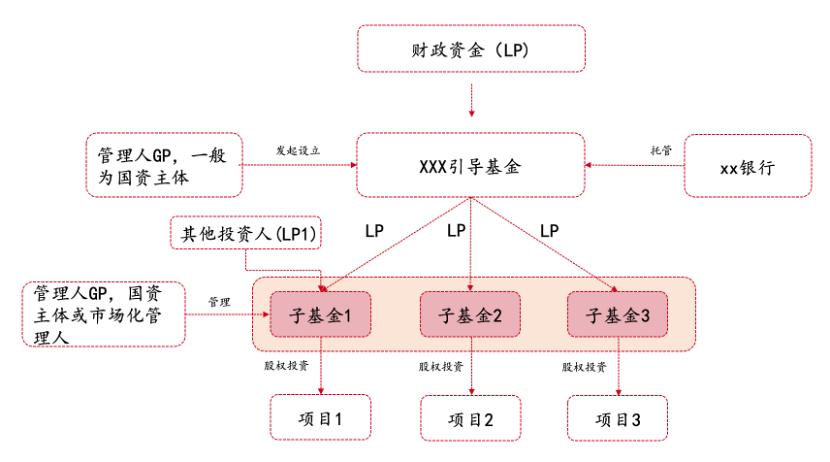
Schematic diagram of the operation of government industrial guidance funds. Source: Nie Huihua, "The Operating Logic of Grassroots China".
Therefore, what Shenzhen Venture Capital Group has formed is actually a capital cycle of "raising capital nationwide — managed by professional GPs — searching for projects nationwide — market-based exit". Previous data from Shenzhen Venture Capital Group shows that about 30% of its invested projects are located in its "base camp" Shenzhen, projects registered in Zhejiang and Jiangsu in the Yangtze River Delta account for 30% and 20% respectively, forming an investment network of "deep cultivation in the local market + heavy allocation in the Yangtze River Delta + supplementation from key cities + tapping regional opportunities", to maximize the coverage of high-quality project gathering areas.*
This data is certainly not a complete statistic of all Shenzhen Venture Capital Group's investments, but it well illustrates its basic spatial characteristics: Shenzhen Venture Capital Group not only raises capital from all over the country, but also searches for enterprises nationwide. It is first and foremost an investment institution, not a Shenzhen investment promotion department.
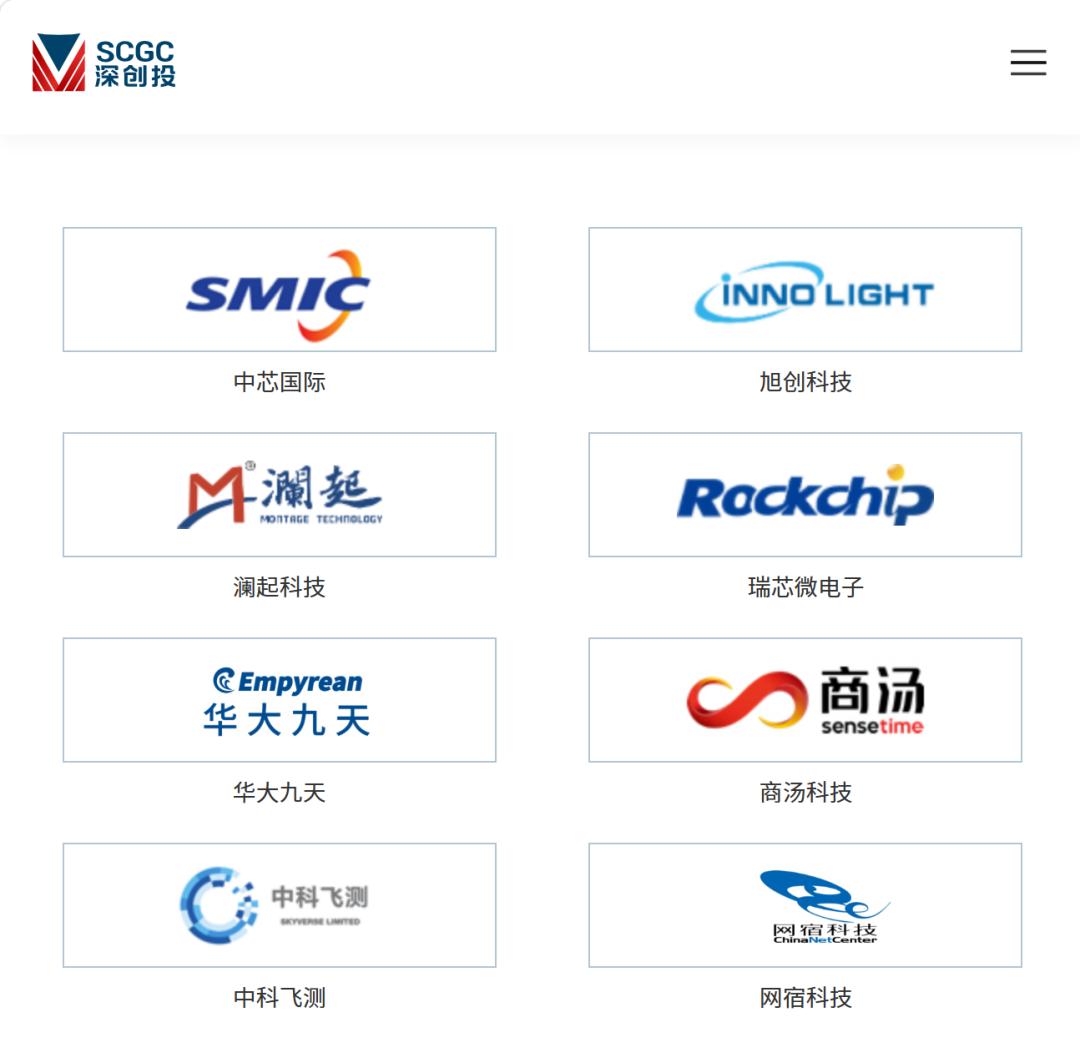
Partial investment cases of Shenzhen Venture Capital Group, whose vision is to "discover and achieve great enterprises".
Hefei is completely different. No matter for BOE, NIO or ChangXin, the investments are huge, highly concentrated, and deeply bound to the local industrial layout. What Hefei really needs is not to build a nationwide portfolio of financial assets, but to keep a leading enterprise, a large factory and even a whole industrial chain in Hefei through a sufficiently large investment.
In this sense, Shenzhen Venture Capital Group has developed a local state-owned background institution into a national GP; while Hefei has turned local capital into a tool for investment attraction.
What Hefei does is still manufacturing investment attraction
From this perspective, the so-called "Hefei Model" is not that mysterious. It did not suddenly invent a new type of government venture capital, but is more like an upgrade of the most familiar manufacturing investment attraction for Chinese local governments over the past decades in the financial era.
In the past, local governments used land, tax incentives, factory buildings and infrastructure as bargaining chips for investment attraction. The government did not mainly care how much the company's stock price would rise in the future, but cared about where the factory was built, where the output value was counted, where the tax revenue was retained, and whether upstream and downstream enterprises would follow.
Hefei only added a more powerful weapon to this toolbox: equity capital. In the past, it was "land + factory building + tax incentives", but now it has become "land + policy + industrial fund + equity investment". The tools have changed, but the objective function has not fundamentally changed.
The significance of BOE is not only how much money an equity investment has earned, but that the panel production lines and related industrial chains have settled in Hefei; the significance of NIO is not only about its stock price, but that the new energy vehicle industry is deeply bound to Hefei; the same is true for ChangXin, the location of a large DRAM wafer fab is itself an industrial policy.
Therefore, rather than saying that Hefei upgraded investment attraction to venture capital, it is better to say the opposite: it turned equity investment into investment attraction.
This also explains why Hefei naturally tends to make concentrated bets. Manufacturing investment attraction is never a portfolio game. A city cannot attract dozens of complete vehicle manufacturers at the same time just to diversify risks, nor can it build dozens of large wafer fabs simultaneously. It must select a few leading enterprises, and then allocate land, credit, funds, talents and upstream and downstream resources around these leading enterprises.
If you have to find an inappropriate but vivid metaphor, Shenzhen Venture Capital Group is closer to traditional venture capital institutions such as HSG, while Hefei is a bit like Masayoshi Son.
Traditional VCs emphasize portfolio discipline, and even if they are very optimistic about an enterprise, they rarely allocate an excessively high proportion of the fund to a single project. Masayoshi Son is famous for the opposite: once he believes he has seen the future, he dares to place heavy bets that others dare not make. From Yahoo to Alibaba, the most legendary investments in his career all have this feature.
The story of Masayoshi Son is also fascinating because venture capital has extremely strong power law characteristics. When you invest in 100 companies, you don't need all 100 to succeed. The return brought by one Alibaba may cover a large number of failures. As a result, a super winner can easily shape the investor into a "person who foresees the future".
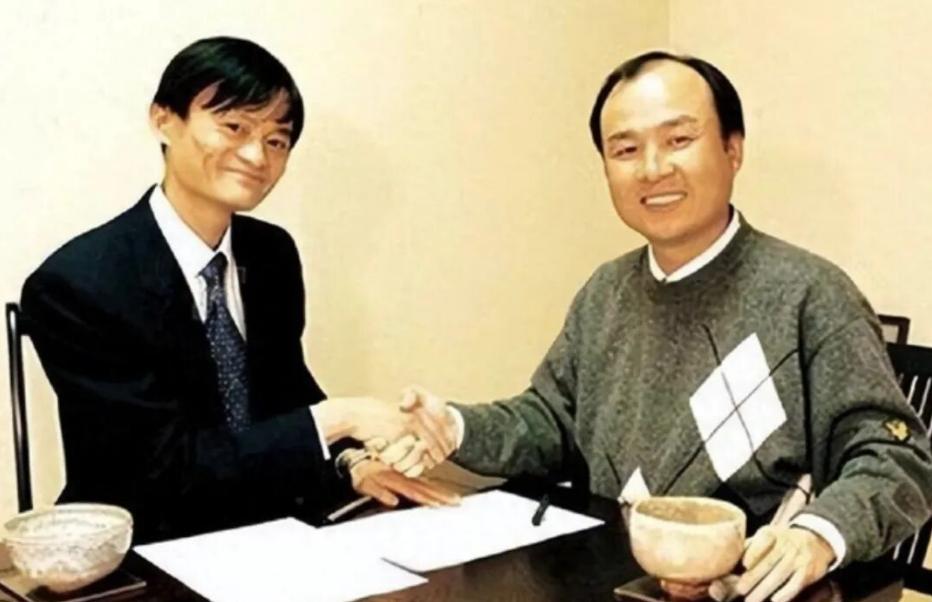
In 2000, when Masayoshi Son first met Jack Ma, Alibaba did not even have a decent source of revenue.
But this also leaves a question that can never be fully answered: how much of the success comes from judgment, and how much comes from luck? The same is true for Hefei. Several projects of BOE, NIO, and ChangXin together easily form the narrative that "Hefei is particularly good at investing", but the biggest difference between concentrated investment and diversified investment is that the former requires extremely high accuracy for a few major judgments.
Of course, there is also a fundamental difference between the two. Masayoshi Son ultimately has to accept the capital market accounting, and failures like WeWork will directly become SoftBank's investment losses; in addition to the financial investment account, Hefei has another account — GDP, tax revenue, employment and industrial chains.
An investment with a low Internal Rate of Return (IRR) can also be considered successful as long as it brings an industrial cluster; even if the equity investment suffers losses, the investment attraction goal may still be achieved as long as the enterprise and production lines are retained.
What Hefei really invests in is not equity, but the future industrial structure of the city.
But the existence of this "second account" also makes the Hefei Model more difficult to evaluate. BOE has become a global panel giant, but being one of the largest producers in the world does not mean that the panel business will maintain high return on capital in the long term; NIO once brought considerable book returns to Hefei, but whether it can form long-term stable profitability still needs to be tested by the market; ChangXin is in the DRAM industry with huge capital expenditure, rapid technological iteration and strong cyclicality, and its real success can only be judged after going through several storage cycles.
Therefore, what is hardest to replicate in Hefei may not be money and courage, but whether it can continuously bet on a few major industries, and how much of that success comes from capability and how much comes from luck?
In the hard technology era, manufacturing investment attraction is back
If we only compare Shenzhen and Hefei, it is easy to fall into the old topic of "market vs government". The really interesting question is: why has the Hefei Model suddenly become particularly in line with the times after entering the so-called "hard technology era"?
The answer may lie in the word "hard".
The last round of the Internet industry mainly required programmers, servers, users and venture capital. It of course matters where an Internet company writes code, but local governments do not need to build a "Tencent factory" for Tencent. Once an enterprise forms network effects, it can expand rapidly across regions, and the traditional capabilities of local governments in land, development zones and industrial chain organization are not that critical.
Chips, new energy vehicles, robotics, and commercial aerospace are completely different. They again require land, factories, equipment, power, infrastructure, supply chains, and huge fixed asset investments. Where the wafer fab is located, where the complete vehicle factory is located, and where the robotics industrial chain is located are all very specific matters for a city.
Thus, a rather counter-intuitive phenomenon has emerged: The deeper China enters the hard technology era, the more valuable the manufacturing investment attraction capabilities accumulated by local governments over decades become.
In this sense, Hefei has not created a brand new system. It is more like re-arming the most familiar model of "development zone — investment attraction — leading enterprise — industrial chain" for Chinese local governments with industrial funds. In the past, investment promotion bureau directors took land indicators and tax incentives to find enterprises, now industrial fund principals can also bring billions of yuan of equity capital to negotiate projects.
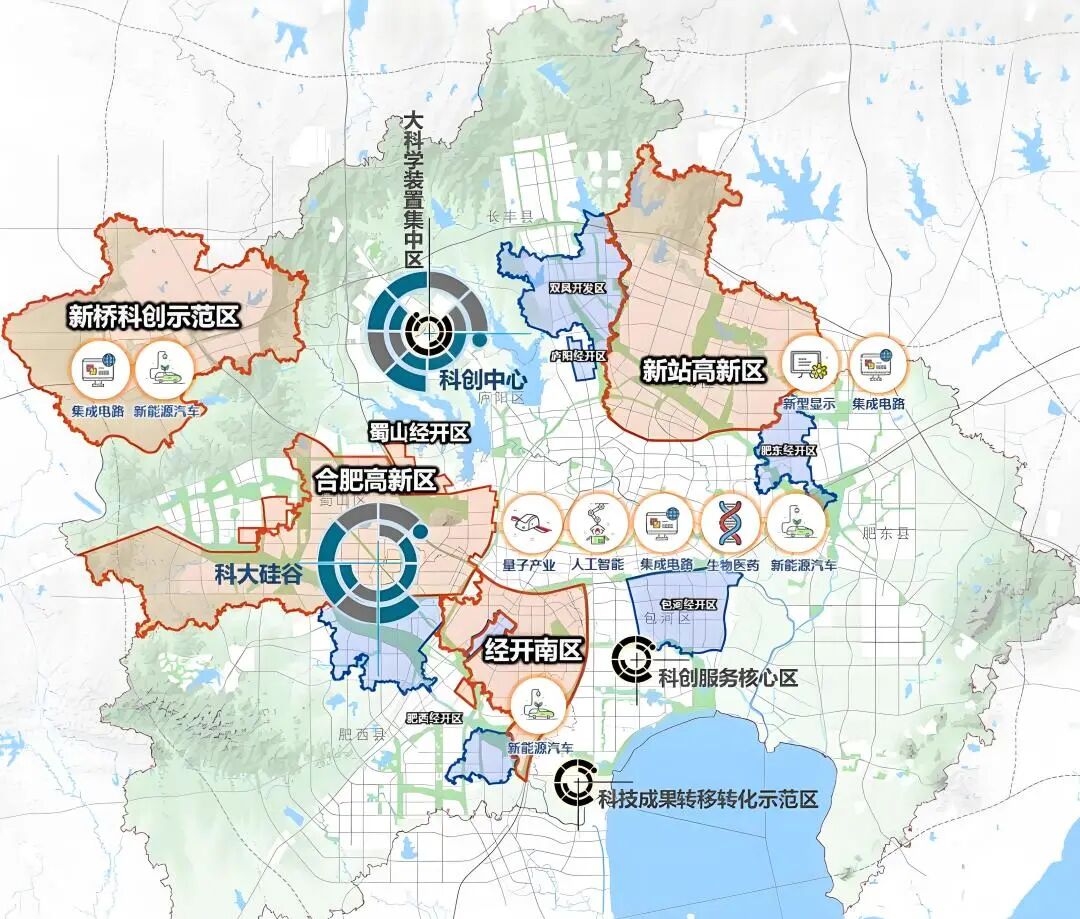
"Core, Screen, Automobile, Integration" and "Emergency, Life, Intelligence" — Hefei's eight major industrial landmarks
This may also explain why the Yangtze River Delta is particularly eye-catching in this round. The Yangtze River Delta already has China's most mature development zone system, local industrial governance and manufacturing investment attraction traditions. When equity investment becomes a new investment attraction tool, these places are not learning VC from scratch, but adding a financial weapon to their best manufacturing organization capabilities.
In contrast, the situation in Shenzhen is somewhat delicate. Shenzhen of course also has industrial policies, and pays more and more attention to industrial funds, but Shenzhen Venture Capital Group represents another evolutionary path. Shenzhen initially created an investment institution with local state-owned background, which later gradually became a national GP: raising money from LPs across the country, and then looking for enterprises worthy of investment nationwide. At this stage, capital allocation itself has become a professional service, no longer just an auxiliary tool for local investment attraction.
In other words, Shenzhen has developed investment into a pure investment business; while Hefei still mainly uses investment to develop manufacturing industries.
This may also provide an explanation: the Pearl River Delta seems a little "lagging behind" today, not necessarily because it cannot invest, but precisely because Shenzhen has made investment too much like investment in the last round of development. In the market-oriented and Internet-oriented growth model, this is an advantage; but when national industrial policies re-emphasize chips, robotics and advanced manufacturing, and when the capability of local governments to organize large-scale industrial projects appreciates again, the capabilities of Hefei and the Yangtze River Delta