AI has accelerated delivery, yet why is the organization still treading water?
A report that would originally take two to three weeks to complete was generated by AI in just two hours. When the person in charge was about to prepare for the board of directors presentation, they applied for a two-week extension. At the site of the Bosshui event hosted by Fudan University School of Management, Zhang Qi, Head of North Asia at Top Employers Institute, shared a real experience from a friend of his.
As an HR business partner at a foreign-funded enterprise, this friend needed to collect data from frontline business staff and provide analysis reports for the management. In the past, sorting out materials and producing presentation materials took a lot of time, but the emergence of AI agents has greatly shortened this process. However, the initial excitement soon turned into new confusion: AI generated a detailed and excellent report in a very short time, but many of the analysis conclusions in it were difficult for her to fully understand.
After all, it is not AI that stands in front of the board of directors in the end, nor is it AI that explains the data and responds to follow-up questions to the executives, but the HR herself. With no other options, she spent another two weeks digesting and verifying the report generated in just a few hours.
This is a microcosm of the current application of AI in enterprise management. The time spent generating reports, weekly updates, and materials has been greatly reduced, but the cost of understanding, judgment, and communication remains the same. AI tools only complete part of the task, which does not mean the entire work is done.
In the early stage of the Bosshui event, *Management Insights* and the Career Development Center conducted a survey on registered HR managers, HR business partners and other relevant personnel, and a total of 324 valid questionnaires were collected. The results show that AI has been introduced into the recruitment, assessment and training links of most enterprises, but building new working methods around AI is far more complicated than introducing the tools themselves.
AI has entered front-end recruitment, but has not yet been implemented in organizational operation
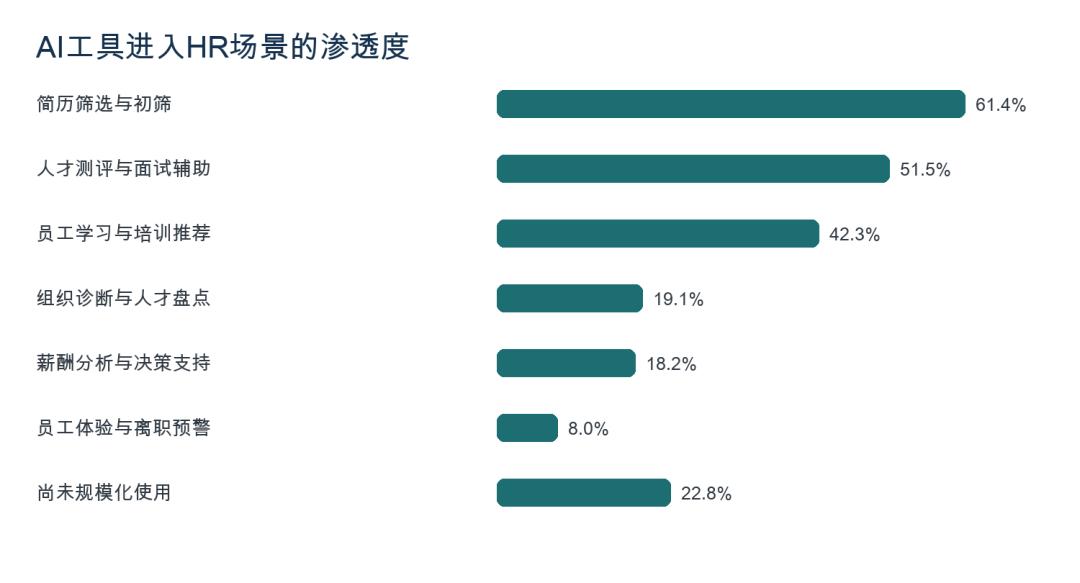
Penetration of AI tools in HR scenarios; N=324, multiple choices allowed
Most respondents said AI has been applied to resume screening and initial filtering (61.4%) and talent assessment and interview assistance (51.5%). In contrast, only a small number of respondents reported that AI is used in organizational diagnosis and talent inventory (19.1%) or employee experience and turnover early warning (8.0%).
These figures reflect the coverage of application scenarios rather than the effect of use, and it cannot be asserted that recruitment has achieved reliable automation based on them. But they show a clear difference: AI has been more widely adopted in the front end of the recruitment process, while applications involving organizational operation and employee relations are still relatively rare.
In the front end of recruitment, it is relatively easy to record how many resumes are screened and how many initial communications are completed, which is not the case for organizational diagnosis. For example, for the same staff turnover, the reason may be compensation, or it may lie with the supervisor, the promotion mechanism or the business prospect. After identifying the correlation, it is also necessary to judge what the enterprise can change, and whether changing one point will cause other problems.
"Judgment is always the scarce resource." Associate Professor Xu Zhengchuan from the School of Management of Fudan University pointed out in his keynote speech that managers are always solving bottleneck problems. As content generation becomes easier and easier, the next bottleneck will be judgment. After the scale of AI application expands, the professional competence of HR cannot be reduced. Precisely because the system can quickly give rankings, scores and explanations, users need to judge whether these conclusions are truly relevant to the position, and whether the candidate in front of them is an exception that the model is not good at handling.
Writing "Human In The Loop" into the process does not mean that the problem can be solved naturally. Xu Zhengchuan reminded that when the system performs well most of the time, people may gradually relax their vigilance. If the reviewer does not have sufficient professional competence, processing time and the motivation to pursue excellence, the so-called manual check will easily turn into a simple confirmation click. For HR, therefore, the end of training is not just learning prompts or building agents. The more important capabilities after tools are introduced into personnel decision-making are whether employees can explain the basis of a judgment and point out the boundaries where the system is not applicable.

Xu Zhengchuan delivers a keynote speech at the Bosshui Forum
Everyone works faster, but the company may not deliver faster
Yu Tianwen, Global Director and Partner of McKinsey and Co-Leader of the Organization, Talent & Performance Practice in China, put forward an assumption in her speech: an engineer originally needed seven hours to complete the work, but only one hour after using AI, but if he still hands over the results to the next colleague at the seventh hour, the whole process will not be accelerated accordingly.
This is not a technical failure, but a disconnection between individual work and organizational processes. Only by changing task handover, approval arrangements or resource allocation can the time saved by employees be converted into a shorter delivery cycle.
However, in the actual operation process, enterprises often assign AI application to the technology department, training to HR, and then require the business department to submit efficiency improvement results. But the goals faced by the three departments may not be consistent: the technology department focuses on whether the system can be deployed, HR focuses on whether employees have mastered the tools, and the business department needs to ensure that current tasks are completed on time. Each party may meet its own indicators, but cross-departmental waiting and repeated labor remain.
In the questionnaire, the biggest obstacle selected by respondents was not concentrated in a single link. 27.2% believed that there was a lack of applicable tools or solutions, 21.9% believed that the HR team had insufficient AI capabilities, and 21.6% believed that the data foundation was weak.
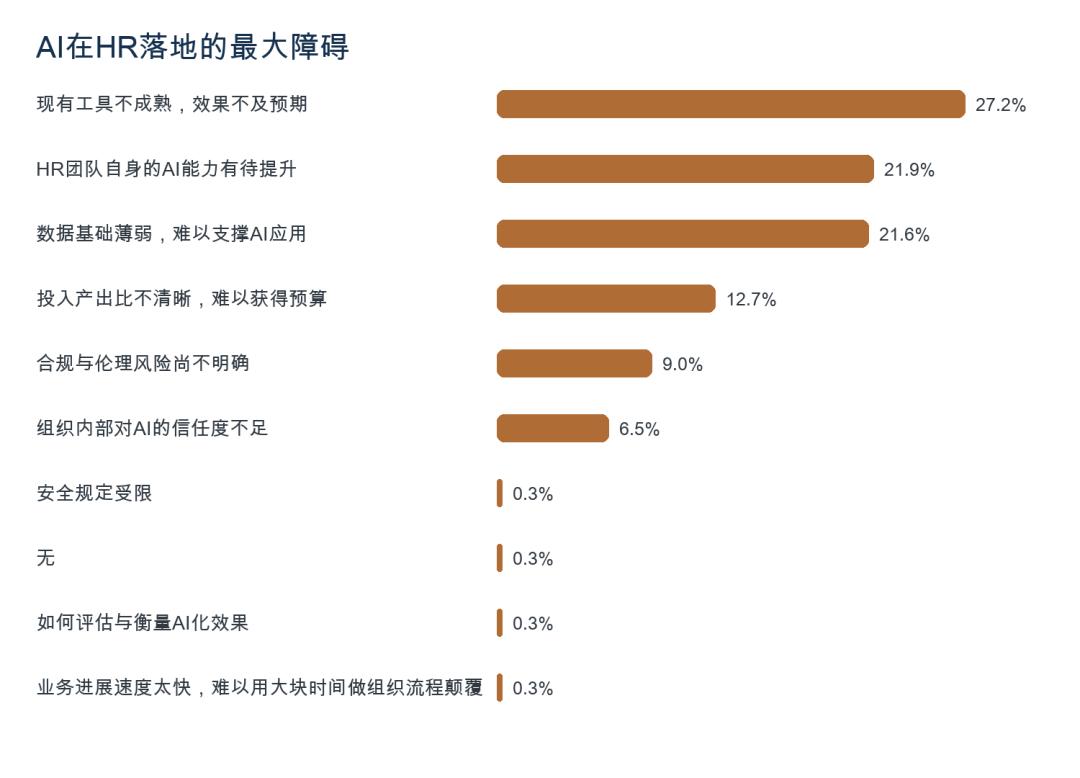
The biggest obstacle to promoting AI application in HR field; N=324, single choice
Fang Rangqing, HR Partner of Fosun International and Chief Organization Development Officer of Yiyao Technology, introduced that AI transformation is not only the responsibility of the IT department. The company is promoting AI applications jointly through three types of business partners: the AIBP business partner is responsible for finding demands, defining scenarios, calculating values, and finally promoting popularization to make colleagues really use the tools. The AITP technical partner is responsible for building platforms, carrying out development, and judging technical feasibility, so that every department does not need to understand technology. The HRBP organizational partner is responsible for reshaping post skills and cultural transformation, so that AI transformation is not only a technical upgrade, but also an upgrade of organizational capabilities. The first step is to find business bottlenecks and pain points, and then see if AI can solve them.
But another opinion at the round table is also worthy of attention. Yu Tianwen asked in follow-up: setting up so many "business partners", is it possible that it will also increase collaboration friction? Can some responsibilities be merged instead of adding a coordination role for each new task? The discussion did not give a unique organizational template, but pointed out a contradiction in AI transformation: in order to reduce the inefficiency of the original process, enterprises may first add new positions, meetings and reporting relationships. Without clear decision-making power and delivery responsibilities, the newly established coordination mechanism may also become a new waiting link.
What HR needs to participate in is not only to find candidates for new positions, but also to judge whether these positions are necessary. Who defines the business problem for an AI project, who decides the choice of solutions, who can promote upstream and downstream teams to change their work arrangements, and who is ultimately responsible for the results, should be determined earlier than the position name.
The total number of personnel may remain unchanged, but the boundaries of positions will become flexible
In the expectations for the next three years, 36.4% of respondents believe that some positions will disappear and new positions will be created, but the total number of personnel will be basically stable; 35.2% believe that the total number of personnel will not change much, and work content will be reorganized. The two categories add up to 71.6%. Another 12.7% expect a large number of positions to be reduced, and enterprises need to take the initiative to streamline personnel.
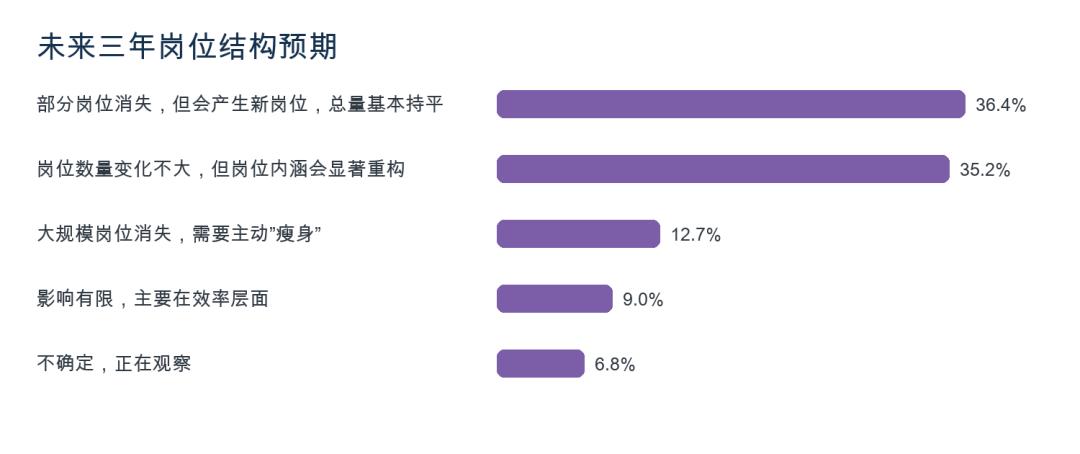
The impact of AI on post structure in the next three years; N=324, single choice
These are the judgments of the respondents, not the employment results that have already occurred. They can neither prove that AI will not lead to layoffs, nor mean that most enterprises have found post transfer solutions. Compared with only discussing the increase or decrease of personnel, what is more worthy of inquiry is how enterprises plan to reorganize work when the original tasks are split.
The cross-border project experience shared by Fang Rangqing provides a specific perspective. This project involves Germany, the United States, Mexico and China, with different links distributed in different countries. When customers encounter problems, design-related problems are transferred to Germany, manufacturing problems to China, and project execution problems to local teams. There are project managers in all regions, but there is a lack of a person who is responsible for the overall global project.
The company therefore promoted the establishment of a global project manager position, requiring the post holder to have cross-cultural communication, global resource integration, coordination and judgment capabilities. This is not a case of AI solving organizational problems, but it illustrates that whether the post setting is reasonable ultimately depends on whether it can assume full responsibilities in real business. AI can speed up data sorting and cross-language communication, but if each team is still only responsible for its own part of the work, customers still need to search for answers back and forth across organizational boundaries. The more tools can undertake decentralized execution tasks, the more worthy it is to reconfigure the judgment and coordination across links.
Talent standards are also changing accordingly. In the questionnaire, learning and adaptability was selected by 55.6% of respondents, interdisciplinary and systematic thinking ability by 51.5%, and human-machine collaboration ability by 44.8%.
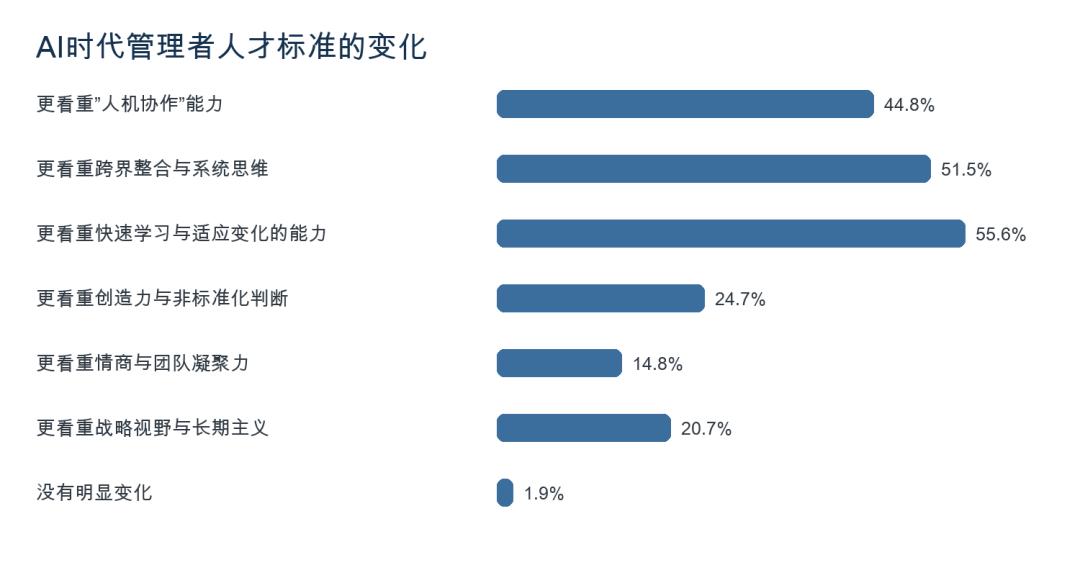
Changes in the most valued abilities of recruitment managers in the AI era; N=324, up to 3 options allowed
Xu Zhengchuan cited the view of Professor Andrew Ng, and summarized the required talent form as "rooted generalist": who can use AI to cross some professional boundaries, and also has his own professional foundation. Without the latter, calling more knowledge may only get more answers that cannot be verified.
This puts forward more detailed requirements for HR than updating JD (job description). Enterprises need to identify which tasks a post contains, which of them can be handed over to machines, which require human-machine collaboration, and which judgments must still be completed by experienced people. Only on this basis can we discuss training, post transfer and recruitment, instead of directly deducing that a post should disappear from the capability of a certain tool.
How can the saved time be converted into organizational capabilities?
AI can enable employees to complete work faster, but whether they are willing to continue to improve depends on how enterprises evaluate and distribute these benefits. Xu Zhengchuan used an assumption in his speech to illustrate this incentive problem: in the past, employees spent three hours to produce an 85-point result; now with AI, they can get an 80-point result in one hour. If improving another 5 points still requires a lot of time investment, and managers cannot distinguish between the two situations, why should employees continue to polish the work?
The problem is not whether employees work hard enough, but whether the original assessment can recognize new contributions. When the quantity of materials and production speed are easy to improve, evaluating performance only with these indicators may encourage more seemingly complete outputs that lack in-depth judgment.
Xu Peiwen, Chief Human Resources Officer of K11 by AC Group, shared the practice of linking the time saved by AI with employees taking on more projects and gaining growth opportunities. She also emphasized that the business of K11 by AC involves art, culture and commercial spaces, and different markets have different cultural contexts. AI can participate in creative generation, but whether the content is suitable for the local market still requires human judgment. This makes the meaning of efficiency different: it is not just to complete the original work with fewer people, but also to allow employees to have time to deal with tasks that they had no time to dig deep into in the past.
Of course, more projects do not automatically equal better growth, and enterprises still need to clarify new work requirements, capability support and returns. Similar incentive problems also exist in knowledge accumulation. Employees have created an effective workflow, how can enterprises make other people use it? If sharing experience means extra input but is not included in performance evaluation, it is difficult for the organization to continuously rely on personal enthusiasm.
Lv Ye, Head of Human Resources of Google Greater China, introduced that the internal HR team can share self-developed workflows or agents for colleagues to use and evaluate, and then the relevant technical team will promote suitable applications to wider internal use, and handle data and compliance requirements. This mechanism connects personal attempts with organizational promotion: employees discover problems and verify methods, while enterprises take responsibility for infrastructure and large-scale application.
Its value is not only to collect more tools, but also to make effective experience not need to be accumulated from scratch every time. At the same time, being popular does not equal safe and reliable; when it comes to employee data, recruitment evaluation or other sensitive decisions, the boundaries of use permissions and human intervention still need to be reviewed separately. In the questionnaire, 39.2% of respondents hope to improve the ability to design and promote organizational change. This means that at least for this group of respondents, HR has realized that their tasks cannot end at teaching employees to use AI.
HR is facing double changes: their own work of screening, analysis and communication is being rewritten, and at the same time they need to assist enterprises to adjust other people's work. The former can start from a scenario and a tool, while the latter requires HR to participate in process design, responsibility division and performance system construction.
There is already a technical answer to whether a report can be generated in two hours. Who can understand it, take actions accordingly, and how the organization supports and evaluates these work, still need managers to give answers.