2026, those pipelines that have been sentenced to "death penalty with reprieve"
September 4, Basel. Novartis' press release, only a few paragraphs long, has drawn a full stop to the last "100-billion-dollar new narrative" in the cardiovascular field: the global Phase III Lp(a) HORIZON study of pelacarsen failed to significantly reduce the risk of major adverse cardiovascular events in patients.
8323 patients, 43 countries, 904 centers, running for nearly seven years. This is the first outcome trial in human history specifically designed to verify whether lowering Lp(a) (lipoprotein(a)) can reduce cardiovascular events. The answer is: Lp(a) was lowered, but the events were not.
In the innovative drug industry, the most expensive failure is never the death penalty. The death penalty is a public announcement with clear loss control, asset write-down, and all parties moving on. The death penalty with reprieve means: on the same target, Amgen's OCEAN(a) trial with about 7300 participants and Eli Lilly's ACCLAIM trial with 16700 participants are still ongoing; more than 30000 subjects around the world have been or are lying on the test beds. Stopping would lead to billions of dollars in sunk costs; continuing means possibly pursuing a question with no answer.
The cold winter of Lp(a) drug R&D has come ahead of schedule. Before the scientific fog is cleared, no rational enterprise will continue to invest billions of dollars to bet on an unproven causal chain.
The harsh reality is that this is just the latest line on this 2026 "death penalty with reprieve verdict". 01
Lp(a): The world's first submitted answer sheet, handed in blank
About 90% of Lp(a) levels are genetically determined, and diet and exercise can barely interfere with it. About one fifth of the global population has elevated Lp(a) levels, and the proportion is nearly one third among patients with premature cardiovascular disease. Both US and European guidelines recommend that adults test their Lp(a) levels at least once in their lifetime. This is a textbook-level target with "genetically validated, huge market, no available drugs". After PCSK9, the cardiovascular field has not seen a second such story for a decade.
The direct consideration Novartis paid for this project: the cooperation was launched in 2017, with a $75 million down payment plus two equity investments totaling $150 million; in 2019, it exercised the option and paid another $150 million in license fee; plus up to $675 million in milestone payments and mid-double-digit to low-20% sales royalties (the total maximum value of this publicly reported transaction was about $1.6 billion back then). Analysts' peak sales forecast for pelacarsen was $2 billion to $3 billion per year.
The trial design is impeccable: 8323 patients with confirmed cardiovascular disease and Lp(a) ≥70 mg/dL (78.6% of whom had Lp(a) over 90 mg/dL), 77.5% received high-intensity statin therapy, with median LDL-C suppressed to 64.6 mg/dL. On top of the optimal background treatment, patients received an 80 mg injection of pelacarsen once a month, and the four-point MACE consisting of cardiovascular death, non-fatal myocardial infarction, non-fatal stroke, and urgent coronary revascularization requiring hospitalization was observed.
As a result, the molecule that could reduce Lp(a) by up to ~80% in Phase II still reduced the index as expected in Phase III, but the hard endpoints did not improve. After the news was released, Novartis' share price plummeted by about 14%, and Amgen, whose pipeline position is further back, also fell by about 10%. The market punished not only Novartis, but the entire track.
This is the precise definition of "death penalty with reprieve": the target has not been falsified, but the hypothesis behind the target has been weakened; no enterprise has announced withdrawal, but every company is recalculating its accounts.
Common clauses of the verdict: All indicators improved, but medicine did not win
If you look at the four FIC outcome trial failures in the cardiovascular field in 2026 side by side, you will see an astonishing set of "common clauses":
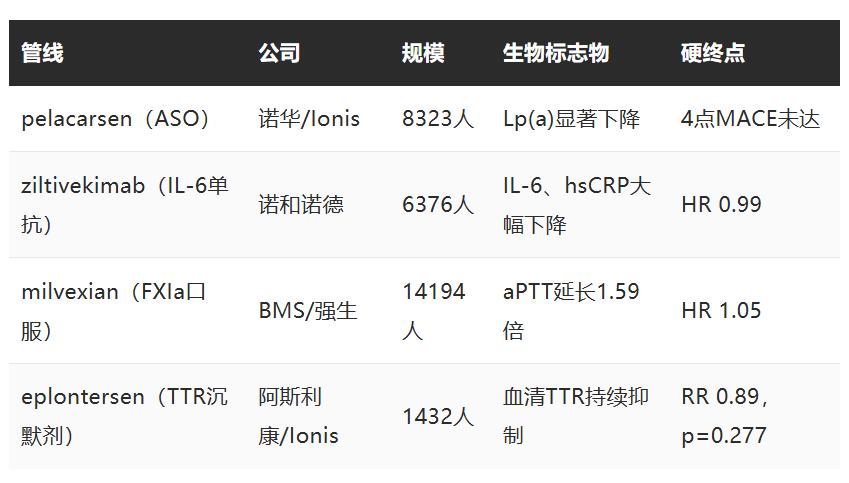
Four molecules, four pathways with completely different mechanisms, ended up with the same fate: Pharmacology won, but medicine did not.
Among them, three "provisions" are worth being included in the due diligence template of every pharmaceutical company:
First, genetic evidence does not equal late-stage reversibility. Genetic studies observe a person's decades of exposure to Lp(a); drug trials reduce the indicator for only a few years after atherosclerosis has already formed. Genes tell you that this river leads to the sea, but they do not tell you that the downstream riverbed has been raised by thirty years of statin treatment.
Second, background treatment has flattened the ceiling. When 77.5% of patients are using high-intensity statins with a median LDL-C of 64.6 mg/dL, the "residual" of residual risk is minimal. In the milvexian study, the 12-month event rate in the placebo group was only 5.1%; any new intervention needs to squeeze out statistical significance from a much smaller base.
Third, the surrogate endpoint is a kind of "compensatory illusion". Lp(a), hsCRP, aPTT, TTR, each of them is a surrogate indicator that has been trusted for many years. In 2026, the entire industry paid the collective bill for "taking the map as the territory".
But why are there still more than 30000 people staying at the table? Because the successful template of PCSK9 proved that this path works — evolocumab reduced LDL-C by nearly 60% and brought a 15% relative reduction in MACE, the chain from biomarker to outcome was never broken.
But the pass of PCSK9 cannot be inherited. Every new target needs to pay its own tuition fee. The biggest suspense on the current track is the "depth threshold": pelacarsen's 80% reduction is not enough, then olpasiran (>95%), lepodisiran (~94%), and even the once-a-year CRISPR (CTX320, Phase I) that reduce Lp(a) even more drastically, are they enough? No one knows.
This is the reprieve of the death penalty with reprieve, and even the evidence for commutation of sentence has to wait another one to three years.
The harsh puzzle: Other routes sentenced to "death penalty with reprieve" in 2026
The 2026 reprieve list is longer than most people imagined.
1. The IL-6 and "residual inflammatory risk" hypothesis.
On July 31, Novo Nordisk's ZEUS study announced results: the 3-point MACE hazard ratio in the ziltivekimab group was 0.99 (0.88-1.11), almost completely overlapping with the placebo group — while free IL-6 and hsCRP decreased significantly as expected.
From the 2017 CANTOS trial (IL-1β, ~15% MACE reduction) to colchicine, "anti-inflammation for cardioprotection" was the closest hypothesis to be verified in the past decade; after ZEUS, the independent data monitoring committee recommended early termination of two Phase III trials, HERMES (~4900 participants) and ATHENA (~680 participants), leaving only the ARTEMIS trial (~10000 participants) in the acute post-MI scenario to continue until the first half of 2027.
This drug was acquired by Novo Nordisk from Corvidia in 2020 for a $725 million down payment and a total value of $2.1 billion, originally planned as "the second leg beyond obesity". Its share price fell by 8.7% on the day. The valuation of the next target, the NLRP3 inflammasome, now also needs to be recalculated.
2. FXIa and the "safe anticoagulation" narrative.
At ESC Munich on August 28, BMS/Janssen announced the full data of LIBREXIA-ACS: among 14194 ACS patients, the MACE incidence in the milvexian group was 5.4% versus 5.1% in the placebo group, with a HR of 1.05. This trial was judged ineffective by the interim analysis as early as November 2025.
The hypothesis that FXI "causes thrombosis without causing bleeding" was once hailed as the holy grail of "next-generation safe anticoagulation". Bayer's asundexian already took the first step in 2023. Now the hope of the entire route is compressed to two final judgments: the unblinding of LIBREXIA-Stroke in October and LIBREXIA-AF in the first quarter of 2027. The safety profile is confirmed (intracranial/fatal bleeding 0.3% vs 0.3%), but "no bleeding" cannot be automatically exchanged for "no thrombosis".
3. The "stacking strategy" for ATTR-CM.
On July 9, AstraZeneca/Ionis' eplontersen did not meet the primary endpoint in the CARDIO-TTRansform trial (1432 participants, 140 weeks): RR 0.89, p=0.277.
The subtlety is that 57% of patients used tafamidis stabilizer as background treatment (this proportion rose to about 80% at the end of the trial) — in the pre-specified subgroup, the HR of the monotherapy group was 0.71, with nominal significance. Alnylam's vutrisiran (HELIOS-B) on the same route has already proved in 2024 that TTR silencing can improve ATTR-CM outcomes, so this is not the death of the target, but the reprieve of the strategy of "stacking new treatment on top of standard treatment".
4. HTT silencing for Huntington's disease.
On the same day of July 9, Roche terminated the development of tominersen: in the GENERATION HD2 study, the level of mutant huntingtin protein decreased significantly, but there was no benefit in functional, cognitive and motor endpoints after 16 months of treatment.
The biomarker endpoint was met but there was no clinical benefit, which was announced on the same day as eplontersen, sharing the same fate. This is the second reprieve for the huntingtin silencing route in a decade (the GENERATION HD1 trial already failed once in 2021).
5. KOR antagonists and depression.
Neumora's navacaprant failed to meet the primary endpoints in all three Phase III trials KOASTAL-1/2/3. Previously, Janssen's aticaprant targeting the same target had already exited due to insufficient efficacy. "The value of the mechanism is being fundamentally questioned" — one of the most popular branches of new mechanism R&D for depression has now entered the target cemetery.
6. The ADC gold rush cools down.
Pfizer acquired Seagen for $43 billion in 2023, and on June 22, 2026, it ushered in the first key readout: sigvotatug vedotin (integrin β6 ADC) failed to demonstrate better overall survival than docetaxel, which has been on the market for nearly 30 years, in 703 pretreated non-squamous NSCLC patients in the SigVie-002 trial.
This is the latest wound in Seagen's asset pipeline: felmetatug vedotin (terminated in February 2025), the vidisertumab bladder cancer program was downgraded with a $1.6 billion impairment, CD228 ADC (March 2026), and tisotumab vedotin for cervical cancer (April 2026) were successively cleared out.
In the same period: Gilead's Trodelvy suffered two consecutive defeats (ASCENT-07 missed PFS, EVOKE-3 was recommended for termination); ADC Therapeutics' Zynlonta met the PFS endpoint in LOTIS-5 (6.1 vs 4.7 months) but there were 27 deaths in the trial group versus 9 in the control group, the share price plummeted by nearly 60% in a single day, followed by a 17% layoff; AstraZeneca's PD-1/CTLA-4 bispecific antibody volrustomig was inferior to Keytruda plus chemotherapy in PD-L1 low-expression NSCLC, and IDMC recommended termination; Novartis' TIM-3 antibody sabatolimab missed the OS endpoint and exited, while Eli Lilly, Roche, BMS, and AstraZeneca had already collectively cut their TIM-3 programs.
ADC is not a dead end — there were more than 400 ADC-related abstracts at 2026 AACR — but the overall clinical failure rate of ADCs is about 80%, and the valuation narrative of "benchmarking DS-8201" is being systematically discounted.
7. Strategic reprieve for "muscle preservation + GLP-1".
Eli Lilly's bimagrumab, acquired for a total price of nearly $2 billion, delivered stunning data in the Phase II BELIEVE trial (507 participants, 72 weeks, published in Nature Medicine in March 2026): in combination with semaglutide, it achieved 22.1% weight loss, 92% of the weight loss came from fat mass, and lean body mass only decreased by 2.9% (compared with 7.4% for semaglutide monotherapy), and the lean body mass in the monotherapy group even increased by 2.5%.
But in September 2025, Eli Lilly terminated its Phase IIb trial in the population of obesity combined with diabetes, citing "strategic commercial reasons"; the FDA also released a signal: improvement in body composition alone is not sufficient to support approval, and incremental weight loss on top of GLP-1 needs to be proved.
Regeneron's COURAGE triple combination group retained 81% of lean body mass, at the cost of a 28.3% treatment discontinuation rate and 2 deaths. The mechanism is valid, the data is excellent, but the commercial calculation does not add up: this is a reprieve ruled by regulatory economics.
8. Regulatory reprieve: Anti-amyloid drugs in Europe.
On March 28, 2025, CHMP issued a negative opinion on Eli Lilly's donanemab: the 35% slowdown in cognitive decline is not sufficient to cover the risk of ARIA (cerebral edema/microbleeding); previously aducanumab was rejected, lecanemab was overturned and approved, and in March 2026 Anavex's blarcamesine simply withdrew its EU application. Anti-amyloid drugs that are advancing rapidly in the US market are in a state of overall regulatory reprieve in Europe.
How the reprieve list rewrites the valuation of Chinese pharmaceutical companies
This verdict is much closer to Chinese assets than it seems.
1. Lp(a) is one of the most densely targeted targets for Chinese innovative drug BD, and milestone clauses are becoming "outcome-bound".
In March 2025, Hengrui Pharmaceuticals out-licensed the Greater China ex-rights of its oral small molecule HRS-5346 to Merck: $200 million down payment, up to $1.77 billion in milestones, with a total value of about $1.97 billion; in February 2026, this drug obtained CDE breakthrough therapy designation, and in late August, Phase II data was presented at the LBA session of the ESC annual meeting (the maximum Lp(a) reduction of 86.3% at week 12 in the 240 mg group).
Shijiazhuang Pharmaceutical Group out-licensed the oral small molecule YS2302018 discovered on its AI platform to AstraZeneca for a total value of about $2.02 billion, and its self-developed siRNA SYH2068 has entered Phase II. Kylo-11 from China Biopharma (Hugia) had its final Phase I data published in *The Lancet* in August this year: a single administration achieved a maximum median Lp(a) reduction of 97% at week 48, and Phase II is being advanced in both China and the US.
In addition, there are Bogen