The new policy issued on August 28 has not yet been implemented, and real estate projects in many regions across the country are already planning to raise prices.
Before the implementation rules for the real estate "828 New Policy" are rolled out at the execution level, a number of new residential properties in multiple cities across China are preparing to raise prices.
1
New property projects in multiple regions release price hike promotions
On September 9, China Resources Land Shaanxi announced that it will uniformly withdraw the previous approximately 2% discount for all available properties for sale starting from September 14. It is the first real estate enterprise in Xi'an that officially announced a price hike after the new property market policy on August 28, triggering widespread market attention.
China Resources Land's current available projects in Xi'an mainly include Wang Yun, Shiyuan Run Fu, Gang Chen Run Fu, Xi Chen Shang Yuan and others. However, apart from China Resources Land's announcement of withdrawing discounts, no other real estate enterprises have followed up to raise prices. According to CRIC statistics, as of July 2026, the inventory of new residential properties in Xi'an is about 181,700 units, with a de-stocking cycle of about 38.8 months, and there is no market driving force for widespread price hikes at present.
Different from the sporadic price hikes in Xi'an, Chengdu has become the city with the most concentrated actions in this round. According to public information released by various real estate enterprises and projects, after the release of the 828 New Policy, more than 20 projects in Chengdu have announced the withdrawal of discounts, including all 13 property projects under Jiaxing Xing Real Estate, 2 projects of Yuexiu Property, 3 projects of CTG Investment, Western Jinsha Luda and Zhengcheng · Honglu Academy, etc., with the discount withdrawal range concentrated at 1% to 2%.
On September 1, Jiaxing Xing Real Estate, a leading local real estate enterprise, issued an official notice that starting from September 15, all its available, pending-sale and remaining inventory projects will withdraw the 2% sales discount; the document also stipulates that customers who complete subscription and contract signing before September 15 will keep the original discount unchanged. The person in charge of Jiaxing Xing Real Estate said bluntly in an interview with the media that the new policy extends the capital occupation cycle and raises the comprehensive financial cost of projects, which is the core reason for adjusting the discount policy.
However, the Chengdu market is also internally differentiated. Some projects of Poly Sichuan still retain promotion policies in the same period, and high-inventory properties in outer suburbs still maintain the strategy of exchanging price for sales volume, instead of tightening discounts uniformly across the city.
Hefei market has also seen cases of batch discount withdrawal. More than 20 property projects across the city have successively reduced discounts, most projects have a withdrawal range of 1% to 2%, and still retain a small amount of promotion space. Among them, two projects, Tianfu Qinglan Yuhua and Yihe Honglu, directly cleared all discounts and sold properties at the record price, which is the most intense individual case in this round of the market.
From the perspective of the fundamental relationship between supply and demand, the inventory in the main urban area of Hefei is relatively low. At the end of August, the overall de-stocking cycle of new residential properties was only 11.6 months, and the de-stocking cycle of the Economic Development Zone was about 5 months. The supply of high-quality properties is scarce, which provides a basis for developers to adjust price strategies. Popular improvement-oriented properties such as Zhonghai Guan Lu Fu, Baichuan Xu An Lan Fu, and Gaosu Shang He Yuan have also joined the ranks of withdrawing discounts.
Hangzhou has seen a small number of cases where the record price is directly raised. The 14 buildings of Poly Tianyi that newly applied for the pre-sale permit on September 1 have an average hardcover price of 36,538 yuan/㎡, which is about 1,000 yuan/㎡ higher than the record price of the previous batch. However, this price adjustment only applies to the newly launched properties, and the record price of the existing properties that have obtained pre-sale permits remains unchanged. It belongs to the pricing adjustment in the permit obtaining stage of new projects, rather than a direct price hike of old properties already on sale.
In Shanghai, three projects under Poly, namely Poly Dou He Xu He, Poly Jun Yuan, and Poly Hongqiao He Zhu · Jing An, raised the selling price of newly permitted buildings by 1%, which only applies to the 97 newly launched properties, concentrated in the total price range of 5 million to 6 million yuan; the existing properties that have obtained pre-sale permits maintain the original price system.
A large number of "price hike notices" have also appeared in Guangzhou market. Price adjustment posters of projects such as Poly Hai Yun, Guomao Xue Yuan, and Xiguan Jinmao Jin Tang claim that the project price will be raised by 1% to 2%. However, most of these promotional posters come from intermediary channels with strong marketing hype attributes, rather than official price adjustment announcements from real estate enterprises.
Tianjin also saw new properties quickly follow up with price hikes. The poster of Jiantao Aoyu Yuan has two large words "Price Hike" written on it, claiming that the price of all properties will be increased by 3% starting from September 1; many projects including CCCC Hai He Xi, Greentown Yu Bai He, Ti Bei Jin Mao Fu, and Gemdale Hai He Jiu Li all released posters claiming that the price is increased by 1% to 3% respectively.
At present, among the key cities with high attention, only Beijing and Shenzhen have not seen widespread price hike promotions.
2
Why does the wave of discount withdrawal appear?
The 828 New Policy systematically reconstructs the industry operation system from all dimensions including land supply, pre-sale rules, mortgage lending, capital supervision, and development financing, ending the high-leverage and high-turnover development mode that has been used for more than 20 years, and starting a new operating logic for the real estate industry. However, when transmitted to the market side, the first reaction of real estate enterprises is to "raise prices", mainly for two reasons:
First, it is the prediction of changes in the relationship between supply and demand. According to the requirements of the 828 New Policy, a project can only be pre-sold after the main structure is capped, which means the sales node of the project will be delayed by about one year. If the newly supplied land is implemented in strict accordance with the new policy, the supply of new residential properties will be significantly interrupted during the one-year transition period between the old and new rules, and the supply of new residential properties in the market will drop sharply.
It is not only the change of pre-sale nodes that leads to the decline of new residential property supply, but also the willingness of real estate enterprises to acquire land. According to CRIC statistics, in the first week after the release of the new policy, the total construction area of residential land supply in 50 key cities across the country was 3.82 million square meters, a month-on-month decrease of 29.9%, with an average premium rate of 5.0%, which is lower than the weekly average level of 9.2% since this year. After the implementation of the new policy on August 28, the number of high-premium plots decreased significantly, the number of bidding rounds shrank as a whole, and the bidding rhythm of real estate enterprises slowed down obviously.
The decline in land transaction volume will directly lead to the reduction of new residential property supply in the future. Even if the land supply side does not reduce the volume, due to the higher threshold for land acquisition and higher requirements for real estate enterprises' own funds, the number of real estate enterprises that have the strength to acquire land in many places across the country will also drop significantly, and the number of developers in the market will decrease.
On the other hand, the new policy will change the payment collection rhythm of projects, extend the capital occupation cycle, and the financial cost of real estate enterprises will inevitably rise substantially, which leads to real estate enterprises being more "reluctant to sell" their existing high-quality inventory projects. The new policy clearly stipulates that the personal housing loan for pre-sold properties can only be issued by the bank after the project is completed and filed. The early-stage land, construction and installation, and management costs of the project all require continuous investment from the real estate enterprise's own funds or development loans, the capital precipitation time increases significantly, and financial interest continues to accumulate. Chengdu Jiaxing Xing Real Estate listed the rising cost as the primary reason for withdrawing discounts in its official notice, which also confirms that the rise in capital cost has been included in the pricing decision-making of real estate enterprises.
In the long run, the 828 New Policy is a re-regulation on the supply side, but the short-term effect is to further destock, which may lead to a reversal of the market supply-demand relationship in the next 2 to 3 years.
This round of price hikes in the form of discount withdrawal is the result of the superposition of three factors: short-term marketing expectation, mid-term supply contraction and long-term cost rise.
How intense the disturbance of the new policy implementation to the market is remains to be seen. However, the new policy has arrived.
In September, Xiamen, Guangzhou and other places have begun to include completed-property sales and capped pre-sales in the transfer conditions of new plots in accordance with the requirements of the new policy. For example, on September 3, Xiamen announced two plots of land 2026P13 and 2026XP07, which are located in the island and outside the island respectively. In accordance with the principle of implementing policies based on local conditions, differentiated housing sales management is implemented. Among them, the 2026P13 plot located in the island implements completed-property sales, and the engineering image progress standard is: the project has completed the completion acceptance, and the first registration of the house has been processed. The 2026XP07 plot located outside the island can implement pre-sales. The engineering image progress standard is: the funds invested in the development and construction of the project reach more than 25% of the total investment of the project, and the main structure of the single building is capped.
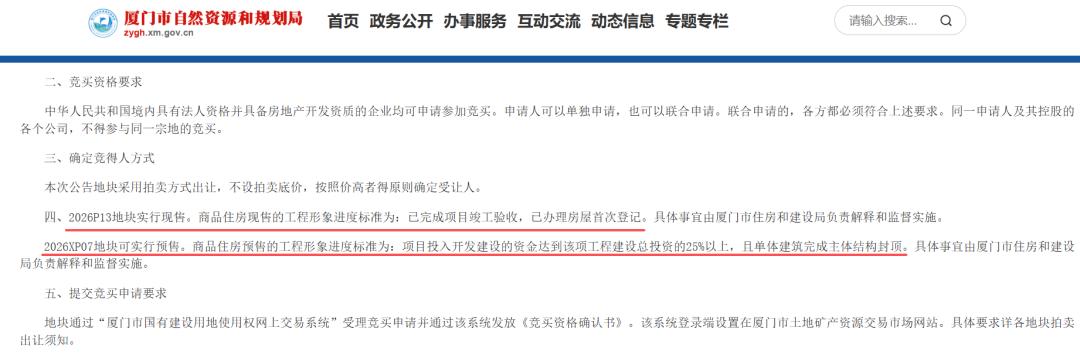
Announcement
Chen Zhi, Vice President of Beijing Real Estate Association, said that the 828 New Policy is not a "sudden move". The discussion process lasted for nearly a year from putting forward relevant suggestions to determining the policy content. The original intention of the new policy is in the same line with the logic of the previous sales capital supervision policies, which is to protect consumers, and the new policy will definitely enter the implementation and execution stage.
Then, will the "price hike wave" last? It will probably be difficult.
On the one hand, in major cities across the country, the substitution effect of second-hand residential properties on new residential properties is obvious, especially the transaction volume of second-hand residential properties in Beijing and Shanghai is more than 4 times that of new residential properties. The transaction volume of second-hand residential properties in Chengdu is more than twice that of new residential properties.
On the other hand, once there is the expectation of completed property supply, who will pay for the rising off-plan properties?
At present, the "price hikes" in Chengdu, Hefei, Shanghai and other cities are mainly "withdrawing marketing discounts", and only a few high-quality individual projects in Shanghai and Hangzhou have seen tentative price hikes. Real estate enterprises use the expected changes brought by the new policy to create a sense of urgency, and push waiting customers to place orders faster, which is a common forced-order marketing technique in the real estate industry.
Chen Zhi said that even without the introduction of the completed property sales policy, in some regional markets, some projects have gradually become completed properties while being sold. What real estate enterprises need to do is to face up to the market, re-sort out the accounting logic, and figure out whether they will continue to operate in the development industry in the future.
This article is from the WeChat official account "Future Habitable", written by Xiao Wu Jian Da Wu, and authorized for release by 36Kr.