The First Year of Mass Production, Who Is Racing Ahead? — The Initial Landscape of the Two Major Giants in China's Humanoid Robot Industry
In July 2026, the Ministry of Industry and Information Technology released a signal at the WAIC press conference: China's total output of humanoid robot complete machines is expected to exceed 100,000 units this year — compared with the total global shipment of about 18,000 units in 2025, of which domestic complete machines accounted for about 14,000 units, this is a leap of more than 5 times. Humanoid robots have officially moved from "exhibition prototypes" to "the first year of large-scale mass production". On this track, Chinese companies are far outperforming their European and American peers on the most simple and most solid indicator of "shipment volume".
From "concept" to "production capacity", there is the most brutal moat in between: whether it is possible to mass-produce a machine composed of thousands of parts that can run stably for thousands of hours in real scenarios with acceptable yield and cost. Before 2025, the humanoid robot industry was talking about "who has more stunning parameters and who has more dazzling demos"; in 2026, the subject of the story has been replaced by "who delivered thousands of units, what the yield is, and how many hours the customer has run on site". This shift of the subject precisely hits the muscle memory that China's manufacturing industry is best at — supply chain, engineering, cost reduction, and volume scaling.
If we condense the current embodied intelligence in China into a picture, the clearest outline is "duopoly" — Unitree and Agibot together account for nearly 75% of global shipments (in the first half of this year); followed by differentiated players such as UBTECH and Fourier Intelligence. Let's take a look one by one.
Unitree Technology: The "Global Sales Champion" of Motion Control, Officially Listed on A-Share Market
Unitree is the company in this wave that most resembles the "business card of Chinese robots". It started with quadruped robots, became famous for "making robotic dogs available at consumer-grade prices", and then smoothly entered the humanoid robot track, bringing the gene of "motion control + extreme cost-effectiveness" all the way to the humanoid circuit.
On August 19 this year, Unitree Technology was officially listed on the Sci-Tech Innovation Board of the Shanghai Stock Exchange with the stock code "688836.SH". The issuance price is 150.80 yuan per share, corresponding to a market value of about 60.993 billion yuan after issuance. On the first day of listing, it opened at 1100 yuan per share, an increase of 629.44%, and the total market value once reached 444.9 billion yuan; it closed at 845 yuan per share, with a turnover of 23.16 billion yuan and a total market value of 341.8 billion yuan. Currently, the company's market value has fallen back to about 270 billion yuan. It only took about five months for Unitree Technology from the IPO being accepted on March 20 to the official listing on August 19, setting a record for the "first humanoid robot stock" in the A-share market.
In terms of performance, the company achieved revenue of 1.699 billion yuan in 2025 (+335%), non-recurring profit and loss deducted net profit of 591 million yuan, and gross profit margin of main business of 60.13%; the shipment of humanoid robots exceeded 5,500 units, ranking first in the world. In the first half of 2026, it achieved revenue of about 1.152 billion yuan, a year-on-year increase of 48.54%; net profit attributable to owners of the parent company was 274 million yuan, turning year-on-year loss into profit. Its revenue increased from 123 million yuan to 1.7 billion yuan in three years, about 14 times — this growth curve almost reproduces the most classic "volume scaling - cost reduction - profitability" path of China's manufacturing industry.
In terms of capital, founder Wang Xingxing directly holds 21.44% of the shares after issuance, and controls a total of about 65.31% of the voting rights of the company through a special voting rights arrangement. Its shareholder lineup includes institutions such as DeepSeek, Tencent, National Council for Social Security Fund, PetroChina Kunlun Capital and other institutions. Its moat is that the self-developed and self-produced rate of core components exceeds 90% — motors, reducers, controllers, and LiDAR are all fully independent and controllable. Overseas orders accounted for half of its total orders in 2025, and as of July 2026, the cumulative off-line production of bipedal humanoid robots reached about 18,000 units.
Unitree's development strategy reveals an industry truth: the first humanoid robot to achieve commercial success may not be the "smartest" one, but the most "durable, cheap and easy to repair" one.
Agibot Robotics: The "Hidden Champion" of Mass Production Speed
Agibot is the "fastest runner" in the duopoly. Its label is "embodied intelligence" — it does not just build a walking machine, but enables the machine to continuously become smarter through data in real tasks. This positioning gives it an additional "data flywheel" imagination beyond mass production.
According to data released by Counterpoint Research in August 2026, global shipments of humanoid robots exceeded 22,000 units in the first half of 2026, a year-on-year increase of nearly 300%. Among them, Agibot ranked first in the world with shipments of about 9,700 units, with a market share of over 43%. Agibot is currently advancing towards the goal of achieving revenue of over 10 billion yuan in 2027. Different from Unitree's "motion control + consumer-grade volume scaling", Agibot is more focused on "industrial scenarios + loading and unloading in 3C/automobile production lines". Its G2 series has achieved cluster deployment in consumer electronics and auto parts production lines through cooperation with Longcheer Technology and Joyson Electronics.
In terms of capital, Agibot reached a valuation of 15 billion yuan after completing its financing in May 2025. In July 2026, Agibot announced the launch of the Hong Kong stock listing process, with the target valuation given by cornerstone investors ranging from 40 billion to 50 billion Hong Kong dollars. Its shareholders include GL Ventures, BYD, Tencent, JD and other institutions. Agibot bets on the most pragmatic commercialization path of "robots entering factories": tasks in factory scenarios are standardized, customers have clear willingness to pay, and have high tolerance for robots that are "a little less intelligent but more stable" — humanoid robots may make profits in factories earlier than in households.
UBTECH: Commercialization Catch-up of the "First Humanoid Robot Stock" on the Hong Kong Stock Exchange
UBTECH (09880.HK) is the earliest humanoid robot benchmark in the capital market. It was listed early and has a great reputation, but it is also a typical example of "first mover catching up" — it took the lead as the "first stock", but was overtaken by rising stars in terms of shipment volume, and is making up for the "scale" lesson with scenarios and reputation.
In 2025, UBTECH achieved revenue of 2.001 billion yuan (+53.3%), with a net loss of 790 million yuan (31.9% narrower than the 1.16 billion yuan loss in 2024); the revenue of full-size embodied intelligent humanoid robots reached 820 million yuan (+2203.7%), accounting for 41% of total revenue. Walker S focuses on industrial practical training, and has reached cooperation with many auto companies to enter automobile factories to carry out practical training of quality inspection and assembly. In the first half of 2026, UBTECH ranked fourth in the world, with humanoid robot deliveries reaching the thousand-unit level, accounting for 4.4% of the market share. The 2026 shipment guidance of the Walker S series has been significantly raised from the initial 2,000-3,000 units to 5,000 units. The pre-sale orders of the household model U1 reached 13,600 units, which are planned to be delivered in 2026.
Its shortcomings are also obvious: it is still in a loss-making state, and the shipment volume of humanoid robots lags behind Unitree and Agibot; but it has the advantages of early listing and full scenario coverage (automobile factories, government and enterprise exhibition halls, households), with a market value of about 40-54 billion Hong Kong dollars, making it one of the few targets in the sector that can speak with public financial reports. The value of UBTECH lies in its "benchmark effect": it has exchanged years of losses for brand, channels and cross-scenario verification. Once the proportion of humanoid robot revenue continues to increase and losses are further narrowed, it may still be the most convenient "humanoid robot pricing anchor" in the capital market.
Fourier Intelligence: The "Differentiated Player" That Crosses From Rehabilitation To Elderly Care Humanoid Robots
Fourier Intelligence takes a more vertical path — crossing from rehabilitation robots to humanoid robots. Its starting point is not "showing off technology", but real medical demands: exoskeletons and rehabilitation robots have been deployed in hospitals and elderly care institutions, accumulating a large amount of engineering experience in "human-robot contact, safety, long-term reliability", which are exactly the areas where consumer-grade humanoid robots are most likely to fail.
Fourier Intelligence was founded in 2015. In early 2025, it completed Series E financing with investors including SoftBank, Vision Plus Capital, Qianhai Mother Fund, IDG Capital and other institutions. In August 2025, it completed Series E+ financing with a valuation of about 8 billion yuan. Its GR series focuses on elderly care scenarios and has been deployed in hospitals and nursing homes; in 2025, it also launched the N1 small open-source humanoid robot, trying to leverage the developer ecosystem with "open source". Outside the duopoly of Unitree and Agibot, it has secured a differentiated position with "elderly care + open source", avoiding direct volume competition and retaining its own ecological niche.
Who Else: "Potential Rising Stars" Outside The Echelon And The Supply Chain Base
Outside the duopoly, China's embodied intelligence echelon is stratifying rapidly. Galaxea General accumulated shipments of over 1,100 units in the first half of the year, with a market share of about 5%, ranking third in the world; UBTECH ranked fourth, accounting for 4.4% (as mentioned above); Leju Robotics shipped 650 units, accounting for 2.9%. The top five manufacturers are all Chinese enterprises, together accounting for 86% of the total global shipments. Galaxea General, Star Era, Leju, Magic Atom and other players are mostly differentiated in vertical scenarios such as scientific research and education, industry, and retail, trying to find their own niche markets under the shadow of giants.
What is more worth mentioning is the "base" — China's ability to achieve volume scaling on this track does not only depend on complete machine manufacturers. As the leading OEM/ODM of complete machines, Lingyi iTech's orders exceeded 1 billion yuan in 2026, and 5,000 units have been delivered; further upstream, the localization rate of core components such as harmonic reducers and servo motors has exceeded 70%. The significance of these figures is that when core components are no longer restricted and costs are reduced, complete machine manufacturers have the confidence to push prices to the range that customers are willing to purchase in batches. The advantage of China's manufacturing industry has never been that a single company has dazzling technology, but that "once the supply chain is running smoothly, the cost reduction curve will not stop".
The "Economic Threshold" of Mass Production: Why Volume Scaling Is More Difficult Than Showing Off Technology
There is a deliberately avoided truth in the humanoid robot industry: the "backflip" in the demo video is worthless, and "running continuously for 2000 hours without downtime" in the factory is valuable. From prototype to mass production, three economic thresholds need to be crossed.
The first one is yield. The complete humanoid robot is composed of hundreds of functional components in series, and the yield shortboard of a single link will be exponentially amplified through the system coupling effect. Even if the yield of a single part reaches 99%, the comprehensive qualified rate of the complete machine will be significantly attenuated after accumulation of multiple links. The premise for Chinese manufacturers to dare to shout the "10,000-unit level" is that the supply chain yield has been repeatedly polished. The second one is unit economics. According to the current BOM (bill of materials) estimation, the cost of a functional humanoid robot is still calculated in hundreds of thousands of yuan, while the annual salary of the blue-collar worker it replaces is often lower — unless the cost is reduced to tens of thousands of yuan through self-developed components and scale effect, "replacing human workers" is not cost-effective on the books. The third one is operation and maintenance. Selling robots is not the end of the business, but remote upgrade, on-site maintenance and data recycling are required. This service system itself is a heavy asset business.
Because of these three thresholds, the "duopoly" pattern in 2026 is actually a kind of "survivorship bias": the reason why Unitree and Agibot take the lead is not that they released products first, but that they first got through the triangle of "yield + cost + operation and maintenance". This also explains why UBTECH is still highly favored by capital even if its shipments lag behind — the channels and cross-scenario verification it obtained through years of losses are intangible assets that latecomers cannot quickly replicate.
China-US Comparison: China Focuses On "Volume", While Europe And The US Focus On "Price"
Looking at the global market, the most thought-provoking contrast of humanoid robots in 2026 is the dislocation between "volume" and "price". Chinese manufacturers are crushing in terms of shipment volume — the top five are all Chinese enterprises, together accounting for 86% of the global market share; while European and American companies hold higher valuations and more famous brands, with Figure valued at 39 billion US dollars, Apptronik at 5.5 billion US dollars, and Agility at 2.5 billion US dollars, most of them are still stuck at the "thousand-unit level" deployment.
This dislocation has structural reasons. China has the most complete hardware supply chain in the world, the most mature OEM system, and the most willing manufacturing customers who "use robots first" — 3C and automobile production lines have extremely high acceptance of robots that are "a little less intelligent but cheap". Europe and the United States rely more on "technical prestige + capital narrative", customers have higher requirements for reliability, safety and compliance, so the pace of mass production is naturally slower. In short: China exchanged "manufacturing genes" for volume, while Europe and the United States exchanged "capital and brand" for price. Which route will win in the end depends on who can first prove "mass production means profitability" in 2027.
A Table To Clarify The Four Leading Players
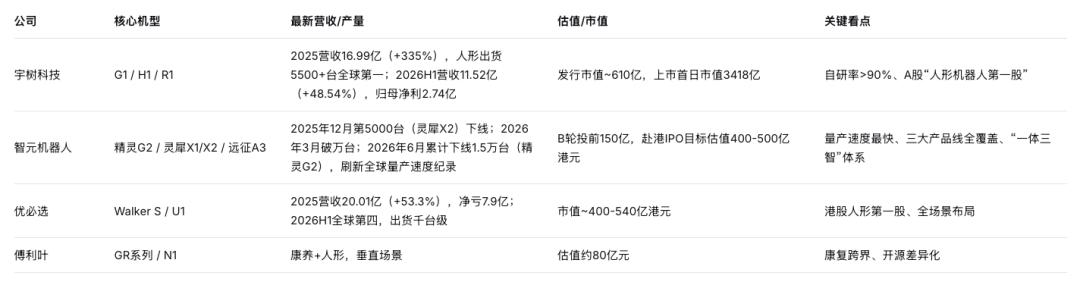
2026 is called the "first year of 100,000-unit level mass production" of humanoid robots, but under the prosperity, differentiation has already occurred. Unitree and Agibot defined the "duopoly" by shipment volume, UBTECH maintained its benchmark status by listing position, and Fourier Intelligence and other players found their own way out in vertical scenarios. Lingyi iTech and a large number of component manufacturers are pulling the cost curve down — this is the most critical confidence of Chinese-style volume scaling.
The real exam will be from the second half of 2026 to 2027: when the production capacity rushes from 10,000 units to 100,000 units, whether the unit economy can turn positive, whether the utilization rate data can be disclosed, and whether the failure rate in real scenarios can be suppressed to an acceptable range — these are the hard indicators that determine who will stay and who will exit. The current popularity cannot cover up the potential reality of "losing money for every unit sold"; only when a company can prove that "mass production means profitability", the duopoly pattern can be truly stabilized.
The fact that makes Chinese companies proud is that this time, China is leading in the matter of "who first truly delivers mass-produced robots". Counterpoint Research predicts that the global shipment of humanoid robots will exceed 50,000 units in 2026, a year-on-year increase of 210%. Europe and the United States hold relatively higher valuations and more famous brands, but they show a subtle embarrassment in front of the shipment volume of Chinese manufacturers — they tell the biggest stories, but deploy the least number of products. In this race of "who can first send robots into factories",