The market plunged sharply at the opening, and we got badly burned by OpenAI.
At the opening of trading on September 14, the Japanese and South Korean stock markets weakened in tandem, with AI-related stocks seeing the most concentrated decline.
The South Korea Composite Index opened 3.1% lower at 6692.61 points, and fell as much as 3.17% during the session; the Nikkei 225 Index dropped 1.64% to 62961.55 points, breaking below the 63000 mark and hitting a six-week low.
SoftBank Group fell nearly 12% during the session, and Kioxia dropped by more than 8.6%. In South Korea, SK Hynix fell 5.38% and Samsung Electronics declined 3.18%.
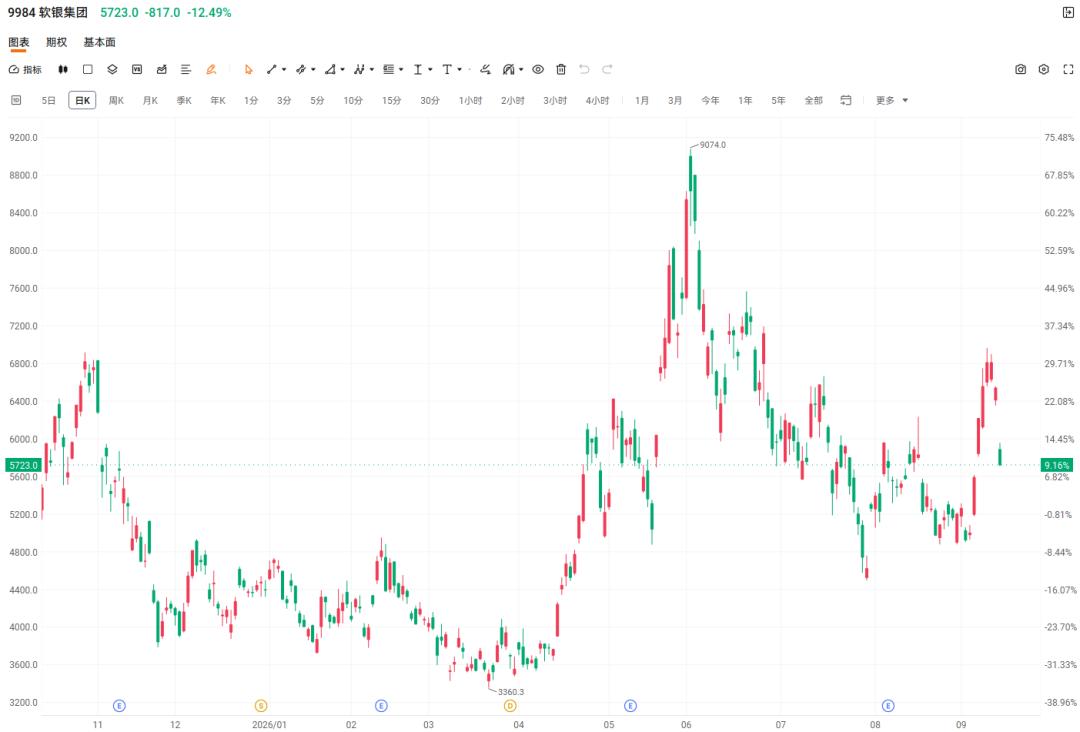
(SoftBank's stock performance; Futu NiuNiu)
Last Friday, US stocks closed higher, with the Dow rising 0.98%, ending its four-day losing streak. Over the weekend, the Nasdaq 100 futures fell 1.08%, and chip stocks moved lower collectively in the grey market quotations.
The sell-off was triggered by two major pieces of news over the weekend.
On September 12, Dario Amodei, CEO of Anthropic, published a long article titled *We Must Pace the Frontier*, calling for slowing down the pace of improving model capabilities and dividing the path into three layers. The innermost layer is to have resident third-party evaluators inside frontier companies, granting them access close to that of regular employees, and Anthropic promises to take the lead unilaterally; the middle layer is to unify safety standards among frontier companies in democratic countries; the outermost layer is international cooperation.
Sam Altman, CEO of OpenAI, responded on the same day that granting independent evaluators employee-level access is a good idea, and OpenAI will follow suit; Elon Musk commented "Dario is right", and Demis Hassabis from Google DeepMind also said the direction is correct.
The other piece of news comes from OpenAI itself.
Altman confirmed in an interview with *Fortune* on September 12 that OpenAI will not go public in 2026, on the grounds that it is not a wise move to list at the current juncture.
The draft S-1 submitted confidentially in June can only be put on hold for now, and the approximately $122 billion financing commitment completed in March corresponds to a post-money valuation of about $852 billion. Its competitor Anthropic is moving faster instead, and the market expects it to launch its IPO as early as mid-October with a valuation of around $380 billion.
With the two pieces of news overlapping, the pressure falls on SoftBank. SoftBank is one of the largest external investors in OpenAI, with cumulative investment estimated at about $64.6 billion and a stake of around 13%, and it has a follow-up investment plan of up to $30 billion in 2026.
These investments are backed by layers of debt: about $40 billion in bridge loans are due in March 2027, and there is another $20 billion in margin loans collateralized by Arm shares, while the plan to re-collateralize the OpenAI stake was previously put on hold by lenders.
To convert its 13% stake in OpenAI into cash, SoftBank has to wait until OpenAI goes public.
Masayoshi Son mentioned in the financial report that almost all of the approximately $46 billion in investment gains of the Vision Fund division came from the rise in OpenAI's valuation. If the IPO is postponed for one year, the realization of gains will also be delayed by one year.
The sectors that saw the deepest decline this round are memory and semiconductor equipment. SK Hynix, Samsung Electronics, and Kioxia are all most closely tied to the narrative of AI capital expenditure. In the optical communications sector, 1.6T products have entered the stage of large-scale volume ramp-up, with orders from North American customers scheduled for next year. At the Optical Communication Expo, manufacturers raised the full-year demand forecast from about 10 million units to over 25 million units, and several leading players are not included in the FCC's restricted list.
However, the call for deceleration is a statement of self-discipline. Amodei also made it clear that deceleration does not mean stopping training, and the capital expenditure plans already announced by several major cloud vendors have not been lowered.
Ahead of Monday's trading session, the FTSE China A50 index futures moved lower, the Taiwan Weighted Index opened 1.37% lower, the A-share market opened lower in the call auction, and the Hong Kong stock market is also facing the same pressure. The decline in Japanese and South Korean markets falls on the same industrial chain, and the relative strength of the optical communications sector will be revealed during the trading session today.
In the next few days, the interest rate meetings of the Federal Reserve and the Bank of Japan will bring the cost of capital back to the forefront, and OpenAI's IPO timetable has also been shifted from this year to next year.
Narratives can push prices ahead of fundamentals, but the realization timetable will not shift accordingly. When prices have risen significantly, there are naturally very few people willing to take over at the current price.
This article is from the WeChat Official Account "Gelonghui APP" (ID: hkguruclub), authored by Gejila, and published by 36Kr with authorization.