The most hyped track of last year has crashed.
Looking back on last year, the most popular track in the new consumption sector was none other than the pet industry.
Labeled as a "counter-cyclical track", it is backed by 126 million urban dogs and cats, a 312.6 billion yuan consumer market, and an annual compound growth rate of 8.6%. Coupled with the social sentiment that "young people choose to raise cats instead of having children", the pet sector has almost become "the last blue ocean of new consumption".
The narrative in the capital market is so attractive that it seems almost unassailable.
From the end of 2024 to the middle of 2025, the stock prices of the three leading players soared sharply: China Pet Co., Ltd. rose by nearly 300%, Guabao Pet rose by nearly 200%, and Petpal Co., Ltd. rose by more than 60%.
But this year, the plot took a sharp turn for the worse.
The share price of Guabao Pet plummeted from around 115 yuan to the 36 yuan range, with a maximum drop of nearly 70%, and its market value shrank from over 48 billion yuan to 16.4 billion yuan.
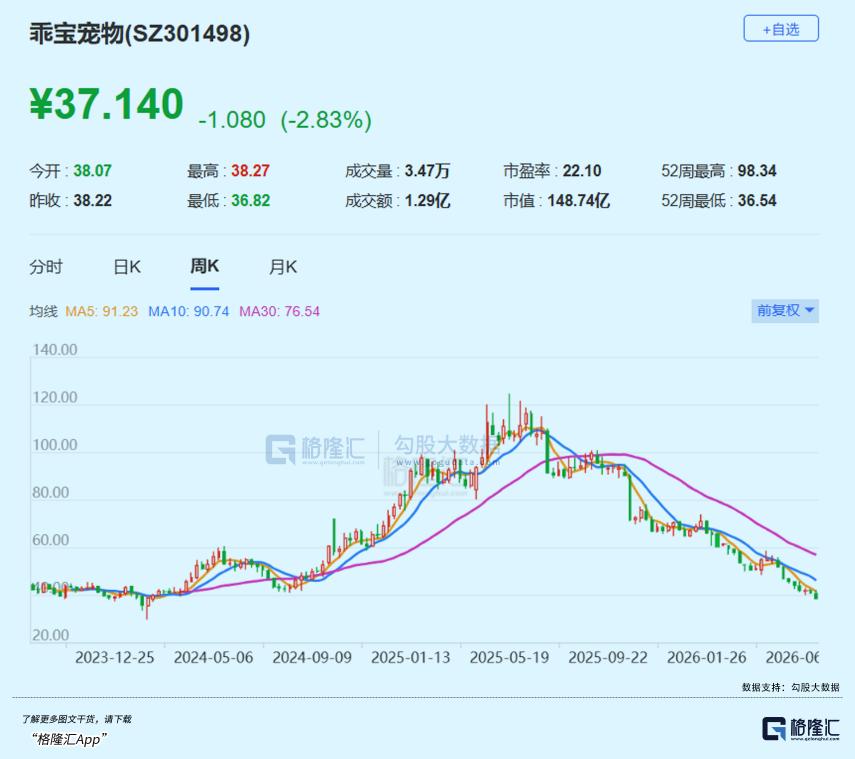
China Pet Co., Ltd. fell from its historical high of 73.80 yuan to less than 30 yuan, down more than 60% from the high point, and Petpal Co., Ltd. also saw its stock price more than halved.
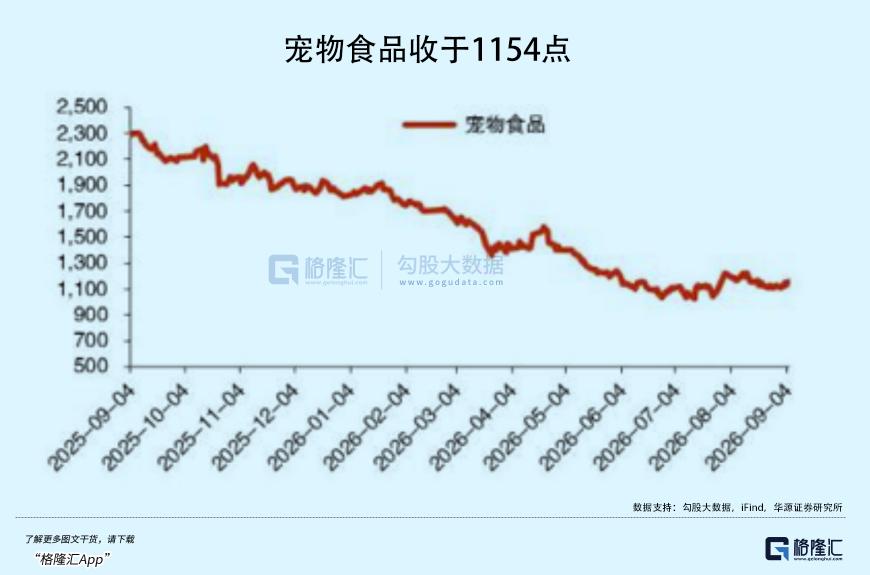
As of September, the pet economy index has fallen by more than 20% during the year, and the maximum decline in the range once approached 30%, with all 7 A-share listed pet enterprises seeing a collective pullback.
Why has the pet track been abandoned?
01 Collective Capital Flight
What prompted the collective flight of capital is the internal troubles and external challenges faced by the pet economy.
Externally, the industry is experiencing headwinds in its overseas business.
Enterprises including China Pet and Petpal have long been highly dependent on overseas OEM and export business, with overseas revenue generally accounting for around 80% of their total revenue.
However, since 2025, overseas tariff policies have fluctuated repeatedly, maritime transportation costs have remained high, coupled with the depreciation pressure during the capacity ramp-up period of new factories built by enterprises in Vietnam, Cambodia, New Zealand and other regions, the gross profit margin of export business has been eroded layer by layer.
Although the proportion of overseas revenue of Petpal Co., Ltd. in 2025 decreased slightly from 82.63% to 80.35%, the exchange loss caused by exchange rate fluctuations significantly increased financial expenses, directly eating into profits.
What has hurt the fundamental of the industry even more is the sharp rise in domestic competition.
Driven by the high prosperity of the industry, hot money from the primary market has poured into the pet track. Emerging brands have launched price wars with the help of live-stream e-commerce and private domain traffic, rapidly pushing up the ratio of sales expenses.
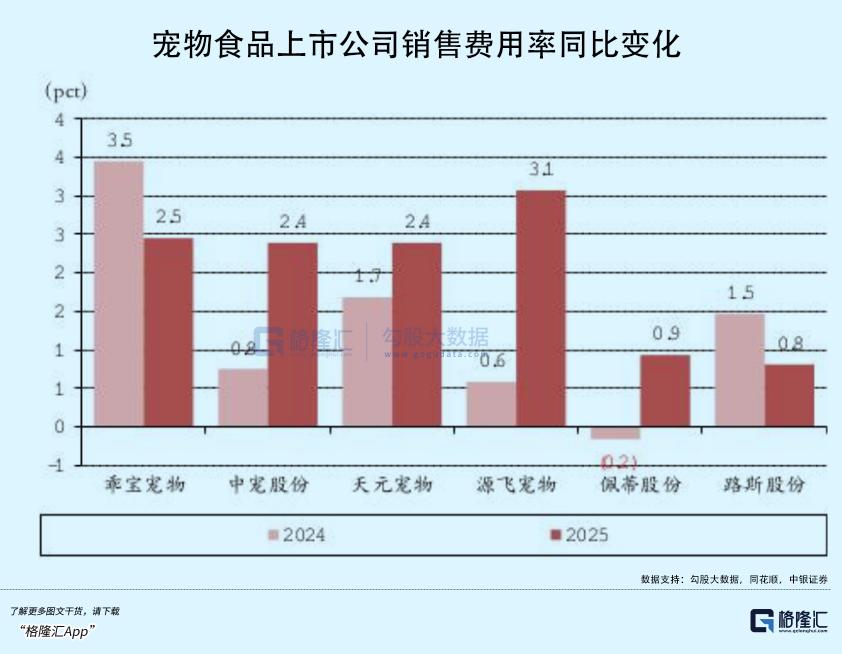
In 2025, the sales expenses of Guabao Pet surged by 44.79% year on year to as high as 1.527 billion yuan, while the sales expenses of Yuanfei Pet soared from just over 40 million yuan to more than 100 million yuan, an increase of over 160%.
This means that these funds are spent on influencer placement, platform promotion and brand marketing, bringing about revenue growth, but profits are almost completely eroded.
As a result, enterprises in the upstream and downstream of the pet industry have fallen into the strange cycle of increasing revenue without increasing profits one after another.
For the whole year of 2025, 3 out of the 7 listed pet enterprises have encountered this situation.
By the first quarter of 2026, this number has expanded to 6. Together with Yiyi Co., Ltd. which saw both revenue and profit decline, the net profit of all 7 companies in the first quarter declined year on year.
The gross profit margin of Guabao Pet in the first quarter still remained at a high level of 41.6%, but the net profit margin was only 7.5%.
However, the pricing previously given by the capital market was based on the logic that the high growth of the pet economy would inevitably bring high profits to the industry.
When this assumption is falsified, valuation correction will inevitably come.
From 2024 to 2025, the P/E ratio of the pet sector was once pushed to 50 to 60 times, and the market regarded it as a golden consumption track that can traverse economic cycles.
But when the profit growth rate turns downward, investors begin to re-examine the sector with the stricter PEG indicator, and the valuation center quickly moves closer to 20 times.
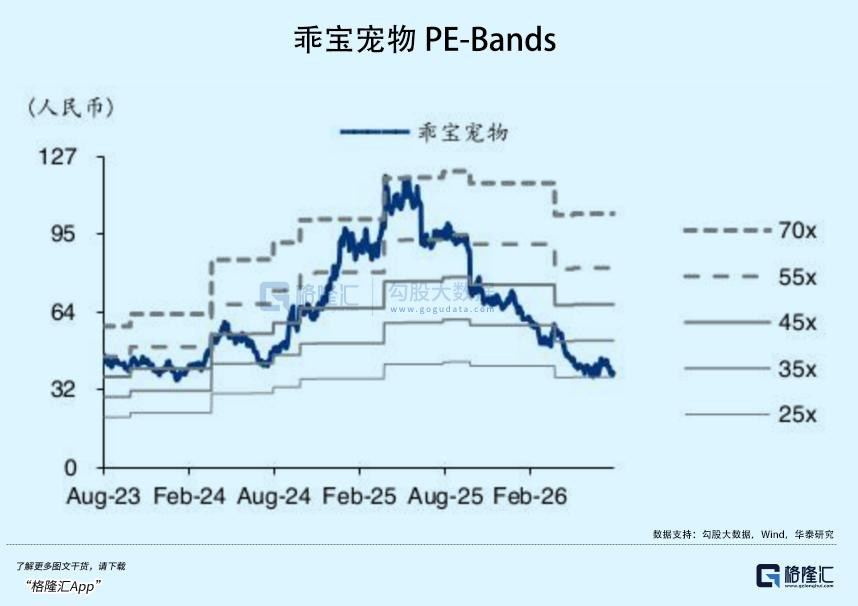
The fall in stock price comes half from the downward revision of earnings expectations, and half from the compression of the valuation multiple, which is a standard "Davis Double Kill".
02 Retreat Before the Battle
In addition to the pressure on fundamentals, the concentrated withdrawal of capital has also become the last straw that crushes market sentiment.
Behind the "deity-making" movement of the pet sector is the deep grouping of institutional investors.
In the first half of 2025, public funds flocked to the pet track, and their allocation to the sector reached its peak.
As of the end of June 2025, the shareholding ratio of public funds in Guabao Pet was as high as 18.25%, the shareholding ratio in China Pet Co., Ltd. rose from 8.06% at the end of 2024 to 15.74%, and the ratio in Yuanfei Pet soared from 1.69% to 15.27%.
In August 2025, a total of 77 institutional investors disclosed that they held A shares of China Pet Co., Ltd., totaling 207 million shares, accounting for 68.12% of the total share capital, and the top ten institutional shareholders held 62.67% of the shares.
A once niche track has been forcibly turned into a hundred-billion-yuan capital pool.
Then, the narrative was falsified, and the capital retreated rapidly.
At the end of the first quarter of 2026, the number of Guabao Pet shares heavily held by active investment funds plummeted from 13.3749 million shares in the same period of the previous year to 1.4351 million shares, and the number of heavily held shares of China Pet fell from 24.2939 million shares to 9.4285 million shares.
Statistics from Caitong Securities are more straightforward: in the second quarter of 2026, the proportion of the pet sector in fund positions has dropped to 0.00%.
Industrial capital has long cashed out accurately at high levels.
According to market statistics, the early investor KKR has cashed out nearly 1.5 billion yuan in total, and the shareholders related to the Jun Group have cashed out more than 1.8 billion yuan in total.
A more dramatic plot took place in June 2025: the second largest shareholder of Guabao Pet completed its reduction of holdings through block trading, making a profit of 1.08 billion yuan.
The list of transferees is very impressive, including the Cathay Fund, Shanghai Jueshuo Asset, Orient Securities Asset Management, etc., as well as UBS and Morgan Stanley, with a lock-up period of six months.
Subsequently, these institutions were deeply trapped after taking over the shares.
The well-known investor Ge Weidong and related parties once entered the top ten tradable shareholders of Guabao Pet at the end of 2025, but all withdrew after only one quarter, and the operation with a position market value of about 230 million yuan ended in loss.
It can be seen that even the most professional buyers failed to escape unscathed from the overvalued high valuation.
03 Profound Transformation
Then, after the sector has experienced a brutal valuation regression, a key question emerges: is the current position the bottom or a trap?
From the perspective of fundamentals, the industry has not deteriorated, it is just not as good as the market once imagined.
Compared with the sharp pullback in the capital market, the number of pet "fur babies" has not decreased.
In 2025, the number of urban dogs and cats in China reached 126 million, an increase of 2.21 million over the previous year. The scale of the pet consumer market rose to 312.6 billion yuan, a year-on-year increase of 4.1%, and it is expected to grow to 405 billion yuan by 2028.
Compared with overseas markets, the pet ownership penetration rate of Chinese families is only 29%, far lower than 81% in the United States and 60% in Japan.
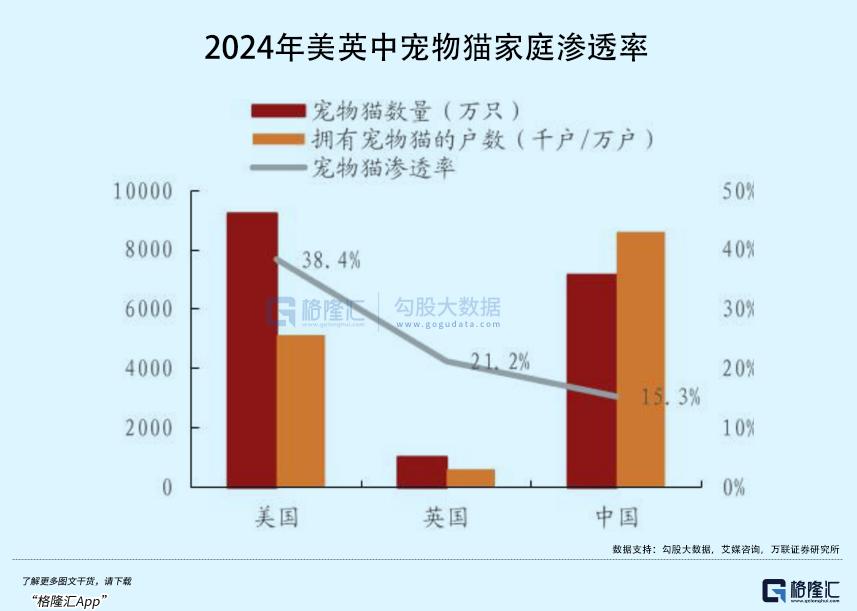
The penetration rate of professional cat food and dog food is only 51.9% and 28.8% respectively, and the market share of high-end categories still has huge room for improvement.
But the slowdown in growth is an indisputable fact.
Since 2023, the growth rate of the pet consumer market has remained at a low level of 4% to 5%. In 2026, it is expected to reach 336.5 billion yuan with an annual growth rate of 4.3%, and the growth rate of the number of dogs and cats is also slowing down.
This means that the driving force of industry growth is changing. The era of growth driven by the increase in the number of pet owners has ended, and structural opportunities will be the core battlefield in the next five years.
At present, the trend of consumption upgrading in the pet economy is still continuing.
Since 2025, the growth rate of mid-to-high-end and high-end price bands has significantly led the industry, and the low-end price band has even seen negative growth.
Pet feeding is gradually stepping into the era of scientific feeding. Trends such as dedicated food for specific pets, functional staple food, and increasing proportion of wet food will continue to boost consumption upgrading.
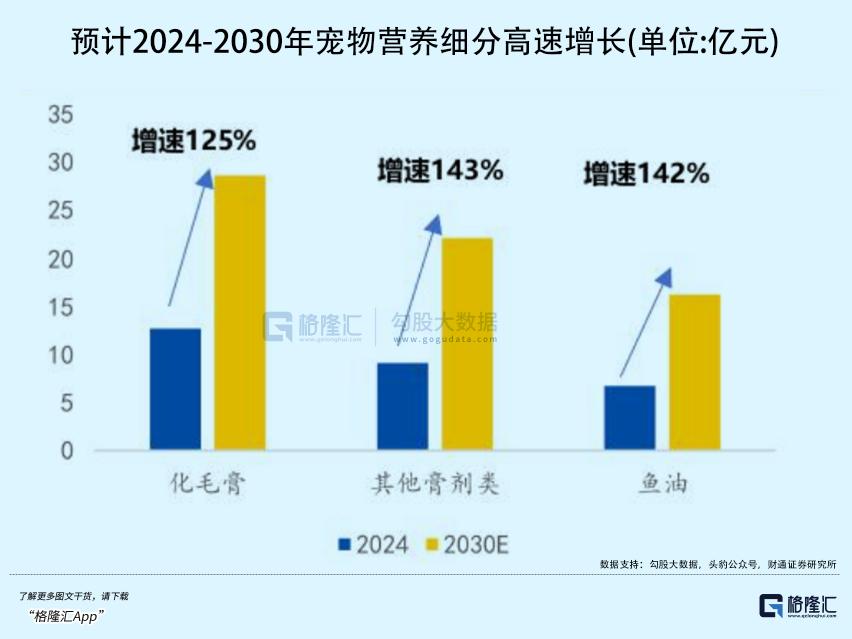
The competitive landscape is also undergoing considerable changes.
As the new production capacities of leading brands and leading OEMs in the past few years have been gradually put into operation and released stably, the competitive landscape on the production capacity side has begun to stabilize, and the model of blindly burning money for traffic is losing its effect.
The implementation of industry standards for prescription food has raised the industry access threshold, and the R&D capability and brand premium advantages of leading enterprises will become more prominent.
From the perspective of institutional views, many securities firms believe that the pet sector has entered the window period for left-side layout, and investment opportunities may come again after the performance growth rate recovers.
Judging from the trend of market funds, the views of different institutions have diverged.
On the one hand, the main funds are still continuously leaving the market recently.
On September 11, the main funds of the pet economy sector had a net outflow of 185.86 million yuan, and the net inflow of main funds of Guabao Pet on that day was -16.0861 million yuan, with the stock being reduced by main funds for 3 consecutive days.
On the other hand, a small number of long-term active funds and foreign investment banks are carrying out left-side layout.
At the end of the first quarter of 2026, all the funds under the Xingxi system appeared in the top ten shareholders of China Pet Co., Ltd. China Pet itself also announced a repurchase of up to 200 million yuan on January 25.
For Guabao Pet, it was announced on September 1 that senior executives including Qin Hua had increased their holdings by 3 times in total, amounting to 287,300 shares. In the same period, Goldman Sachs and Morgan Stanley took a contrarian position in the pet track in the second quarter, with the total market value of new positions approaching 290 million yuan.
This drastic exchange of chips shows that the market's judgment on the pet sector has completely split: the bears believe that the profit bottom has not yet arrived, while the bulls believe that the valuation bottom has already arrived.
At a time when such judgments are highly divided, investment may either bring great opportunities or carry great risks.
04 Conclusion
Looking back on this round of sharp drop in the pet sector, it is actually not a complete denial of the industry's prospects, but more like a liquidation of excessive speculation.
Since 2024, capital has pushed the story of a good track to the extreme, with a P/E ratio of 50 times or even 60 times, which has already overdrawn the growth expectations for several years to come.
When short-term disturbances such as tariff shocks and price wars are concentratedly exposed, the valuation bubble will inevitably burst.
But after the bubble bursts, real value is also emerging.
The 312.6 billion yuan market scale, the family penetration rate of less than 30%, and the continuously upgrading consumer demand, these positive fundamentals have not changed.
What has really changed is the pricing of the pet sector in the capital market.
For investors, the current moment may not be the best time to chase the hot track, but it may be the best time to examine value.
When the hustle and bustle