Apple's foldable screen, which has been 15 years in the making, still falls just one step short of a perfect user experience.
On September 30, 2011, Apple filed a patent application titled "Flexible electronic devices". It describes a device with a foldable screen that can be tucked into a pocket when closed, and uses sensors to determine whether it is open or closed.
This patent was granted in January 2015, with a total of six inventors, one of whom is John P. Ternus.
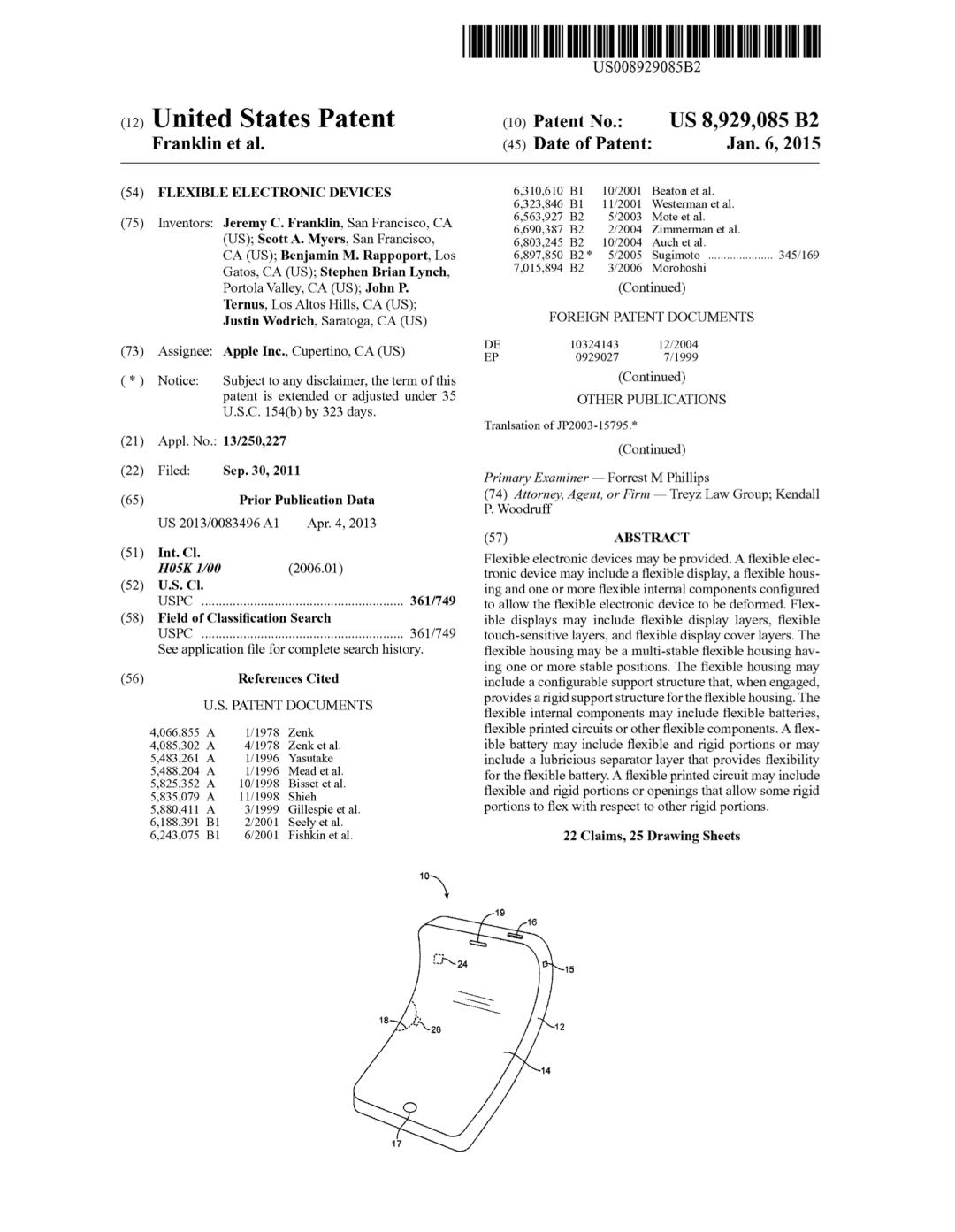
Fifteen years later, on September 9, 2026, the engineer whose name was listed back then stood on the stage of the launch event for the first time as Apple CEO, and unveiled the iPhone Duo.
For this new CEO, this is the most important product at this launch event, but over the past 15 years, Apple has carried out a large number of pre-research work on foldable screens under the surface for a long time.
According to a report by Mark Gurman of Bloomberg the day before the launch event, Apple engineers did not start serious work on foldable iPhones until around 2016, and the project was initiated by Dan Riccio, Ternus's predecessor and head of hardware engineering. The direction was never settled. In the first few years, the team tested an iPad mini that could be unfolded into a large tablet.
In February 2019, Samsung and Huawei released their first foldable screens four days apart: the Galaxy Fold is more than 15mm thick when closed, and the Mate X even folds the screen outward, with a visible crease that looks like a groove to the naked eye. Apple thought of this eight years earlier than the two companies, but had not launched any product at that time.
The turning point came in 2020. After Cook returned from a business trip in Asia, he saw that Samsung and Huawei's foldable phones were everywhere there, and adjusted the direction to focus on foldable iPhones. A quote in Bloomberg's report notes that Cook was the earliest and biggest supporter of this project.
Four things really stuck the engineering team: whether the crease is visible, whether the hinge can withstand repeated opening and closing, how to make the flexible cover glass for the inner screen, and how to hide the camera under the screen. The cover glass was finally customized together with Corning, and the hinge uses titanium and aluminum. All four are pure hardware problems.
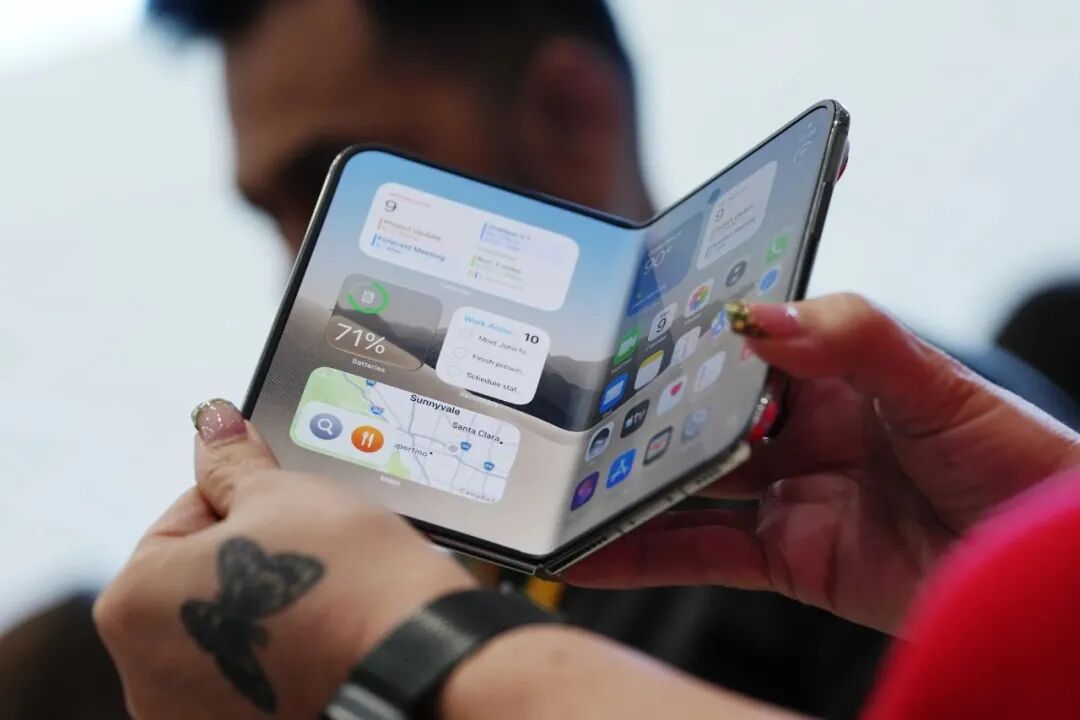
Counting from those two devices launched in 2019, seven years have passed. The Huawei Mate X7 is 9.5mm thick and weighs 235g, while the Xiaomi 18 Fold sells its book-style foldable device for 10999 yuan. Apple was the last to enter the market, and the iPhone Duo it delivered is 11.3mm thick, weighs 254g when closed, and starts at 15999 yuan for the Chinese mainland version, making it the thickest, heaviest and most expensive foldable screen device of its size.
TrendForce's forecast released on the day of the launch event shows that this device will sell about 5 million units this year, taking 24.8% of the global foldable screen market in the first year; Counterpoint's estimate in July was 25%. For a foldable screen whose hardware parameters are almost all behind its competitors, analysts unanimously believe that it can take a quarter of the market share as soon as it is launched.
Explaining this with "Apple brand premium" is undoubtedly a lazy approach to this issue: the problem that foldable screens have not been solved for seven years never lies in the hinge. Hardware problems can be solved with money and time, but the one thing that Huawei, Samsung and Xiaomi have not achieved in these seven years is to get all the apps on mobile phones to properly adapt to foldable screens.
01
The Android foldable industry's answer over the past seven years
The software problem of foldable screens can be summed up in one sentence: apps are written for a vertical rectangular screen, and after unfolding, the screen becomes nearly square, and the app does not know how to adapt.
Google's solution was finalized in Android 12L released in 2022: for apps that cannot adapt, the system displays them as a vertical bar in the middle of the screen with black bars on both sides, which is called compatibility mode. This is a fallback solution, based on the premise that developers will follow up as soon as possible. Four years later, this premise has not been fulfilled. In the wide fold adaptation guidelines for developers released by Google this July, the listed problems still include stretched, cropped or misoriented images after unfolding.

Google has long had content about foldable screen adaptation in its Android development specifications, but the progress is slow | Image source: Google
Starting from Android 16, the Android system will by default ignore the orientation and size limits declared by apps on large-screen devices, and developers can apply for exemption temporarily; by Android 17, the exemption will be cancelled, except for games. The platform owner that controls the entire Android ecosystem took four years to go from "asking" to "forcing" developers to adapt, and the effect after implementing the mandatory policy will not be visible for another year.
The reason why developers are unwilling to follow up is first reflected in the volume: foldable screens still account for less than 2% of global smartphone shipments so far, and the revenue for a developer to modify the interface for foldable screens cannot cover the cost.
The second reason is the inconsistent form factors: the outer screens of Samsung's past generations are narrow strips with a 21:9 aspect ratio, while Chinese manufacturers make wide outer screens close to regular bar phones, and Huawei Pura X uses a wide fold with a 16:10 aspect ratio, so every manufacturer has a different aspect ratio after unfolding. Adapting for one manufacturer does not mean adapting for all foldable screens.
In China, this problem is half hidden by Huawei's market share. According to IDC data, China's foldable screen shipments reached 2.8 million units in the first quarter of this year, a year-on-year increase of 65%. Huawei alone accounts for 60% of the market, and the cumulative shipments of Pura X exceeded 1.5 million units one year after its launch. Even so, it still failed to get all apps to modify their interfaces for a 3.5-inch square screen.
On the hardware side, there are no secrets left at all: the foldable panel of iPhone Duo is exclusively supplied by Samsung Display, and South Korean media The Elec reported in April this year that the supply contract is valid for three years; manufacturers such as Lens Technology and Wingtech that also supply components for domestic mobile phones responded to the media successively on the day of the launch event, stating that they provide UTG ultra-thin glass, screen support plates and precision hinge parts.
In other words, the screen of Apple's first foldable screen device comes from Samsung, and the structural parts come from the same batch of factories that supply Huawei and Xiaomi. The hardware supply chain for foldable screens is shared by the entire industry, and no one can build a moat relying on it.
The only thing that can build a moat left is the operating system.
02
The new solution for iPhone Duo
Apple's prescription for the foldable screen ecosystem is essentially to turn it into an iPad that you can carry in your pocket.
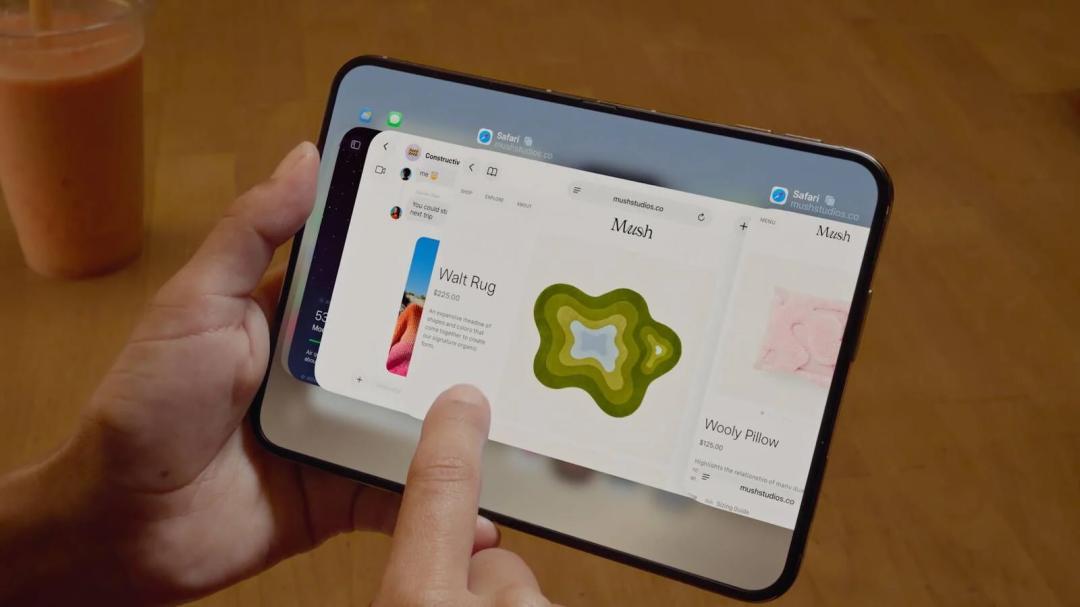
The interaction of the unfolded inner screen looks not much different from iPadOS at first glance | Image source: Apple
But this approach was not made temporarily for Duo. iOS abstracted screen sizes into two categories, "compact" and "regular", back in 2014, and developers have been required since then to use one set of interfaces to support both iPhone and iPad; in 2015, iPad got split view, in 2022 it got Stage Manager, and with last year's iPadOS 26, Apple simply abolished the 11-year-old split view and Slide Over, replacing them with true free-form windows.
For twelve years, Apple has been doing one consistent thing: allowing an app to deliver the same user experience on all screen sizes without assuming what size of screen it will be displayed on.
This is exactly the capability that foldable screens need. So Apple does not need to invent anything new this time, it only needs to add the last layer of fold-related features on the 12-year-old foundation: where the hinge is, how to handle the half-open state, and how to transition between the two screens.
This strategy can help Apple achieve "finish line at the first battle": although it entered the market seven years later than its competitors, the first-generation product is already a finished product. The Android ecosystem iterates and improves while selling products, and Google took four years to dare to make adaptation mandatory; Apple spent all its time on improvement before entering the market.
To achieve this, the first problem Apple needs to overcome is the brand new size: the iPhone Duo has a 5.4-inch outer screen with a width of 84mm when closed, and Apple states that its display area is equivalent to 90% of that of the iPhone 18 Pro; when unfolded, it is 7.6 inches, with an aspect ratio close to 1:1.42, slightly longer than an iPad.
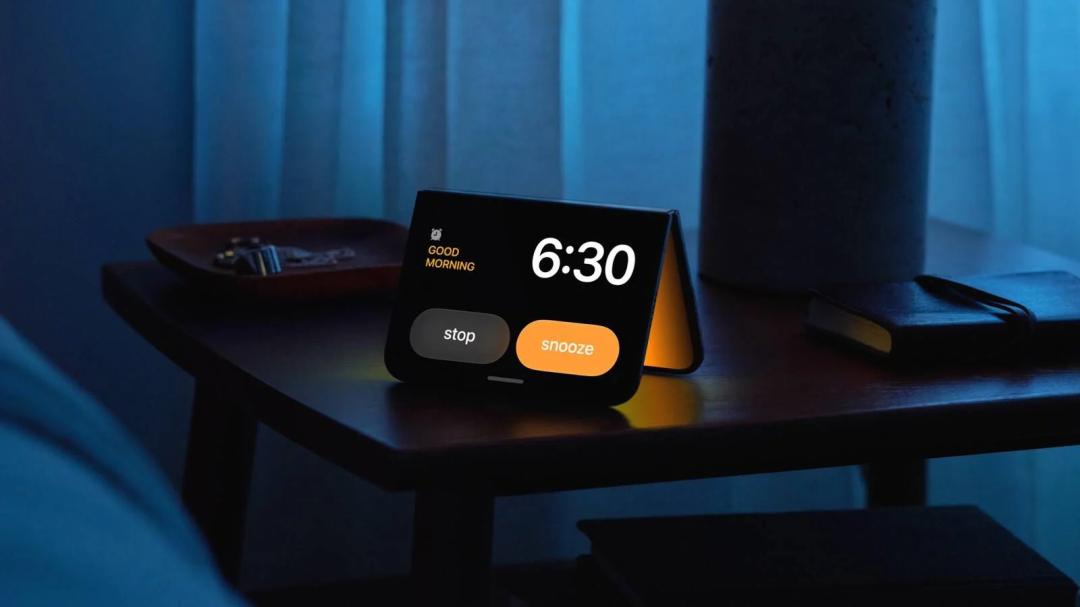
In Apple's guidelines for developers, the outer screen corresponds to "compact width", and the inner screen corresponds to "regular width": In other words, an app that has already developed an iPad version does not need to redefine itself on Duo, it only needs to use the iPad layout when unfolded.
Apple took a side in this step. It did not follow Samsung's 7-year-old narrow long outer screen design, but stood on the other side: the outer screen size of Duo is almost exactly the same as the 5.38-inch outer screen of the Xiaomi 18 Fold released on September 7. Samsung itself changed its design this year, according to the comparison table of GSMArena, the Z Fold8 uses a 5.5-inch wide outer screen, and Google immediately released the wide fold adaptation guidelines for developers in July.
The form factor of foldable screens converged to the same answer in 2026, and Apple's rules are written according to this answer.
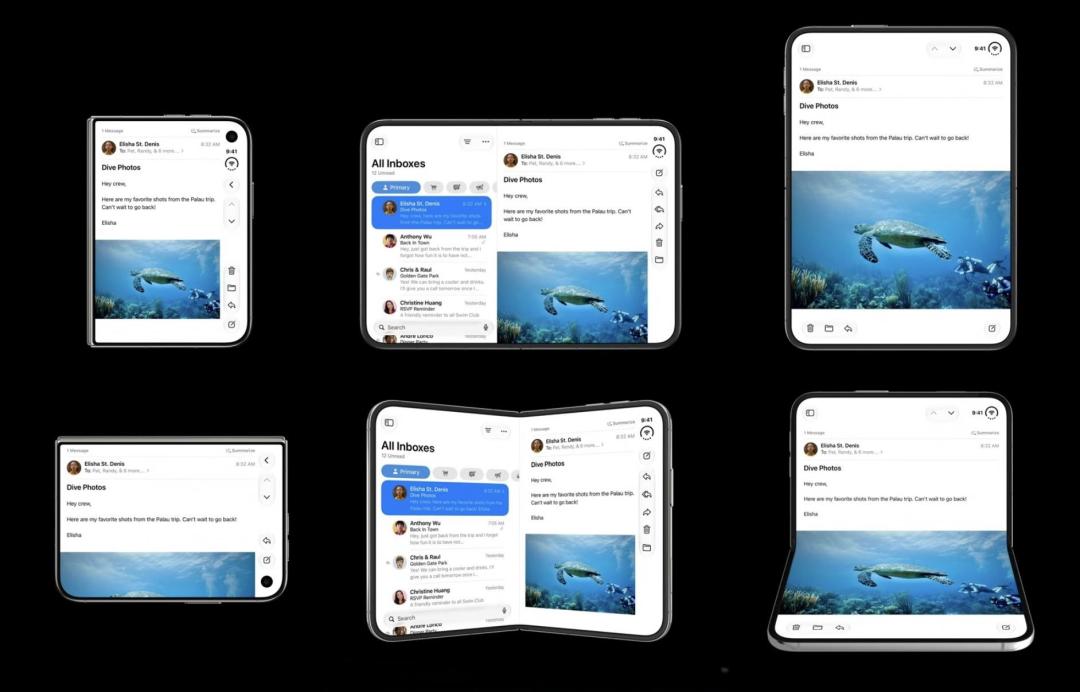
The second part is the development interface: iOS 27 adds a concept called "reserved area", the system tells the app where the hinge and camera are located, and the app moves the content away from the crease when the device is half-opened; toolbars, tab bars, and Dynamic Island are moved from the top and bottom of the screen to the side and placed vertically, leaving a complete rectangle for the content.
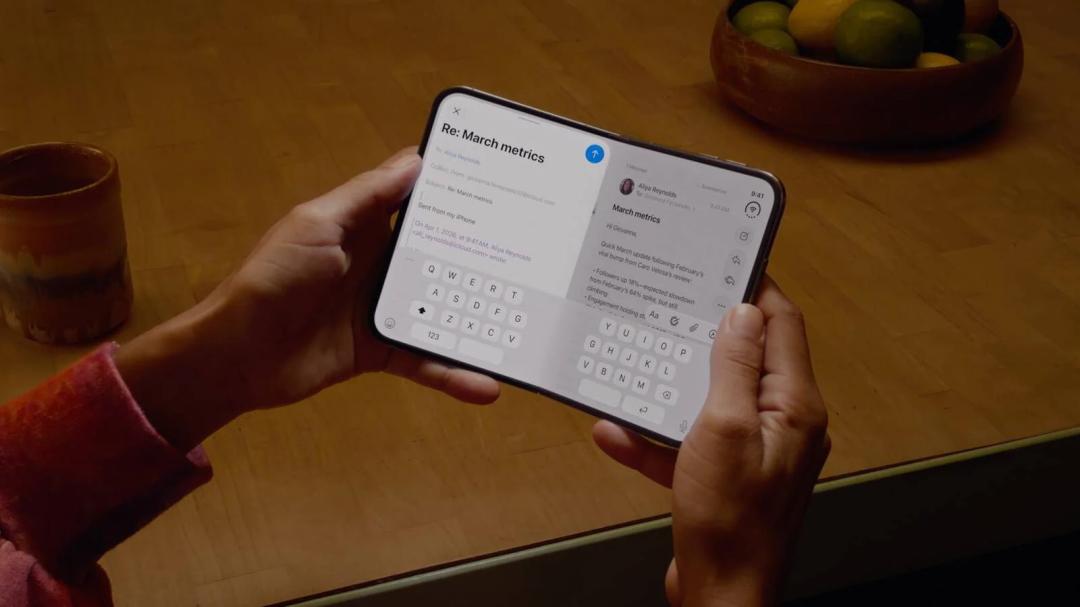
Dock and Dynamic Island are placed vertically on the side to leave a complete rectangle for content | Image source: Apple
Apple's only suggestion for developers is: do not draw a separate set of interfaces for each posture, make a set of self-adapting layouts. Even the distinction between landscape and portrait orientation is secondary, the first thing to consider is the size category.
The outer screen held vertically is "compact", and the inner screen is "regular" in both landscape and portrait after unfolding. The interface is determined according to the available space, not according to the direction the device is facing.
Apart from the rules, Apple also provides something that is not written as a mandatory requirement.
The same app can open two interfaces on two screens at the same time, and the two screens can display different content respectively. From this perspective, Duo is not necessarily a special device, but more like the starting point of the iPhone application form iteration.
iOS 27 has a set of interfaces specifically for the hinge of Duo, called onHingeChange in SwiftUI and UIHingeInteraction in UIKit. The app can not only know whether the device is closed, half-opened or fully opened, but also get the continuously changing hinge angle.
The folding action is therefore no longer just switching interfaces. The angle is a continuous input variable: the camera can map it to a certain parameter, 3D software can use it to rotate the view, and music software can use it to adjust the pitch. Apple's own demonstration shows the last use case: when you fold the device to different angles, the pitch of a virtual guitar changes accordingly, just like using a whammy bar. There is no such dimension on regular bar iPhones.
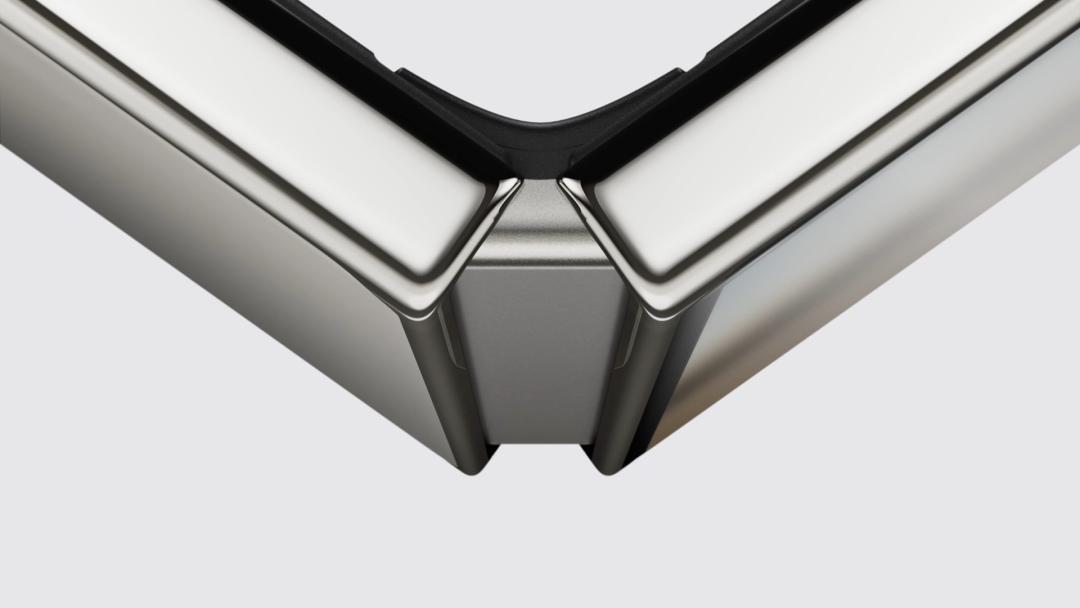
The hinge angle is a continuous input, and the official demo uses it to adjust pitch | Image source: Apple
Another usage of the two screens is to leave the outer screen for others to view. Apple demonstrated three scenarios at the launch event: other people nearby can join the FaceTime call through the outer screen; when you use the rear camera to take photos of people, the person being photographed can see the viewfinder frame on the outer screen; there is also a special scenario for soothing children, where animations are played on the outer screen to attract their attention.
