Now that everyone is buying pure electric vehicles, is there any need to bother with fuel-powered cars anymore?
Fuel vehicles are not dying out, but embedded in the development trajectory of China's automotive industry in a new form.
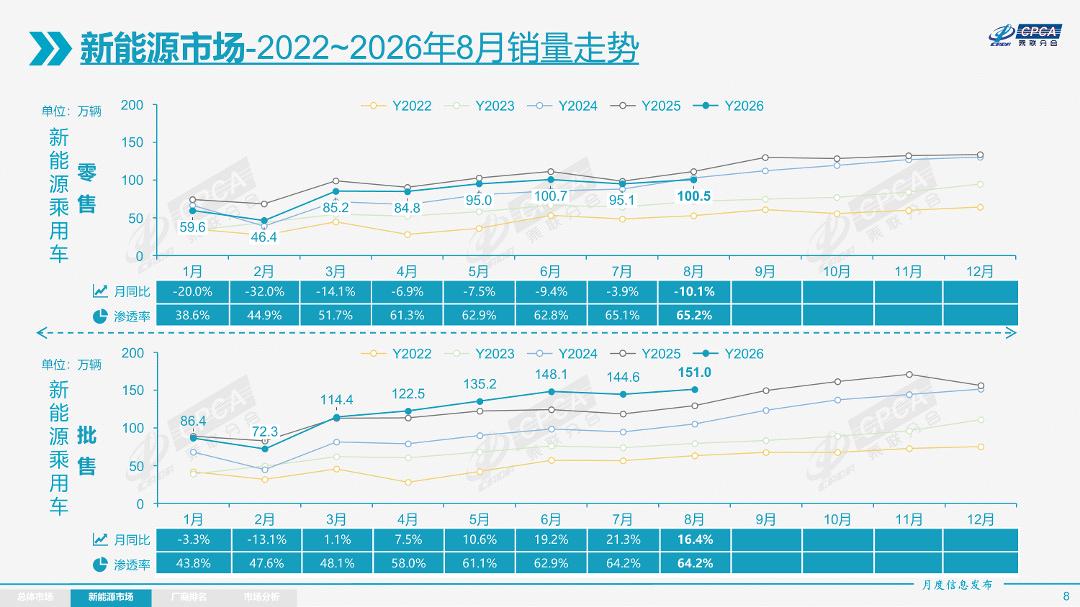
Data from the China Passenger Car Association (CPCA) shows that the wholesale sales of new energy passenger vehicles in August reached 1.51 million units, a year-on-year increase of 16.4% and a month-on-month increase of 3.9%; from January to August, the wholesale sales of new energy passenger vehicles reached 9.778 million units, a year-on-year increase of 9.1%. In August, the wholesale sales of conventional fuel passenger vehicles reached 840,000 units, down 29% year on year and up 5% month on month.
In August, the retail sales of new energy passenger vehicles hit 1.005 million units, down 10.1% year on year and up 5.7% month on month, with a penetration rate of 65.2%, hitting a new all-time high; from January to August, the retail sales of new energy passenger vehicles reached 6.674 million units, down 12.1% year on year. In August, the retail sales of conventional fuel passenger vehicles reached 540,000 units, down 40% year on year and up 5.1% month on month.
Look, ten years ago we were still arguing about "whether electric vehicles are policy-driven products", but no one is arguing about that now. The ride-hailing cars with green license plates on the streets, the charging piles under office buildings, and the exhibition halls in shopping malls that push fuel vehicles to the corners all point to one fact: the expansion of electric power and the retreat of fuel power is not a trend, but a reality.
However, a question also arises: with the rapid growth of pure electric vehicles and the low presence of fuel vehicles, does it mean that there is no point in continuing to develop fuel vehicles in China?
In the past two years, not to mention how few people are speaking up for fuel vehicles on social platforms, even if you try to discuss the differences between fuel vehicles and new energy vehicles from an objective perspective, you will be labeled as old-fashioned and rigid.
In the new era, it seems that fuel power is a sin, and all remarks that go against the spirit of the Internet cannot be recognized. When talking about enterprise development, if the attribute of joint venture is added, you will face even more overwhelming criticism and denunciation.
Who says fuel vehicles are no longer selling well?
Looking at the changes in the automotive market, terminal sales are only a superficial phenomenon. Although the market share of fuel vehicles is still around 40%, judging from the current actions of automakers, fuel vehicles are only the main force for securing the low-tier market and supporting exports, and the possibility of large-scale iteration and upgrading is extremely low.
It takes at least two or three years for a fuel vehicle to go from project approval to market launch. Therefore, when we browse the "Announcement of Road Motor Vehicle Manufacturing Enterprises and Products" every month, we find that automakers are putting their most sufficient R&D resources mainly on pure electric vehicles, and there are indeed fewer innovations on the fuel vehicle side.
In other words, the newly declared fuel vehicle models are essentially "facelifting, adding screens, replacing grilles, and adding a mild hybrid system", instead of developing a brand-new vehicle. Therefore, "fuel vehicles still account for more than 40% of sales" seems to be a deception. When no one is investing in the development of new fuel vehicle models anymore, the conclusion is clear: fuel vehicles are not dead, but their "right to expand the lineup" has been lost.
In the past two years, BYD announced very early that it "will no longer produce fuel vehicles", which is the awareness of a new energy automaker.
However, as GAC Honda shifts its resources to e:HEV, plug-in hybrid and pure electric vehicles, Volkswagen is vigorously promoting the ID. series and the plug-in hybrid Passat in China, and fuel vehicles are relying on the "Pro series" to extend their lifespan; even Toyota is putting the THS hybrid and bZ pure electric series in the spotlight, instead of only focusing on models like Camry and Corolla. It seems that further updating fuel vehicles has become an anomaly in the entire industry.
Nevertheless, I always believe that when looking at China's automotive market, the most inappropriate thing is to infer the whole country based on the situation in first-tier cities.
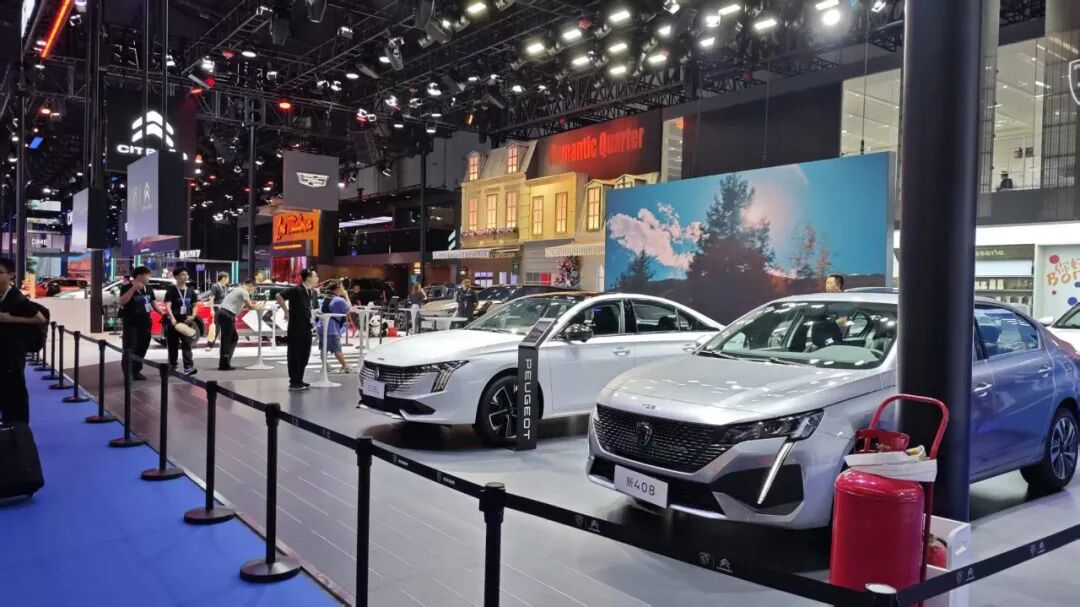
In the first half of the year, the CPCA released a distribution data: the penetration rate of new energy vehicles in first- and second-tier regions with license plate restrictions exceeds 65%, and that in third- and fourth-tier cities is close to 45%. Note that for third- and fourth-tier cities, "close to 45%" indicates that a large number of consumers in China still have demand for fuel vehicles.
That means, even today, when electric vehicle enterprises have built charging piles at the foot of the Himalayas, there are still a large number of scenarios in China that require fuel vehicles to fill the gap.
For a long time, if you go deep into most underdeveloped areas in China, you will find that especially in places far from urban areas such as Northwest China and Northeast China, there are still huge energy supply blind spots in counties and towns. Once the density of charging piles drops, the first reaction of users is still "fill up the oil in five minutes and go on the road".
To put it more extreme, when users need to travel long distances across remote areas or work under high-altitude conditions, what they need is not just "the car can still run when the power is off", nor to save the so-called fuel cost. Highly reliable fuel vehicles are absolute hard currency.
Of course, these are all clichés. China's vast territory and abundant resources always determine that the industrial process varies from region to region.
In fact, even looking at overseas markets, the export volume of new energy vehicles in August 2026 reached 526,000 units (data from the China Association of Automobile Manufacturers), with a year-on-year increase of more than 130%. This is the full-caliber export data of new energy vehicles. If we only look at new energy passenger vehicles, the export volume in August counted by the CPCA is 518,000 units, up 154.7% year on year.
However, no matter which statistical caliber is used, what if the export of new energy vehicles accounts for more than 50%? When Chinese automakers go global, a large number of markets in Southeast Asia, the Middle East, Latin America, Africa and Russian-speaking regions are still buying fuel SUVs and pickup trucks. If we give up the iteration of fuel vehicles now, isn't it equivalent to ignoring the market development potential of regions such as Peru, Saudi Arabia and Kazakhstan?
For this reason, when the whole industry is sentencing fuel vehicles to death, and public opinion is keen to equate fuel vehicles with "Nokia", a more accurate statement is: fuel vehicles in China have changed from "mainstream power" to "power for specific scenarios", from "growth engine" to "profit-preserving asset", and from "strategic center" to "one part of the combined strategy".
To extend the lifespan of fuel vehicles, smarter strategies are needed
Of course, for the current industrial situation, we must admit that if enterprises still follow the logic of 2018, relying on terminal discounts to clear inventory, forcing dealers to stock up, and brands turning a blind eye to the reality, such enterprises, whether joint ventures or local independent brands, will be crushed by the rapid cost reduction of the new energy industry in the next three years. The fuel vehicle market below 300,000 yuan is no longer a matter of "whether you compete fiercely", but a matter of "whether there is still gross profit".
In addition, even if you equip fuel vehicles with intelligent driving systems, improved infotainment systems and better mute performance, and price them close to plug-in hybrid models of the same level, this approach can extend the lifespan, but it only treats the symptoms not the root cause — because once users experience "no fuel consumption in urban driving", it is very difficult for them to go back to fuel vehicles.
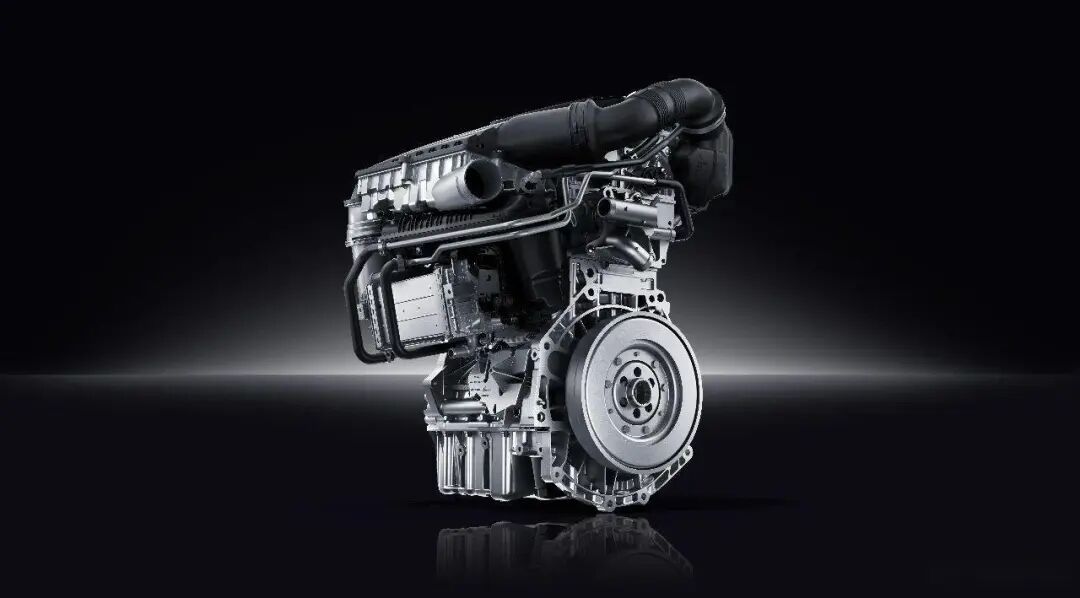
In contrast, in addition to meeting export demands, to achieve diversified development in China, the only correct way to develop fuel vehicles after 2026 is to turn the internal combustion engine into an "energy component".
In other words, is it meaningful to turn the existing fuel power system into an efficient hybrid power source, off-road backup, export product, commercial scenario solution, and low-cost market entry point? Yes, it is very meaningful, and the significance is huge.
The development of the market has always been most afraid of dualism. "Electrification will surely win" and "fuel vehicles are doomed" are two different statements, and there is a gap between them: the power form will recede, but user scenarios will not disappear.
When Chinese people buy cars, they do not choose "fuel or electric" first, but the scenario determines the demand. Pure electric vehicles cannot solve all problems. Fuel vehicles cannot justify all premium prices either. The ones that will survive in the end are the systems that can clearly explain the advantages of both fuel and electric power. The next stage of China's automotive market is not "fuel dies and electric survives", but "fuel shrinks, electric becomes the main force, hybrid serves as the bridge, and scenarios determine the survival of products".
Since the beginning of this year, while the market share of range-extended electric vehicles has been quickly replaced by pure electric vehicles, we have seen Chinese enterprises including Geely and Changan pick up HEV technology again and incorporate it into their future development plans.
In each batch of new car information from the Ministry of Industry and Information Technology, we can occasionally find that some familiar products have launched new fuel hybrid models. Essentially, the emergence of these models is not to "resurrect fuel vehicles", but to verify whether Chinese enterprises have fully mastered the core capabilities of the "powertrain system".
Hybrid-specific engines and range extenders are necessities for global competition. For Chinese brands to go global, they cannot only bring pure electric products. The charging conditions in most markets around the world determine that "low-fuel-consumption hybrid vehicles" will be the greatest common divisor in the next ten years.
Besides, the retention of internal combustion engine technology capability is the foundation of vehicle energy efficiency optimization.
High thermal efficiency engines, low friction technology, intelligent thermal management, electronic oil pumps, 48V mild hybrid systems... The accumulation of these technologies will ultimately contribute to the energy consumption performance of the whole vehicle. Even on the pure electric platform, the experience in thermal management systems, energy management strategies, domain controller architecture and other aspects is also in the same line as the engineering accumulation in the internal combustion engine era. Giving up the internal combustion engine means giving up the continuation of this capability chain.
Then back to the original question: is there a future for the development of fuel vehicles?
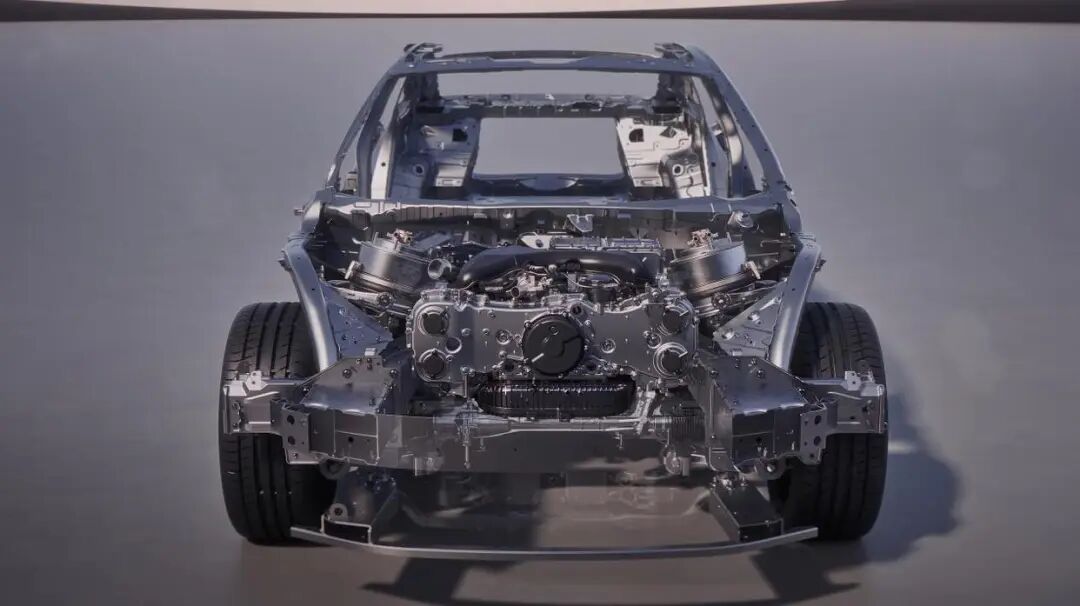
A more accurate statement is: the era of pure fuel vehicles as mainstream consumer products has ended, but the internal combustion engine, as the core component of the power system, is being embedded into the future of the automotive industry in new forms of hybridization, cleaning and systematization. The horizontally opposed engine used by BYD in the Yangwang U7 is the most typical example.
This is not an either-or replacement story, but an evolutionary story of ebb and flow and form reconstruction. To this day, there are still many people on the Internet inciting the opposition between fuel and electric vehicles. For China's automotive industry, the real wisdom does not lie in "taking sides". The belief that "fuel vehicles will never die" is not a slogan from old-fashioned people, but the key to promoting Chinese automobiles to truly win the match point in the global arena.
This article is from the WeChat Official Account "Auto Community" (ID: iAUTO2010), written by Cao Jiadong, and authorized for release by 36Kr.