Domestic AI chips have seen booming sales, who actually made real profits in the first half of the year?
Recently, Haiguang, Cambricon, Moore Threads, Muxi Co., Ltd., Biren Technology, and Iluvatar CoreX have successively disclosed their 2026 semi-annual reports, and the newly listed Enflame Technology has also updated its data for the same period in its prospectus. The total revenue of the seven companies in the first half of the year was about 21.46 billion yuan, nearly twice that of the same period last year.
Revenue rose almost across the board: Cambricon's revenue increased by 108.13%, Moore Threads by 147.42%, Iluvatar CoreX by 191.6%, Enflame Technology by about 279%, and Biren Technology recorded a 1997.6% growth on a low base. Domestic AI chip companies that once relied on financing to support R&D are collectively crossing the threshold from sample production and testing to mass delivery.
Who is the most profitable? Check the books first
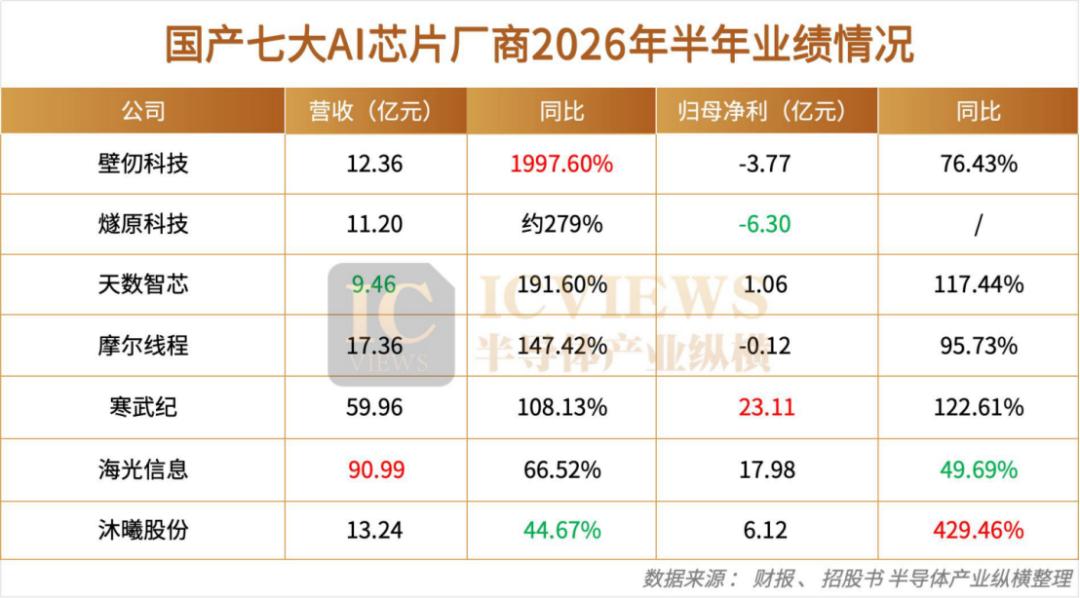
"Who is the most profitable" is not a question that can be answered by simply looking at the net profit ranking. Haiguang has the highest revenue, while Cambricon has the highest attributable net profit; Muxi and Iluvatar CoreX have turned losses into profits in their statements, but their main business still remains in deficit; Moore Threads is only one step away from breaking even; Biren and Enflame have seen rapid revenue growth, but they still have not got rid of losses of hundreds of millions of yuan.
There are four intuitive trends:
First, the revenue has achieved collective high growth, with many companies doubling their revenue. Cambricon's revenue increased by 108.13%, Moore Threads by 147.42%, Iluvatar CoreX by 191.6%, Enflame by about 279%, and Biren even recorded a 1997.6% growth on a low base. Although Haiguang and Muxi did not double their revenue, their growth rates of 66.52% and 44.67% are also significantly higher than most mature chip companies. More critically, the half-year revenue of many companies has exceeded the full-year revenue of last year. Moore Threads' revenue in the first half of the year was 1.736 billion yuan, higher than the 1.506 billion yuan for the whole of 2025; Biren's revenue in the first half of the year was 1.236 billion yuan, which also exceeded its full-year revenue of last year; Enflame's half-year revenue of 1.120 billion yuan surpassed its full-year revenue of 990 million yuan in 2025. The business scale of domestic AI chip manufacturers is stepping up, which indicates that domestic AI chips are beginning to move from small-batch testing and project verification to larger-scale product and cluster delivery.
Second, the profit camp and the cash-burning camp have begun to diverge. While revenue is growing together, profitability has not converged synchronously. Haiguang and Cambricon have entered the stage of large-scale main business profitability. Moore Threads and Muxi are in the second tier, and both companies have touched the break-even line of their main business . Moore Threads' attributable net loss narrowed to 11.56 million yuan, and Muxi's attributable non-recurring net profit loss for the half-year was 49 million yuan. Biren Technology's gross profit in the first half of the year was 527 million yuan, but it invested 804 million yuan in R&D; Enflame Technology recorded a net loss of 630 million yuan, and it is still in the stage of simultaneous expansion of products and customers.
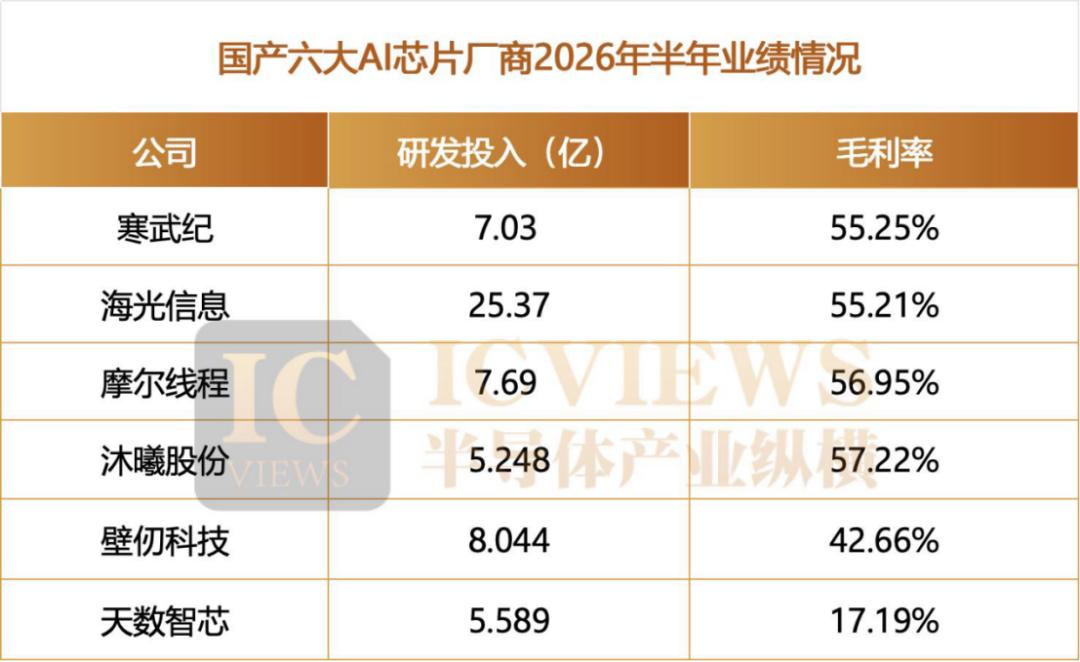
Third, the overall gross profit margin is resilient, and the difference mostly comes from product structure. After the mass production of domestic AI chips, they are not generally trapped in the situation of exchanging market share for low prices. Cambricon's comprehensive gross profit margin in the first half of the year was 55.25%, which further rose to 56.10% in the second quarter; Muxi's gross profit margin was about 57.22%, a slight year-on-year increase of about 1.1 percentage points; Moore Threads' gross profit margin was 56.95%. The three companies still maintain a gross profit margin above 55%, which shows that domestic chips have certain bargaining power in a market with tight supply and demand. It is worth noting that the overall gross profit margin of Iluvatar CoreX dropped from about 50.1% in the same period last year to 17.2%.
Fourth, R&D investment has entered the realization period, and the difference lies in the transformation speed. High R&D investment is the norm in the chip industry. Take several GPU companies that are still in the climbing stage as examples: Moore Threads, Muxi, Biren, Iluvatar CoreX and Enflame invested 769 million yuan, 525 million yuan, 804 million yuan, 559 million yuan and 640 million yuan in R&D respectively in the first half of the year, with a total of about 3.297 billion yuan, equivalent to about 52% of the total revenue of the five companies in the same period. In comparison, Cambricon's R&D expenses in the first half of the year were about 703 million yuan, which is at a similar level to that of Moore Threads and Biren. Cambricon's profit performance more indicates that its existing products have entered the stage of large-scale delivery and profit release.
The expense rate can better reflect the stage differences of each company. The R&D expense rates of Moore Threads and Muxi are 44.3% and 39.65% respectively, while those of Biren, Iluvatar CoreX and Enflame are about 65%, 59.1% and 57.1%. High R&D investment is only the entry ticket. What really determines the financial performance is whether the investment can form mass-producible products, whether the products can enter large-scale clusters, and whether they can bring continuous orders. The competition of domestic AI chips is shifting from "daring to invest" to "being able to deliver results".
Orders are scheduled to next year, domestic AI chips are in short supply
According to CCTV Finance, domestic computing power chips are seeing a surge in orders, and the delivery schedule of some products has been extended to one year later, with domestic computing power demand reaching more than 10 times the supply. Many computing power service providers said that their orders have maintained rapid growth for two consecutive years, and the number of customers of some enterprises has increased by about 10 times in the past year. The demand is transmitted upstream along the industrial chain, leading to shortages in chips, servers, storage and packaging.
Behind the tight supply is that domestic chips have begun to undertake real large-traffic services. In late August, Zhipu AI disclosed the deployment details of GLM-5.3-Flash, the first native multi-modal model of the GLM-5 series: All online traffic is carried by 100,000 domestic chips. Before the official release of the model, Zhipu AI also tested on two overseas platforms OpenRouter and OpenCode with an anonymous identity, with a total token call volume of 62T, and all related request traffic was supported by domestic chips for computing power. Through underlying architecture transformation and inference service optimization, the cluster hardware efficiency and single-token cost have reached the equivalent level of mainstream NVIDIA GPUs. "This proves that domestic chips can fully and efficiently support the inference needs of cutting-edge models in large-scale scenarios in an economical way," Zhipu AI wrote in the announcement.
Such cases test not only the peak computing power, but also concurrent scheduling, inter-chip communication, fault recovery, model adaptation and cost control. Therefore, the customer procurement standards have extended from the performance of a single card to the availability of the entire system. Domestic chips have moved from "being able to light up" to "being able to provide stable services", and a new anchor point has emerged in the supply-demand relationship.
The demand structure is changing synchronously. Training clusters are still the source of large-value procurement, while inference continues to be released with the use of search, recommendation, intelligent customer service, content generation and enterprise agents, becoming a more stable and higher-frequency computing power consumption. Iluvatar CoreX's revenue structure has presented this trend. In the first half of 2026, the company's inference series revenue was 654 million yuan, a year-on-year increase of 651.8%, exceeding the 262 million yuan of the training series, and nearly twice the full-year inference revenue of 2025. The company said that the increase in sales volume and selling price of higher-version products jointly drove the growth of the inference business. For domestic chip enterprises, the inference market has opened up a second entry point beyond training.
Commercialization is shifting from selling chips to delivering systems
Judging from the semi-annual reports, the commercialization of domestic AI chips has formed a clear systematic path: cloud products provide standardized revenue, cluster delivery amplifies the value of a single order, the industry ecosystem expands the customer coverage, and software adaptation and continuous services determine the repurchase depth.
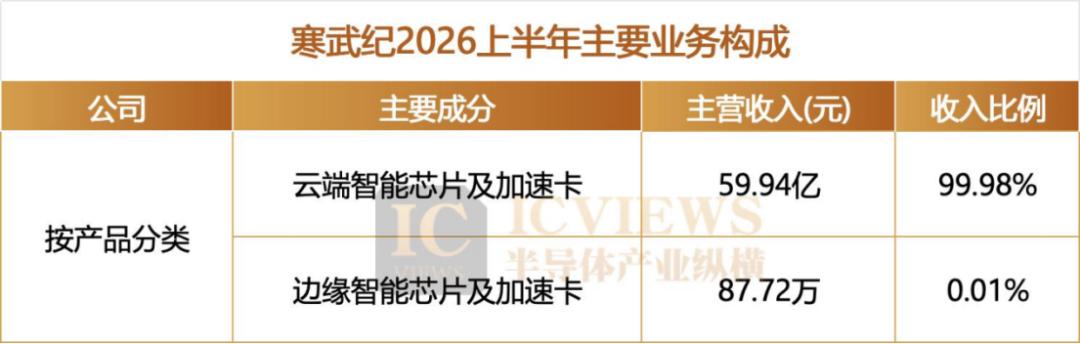
Cloud products are the starting point for revenue scaling. Cambricon generated 5.994 billion yuan in revenue from its cloud product line in the first half of the year, accounting for 99.98% of the total revenue, with training and inference chips focusing on serving large model infrastructure. Haiguang DCU has completed the adaptation of more than 400 mainstream large models, and has entered cloud service providers and intelligent computing centers relying on the collaboration of CPU and DCU.
Moore Threads extends the platformization further to clusters. The company's cloud product revenue in the first half of the year was about 1.69 billion yuan, accounting for 97.49% of the total revenue. The mass production of MTT S5000 and the delivery of the Kua'e intelligent computing cluster became the main growth drivers. The 660 million yuan Kua'e intelligent computing cluster sales contract disclosed in March has been fully delivered and recognized as revenue in the first half of the year; the Kua'e cluster has also been deployed in Beijing, Wuxi, Hangzhou and other places. On September 9, JD Cloud announced that it will build a domestic 10,000-card cluster with partners including Moore Threads, and plan to build a 100,000-card full-featured GPU cluster. The system delivery of domestic GPUs continues to expand upwards from 10,000-card level projects.
Muxi has proposed the "1+6+X" industrial ecosystem strategy, taking the independent GPU computing platform and MXMACA software stack as the core, covering six industries including finance, healthcare, energy, education and scientific research, transportation and pan-entertainment, and extending to scenarios such as embodied intelligence and low-altitude economy. The all-domestic process Xiyun C600 achieved mass production in May, and the Xijing S600 super node for training, inference and intelligent computing center construction is being promoted synchronously. Muxi GPUs have been commercially applied in 1000-card scale clusters.
Biren Technology follows the route of cloud training combined with high-speed interconnection. The R100 series is applied in intelligent computing centers, operators and large model customers. Its revenue in the first half of the year was 1.236 billion yuan, and the volume of training products drove the gross profit margin up to 42.7%. The commercial version of "GuangYue" optical interconnection and optical switching GPU super node jointly released with Shanghai Yidian, Lightelligence and ZTE has achieved thousands of cards scale deployment. In July, it announced the next-generation optical interconnection super node solution, extending the product form from training chips to large-scale interconnection systems.
Enflame Technology serves Tencent and other internet customers around training, inference chips and cluster solutions, and its products' application in Tencent has expanded from small-batch pilots to multiple scenarios. Tencent is not only an important shareholder of Enflame Technology, but also its largest customer. In 2025, direct sales to Tencent and related model revenue accounted for 83.79% of the total; outside Tencent, some unrelated leading internet customers have completed hardware and model testing and started small-batch orders.
Conclusion
The current high prosperity provides a window for domestic AI chips to achieve collective volume growth. When supply is tight, the first thing customers want is to get the goods; when production capacity recovers gradually and the prices of chips and computing power services enter a new round of game, customers will shift their comparison dimensions to utilization rate, energy consumption, software upgrade and payment recovery cycle.
The Ministry of Industry and Information Technology has issued the "15th Five-Year Plan for the Development of the Information and Communication Industry", which proposes to improve the development level of computing power facilities, deepen the collaborative development capability of computing power, and strengthen public computing power service capabilities. By 2030, China's intelligent computing power scale will increase by more than 5 times compared with 2025. We will deploy intelligent computing clusters with 10,000 cards, 100,000 cards and above in an orderly manner, deploy inference computing power facilities on demand for specific scenarios, and make greater efforts to adapt to domestic computing power chips.
Domestic AI chips are moving from "selling a single chip" to "delivering a complete system, serving a specific industry, and operating a corresponding ecosystem". Listing and financing only wins time for development. The next round of ranking will not only look at who has the fastest revenue growth rate. Companies that can survive the computing power cycle need to be able to replicate one-time projects into clusters, and precipitate clusters into stable industry loads.
This article is from the WeChat official account "Semiconductor Industry Review" (ID: ICViews), author: Jiu Lin, authorized for release by 36Kr.