The AI programmer developed by an all-Chinese team is valued at 48 billion U.S. dollars.
In just four months, the valuation of one unicorn has surged by another 22 billion US dollars.
Recently, AI programming startup Cognition officially announced the completion of a new round of financing of more than 2 billion US dollars, pushing its valuation to 48 billion US dollars. This round of investment is led by top Silicon Valley institutions including a16z, Accel, Founders Fund, General Catalyst, and Avenir.
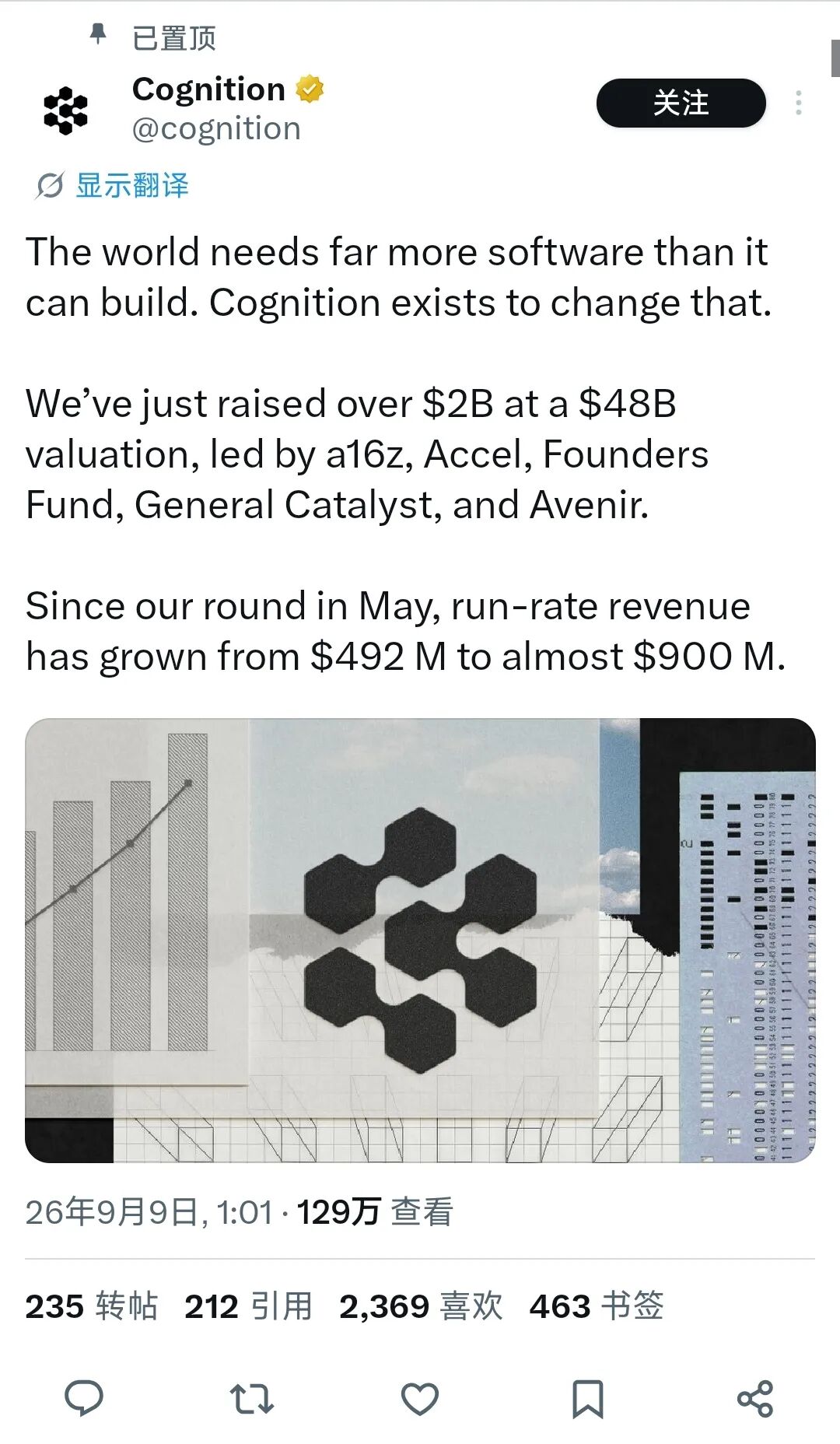
It is worth noting that Cognition only announced a financing of more than 1 billion US dollars in May this year. This round of financing was co-led by Lux Capital, General Catalyst and 8VC, with participation from Ribbit Capital, Atreides Management, Founders Fund and other institutions.
After this financing of more than 1 billion US dollars at that time, the company's post-money valuation reached 26 billion US dollars. Only four months later, the company's valuation has hit 48 billion US dollars. At present, Cognition is also "the world's highest-valued AI programming company", after all, Anysphere, the parent company of Cursor, which was once one of the leading players in the AI programming track, has been fully acquired by SpaceX under Elon Musk.
On one side are rising new players with skyrocketing valuations, on the other side are former leaders swallowed by tech giants. The AI programming track is spawning unicorns in batches at a faster pace than embodied intelligence, while some unicorns are choosing another "exit" path.
AI Programmer Built by an All-Chinese Founding Team
Valued at 48 Billion US Dollars
This is a very young enterprise.
But the labels attached to its story are enough to make top investors beat a path to its door — Olympiad competitions, top universities, dropping out to start a business, AI Agent... The three young Chinese-American founders, Scott Wu, Steven Hao and Walden Yan, are all gold medalists of the International Olympiad in Informatics (IOI), holding a total of 5 gold medals, and their resumes are the top-tier combination in the competition circle.
Scott Wu was born in 1996 into a Chinese immigrant family in Louisiana, USA. He was the national champion of mathematics competitions in middle school, and later won three IOI gold medals. He dropped out of Harvard University after two years of study. Before starting his own business, he worked as a founding engineer at Scale AI, and co-founded AI social product Lunchclub.
Steven Hao, who was also born after 1995, studied at the Massachusetts Institute of Technology for his undergraduate degree, won the IOI gold medal in 2014, and was one of the earliest core engineers at Scale AI after graduation. Walden Yan, a post-2000s generation, is the youngest of the three. He won the IOI gold medal in 2020, and spent more than 1000 hours specializing in graph theory and dynamic programming for that goal. In 2023, he interned at Anysphere, the parent company of Cursor, for a period of time, then dropped out of Harvard, and co-founded Cognition, which is regarded as a strong competitor of Cursor.
The three Olympiad contestants joining forces to start a business speaks for itself. But at the very beginning, the three of them actually explored the cryptocurrency direction first, and did not turn to generative AI until they saw the leap in the capabilities of large language models at the end of 2022.
In early 2023, they officially founded Cognition in an apartment in New York. In Scott Wu's words, "We locked ourselves in and built a product that we have always wanted."
With so many auras, the company received a $21 million seed investment from Founders Fund under Peter Thiel in its early days, and its valuation reached 2 billion US dollars after completing financing in April 2024, which can be described as a "unicorn" achieved at an unprecedented speed.
Around the same time, Cognition also became well-known for its strength. Devin, which it released in March 2024, is known as "the world's first AI software engineer", focusing on completing programming tasks fully autonomously. But soon after the product was launched, huge challenges emerged: in real tests, only 3 out of 20 tasks succeeded, with an extremely high failure rate. Coupled with the price of 500 US dollars per month that discouraged many users, there were constant controversies over its reputation for a while.
The turning point came in 2025. This year, the AI programming track witnessed an acquisition battle known as "the fastest reversal in Silicon Valley history": Windsurf, an AI-native IDE company, was once rumored to be acquired by OpenAI for 3 billion US dollars. When the transaction was about to be completed, Google DeepMind stepped in halfway, taking away Windsurf's CEO Varun Mohan and the core R&D team with a license fee of about 2.4 billion US dollars, thus invalidating OpenAI's acquisition agreement.
Within just a few days, Cognition moved quickly to take over Windsurf's remaining intellectual property, products, brand and team. The transaction price was not disclosed, but it was regarded by the outside world as a classic case of "the third party benefiting from the tussle of two sides". Within 7 weeks after the acquisition was completed, Cognition's overall annualized revenue increased by more than 30%, and the customers of both sides began to cross-convert.
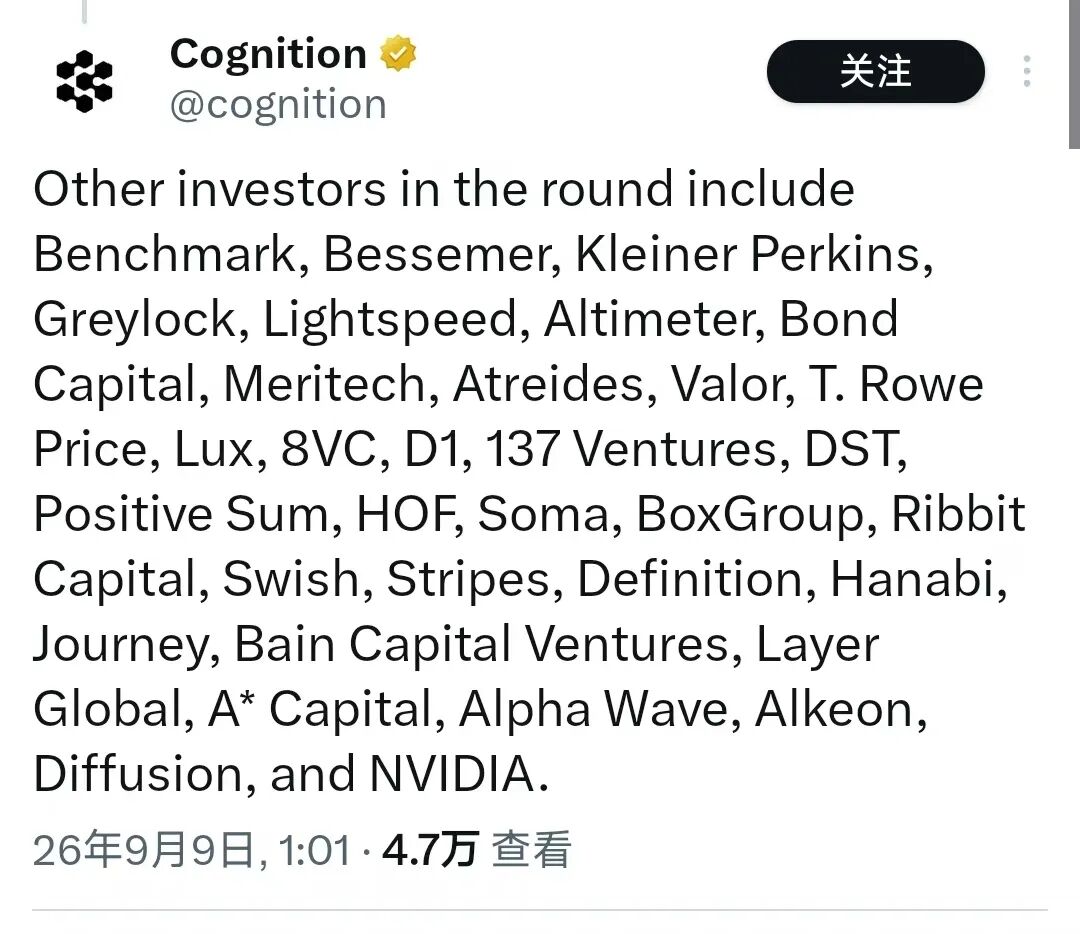
After the acquisition of Windsurf, Cognition's valuation curve rose vertically at a skyrocketing speed. In September 2025, the company completed 400 million US dollars in financing with a valuation of 10.2 billion US dollars; in May 2026, the company completed 1 billion US dollars in financing, and its valuation rose to 26 billion US dollars; in September this year, the company's new round of financing exceeded 2 billion US dollars, with a post-money valuation of 48 billion US dollars. The lead investors are a16z, Accel, Founders Fund, General Catalyst, and Avenir, and the follow-on investors include a long list of more than 30 institutions such as Benchmark, Bessemer, Kleiner Perkins, Greylock, Lightspeed, Altimeter, T. Rowe Price, Lux, 8VC, D1, Bain Capital Ventures, and NVIDIA.
The key data given in the official announcement is that since the completion of the last round of financing in May this year, the company's annualized revenue run-rate has grown from 492 million US dollars to nearly 900 million US dollars, an increase of nearly 100%. The customer list has also expanded simultaneously, covering NVIDIA's chip design business, GE Aerospace's aviation business, Citibank's financial services, Mercedes-Benz's automobile manufacturing, and AI infrastructure company Modal, all of which are paying customers of Devin.
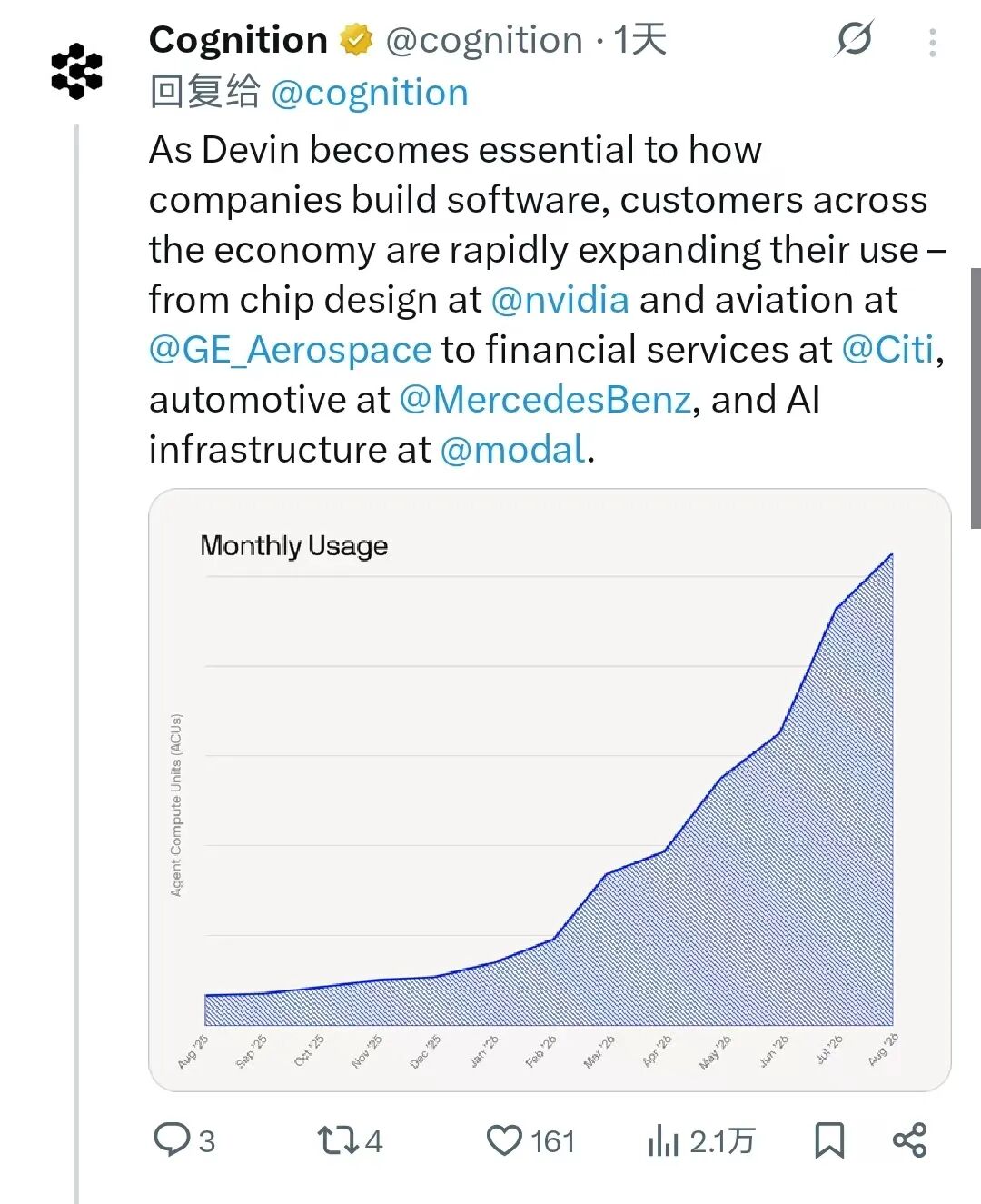
Scott Wu said publicly that Devin's current positioning is not to replace programmers, but to undertake the long-tail maintenance work that programmers are unwilling to do, such as legacy system upgrading and platform migration, so as to free up human resources for more creative work.
Another Ending for Unicorns
If Cognition's story is a "comeback from a desperate situation", Cursor, once the most dazzling star in the AI programming track, has taken a completely different path from Cognition.
Coincidentally, this is also a very story-rich startup.
In 2022, Anysphere, the parent company of Cursor, was founded by four MIT students. It received 8 million US dollars in seed round from the fund under OpenAI in 2023, and the subsequent financing pace was extremely fast, with its valuation rising accordingly. In August 2024, its valuation reached 400 million US dollars; in January 2025, its valuation hit 2.6 billion US dollars; in June 2025, its valuation was close to 10 billion US dollars; in November 2025, its valuation jumped to 29.3 billion US dollars at one stroke, with big names such as NVIDIA and Google appearing in the investor list. At that time, Cursor's annualized revenue had exceeded 1 billion US dollars, serving more than half of the Fortune 500 companies, making it one of the fastest-growing software companies in history.
But the real turning point came in the first half of 2026.
SpaceX announced that it would acquire Anysphere through an overall acquisition. The transaction consideration was about 20% premium to the approximately 50 billion US dollar valuation that Cursor was negotiating at that time, which was equivalent to 24 times the valuation after the latest round of financing in the capital market. This transaction was completed through X67 Inc., a wholly-owned subsidiary of SpaceX. The two parties signed a merger agreement in June this year. Anysphere was merged into SpaceX, and Cursor became its wholly-owned subsidiary as a surviving entity.
This move is regarded as the last piece of Elon Musk's computing power layout — before the acquisition, two heads of product engineering at Cursor had joined SpaceX to participate in R&D related to xAI. After the acquisition, the relevant resources will be used to improve Grok. SpaceX also explicitly mentioned in its IPO prospectus that the data of programming requests and design decisions from Cursor developers will be used to improve its AI model Grok.
At this point, the outstanding AI programming player that once had an independent valuation of nearly 30 billion US dollars has disappeared from the "unicorn" list, becoming a part of Elon Musk's business empire.
In the same track, there are still several players running independently at a fast pace.
For example, Lovable, a Swedish startup founded in 2024, focuses on "vibe coding". Its valuation was 6.6 billion US dollars in December 2025, its annualized revenue exceeded 500 million US dollars in June 2026, and it announced the completion of a 400 million US dollars Series C financing in August 2026, with a valuation of 13.3 billion US dollars. This round of financing was led by Menlo Ventures and co-led by Scaleup Europe Fund under EQT; at the same time, Replit, the established American online programming platform, has completed the transformation from an "educational tool" to an "AI-native development platform". Its valuation was 3 billion US dollars in September 2025, and reached 9 billion US dollars in March 2026, tripling in half a year.
As we can see, the financing pace of the AI programming track is refreshed on a monthly basis, and the speed of valuation doubling far exceeds the historical record of traditional SaaS companies.
Why Are Capital Players Willing to Bet Big on "AI Programmers"?
The reason why the AI programming track has produced many unicorns, even super unicorns with a valuation of tens of billions of US dollars in just two or three years, comes from a very simple business judgment: coding is one of the scenarios with the most sufficient commercial verification and the strongest willingness to pay for large language models at present.
Menlo Ventures gave specific data support in its *2025 State of Enterprise Generative AI Report*: In 2025, enterprise department-level AI expenditure reached 7.3 billion US dollars, a year-on-year increase of 4.1 times, of which programming alone accounted for 4 billion US dollars, equivalent to 55% of the total department-level AI expenditure. It is the largest single category in the entire application layer, far outperforming categories such as IT operation and maintenance (10%), marketing (9%), customer success (9%), design (7%), and human resources (5%).
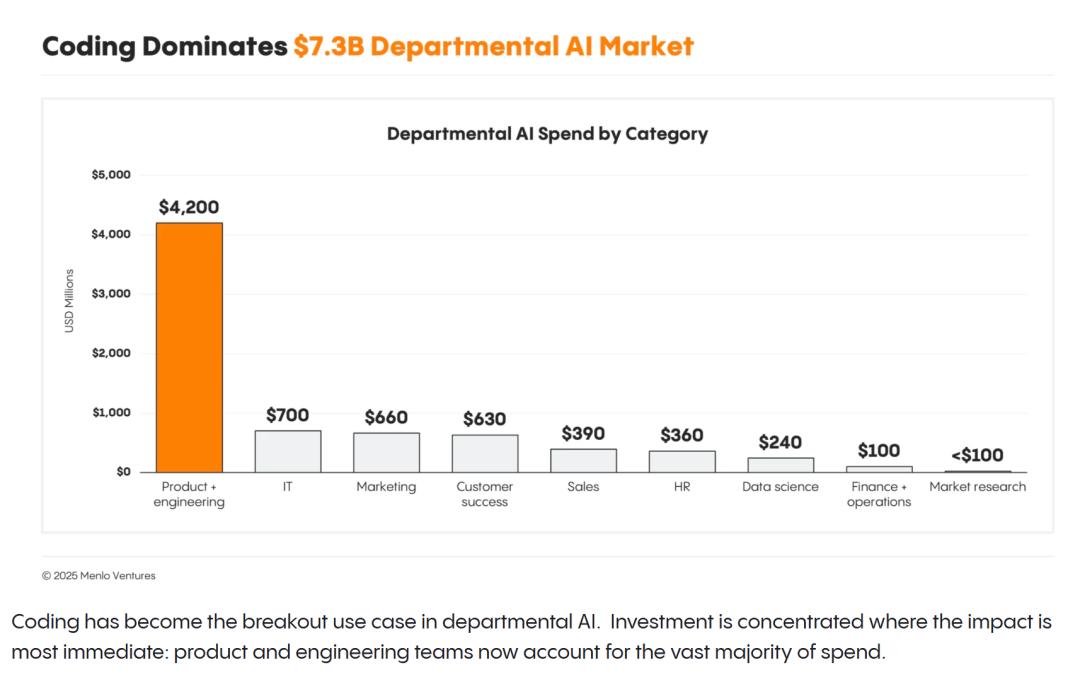
The report calls programming the "first killer application scenario" of generative AI, which also explains why capital is pouring into this track so intensively — compared with general chat assistants, the value of programming tools can be directly measured by "how many engineer working hours are saved", the payment logic is closer to traditional enterprise software, and it is easier to convert into sustainable subscription revenue. This is also why Cognition emphasizes "undertaking long-tail maintenance work", which essentially aims to prove to the market that AI programming tools have crossed the "toy" stage and entered the ranks of core enterprise productivity tools.
But this track is also full of undercurrents.
According to data from Ramp, Cursor's market share in the AI programming tool market has dropped from 41% in June 2025 to about 26% in May 2026; correspondingly, according to Menlo Ventures data, Anthropic, with its own Claude Code product, saw its market share rise from 42% in the second half of 2025 to about 54%, with a customer satisfaction (CSAT) rate as high as 91% and a Net Promoter Score (NPS) of 54, far higher than the performance of the established tool GitHub Copilot, which only got a "most favored" score of 9%.
It should be noted that Menlo Ventures itself is one of the investors of Anthropic, and this industry report needs to be interpreted with consideration of its potential stance tendency. Menlo Ventures specifically pointed out in the report that this does not mean that the market will move towards a winner-takes-all consolidation. Most professional developers will use more than two tools in their daily work. IDE-integrated tools (Cursor, Copilot) and terminal/agent tools (Claude Code) occupy different positions in the developer workflow and are not mutually replaceable.
But this still shows that before being acquired by SpaceX, Cursor had already felt the pressure from model manufacturers "overstepping their authority" in the market — when large model companies such as OpenAI and Anthropic develop programming tools on their own, pure application-layer startups must find more irreplicable moats in computing power, model capabilities and product experience. Perhaps this is also one of the practical considerations for Cursor to choose to join SpaceX, which has abundant computing power resources, instead of continuing independent financing.
Looking at the entire AI application ecosystem, programming is only the first segment where capital has achieved a closed commercial loop.
According to estimates from Grand View Research, the global AI programming tool market size will grow from 9.8 billion US dollars in 2026 to 26 billion US dollars in 2030, with a compound annual growth rate of about 27.1%; some research institutions have given more radical forecasts, believing that this market is expected to exceed 90 billion US dollars around 2032.
Multiple industry research reports share the same judgment that North America still accounts for more than one-third of the global market share, but the fastest growing engine is shifting from basic functions such as "code completion" to in-depth enterprise-level and cross-industry penetration — industries with higher data compliance requirements such as healthcare and finance are considered to be the fastest growing segments in the future.
According to data from TechCrunch, in the first two months of 2026 alone, nearly 20 financing deals of over 100 million US dollars were completed by AI startups in the United States, and super financing of tens of billions of US dollars in the whole year has become the norm. At the same time, the domestic market is also echoing this trend, and AI programming tools under large companies such as ByteDance and Alibaba are also accelerating their iteration.
Obviously, this wave of mass emergence of unicorns in the AI programming track may just be the beginning, not the end.
Author | Feng Xiaoting Editor | Wu Ren