Does AI infrastructure bring the construction industry chain back to life once again?
In September, Jensen Huang publicly urged countries around the world to accelerate AI application and expand the construction of infrastructure such as data centers. It is reported that Jensen Huang, who has been strongly supporting the arrival of the AI era, compared AI to infrastructure like water and electricity in 2026. In the future, across the world, AI will seemingly become a "necessity" for modern life.
Interestingly, around the same period, China State Construction released its semi-annual financial report.
The value of newly signed contracts for data centers and computing power centers reached 87.3 billion yuan, up 328.3% year on year.
The two events, echoing each other, once again raise a point of concern: Will the long-quiet construction track be revitalized by industrial real estate? Previously, related topics like "DeepSeek is recruiting civil engineering talents" and "AI boosts excavator sales, civil engineering practitioners see hope?" were wildly shared in the social media circles of construction practitioners.
Apart from China State Construction, a number of small and medium-sized construction enterprises are also vigorously developing industrial construction. The client list of some curtain wall design enterprises in Linyi, Shandong, notably includes the Volcano Engine Computing Power Center. In Tongzhou, known as the "Hometown of Construction", industrial plant construction has become the core business of local construction enterprises.
The old golden era is most likely gone forever.
For the entire construction track, a new cycle of industrial infrastructure has just kicked off, and it remains to be seen whether enterprises can keep up with the trend smoothly.
Who has reaped all the dividends, and who is left out in the cold?
Entering the AI era, how huge is the boom of computing power infrastructure?
It is reported that intelligent computing centers, data centers and supporting infrastructure have become one of the fastest-growing new business forms in industrial real estate. Data shows that China's intelligent computing scale is expected to reach 1271.4 EFLOPS in 2026, with an annual compound growth rate of 52.3%; the annual compound growth rate of China's IDC market scale will reach 21.39% from 2023 to 2028, and the market scale is expected to exceed 626 billion yuan in 2028.
Meanwhile, the development of intelligent computing centers has exploded in the past two years. Statistics from China IDC Circle show that there are more than 500 intelligent computing center projects in different construction stages, of which 160 projects have been put into operation and more than 200 projects are under construction. Specifically, the physical computing power infrastructure covers civil construction, park construction, electromechanical installation, power grid expansion...
This is undoubtedly exciting good news for construction enterprises that have been struggling on the "profitability warning line".
Some time ago, the news that DeepSeek recruited civil engineering graduates made the entire construction industry celebrate the news widely. It is reported that apart from DeepSeek, statistics from "You Zhiyuan" show that a large number of Internet enterprises including ByteDance, Zhipu AI, Alibaba Cloud and Tencent have expanded their recruitment of talents in civil engineering, HVAC, electrical engineering and energy. Among them, ByteDance has registered a company in Ningxia, and technology enterprises are scrambling to embrace land, plants and infrastructure.
A large number of construction enterprises have indeed started the construction transformation for the AI era. As reported by *National Business Daily*, China State Construction has participated in the construction of multiple large-scale computing power centers, including Hebei Artificial Intelligence Computing Center, Volcano Engine Yangtze River Delta Computing Power Center, and Guangdong-Hong Kong-Macao Greater Bay Area Computing Power Infrastructure of Lianrong...
In addition to leading enterprises like China State Construction, some regional enterprises have also stepped into the AI track rapidly. Public information shows that as early as 2024, several leading construction enterprises in Shaanxi, including Shaanxi Construction Engineering Group, China Gezhouba Group No.3 Engineering Co., Ltd., Hualu Engineering Technology Co., Ltd. and Shaanxi Modern Design Institute, were exploring the integration of AI and the construction industry.
More interestingly, some enterprises have started to "reduce their reliance on real estate business".
A typical example is Chengdi Xiangjiang. In its main business composition, IDC business once accounted for 99.79%. It has successively won the bids for China Mobile Yangtze River Delta (Yangzhou) Data Center Computing Power Infrastructure Construction, China Telecom Jiangbei Data Center Computing Power Infrastructure, and the first phase project of Wuhu Longteng Intelligent Computing Internet Industrial Park...
However, after AI has activated traditional tracks one by one, an idea has quietly emerged in the construction industry:
Can this wave of industrial infrastructure replicate the universal dividends of the real estate golden era back then?
Looking back, in the inclusive period of the real construction industry, almost every enterprise made huge profits. Statistics from the China Index Academy show that in 2005, the average revenue of representative real estate enterprises in China was 2.49 billion yuan, and it reached 33.04 billion yuan in 2014, with an average annual growth of 32.2%. In terms of profitability, the average net profit margin of representative real estate enterprises from 2005 to 2014 was 18.1%.
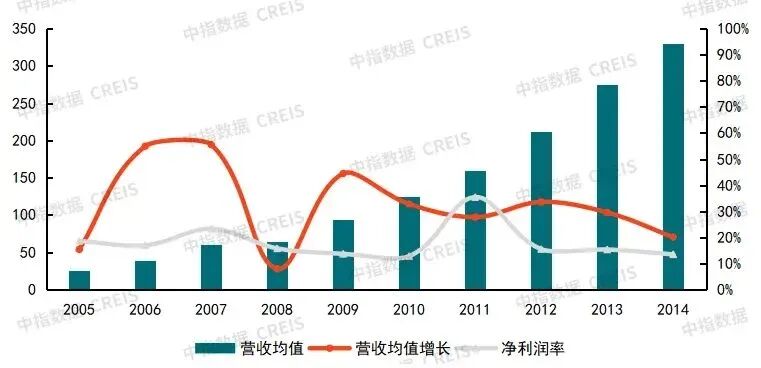
Can the computing power infrastructure boom driven by AI help the entire construction industry get rid of the downturn in recent years and regain confidence collectively?
Specifically, according to different capability levels, different enterprises occupy different ecological niches in the AI infrastructure industrial chain:
For example, the upper-tier EPC general contractors are represented by leading enterprises such as China State Construction, PowerChina and China Energy Engineering; the middle tier consists of professional engineering subcontractors, focusing on professional links such as electromechanical installation, clean engineering, liquid cooling system construction and special fire protection; the bottom tier is pure civil engineering subcontractors, undertaking the construction of main plants, facade curtain walls and park roads.
According to statistics from Qichamao, as of April 2026, there are as many as 23,366 surviving or operating industrial real estate-related enterprises in China. Coupled with cross-border traditional construction enterprises, this track will only become more crowded, and the internal competition will become more intense. Some enterprises have just started to reap dividends, while some others are facing declining performance.
Take Chengdi Xiangjiang as an example. Since the second half of 2024, Chengdi Xiangjiang has frequently won large orders in the computing power infrastructure sector.
In 2025, Chengdi Xiangjiang achieved an operating revenue of 3.858 billion yuan. In the first half of 2026, its operating revenue reached 1.473 billion yuan, up 14.59% year on year; but the net profit attributable to shareholders of listed companies was 6.4532 million yuan in loss, compared with 37.3581 million yuan in the same period of 2025, turning from profit to loss year on year.
In addition, computing power centers can be divided into two categories: IDC and AIDC. From the perspective of CAPEX (capital expenditure), the capital expenditure proportion of infrastructure, electromechanical and equipment is about 10%/40%/50%, which means that the capital expenditure proportion of infrastructure is not high compared with that of electromechanical and equipment.
Similarly, when DeepSeek's recruitment became a hit in the construction industry, many industry insiders said that in the total engineering volume of data centers, the proportion of civil engineering works is usually less than 20%. In contrast, the demand for electrical, HVAC and structural professionals is greater, which means that AI infrastructure does not treat all construction enterprises equally.
For leading enterprises with inherent power construction genes, this is a natural extension of their capabilities. But for some small and medium-sized enterprises that only have civil construction capabilities and imperfect business chains, this market boom has little to do with them. Without access to large subcontracts, they can only compete at low value-added links such as peripheral civil works, curtain walls and site roads.
The era is indeed advancing, but it does not take everyone along this time.
Is it hard to make money from Internet enterprises?
According to the *White Paper on China's Data Center Industry Development*, the Internet industry is the main driving force for the development of the IDC industry.
Entering the AI era, the global AI investment focus is further shifting to the upgrading of full-chain infrastructure.
According to the latest statistics from TrendForce, the total capital expenditure of the world's nine cloud service providers in 2026, including Google, Amazon, Meta, Microsoft, Oracle, as well as Chinese vendors ByteDance, Tencent, Alibaba and Baidu, will exceed 886.7 billion US dollars.
As the core carrier of AI infrastructure, computing power centers have naturally become the key track for major enterprises to bet on.
For example, in July 2026, Alibaba Cloud officially announced that its three super data centers located in Nantong, Hangzhou and Ulanqab were officially completed, and more than 10 super data centers will be built across the country in the future; in September, *South China Morning Post* reported that ByteDance is building a new batch of data centers in Ulanqab, Inner Mongolia, and the newly added computing power scale is expected to reach 5-6 GW.
The large-scale capital investment of Internet enterprises has opened a window for a large number of construction enterprises to participate in AI infrastructure.
For example, China Construction Third Bureau undertook the Wuwu Computing Power Center project of Volcano Engine in the Yangtze River Delta; Hunan Construction Investment Engineering Group undertook the second phase project of the Zero-Carbon Intelligent Computing Center Base of 21Vianet in Ulanqab; Chengdi Xiangjiang has cooperated with a large number of leading Internet enterprises such as ByteDance, Alibaba, Tencent, Huawei and JD.
It should be noted that although the era has given the construction track a chance of rebirth, it is not easy to make money from leading Internet enterprises.
First of all, computing power centers are asset-heavy and high-energy-consuming. *South China Morning Post*, citing a previous research report released by Soochow Securities, said that the upfront investment required to build a 1GW AI data center is about 160 billion yuan, of which IT hardware and power expenditure run through the whole cycle of the project and are the two core cost items.
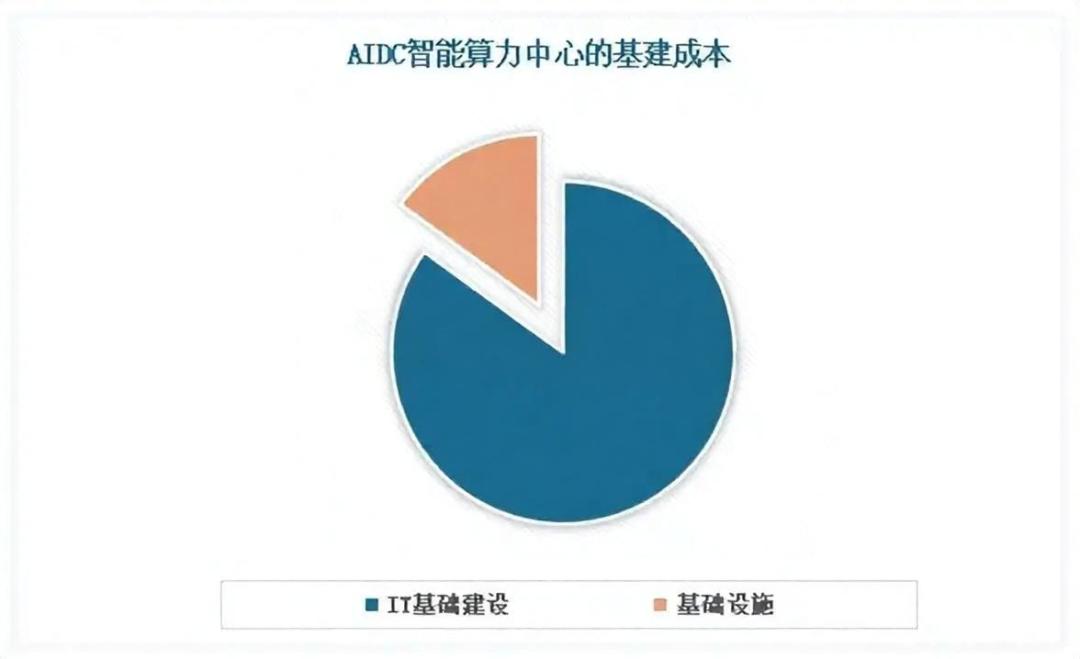
Consistent with the previous statement that infrastructure accounts for 10% of the capital expenditure of computing power centers, a set of explanations disclosed by Aofei Data in 2022 shows that:
For the company's IDC projects (taking Building B and C in Langfang Gu'an and Building A in Guangzhou Nansha as examples), the proportion of equipment procurement expenditure in the total investment exceeds 80% (84% and 83% respectively), and the project construction is dominated by hardware investment; in addition, the proportion of engineering expenses such as civil engineering design is 14%-15%.
In the past two years, as AI drives high-end ten-thousand-card level AIDC projects, the proportion of hardware equipment cost will only be higher, and the proportion of civil engineering cost will be lower.
Secondly, in the entire IDC industrial chain, Internet customers have always had requirements for high customization, high flexibility, low cost and fast delivery. In the AI era, the contradiction of high demand flexibility of Party A and weak revenue certainty of downstream contractors has become more prominent. It is reported that Chengdi Xiangjiang has encountered successive changes in the contracts of two computing power projects.
If cross-border enterprises that follow the trend are involved, the probability of fluctuation will be even greater.
In the past two years, food enterprises, clothing enterprises and home appliance enterprises have been rushing into the computing power track, but the subsequent collapse came very quickly. It is reported that in April 2025, Lotus Holdings terminated a computing power contract with an amount of 555 million yuan; in September of the same year, the wholly-owned subsidiary of Jingyuan Environmental Protection announced the termination of the 320 million yuan computing power cluster construction project.
In July 2026, Jim Chanos, the Wall Street short master and founder of Chanos & Co., said on the Risk Reversal podcast: The current scale of AI infrastructure investment far exceeds that of the dot-com bubble period, and the return on incremental invested capital of hyperscale cloud vendors has dropped from 40% about 18 months ago to about 20% at present.
If the expenditure rate continues, this figure may further drop to 10%.
This "prediction" for AI infrastructure not only sounds the alarm for Internet manufacturers, but also reminds construction enterprises that are flocking to the transformation of computing power construction: the current hot order boom is essentially a rush by technology giants, not a permanent long-term rigid demand.
This forces construction enterprises not to blindly chase for orders, but to seize opportunities to give full play to their own strengths and focus on solid performance of contracts.
For example, some power enterprises rely on wind power, photovoltaic and energy storage resources to build an "integrated computing and power" model, which greatly reduces the power cost of computing power centers through direct supply of green power. Traditional construction enterprises and building material manufacturing enterprises can quickly deploy computer rooms by revitalizing idle plants, greatly shortening the infrastructure cycle and cutting fixed investment.
Looking back at the general carnival of the real estate golden era, the construction industry may never wait for such universal dividends for all.
Fortunately, AI computing power infrastructure can bring about a precise capability stratification and value reconstruction, which is enough to reward enterprises that strive for upward growth.
Is the industrial real estate track undergoing drastic "reshuffling"?
The heat wave set off by computing power infrastructure makes it easy to mistake it for the biggest boom in industrial real estate. But in fact, if we set aside the topical effect of AI, we will find that after breaking away from the low-end plant construction, the entire industrial real estate is splitting into a number of segmented tracks along the context of high-end manufacturing.
Computing power centers are certainly one of the fastest-growing categories, but in addition, semiconductor clean plants, new energy super factories, intelligent automobile production bases, aerospace supporting industrial parks, humanoid robot test sites, low-altitude economy takeoff and landing hubs... a new batch of industrial real estate carriers are also rising rapidly.
Take China State Construction as an example. Its 2026 semi-annual financial report shows that industrial plants have become the largest growth pole of the enterprise, with newly signed contracts of 561.7 billion yuan in the first half of the year, a year-on-year increase of 24.2%, accounting for 36.2% of the total newly signed contracts for housing construction. In addition to computing power centers, it also covers the plant construction for emerging industries such as semiconductors, new energy, electronics and communications, automobile assembly and aerospace.
As the return on investment of residential and commercial properties is gradually decreasing, industrial real estate is indeed taking over the baton of the era. The Forward Industry Research Institute predicts that with the outbreak of industries with large land demand such as low-altitude economy and humanoid robots, the total supply of industrial and mining storage land across China is expected to rise to more than 150,000 hectares by 2031.
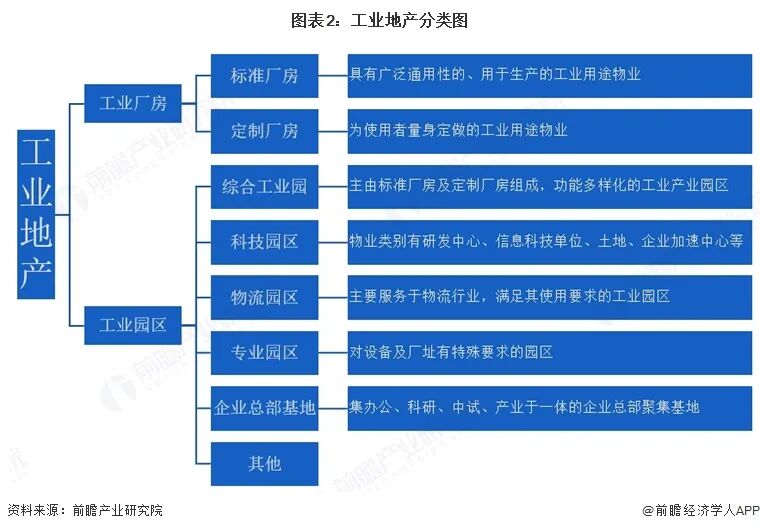
It is worth noting that with the change of times, great changes are taking place in the industrial real estate track.
Specifically, land supply rules, industrial forms and business models are all refreshing the old game rules of the past few decades.
First look at the land supply rules. The current industrial land is basically bound to high-end industries.
In August 2025, *CNR* reported that Zengcheng District, Guangzhou, listed and transferred 5 plots of industrial land, with a total land area of 12.41 hectares and a planned floor area of 490,200 square meters, focusing on new energy, low-altitude economy, new materials... Similarly,