Soaring by 98.7%, the smart glasses industry is undergoing accelerated differentiation: AR is advancing at a frantic pace, while audio and photography-related tracks are on the wane.
According to Luo Tu Technology, the cumulative sales volume of domestic smart glasses through online and offline channels in the first half of this year reached 909,000 units, a year-on-year surge of 85.5%, with sales revenue hitting 1.88 billion yuan, up 98.7% year-on-year. The entire industry is showing a thriving scene.
However, in July, affected by the consumption overdraft of the 618 shopping festival, the retail sales of smart glasses on the three mainstream e-commerce platforms monitored by Luo Tu, namely JD.com, Tmall and Douyin, were only 74,000 units, down 15.3% year-on-year. The fluctuation of the overall sales volume of smart glasses is related to market changes, but the ebb and flow of different categories indicates that some types of smart glasses are at risk of being eliminated by the market.
AR Glasses Are Advancing by Leaps and Bounds, While Audio and Camera Glasses Are Stuck in the Mire
Luo Tu Technology divides smart glasses into three major categories: AR glasses (with display + audio), audio glasses (no display + with audio), and camera glasses (no display + with camera). Among them, AR glasses perform the best. In July this year, not only did their average price reach 2990 yuan, but their retail volume also reached 32900 units, up 72.7% year-on-year. The retail volume of audio glasses and camera glasses decreased by 16.6% and 46.6% year-on-year respectively, with the average price being 656 yuan and 819 yuan respectively.
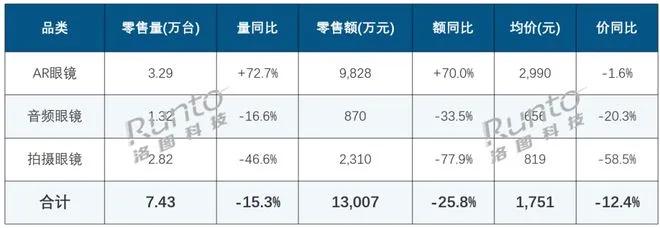
(Smart glasses sales volume in China's online market in July; Source: Luo Tu Technology)
The reason behind this is that the biggest difference between these three types of smart glasses lies in whether they can provide independent value that is difficult to replace by other devices, and AR glasses just have this advantage.
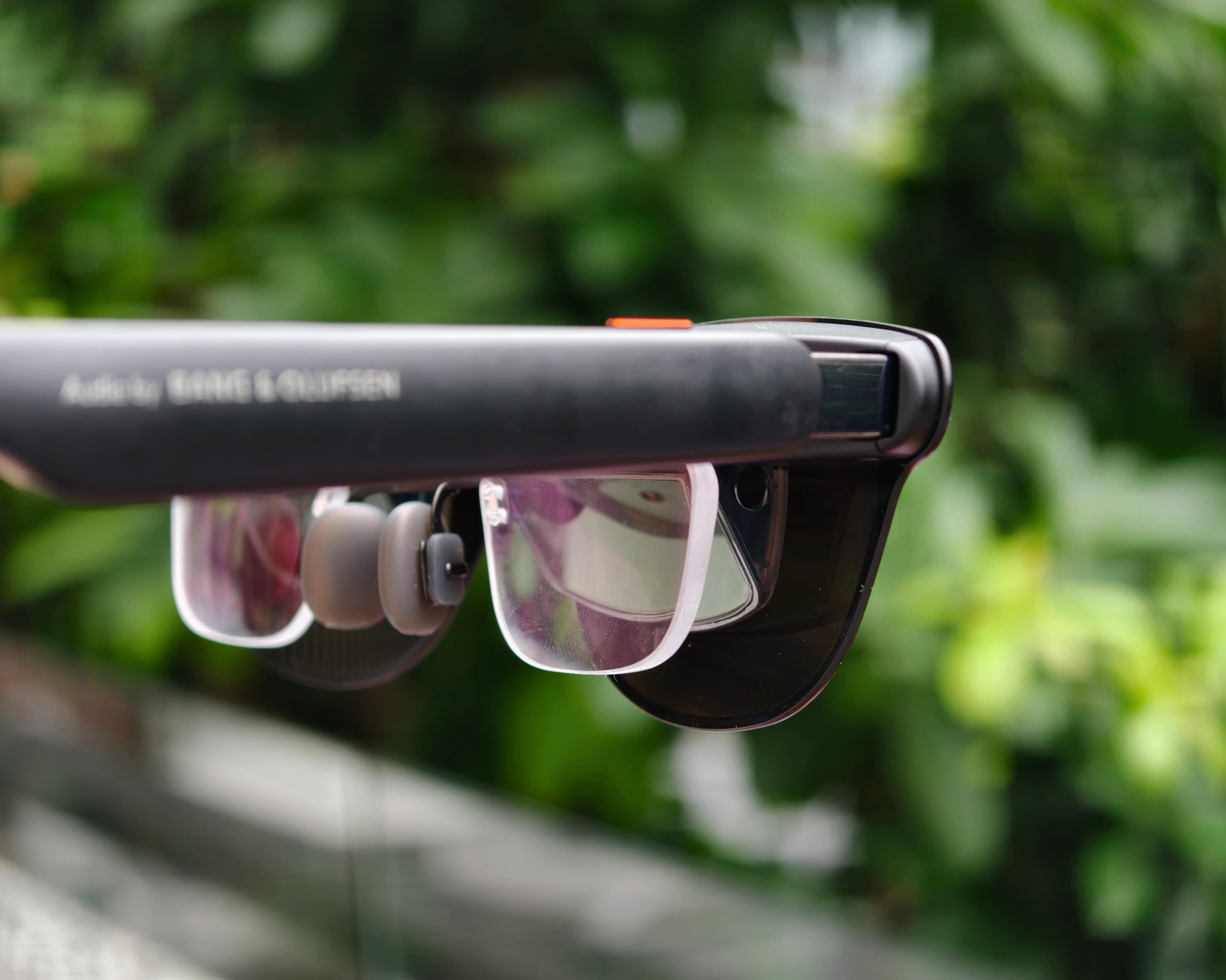
The unique feature of AR is that the lens can display content, and it can convey information to users in multiple modes such as images, videos, and texts. For specific products, taking the Thunderbird Innovation GT Max as an example, this device can achieve a 59° field of view, project a 267-inch giant screen, and also support head tracking and spatial audio, allowing users to immerse themselves in their own world anytime and anywhere.
The Thunderbird Innovation iO AI glasses, which focus on AI interaction, have a 33-inch projection screen and support functions such as full-day AI Q&A, real-time prompts, full-day AI intelligent note-taking, AI assistant, and translation communication. Smart glasses have become a very important AI interaction entry, but the lenses of audio glasses and camera glasses cannot display content, which limits the efficiency of information interaction.
In addition, the optical waveguide technology has become one of the main technical routes for AR glasses to achieve lightweight. The relief optical waveguide, which balances performance and mass production feasibility, is the common choice of domestic mainstream brands, Microsoft and Meta. The Blue Lake optical waveguide solution adopted by Thunderbird Innovation iO AI glasses is also based on this, and technologies such as geometric optical waveguide, volume holographic optical waveguide, and polarized volume holographic optical waveguide are also iterating synchronously.
AR glasses with comprehensive and clear information interaction and continuously optimized overall experience are playing an increasingly important role in scenarios such as audio-visual entertainment, office work and daily life. Even with relatively high prices, they still show strong consumer appeal.
(Source: Lei Technology Production)
Audio and camera glasses are different, they are too easy to be replaced by other products. In the audio glasses category, Huawei Smart Glasses 2 is a representative product. This pair of glasses adds functions such as face-to-face translation, simultaneous interpretation, and portable assistant. It can also monitor the user's neck posture through the built-in attitude sensor and send a reminder when the user lowers his head for a long time.
Functions such as face-to-face translation and simultaneous interpretation can also be realized by the HUAWEI FreeClip 2 ear-mounted headset. This headset can also wake up the voice assistant and support setting third-party agents on iOS and Android systems.
In short, audio glasses are like open-ear AI headphones + ordinary glasses, without deep technical and brand barriers. As a result, the tail market is extremely fragmented, and a large number of small and medium-sized brands rely on low-price and high-volume sales to carve up more than 60% of the low-end market share.
The situation of camera glasses is similar to that of audio glasses, which is equivalent to action camera + AI glasses. However, the differences in shooting effect, intelligent assistance and battery life lead to a polarized pattern in the industry. The products of brands such as Huawei, Xiaomi, Thunderbird Innovation and Qianwen are priced at around 2000 yuan. For emerging small and medium-sized brands such as Qingye and Amoi, their products are usually priced below 1000 yuan.
Relying on the logic of low-price and high-volume sales, Qingye has become a dark horse in the smart glasses market, ranking first in the retail share of smart glasses in China's online market in July.
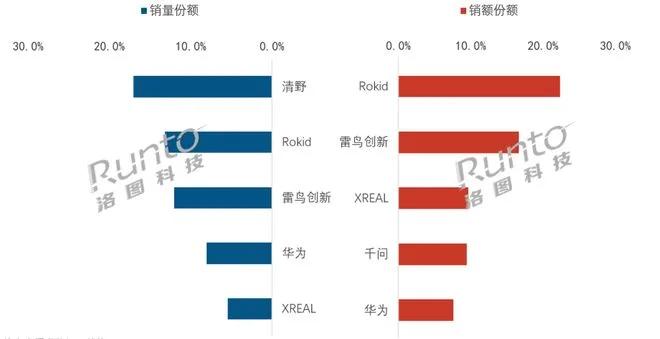
(Retail share of smart glasses in China's online market in July; Source: Luo Tu Technology)
Camera glasses also face two main problems: narrow demand scenarios and privacy security risks. The mandatory demand group for first-person shooting is concentrated among Vlog creators, outdoor enthusiasts and inspection personnel. The general public lacks the demand for continuous shooting in daily life. Moreover, we can use mobile phones to shoot videos, and there is no need for camera glasses. Not to mention that shooting videos in public places is likely to cause privacy disputes.
It is worth noting that according to the data released by Luo Tu Technology, the market share of camera glasses in the first half of this year increased by 9.7 percentage points year-on-year, and the sales volume maintained a growing trend. The sharp decline in sales in July is also related to the impact of low-cost products and the consumption potential overdraft caused by the 618 shopping festival.
From this point of view, the most critical factor for the change in the share of different categories of smart glasses is the usage scenario. Audio glasses can be replaced by open-ear AI headphones + glasses, while camera glasses have a small audience. For ordinary consumers, the first-person shooting provided by camera glasses has not formed a strong enough mandatory demand, and mobile phones can already cover most of the daily shooting needs.
In contrast, AR glasses directly bring images, texts and videos into the user's field of vision through near-eye display. This interaction mode is still difficult to be completely replaced by devices such as mobile phones and headphones. With the iterative upgrade of optical waveguide technology, AR glasses that are more lightweight and have better display effects will continuously enhance the user experience.
IFA Has Become a Smart Glasses Show, and "Capability Integration" Has Become the General Trend
IFA (Berlin International Consumer Electronics Show) is not only a stage for enterprises to show their technologies, but also a window for us to observe many industry development trends, and smart glasses are no exception.
The Lei Technology IFA coverage team found that at this year's IFA exhibition, Thunderbird Innovation exhibited the GT Max and iO AI glasses products mentioned above. In addition to AR functions, they also support audio functions and can be used to play music. The GT Max is equipped with four speakers jointly tuned by Thunderbird Innovation and Bang&Olufsen, a century-old Danish acoustic brand.
Thunderbird Innovation's V4 AI smart glasses, which focus on video shooting, are also equipped with four speakers jointly tuned by Bang&Olufsen to support high-quality music playback.
The AURA glasses exhibited by XREAL integrate portable spatial computing, 70° optical see-through display, 6DoF tracking, Bose EQ tuned spatial audio + 4 microphones, Gemini AI assistant and other functions and configurations. They can project screens and play music, and spatial computing can also be used for creation, remote design, medical teaching, industrial maintenance and training.
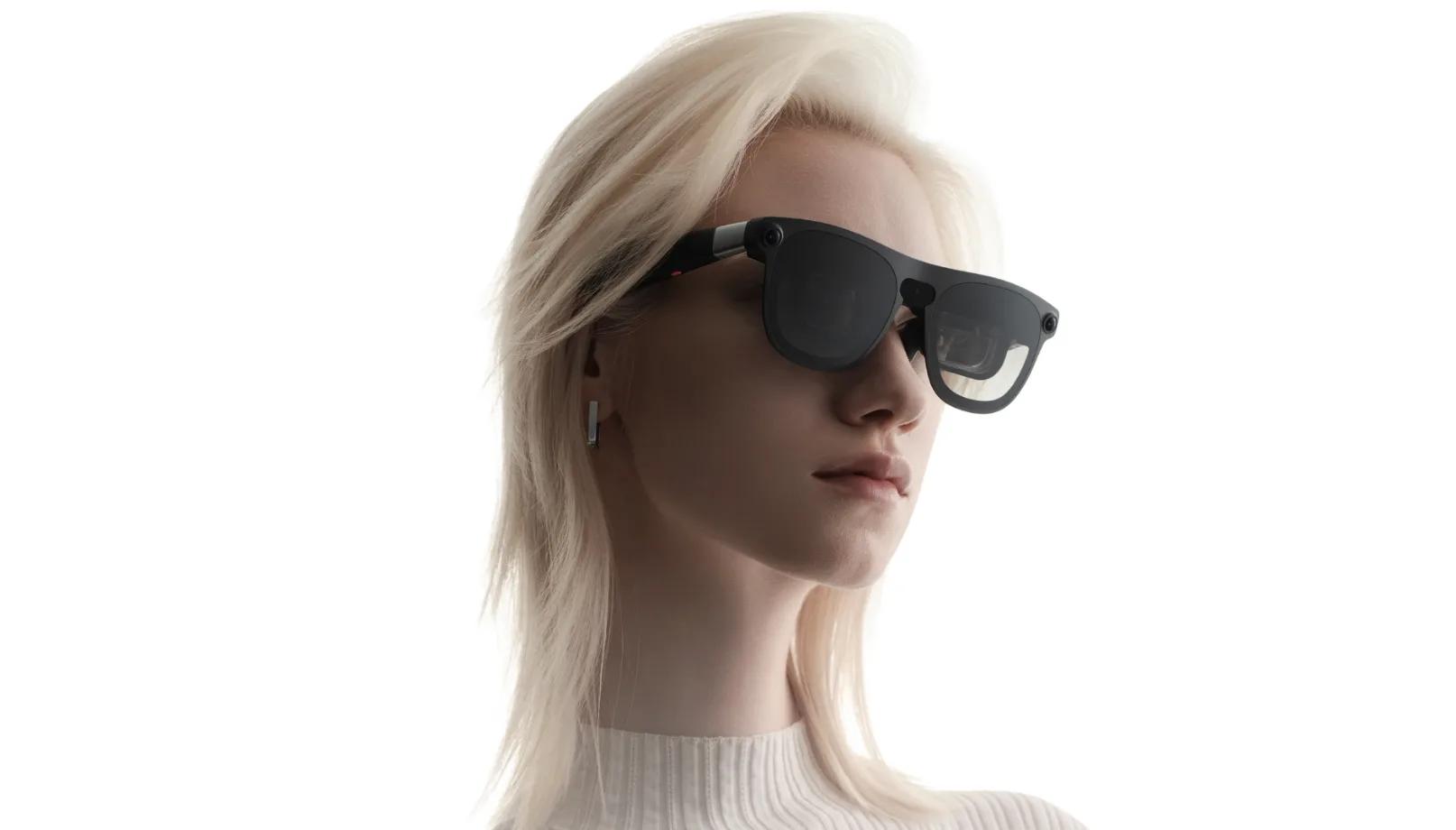
(Source: XREAL official website)
It is worth noting that XREAL AURA has three cameras, two for 6DoF tracking and hand tracking, and one high-resolution camera with a privacy indicator, supporting real-time AI perception.
The INMO GO3, which won the Innovation Award at IFA, does not focus on large-screen cinema interaction, but is mainly oriented to office scenarios. It supports functions such as AI non-inductive teleprompter, AI conference assistance, simultaneous interpretation, and photo translation. The built-in camera can also be used to take photos and videos.
The Qianwen team demonstrated a set of real-time user physical sign monitoring solutions for AI glasses at this IFA, which can measure users' heart rate, blood oxygen, HRV and other data through built-in PPG and temperature sensors. Rokid focused on showcasing AIUI Studio, a one-stop agent development platform, which can empower developers to accelerate the construction of the software ecosystem for smart glasses.
Judging from the smart glasses exhibited by major brands at IFA, integration has always been an industry trend, but this trend is more appropriately called "downward compatibility" rather than simple integration.
With the in-depth integration of smart glasses and AI, voice interaction is almost an essential function of smart glasses. Therefore, the industry has seen that AR glasses are basically compatible with audio and partially compatible with video shooting, while camera glasses are partially compatible with audio.
(Source: Lei Technology Production)
According to the online market data in July, the average price, retail sales and retail volume of audio glasses are all at the lowest level among the three types of products. The situation of camera glasses is slightly better than that of audio glasses, but the retail volume in July decreased by 46.6% year-on-year, which also exposes the current problem of weak growth of camera glasses.
In the view of Lei Technology (ID: leitech), audio glasses and camera glasses have relatively single functions, and the possibility of breaking through with a single point is very small. High-end products emphasize sound quality and shooting effect, while low-end products continue to sink into the market, which may be the best solution.
In addition, Qianwen has proposed another path for smart glasses, that is, health monitoring, which can be integrated with any category of smart glasses. However, considering the issues of battery life, cost, wearing time and other factors, audio glasses are the most suitable category.
As for the full-function integrated smart glasses, limited by factors such as volume, battery life, weight and cost, there will not be many in the short term. Just talking about the cost, the current official promised retail price (pre-tax) of the feature-rich XREAL AURA does not exceed 1500 USD (about 10,000 yuan), while the main AR glasses products of brands such as Thunderbird Innovation and INMO are basically priced below 3000 yuan.
AR Takes the Lead, The Best Days for Smart Glasses Are Yet to Come
Judging from the overall trend of smart glasses from January to July this year released by Luo Tu Technology, the industry has shown extremely strong market potential, and irreplaceable scenario value and interaction capability are the key to product competition in the new stage.
The core functions of audio and camera glasses have mature substitutes, with weak product barriers and serious homogenization. Low-price involution has completely compressed profits and living space. In addition, camera glasses have the shortcomings of niche scenarios and prominent privacy risks, so it is difficult to achieve market breakthrough relying on a single advantage.
The unique near-eye display capability of AR glasses is a visual interaction system that cannot be replaced by mobile phones and headphones. With the iteration of optical waveguide technology and the deep empowerment of end-side AI, it is playing an increasingly obvious role in scenarios such as audio-visual entertainment, office work and daily life.
The products exhibited by smart glasses enterprises at IFA2026 show that downward compatibility of capabilities and integrated upgrading of functions have become an irreversible trend. Audio and shooting functions have gradually lost the attribute of independent tracks and transformed into the basic perception and interaction modules of AR glasses. Limited by the physical hardware constraints such as weight, battery life and cost, full-function all-in-one products will be positioned in the high-end market for a long time.
Of course, audio and camera glasses will not disappear in the short term. With the feature of low cost, they still have a large audience in the low-end market. Qingye, which focuses on the low-end market, was able to outperform brands such as Thunderbird Innovation, Huawei, Rokid and XREAL in July, ranking first in retail volume, which is the best proof.