The optical fiber sector rose against the trend. What happened?
The most vibrant industrial exhibition this week is none other than the China International Optoelectronic Exposition (CIOE) in Shenzhen.
From September 9 to 11, the 27th China International Optoelectronic Exposition kicked off in Shenzhen, with over 4,000 enterprises from around the world participating.
Different from previous years when optical modules played the leading role, optical fiber has taken the center stage for the first time this year: On September 10, Yangtze Optical Fibre and Cable and Hengtong launched new brands of special optical fibers dedicated to CPO/NPO on the same day, making polarization-maintaining optical fiber the star of the entire exhibition.
The capital market responded simultaneously. On September 11, Changyingtong surged by 15.49%, and Yangtze Optical Fibre and Cable rose by 8.78%. Changyingtong even recorded a cumulative increase of over 90% in the single month of August.
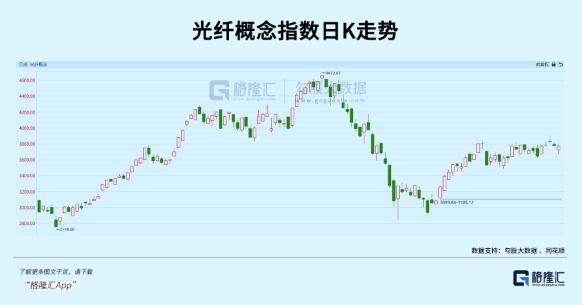
Yet back in July, this sector plummeted sharply in a single month, and the market was rife with concerns over "capacity expansion and oversupply". What exactly happened in between?
One Month, the Market Narrative Completely Reversed
Let's start with why the price dropped in July. The reason is simple: excessive previous gains superimposed on the overall volatility of AI-related assets.
The spot price of optical fiber rose from about 20 yuan per core-kilometer in 2025 to roughly 100 yuan in July 2026, five times the original price. The G.657.A2 optical fiber for AI data centers even jumped from 32 yuan to 240 yuan, marking a 650% increase.
With the price rising too rapidly, the market began to worry about two issues: first, such high profits would trigger frantic capacity expansion, repeating the tragedy of overcapacity in 2018; second, the market believed that the technical barrier of optical fiber was extremely low, and anyone could produce it easily.
However, several events that took place around the CIOE eliminated these two concerns one by one.
The first event: on September 5, China Mobile's centralized procurement of optical cables was finalized, with a budget of 7.1 billion yuan, purchasing nearly 70 million core-kilometers. The average price of ordinary optical cables was converted to about 102.56 yuan per core-kilometer, a 90.46% surge compared to the last round, hitting a new high in recent years.
What is more interesting is the details: the bare optical fiber tendered separately by China Mobile, with a tax-included price of 84 to 85 yuan per core-kilometer, unexpectedly failed half of the tender. The market price has already risen to over 100 yuan, while the tender price cannot keep up, so manufacturers would rather not take orders. This is the most direct evidence of a supply shortage.
The second event: on September 7, Goldman Sachs raised its forecast for the global optical module market size from 2026 to 2028 by 33%, 81% and 115% respectively in one go, and the market size for 2026 to 2028 is expected to reach 677 billion USD, 1314 billion USD and 1485 billion USD respectively. The more prosperous the optical module market is, the greater the consumption of optical fiber behind it, which is the transmission logic of the industrial chain.
The third and most critical event: on September 9, US operator Verizon officially announced that it would purchase more than 80 million miles of high-density optical fiber and connection solutions from Corning from 2027 to 2032, with a total amount of several billion US dollars. The purpose is clearly stated: it not only covers home broadband, but also explicitly serves the national backbone network of AI giants.
What does this mean? In the past, the optical fiber demand for AI computing power was concentrated inside the data center, but now it is expanding out of the data center, towards cross-data center DCI interconnection and national-level backbone networks. The supply and demand gap previously estimated by the market did not take this part into account at all.
The optical fiber price is still on the rise. The latest bulk optical fiber quotation on September 9 shows that the average price of ordinary single-mode optical fiber has rebounded to 105 to 110 yuan, and the quotation of high-end optical fiber for data centers at 170 yuan is still in short supply. The industry expects the price to further rise to 180 to 200 yuan later.
The supply side also provides strong support. The capacity expansion cycle of optical fiber preforms is as long as 18 to 24 months. The president of Hengtong Optoelectronics stated bluntly during the CIOE: it takes more than 20 months for new players to achieve mass production from scratch, and the new capacity will not be truly released until the second half of 2027.
In other words, it is physically impossible to "expand capacity to suppress the market" in the short term.
From "Connecting People" to "Connecting Computing Power", This Cycle Is Completely Different
To understand this market boom, we must first review the previous cycle. From 2015 to 2018, the "Broadband China" strategy superimposed on the fiber-to-the-home construction, leading to a simultaneous rise in the volume and price of optical fiber, making it the most prosperous track at that time.
However, the core of that prosperity was "connecting people": the only demand entities were the three major domestic operators, and all products were homogeneous ordinary optical fibers. As a result, high profits triggered indiscriminate capacity expansion across the entire industry. After 2018, the spot price directly fell from 78.8 yuan to 30 yuan after a 50% cut, and the industry went through seven or eight years of difficult times.
Where does this round of demand come from? Look at the capital expenditure of cloud vendors. The total capital expenditure of Microsoft, Amazon, Meta and Google in the second quarter of 2026 reached 171.2 billion USD, a year-on-year increase of 78.66% and a quarter-on-quarter increase of 30%.
Amazon, Google and Meta are still raising their full-year guidance. The four companies will invest more than 730 billion USD in total in 2026, most of which will flow to AI data centers, and data centers are exactly the scenarios that consume the largest amount of optical fiber.
The global optical fiber demand in 2026 and 2027 is expected to be 760 million and 889 million core-kilometers, with a year-on-year growth rate of 28% and 17% respectively; while the annual supply growth rate is only 11%. Structurally, the data center demand in 2026 is expected to be 132 million core-kilometers with a growth rate of 76%, and will reach 244 million core-kilometers in 2027 with a growth rate of 86%.
Another type of easily overlooked demand is optical fiber for drones, which is expected to reach 146 million core-kilometers in 2026, a year-on-year increase of 155%. This type of optical fiber is a "consumable" in high-end scenarios, with high unit price and strong repurchase demand. The proportion of emerging demand is expected to rise from 37% all the way to 45%.
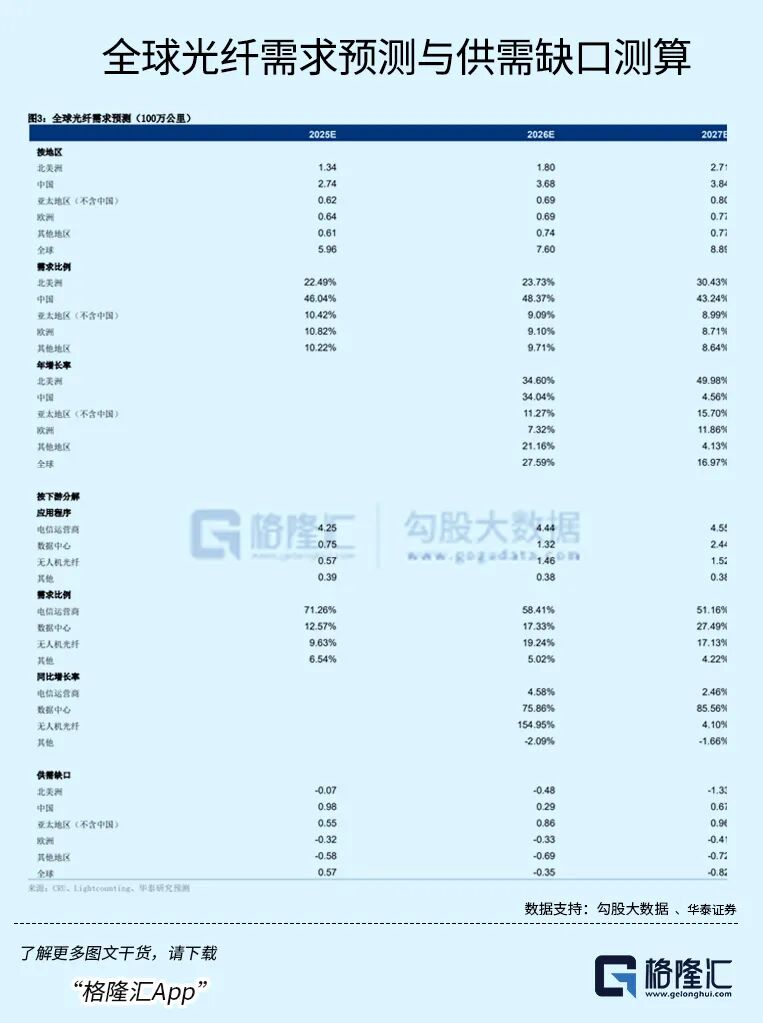
The demand growth rate far exceeds the supply, leading to a supply gap: the global gap in 2026 is about 35 million core-kilometers, and it may expand to 82 million in 2027, with the gap rate rising from 4.6% to 9.2%.
The last cycle was characterized by "oversupply leading to price wars", while this cycle is "rigid supply supporting prices", the development logic is completely reversed.
In terms of business model, the profit elasticity of the optical fiber industry lies in the preform. The pricing system of optical fiber is divided into three layers: the spot bulk fiber price is the most sensitive thermometer; operator centralized procurement is the fundamental base with annual bidding; long-term agreement orders are the ballast.
According to the calculation of Huatai Securities: for an optical fiber manufacturer with self-sufficient preforms, every 1 yuan increase in the spot price can bring 0.86 yuan of elasticity to the comprehensive selling price, and most of the price increase is directly converted into gross profit.
On the contrary, those manufacturers that do not produce preforms and can only purchase preform blanks from outside will see their costs rise along with the spot price, and only earn processing fees, so this round of prosperity has little to do with them.
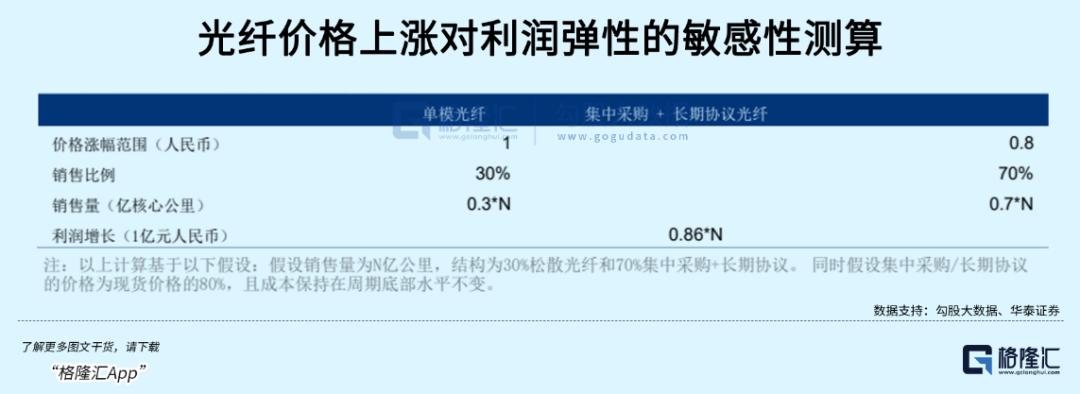
Therefore, the view that "the technical barrier is low" is a misunderstanding. The barrier does not lie in the drawing process, but in the upstream preform: environmental assessment, equipment, factory buildings, process verification, and yield improvement are all indispensable steps.
Moreover, high-end optical fiber is squeezing the ordinary production capacity structurally. For example, the G.657.A2 process is more complex, and the drawing speed is 10% to 15% lower than that of ordinary optical fiber. For every meter of high-end fiber produced by manufacturers, the supply of ordinary fiber is reduced accordingly.
About 60% of the global production capacity is held by Chinese manufacturers, which is a rare link in the optical communication field where we have the advantage of "restricting others' development".
The overseas market is also resonating. Corning has won billions of dollars of orders from NVIDIA, Meta and Amazon, and Japan's Fujikura has directly raised the price of DCI optical cables by 30%. The whole world is facing a fiber shortage, and the export structure of leading Chinese enterprises is still improving, earning profits from both rising sales volume and rising prices.
Where Are the Opportunities?
The first main line is leading manufacturers with self-produced preforms, who can directly benefit from the price increase. Manufacturers with high self-sufficiency rate of preforms are the biggest beneficiaries of the centralized procurement price increase.
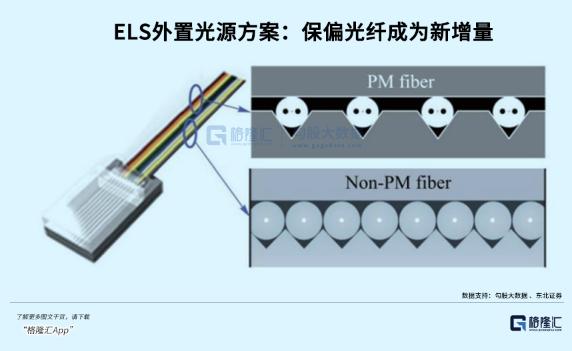
The second main line is polarization-maintaining optical fiber. The logic lies in the new NPO/CPO architecture: the next-generation optical interconnection places the laser outside as an independent light source module, and the continuous light emitted by the laser needs to be transmitted to the optical engine through the polarization-maintaining optical fiber. A 3.2T optical engine usually requires 4 to 8 polarization-maintaining optical fibers for light supply.
Ordinary optical fiber will lose the polarization state when transmitting signals, and only polarization-maintaining optical fiber can lock the polarization state. At this CIOE, the products launched by Yangtze Optical Fibre and Cable and Hengtong on the same day are exactly this type of product.
The third main line is DCI and hollow-core optical fiber after computing power expands out of the data center. The trend of "cross-data center computing power pool" indicated by Verizon's large order directly benefits DCI optical cables and G.654.E trunk optical fibers. The more cutting-edge product is hollow-core optical fiber, whose delay is 30% lower than that of traditional optical fiber. This product is still in the early development stage, but the certainty of its development direction is increasing.
However, since mid-August, many optical fiber companies have issued announcements on abnormal stock price movements. Changyingtong itself clearly stated that the revenue proportion of its polarization-maintaining optical fiber business for devices is less than 1%, and the on-hand orders are few.
This is the real situation of the current sector: the stock price has run ahead of the performance, and the order fulfillment of polarization-maintaining fiber will not come until NPO/CPO achieves large-scale volume production. You can trade on expectations, but do not take the story as actual performance.
Of course, investment cannot ignore the risks: first, with the concentrated release of new capacity in the industry later, if the AI demand fails to meet expectations, price wars may reoccur; second, the special demand such as drones is related to the external environment and has volatility; third, operators are under budget pressure, which may lead to price suppression or delayed centralized procurement; fourth, the short-term fluctuation of the sector may increase after the rebound. Be cautious of chasing high, and focus on the two most solid anchors: orders and prices.
Conclusion
From the concern about overcapacity to taking the center stage at CIOE, optical fiber is experiencing a delayed value revaluation. When AI computing power expands from data centers to backbone networks, and the demand shifts from "connecting people" to "connecting computing power", the first beneficiaries are often those "shovel sellers" who hold preform production capacity and master the polarization-maintaining process technology.
Gelonghui Research Institute has long been deeply engaged in the AI computing power industrial chain, from optical modules, CPO/NPO optical interconnection to optical cables and special optical fibers, continuously tracking the rhythm of price, order and capacity fulfillment, and deeply exploring excellent targets with real barriers and performance support. If you also pay attention to this cycle reversal of the optical fiber industry, welcome to follow us, and grasp the deterministic opportunities in the intelligent era together.
Note: The enterprises involved in this article are only for industrial case analysis, and do not constitute any investment advice. The market is risky, and investment needs to be cautious.
Disclaimer: The copyright of this report belongs to the investment research team of Beijing Gelonghui Investment Consulting Co., Ltd. (Duan Yuehan: A0160625050003). This report is produced based on the principles of independence, objectivity, fairness and prudence. All information is derived from public materials and collected, summarized and edited legally, reasonably and appropriately.
The stock market is risky, and entering the market needs to be cautious. Any investment advice in this article is not the basis for your investment transactions. You must make your own investment decisions independently and bear the risks yourself. Any unit or individual that without the permission of the company, illegally publishes, copies, disseminates or publishes and reposts this report on the network will be regarded as infringement, and the company will pursue the infringement responsibility in accordance with the law.
This article is from the WeChat official account "Gelonghui Finance Hotspot" (ID: glh_finance), the author is Gelonghui editor, and 36Kr publishes this article with authorization.