Unitree falls below 500 yuan, the primary market financing continues to decline, and the robotics industry has entered a cooling-off period.
Unitree, Has It Hit Rock Bottom?
On September 10, Unitree's share price fell 2.99% to close at 498.55 yuan, breaking through the 500-yuan integer mark for the first time and hitting a new low since its listing. Compared with the peak opening market value of 444.9 billion yuan on the first day of listing last month, its market value has evaporated by more than 240 billion yuan.
At the same time, the primary market also seems to be experiencing a receding tide.
According to statistics from Gaogong Humanoid Robot, in August this year, the entire embodied intelligence industry completed a total of 58 financing events, totaling 25.664 billion yuan. Although it increased by more than 375% year-on-year, it also fell by more than 18% month-on-month; in July, this amount was 31.6 billion yuan, down more than 9% month-on-month.
It is not difficult to see that the robot track is entering a period of capital cooling.
01
The Long-Delayed Cooling Period?
In fact, as early as April last year, Leng Xiaokun, founder of Leju Robotics, stated at the China Humanoid Robot Ecosystem Conference that if the industry cannot clearly explain where humanoid robots can be used and how they can generate value, "by the end of 2025, the humanoid robot or the entire machine intelligence industry will enter a cooling period."
From this perspective, the current cooling trend has been delayed for more than half a year.
The reason for the delay of this cooling period is not difficult to understand.
The industry is indeed answering the question raised by Leng Xiaokun. Starting from the second half of 2025, the commercial implementation of humanoid robots has seen visibly accelerated progress.
From more than 100 units at the beginning of the year, Agibot's mass production output rushed to 5,000 units by the end of the year. It won a 78 million yuan order for 200 full-size humanoid robots from China Mobile, and completed deployment in business halls in more than 30 provinces and municipalities across the country. Unitree Technology's annual revenue growth rate reached 332%, making it one of the few whole-machine companies in the global humanoid robot track to achieve large-scale profitability — its attributable net profit for the full year of 2025 was positive.
In the first half of 2026, the acceleration trend continues. The global shipment of humanoid robots is about 19,100 units, a year-on-year increase of 272%, and Chinese manufacturers account for about 97% of the total.
It is these real orders, shipments and revenue growth that make capital still willing to pay for them, thus delaying the arrival of the cooling period.
The total financing of the embodied intelligence track exceeded 41.9 billion yuan in 2025, but in the first half of 2026 alone, this amount exceeded 93.4 billion yuan, more than twice that of last year.
Under this massive wave, many newly established companies have also risen rapidly. Take the robot leasing platform Qingtianzu as an example. This company, which was only established in December last year, completed 6 rounds of financing in less than half a year after its establishment.
The story of Qingtianzu is not an isolated case. Lingxin Qiaoshou, a leading dexterous hand manufacturer, also announced 4 rounds of financing in more than half a year. In early May, when Lingxin Qiaoshou was exposed to plan its next round of financing, less than a week had passed since the company completed its previous round of financing.
In this round of financing plan, the company targets a valuation of 6 billion US dollars, equivalent to about 41 billion to 42.4 billion yuan; in contrast, Unitree, the industry leader that was on the eve of listing at that time, had an IPO valuation of 42 billion yuan.
It is not difficult to see that in the first half of the year, many investors have entered a state of "FOMO (Fear of Missing Out)". Sun Jiatao, Executive President of Haowang Capital of Pudong Science and Technology Innovation Group, said in an interview with the media that if they do not deploy popular tracks and star projects, they are worried about missing the industry outlet and completely missing out on opportunities.
02
The Core of the Cooling Period: Re-alignment of Capital Expectations and Industrial Reality
The root cause of the cooling of capital enthusiasm lies in the fact that the overdrawn long-term narrative in the early stage is forced to return to the industrial reality.
This phenomenon is vividly reflected in Unitree Technology.
The IPO of this "first humanoid robot stock" is quite dramatic: the issue price is 150.80 yuan, but on the first day of listing, the opening price surged to 1100 yuan, skyrocketing by 629%, with a maximum floating profit of 474,600 yuan for one lot, setting a new record for the most profitable new stock since the full implementation of the registration-based IPO system.
But the carnival only lasted for one day.
By August 20, the share price fell to 687 yuan, further fell below 550 yuan on September 2, and broke through the 500-yuan mark for the first time on September 10.
Even after falling below 500 yuan, Unitree's static P/E ratio still exceeds 700 times, which is an extremely aggressive assumption in any manufacturing track.
More notably, Unitree has shown signs of slowing growth. In 2025, Unitree's annual revenue growth rate was 332%, which plummeted to 68.49% in the first quarter of 2026, and further narrowed to 48.54% in the first half of the year; its non-recurring profit and loss deducted net profit was 244 million yuan, down 19.34% year-on-year.
As a leading player in the industry, Unitree naturally acts as the valuation anchor of the industry. Therefore, when Unitree's market value drops from 444.9 billion yuan to about 200 billion yuan, the primary market will naturally be affected.
In addition, the consecutive two-month decline in financing share in the primary market is also related to the extremely hot market in July to a certain extent.
In July this year, the embodied intelligence industry completed a total of 64 financing events, with a cumulative amount of 35 billion yuan, a year-on-year increase of 546.88%, hitting a new high within the year.
Historically, it is normal to see a correction after reaching a high point. For example, after the embodied intelligence industry raised 31 billion yuan in March this year, it also saw consecutive declines in April and May.
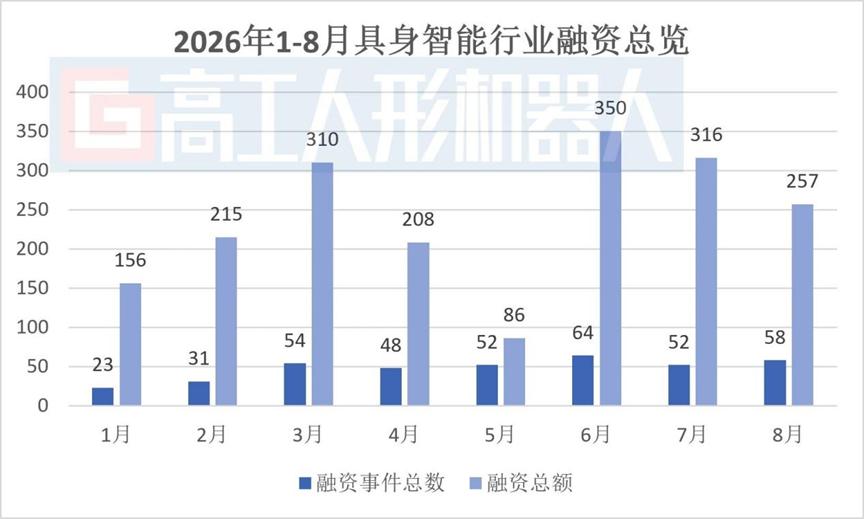
Source: Gaogong Humanoid Robot
03
Waiting for the Next Trigger in the Cooling Period
But equating the cooling trend with the falsification of industrial logic is also a misinterpretation.
If you broaden your perspective, you will find that the technology industry has staged many dramas of "first fanaticism, then cooling, then rekindling of enthusiasm".
Take autonomous driving as an example. From 2018 to 2021, L4-level autonomous driving was the most fanatical narrative of capital. At that time, Waymo's valuation once exceeded 30 billion US dollars, Cruise burned more than 8 billion US dollars in total, and domestic L4 startups often raised billions of yuan in financing.
However, in 2022, Argo AI, backed by two giants Ford and Volkswagen, announced its closure, which became a landmark event in the industry, and capital's enthusiasm for the entire track fell to a freezing point.
The turning point came in 2023.
It was not that L4 ushered in a technological singularity, but that the pragmatic, mass-producible, user-perceivable intermediate form of urban NOA reactivated the entire track. This year, car companies intensively launched services in new cities, and a "hundred-city battle" brought intelligent driving into daily commutes.
According to data from Western Securities, the annual sales of vehicles equipped with NOA in 2023 were about 700,000 units. From January to November 2025, the cumulative sales of passenger vehicles equipped with urban NOA reached 3.129 million units, with a penetration rate exceeding 15%.
In 2026, urban NOA has gone from being exclusive to high-end cars priced above 300,000 yuan to being a standard feature of 120,000-yuan family cars. Autonomous driving did not recover after waiting for L4, but found a mass-producible, perceivable, payable commercial entry point, thus rekindling market enthusiasm.
The current situation of the robot industry is far less depressed than that of the autonomous driving industry in 2022, and leading enterprises are also testing the real boundary of commercialization through different paths.
Among them, Ubtech U1 is a key observation window. This bionic robot, priced from 119,800 yuan to 990,000 yuan, had more than 13,000 orders across all channels on the day of its launch on June 30, which is more than 12 times the 1,079 B-end humanoid robot sales of Ubtech in 2025. The three pricing tiers range from 119,800 yuan to 990,000 yuan, covering multi-layer demands such as family companionship.
This product will start delivery on September 16. If the delivery reputation passes the test, U1 is expected to open up a brand new segmented track and reshape the pattern of the industry.
At the same time, the industry is still growing at a high speed. In the first half of 2026, the global shipment of humanoid robots is about 19,100 units, a year-on-year increase of 272%, with Chinese manufacturers accounting for about 97%; the Ministry of Industry and Information Technology predicts that the annual domestic output of humanoid robots is expected to exceed 100,000 units. Although the growth rate of leading player Unitree has slowed down, it still recorded an attributable net profit of 274 million yuan in the first half of the year, making it one of the few whole-machine companies in the global humanoid robot track to achieve large-scale profitability.
Perhaps for the robot industry, the current cooling trend is not a bad thing.
This article is from the WeChat official account "Alpha Workshop Research Institute", author: Si Che, published with authorization from 36Kr.