100 million Tokens are given away for free every week. Mark Zuckerberg is betting heavily on his ace product Muse: the AI will make money for you 24 hours a day, and I am only responsible for taking a commission from the profits.
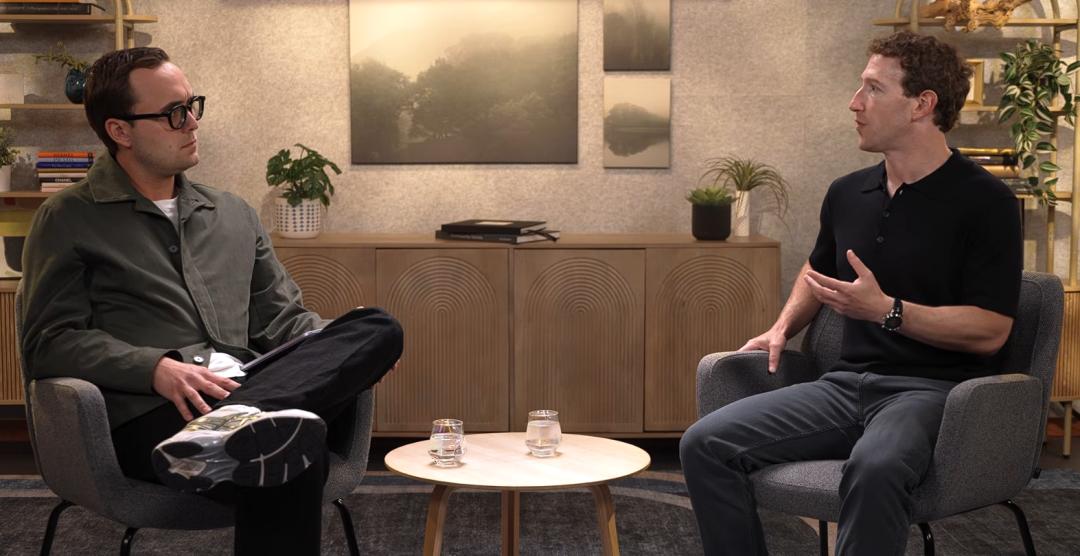
Tech journalist Alex Heath recently sat down with Mark Zuckerberg for a podcast, and the two talked for over an hour. The conversation was sparked by a 15-page long article titled *The Future is for Everyone* that Zuckerberg published on August 10. The article basically takes a counter stance against the mainstream Silicon Valley narrative: While other labs are worried that technology has become too powerful and advocate locking cutting-edge models in the hands of a small number of institutions, Zuckerberg argues that the greatest danger lies in keeping technology controlled by just a handful of players. The only way to build a safe future is to give the tools to everyone, so that ordinary people can form a system of checks and balances among themselves.
The core part of the interview is where Zuckerberg elaborated on their newly launched product Muse. Unlike current chatbots that respond to one prompt at a time, Muse assigns each user a virtual machine in the background that can **handle tasks for you online 7x24 hours a day**.
To ease public privacy concerns, Zuckerberg even brought in Moxie Marlinspike, the founder of Signal, to lead the development of the Confidential VM, locking down permissions at the architectural level so that even Meta's own engineers can never access users' screens. The business strategy is even more radical: Meta plans to offer users around 100 million free Tokens plus virtual machine computing power every week. They have no intention of profiting from computing power subscriptions, but are betting that this product can truly help small businesses and ordinary people make money, and only take a tiny cut from the commercial transactions it facilitates in the future.
When talking about model R&D, Zuckerberg openly admitted on camera that he had stepped into a huge pit: Llama 4 failed to deliver the expected results at all. He reflected that he used to oversimplify things, thinking that building large language models was the same as developing recommendation feeds in the past, which only required hundreds or thousands of engineers to run experiments through a human-wave tactic. Later he realized that large models can only be supported by an extremely high density of top talents. So he restructured the lab, and directly moved the core team to the workstations around his own office, sitting right next to him.
The two also talked about the current public resistance to AI. For example, why are people increasingly disgusted with data centers? Zuckerberg put it bluntly: many of those who just come to grab a plot of land, build a shell, and resell it to big manufacturers are purely short-term speculators, while Meta plans to take root in the local area for decades. The tax revenue brought by the data center built in Louisiana has directly given every local teacher a $50,000 bonus.
The full edited transcript of this interview is as follows:
1. Security is not about hiding technology like guarding against thieves, but about distributing tools to everyone
Host: Let's talk about that long article you published recently — or a manifesto, I'm not sure how to define it, let's call it a manifesto for now. It's a very long piece, and to be clear, it covers a huge amount of content. I want to start from here, because it includes a lot of important ideas that are closely related to our topic today.
I'm curious, why did you write this piece? After all, it's very long and involves so many different topics.
Mark Zuckerberg: Well, I think when you invest so much in AI, it's necessary to let people know what your lab stands for and what values you uphold.
There are enormous opportunities in AI, but there are also all kinds of real, tangible risks. So I think everyone working in this field should have a well-thought-out set of ideas about how their work can lead to a positive future.
Interestingly, different labs don't share the same philosophy on this. There are a lot of widely accepted consensuses in this industry that I actually strongly disagree with.
My view is that to deliver a positive future for everyone, the key is to distribute this technology as widely as possible. This is based on our three core principles:
First, empowering every individual is the source of driving global prosperity, which has always been the case throughout history;
Second, the core purpose of AI is to create new things, not just to automate existing workflows;
The third principle is that the foundation of future security lies in building reasonable checks and balances and a balance of power, rather than restricting access permissions.
Oddly enough, these views are very different from many common perceptions, especially in Silicon Valley. A lot of people will say: "This technology is too powerful, it must be restricted, and so many people can't be allowed to access it."
But personally, I'm actually more worried that such a powerful technology will only be controlled by a handful of labs or a small number of people.
Historically, when you put power in the hands of ordinary people, most progress isn't driven by existing giants or the establishment, but by marginalized groups — whose ideas were not taken seriously at first, but once they have enough tools to verify their assumptions, they will eventually generate huge momentum.
In Western societies, we build governance orders and maintain social balance through a complete set of checks and balances, right? That's the balance of power. In our social values, people fundamentally don't want to see a technology monopolized by just one or two labs.
As for the concerns that people often mention recently, such as cybersecurity, I think the best way to prevent others from using AI to invade systems is to let everyone have access to AI, so that they can reinforce their own systems first.
The development of cybersecurity over the past few decades has basically followed this path: because open-source software is accessible and auditable by everyone, putting it in the hands of the public has counterintuitively created a safer and more stable environment.
So this is my belief, and I think this is the path to a positive future: fundamentally, distribute the technology widely.
This has a lot of implications for what we're going to do next. Obviously, we want to build top-tier AI models, and we are indeed doing that. The newly released Muse Spark 1.3 is very advanced, but it's actually just the latest version of a smaller pre-trained model we built earlier, codenamed "Avocado" internally.
Host: We'll talk more about the code names later —
Mark Zuckerberg: Yeah, we'll dive into that later. And our "Watermelon" is coming out soon, which will be a huge move.
Clearly, the top-tier model can be seen as the most concentrated embodiment or implementation of this vision. The Muse personal agent we are launching is designed to give everyone in the world a highly capable personal agent that can understand your goals and work for you 7x24 hours a day.
A very important part of this is also putting technology in the hands of people. We are firmly committed to open source, ensuring that the huge opportunities here are not limited to a small number of people or a few companies.
Host: I have a lot of questions about the Muse agent, but let's talk a bit more at the macro level first, since you covered so much content just now: is open source the way to counter the trend you mentioned, the one you're worried about? In practice, is this the main response, or is regulation the solution? Or are both needed?
Mark Zuckerberg: No, I think the most critical thing is still putting technology in everyone's hands. So products like the Muse personal agent might be even more important.
You can already see that some labs are training more advanced models and then not even releasing them to the public.
Host: That's right.
Mark Zuckerberg: Yeah, so I think that's very dangerous.
When a technology is subject to external scrutiny, when you release the system publicly — first of all, putting it in the hands of many people will create checks and balances. You can drive widespread prosperity, which is very important for society. We can't just let one or two labs become extremely valuable.
You want to see tangible improvements in the lives of billions of people: whether it's running a small business, being more successful in your career, being more efficient in family life, saving money in all aspects, or improving health outcomes. You want these benefits to be extremely inclusive. That's one aspect.
And at the competitive level, I think having multiple labs is definitely helpful, and open source is very effective in this regard. So open source is a very important part of the whole picture.
The essence of open source is that a huge community is participating together. I'm not saying that our company alone can do all of this. I'm not a fanatic who thinks "everything must be open source". We will release some open source models, and we will also do some closed-source work. As a profitable company, it's only natural to develop some advanced technologies, and you don't have to share everything with the whole world.
But overall, supporting a sound open source ecosystem is the key to maintaining competition, transparency, and letting people understand where technology is heading — and I think this is actually extremely important for security.
If there are only a few truly powerful models left in the world... Take cybersecurity as an example, some people's instinctive reaction is — to some extent I can understand — "Since we have this highly capable cybersecurity model, we should only give it to the top 100 institutions in the world."
But the problem is, there are far more than 100 important institutions in the world.
Just like the incident that happened to Hugging Face before — Hugging Face might not be one of the top 100 large institutions in the world, but it's very important, and many people rely on it. When they found their system was hacked, they couldn't access those closed-source models that might cause problems, so they turned to open source models to solve the issue.
Therefore, having a healthy open source ecosystem is an important part of moving towards a secure and stable future. But for me, the most critical thing is still to ensure that technology can be widely distributed, rather than being held in the hands of a few people.
2. Grabbing land and reselling it is speculation, only taking root locally for decades counts as infrastructure
Host: Silicon Valley has been discussing recently why people's attitudes towards AI are so negative. You also mentioned this in your recent letter, trying to address these concerns. But people's sentiment towards AI, especially towards data centers, is really very negative right now.
It sounds like your core argument is — correct me if I'm wrong — that if we can popularize this technology, let more people access the technology that is currently locked in the hands of a small number of top labs, it might ease the sense of deprivation that people are feeling in this round of AI wave. Is that what you mean?
Mark Zuckerberg: There are actually many layers to this. There are so many aspects involved — that's why that article was 15 pages long, because we wanted to sort out all the different issues.
People have questions about employment and the economy, about data centers and their economic and environmental impacts on local communities. People also worry that AI might be misused, such as cybersecurity issues, and emerging biological risks. People also ask how we can maintain a free society, how to maintain the leadership of the United States, and how we can continue to firmly control technology as its capabilities become stronger and stronger.
These issues are all very important, so we can't just talk about them in general terms from a high level, because each specific issue has different nuances to consider.
But overall, these issues have one thing in common: to create widespread prosperity — and I think one of the better ways is to ensure that there are reasonable checks and balances on the access to technology, and that the scales are generally tilted more towards ordinary people, rather than towards any insider stakeholders — which will ultimately be very critical.
Take data centers as an example, our practical experience is that companies like Meta enter a community and commit to investing there for decades — which is exactly our plan when building data centers — we can definitely make sure that the local community truly benefits.
The tax revenue brought by data centers... For example, in Louisiana, our tax revenue directly funded the local community, giving a $50,000 bonus to every teacher. We created a large number of jobs and made huge investments in the local community. These are all good things.
But there is also a lot of speculation going on right now, some companies have no intention of operating data centers for decades. They just want to grab a plot of land and resell it to a big lab, they don't care much about the local community, and they have no intention of long-term investment. If you don't put in the effort to benefit the local community, people will naturally be very dissatisfied.
That's the difficulty when a speculative boom hits. I don't even know if I should call it a "bubble", because a bubble means overvalued valuations and things like that, but this is indeed a boom.
This leads to some short-sighted interest-driven behaviors that often fail to take every stakeholder into account — but long-term sustainability requires exactly that, taking everyone into consideration.
At the end of the day, if the technology we build can't create jobs, can't bring widespread prosperity, or the infrastructure we build doesn't help local communities at all, this kind of thing can't be allowed to continue. You have to design it in a way that it can help people in every aspect.
For those who are skeptical, or extremely pessimistic about the whole prospect, my basic thought is: if we end up failing to build it in a positive way, it simply won't work in reality.
Establishing reasonable checks and balances and widely distributing benefits can be said to be the prerequisite for this technology to expand in the way that is most beneficial to society in the future.
Host: I've never heard other tech executives in your position talk about data centers like this, seeing them as a long-term investment. Have you always thought this way, or have you gained a clearer understanding of this recently?
Mark Zuckerberg: Precisely because of the anti-data center sentiment you just mentioned, we did in-depth research, because we wanted to figure out: why don't people have such a big resentment towards our projects?
We asked a lot of people and found that there is indeed a big difference between speculators and companies focused on long-term development. If you think about it carefully, this is actually very reasonable.
One thing we did was to launch the "America's Workforce Academy" program. We thought at the time: "Okay, we're going to build so many data centers, and we're going to keep building them for a long time. But there simply aren't enough skilled workers in the market to complete these projects."
We need more fiber optic technicians, electricians, highly skilled carpenters, and so on. There is a serious shortage of people who can do these jobs — we need hundreds of thousands or even millions of people, but people haven't received the relevant skills training at all.
So we set up this training program to solve this problem, promising people who pass the training that they can be directly arranged to work in positions related to building infrastructure for Meta after graduation.
Why are we doing this? This is really not charity. We need these highly skilled people, so this is a win-win situation. If you plan to take root here for decades, this investment is very reasonable; but if you just want to build a place and resell it to another company, you definitely won't do such a thing.
Many problems in the world can often be solved naturally if you think long-term and align the interests and incentives of all parties. This is a very critical part of it.
From my point of view, society will absolutely not allow a handful of labs to control such important, highly capable technology and take all the huge wealth for themselves.
AI must benefit the general public to be truly viable. It must not only work technically, but also work socially. The two must go hand in hand.
3. Don't let lab experts dictate how you live your life
Host: Exactly. Now we can talk about Muse. Before that, you wrote an article about "Personal Superintelligence" a year