Japan is dragging the entire world down with it.
Japanese government bond yields have exceeded 3% for the first time in 30 years. Nomura Research Institute warns that the source of this round of global long-term interest rate rise is Japan itself, rather than external factors.
The combination of Japan's fiscal risks and expectations for monetary policy normalization is spreading globally through the bond market, posing a systematic threat to tech stocks, AI investment and even the real economy.
The yield of 10-year Japanese Government Bond (JGB) once broke through 3.0% during Tokyo trading, the first time since September 1996.
Takahide Kiuchi, executive economist at Nomura Research Institute, pointed out in the latest report that the yield of 10-year JGBs has risen by about 1.4 percentage points cumulatively over the past year, while the increase in the yield of 10-year US Treasury notes in the same period is only about half of that of Japan. This shows that the rise of JGB yields is mainly driven by domestic factors, not transmitted by overseas markets.
Takahide Kiuchi believes that in terms of the absolute yield level, JGB yields have hit a 30-year high, while US Treasury yields have only returned to the high level since January 2025, the 10-year German government bond yield is the highest since 2011, and the 10-year UK government bond yield is the highest since 2008. Through comprehensive comparison, Japan is more likely to be the source driving the rise of global long-term interest rates, rather than a passive follower.
Meanwhile, the Trump administration has begun to intervene in Japan's economic policies in a rare move, pressuring the Bank of Japan to raise interest rates and the Kishida administration to scale back fiscal expansion.
Three Factors Push JGB Yields Above 3%
According to the Nomura Research Institute report, the 10-year JGB yield had approached the 3% threshold in August, and finally broke through this integer level during trading on September 1, driven by three core factors.
First, expectations of the Federal Reserve's interest rate hike have risen. The remarks of Federal Reserve Chair Kevin Warsh at the recent Jackson Hole Symposium have strengthened the market's expectation that the Fed will raise interest rates at the September Federal Open Market Committee (FOMC) meeting, putting pressure on the global bond market.
Second, expectations of the Bank of Japan's interest rate hike have heated up. The market generally expects the Bank of Japan to raise the policy rate at its September monetary policy meeting, further pushing up JGB yields.
Third, the risk of Japan's fiscal expansion has intensified. By the end of August, the total amount of general account budget applications for fiscal year 2027 submitted by various Japanese government departments was about 20 trillion yen higher than the fiscal year 2026 budget, which greatly aggravated the market's concerns about the deterioration of Japan's fiscal situation.
Fiscal Risk is the Main Driver of Yield Rise
Nomura Research Institute conducted a decomposition analysis on the causes of the 1.4 percentage point rise in the 10-year JGB yield over the past year. The results show that rising inflation expectations contributed about 0.49 percentage points, changes in the proportion of JGBs held by the Bank of Japan contributed about 0.08 percentage points, the rise in 10-year US Treasury yield contributed about 0.08 percentage points, changes in real policy rate expectations contributed about 0.15 percentage points, and the "other" factors contributed as high as 0.60 percentage points — this item is considered to mainly reflect the risk premium of the deterioration of Japan's fiscal situation.
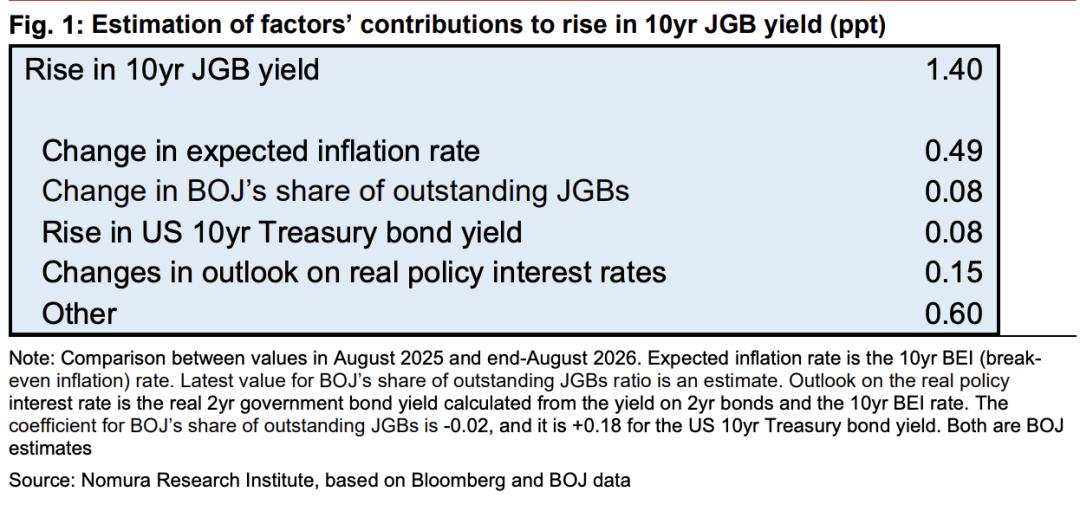
This means that among all factors driving the rise of JGB yields, fiscal risk premium is the largest single contributor, far exceeding the impact of inflation expectations and monetary policy expectations.
Takahide Kiuchi pointed out that the rise of long-term interest rates is not always a "bad thing" — if it stems from the improvement of economic growth potential or the rise of inflation expectations, the real interest rate may not necessarily rise accordingly, and the negative impact on the economy is limited. However, if the rise is mainly caused by fiscal risks, it will often have a substantial negative impact on economic activities, and this kind of shock is usually more lagging and harder to detect than the rise of short-term interest rates.
The Trump Administration Rarely Intervenes in Japan's Economic Policies
The Trump administration has begun to intervene in Japan's economic policies in an unusual way.
US Treasury Secretary Bessent clearly stated to Japanese Minister of Finance Satsuki Katayama and Bank of Japan Governor Kazuo Ueda at the recent G20 Meeting of Finance Ministers and Central Bank Governors that Japan needs to clearly communicate its fiscal sustainability path and interest rate hike plans.
Earlier, after the end of the Japan-US joint foreign exchange intervention at the end of July, Bessent had publicly expressed his expectation for the Bank of Japan to raise interest rates.
Nomura Research Institute believes that the logic behind the Trump administration's move is: The continuous depreciation of the yen and the fall of JGB prices (rise in yields) may have a negative impact on the United States and even the global market. Therefore, Washington is seeking to intervene more actively in the direction of Japan's economic policies, pushing the Bank of Japan to raise interest rates and urging the Kishida administration to scale back its fiscal expansion stance.
The report points out that if the Kishida administration gradually adjusts its proactive fiscal policy stance, the risk of Japan's fiscal deterioration will decline, and the upward pressure on the 10-year JGB yield will also be reduced accordingly.
The Rise of JGB Yields May Trigger Global Financial Market Turmoil and Cool Down the AI Boom
Nomura Research Institute warns that the potential impact of the global long-term interest rate rise with Japan as the epicenter on the economy and financial system cannot be underestimated.
From a macro perspective, the rise of long-term interest rates will push up the interest expenditure of governments around the world, which may trigger a negative spiral of "fiscal deterioration — yield rise", while lowering the market value of bonds in the portfolios of financial institutions and undermining the stability of their balance sheets.
In addition, the rise in interest rates will also put downward pressure on the prices of risk assets such as real estate and stocks.
Of particular concern are technology and AI-related stocks. Such assets are extremely sensitive to rising interest rates.
Takahide Kiuchi pointed out in the report that if the rise of long-term interest rates centered on Japan continues, it may trigger a cooling of the AI boom in the stock market.
The decline in prices of AI-related stocks will further weaken the ability of relevant enterprises to raise large-scale investment funds through equity or debt financing, thus braking the expansion of physical asset investment in AI infrastructure.
"This may not just be a gradual cooling of global economic activities, but may trigger a sudden economic slowdown," the report wrote. Nomura Research Institute believes that this partly explains why the Trump administration has chosen to take rare direct intervention actions to urge Japan to move away from policy paths that may further depress the yen and push up long-term yields.
This article does not constitute personal investment advice, does not represent the position of the platform. The market is risky, and investment requires prudence. Please make independent judgments and decisions.
This article is from WeChat official account "Wall Street CN", Author: Zhao Ying, Published by 36Kr with authorization.