What the leading player in the ETC industry fears most is not the "cancellation of ETC"
"Taking ETC actually saves little time. Nowadays, passing through manual or self-service lanes is also quite efficient for me."
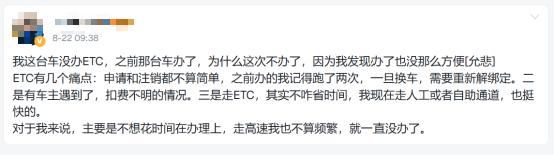
Recently, the topic of ETC has repeatedly topped hot search lists.
Some netizens proposed that since license plate recognition, WeChat Pay and Alipay are already so mature now, why not simply cancel the on-board ETC device, bind the license plate to the payment account, and charge fees directly after recognition?
Other netizens left a message directly on the official website of the Ministry of Transport: Now that license plate recognition is so widespread, why do expressways still require a dedicated device installed on vehicles?
The Ministry of Transport quickly gave a response.
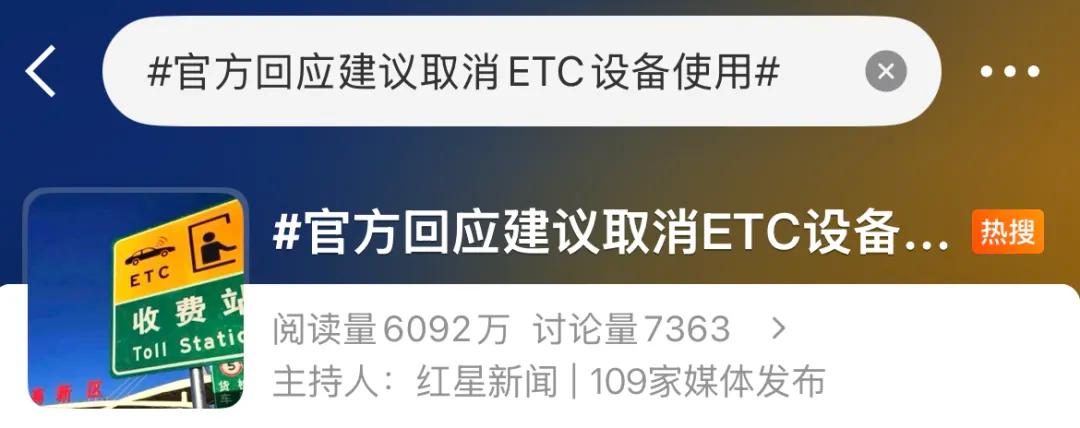
ETC will not be cancelled, but new toll collection methods are indeed on the way.
In February this year, the Ministry of Transport reviewed and approved the Implementation Plan for "Mobile Phone +" Card-Free Convenient Passing on Expressways (2026-2028). The "Mobile Phone +" mode mainly relies on license plate recognition to record vehicle information, allowing passenger cars without ETC installed to pass through MTC lanes without picking up or returning cards, and complete payment through electronic payment.
The Ministry of Transport also emphasized that this model is not intended to replace ETC, but serves as a supplement to coexist with ETC and MTC for a long time.
This discussion about "whether ETC is still necessary" has also unexpectedly brought a name that has been low-key for many years back to the public eye — Genvict Technology.
When ETC swept across the country in 2019, it stood at the very center of this wave, selling tens of millions of devices, with profits skyrocketing, and once became one of the most typical ETC beneficiaries.
Seven years later, as ETC moved from the incremental boom to the stock era, how is this company that once reaped the most dividends doing now?
The golden age of ETC came fiercely and went quickly
ETC did solve a very practical problem back then: congestion.
Before large-scale popularization, expressway toll stations were often the most easily jammed sections of the entire highway. Especially during holiday peaks, the manual windows collect money, give change, and issue invoices, and long queues will form quickly once the traffic flow surges.
In contrast, ETC completes identification and fee deduction through the on-board OBU and roadside equipment, and the whole process takes less than one second. It was 2019 that truly turned it from a toll collection tool into a national public infrastructure.
In May of that year, the General Office of the State Council proposed to basically cancel the provincial boundary toll stations on national expressways and vigorously promote non-stop fast toll collection. A nationwide ETC rush installation boom started immediately.
In just one year, about 123 million new ETC accounts were issued nationwide, bringing the total number of users to 204 million; in the same period, 24,588 ETC gantries were built, and 48,211 ETC lanes were renovated.
A large number of device demands that might have been released over several years were compressed into just one year, and Genvict Technology was right at the center of the wave.
In 2019, the company's OBU sales reached 36.7885 million units, a year-on-year increase of 620%; the annual revenue was 2.86 billion yuan, a year-on-year increase of 373%; the net profit attributable to shareholders was 875 million yuan, a year-on-year surge of nearly 40 times.
The capital market got excited even earlier than the financial reports.
In 2019, Genvict Technology's stock price rose from the lowest 14.19 yuan in the year all the way to 65.33 yuan at the end of the year, with an annual increase of more than 360%. By February 2020, the stock price once rushed to 89.98 yuan.
In 2022, the Prospective Industry Research Institute listed Genvict Technology as the "leading enterprise in China's ETC industry", and estimated that Genvict Technology's OBU market share was about 47% and RSU market share was about 54% in 2020.
In those years, ETC was Genvict Technology's most competitive core advantage. But the problem with this advantage is also obvious: The faster the installation, the fewer installations there will be in the future.
At the end of 2019, the number of national ETC users had reached 204 million, and further increased to 225 million by the end of 2020. After all eligible vehicles were installed intensively in a very short period of time, the industry quickly shifted from "competing for new users" to the stock business brought by equipment renewal, vehicle replacement and license plate change, and new vehicles.
The super demand created by policies receded just as quickly.
In 2020, Genvict Technology's revenue dropped to 1.564 billion yuan; by 2021, it was only 302 million yuan, shrinking by nearly 90% compared with the 2019 peak, and the net profit attributable to shareholders also turned from a profit of 875 million yuan to a loss of 193 million yuan.
From making nearly 900 million yuan a year to losing money directly two years later, Genvict Technology has almost fully experienced the whole process of ETC from "national rush installation" to "stock era".
After entering the stock era, some problems that were once covered up by rapid growth have become increasingly prominent.
Traditional ETC requires OBU to be installed on the front windshield, and vehicle replacement or license plate change often involves re-applying for the service. Equipment aging and power loss may also lead to identification failure. There are also long-standing disputes such as induced consumption and illegal charging at the service handling end.
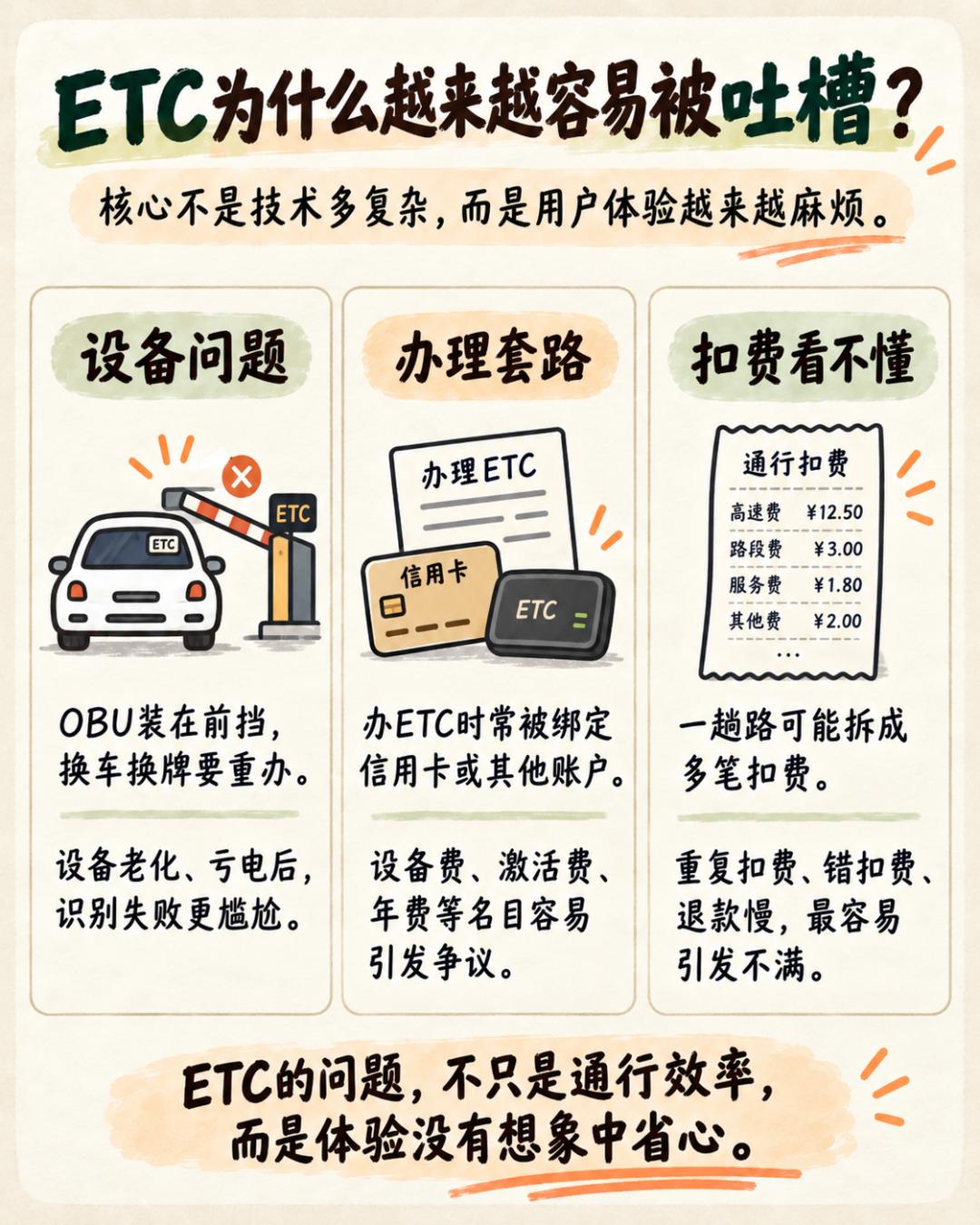
In 2026, in the first half-year complaint analysis released by the China Consumers Association, ETC has been separately listed as one of the five major complaint hotspots, with specific mentions of problems such as false publicity and induced consumption, and it clearly stated that ETC-related complaints continued to increase in the first half of the year.
For an industry that has entered stock competition, this is not good news.
More critically, an important premise for the rapid popularization of ETC back then was that it was almost the only choice for "non-stop toll collection" on expressways.
But now, this premise has begun to loosen.
"Mobile Phone +" will not replace ETC in the short term, and the traffic efficiency cannot be completely the same, but it at least gives car owners who have not installed ETC an extra choice.
ETC still exists, and the demand will not disappear. It is just that the era when the national unified equipment installation can push the performance up rapidly is over.
When the most familiar and most profitable market changes from incremental to stock, what else can Genvict Technology rely on to make up for the lost growth?
Traditional business shrinks, transformation starts to pay tuition fees
Seven years later, Genvict Technology's performance has not returned to the golden age of ETC.
In the first half of 2026, Genvict Technology achieved a revenue of 183 million yuan, a year-on-year decrease of 10.03%; the net profit attributable to shareholders was a loss of 39 million yuan, and the loss range expanded by about 230% year-on-year. Similar situations actually appeared in the 2025 annual report and mid-year report.
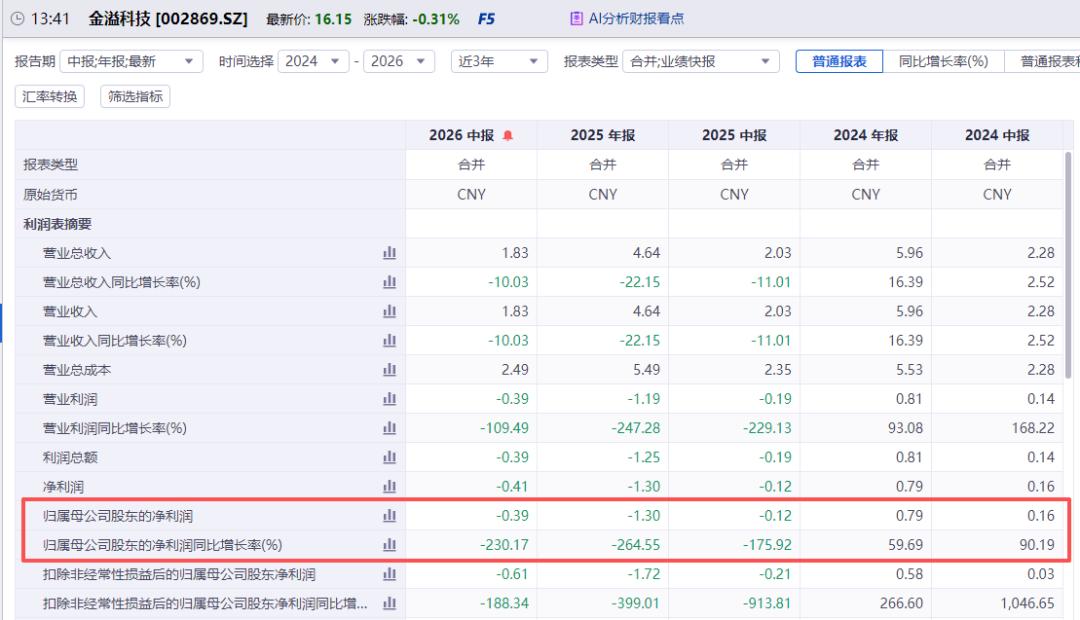
More critically, the two core businesses have not been able to support the growth.
Among them, smart toll collection is still the largest source of revenue for Genvict Technology. In addition to the familiar OBU, the company is also developing a full set of expressway toll collection products including CPC transit cards, RSU roadside equipment, self-service toll collection, ramp pre-transaction, and free-flow toll collection.
But in the first half of this year, the revenue of this business was about 124 million yuan, a year-on-year decrease of 16.15%.
Another automotive electronics business that was highly expected is also declining.
Over the years, Genvict Technology has been trying to expand from ETC to the automotive industry chain. Its products have extended to pre-installed ETC, V2X Internet of Vehicles equipment, and new energy vehicle thermal management fields, and its customers have gradually expanded from toll operators to automakers and Tier 1 suppliers.
But in the first half of this year, the automotive electronics revenue was about 36.45 million yuan, a year-on-year decrease of 24.6%.
The company itself mentioned in its performance forecast that while the revenue of traditional business is under pressure, emerging businesses are still in the cultivation period, and R&D and market investment will continue to increase. In the first half of the year, Genvict Technology's R&D investment reached 51.89 million yuan, a year-on-year increase of 64.3%.
The most difficult stage of transformation is like this: the money earned from the old business is getting less and less, the new business has not yet grown up, but all the necessary expenses cannot be reduced.
This pressure is also reflected in cash flow and turnover efficiency.
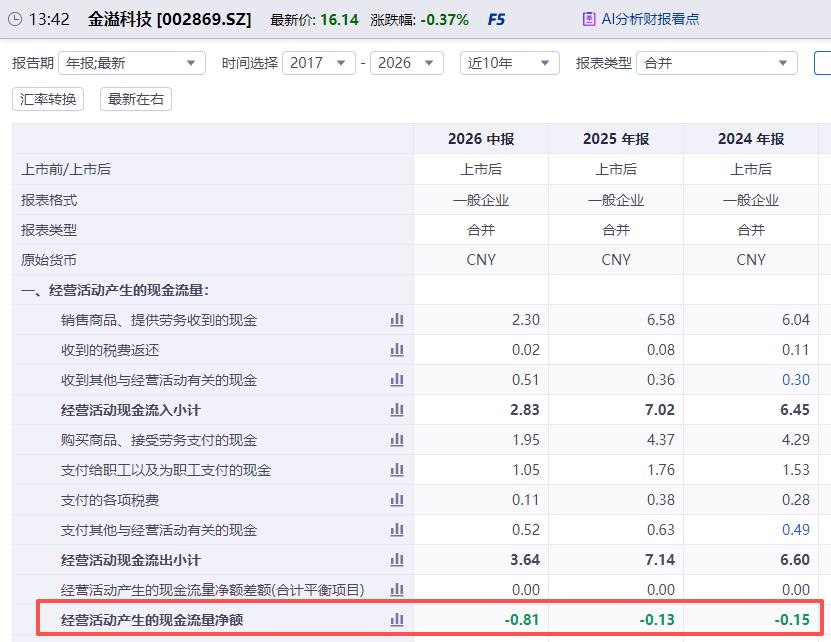
In 2024 and 2025, the net cash flow from operating activities of Genvict Technology was net outflow for two consecutive years, and it once again had a net outflow of 81 million yuan in the first half of this year.
At the same time, the inventory turnover days have increased from just over 120 days in 2023 to 222.72 days in the first half of this year, and the accounts receivable turnover days have increased to 348.1 days.
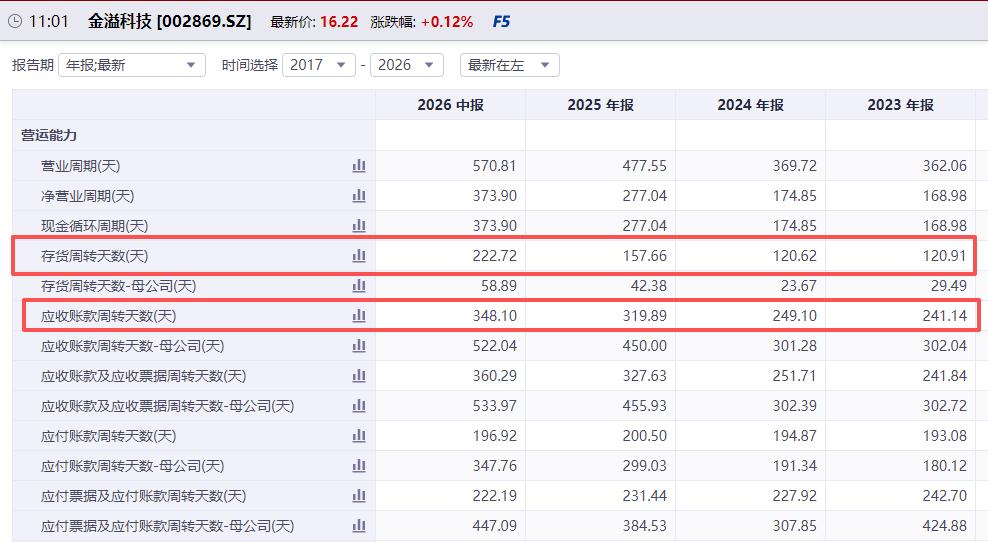
For a company that is heavily involved in transportation projects and government projects, the accounts receivable cycle is not originally short, but the continuous extension of the cycle means that it takes longer for revenue to turn into real cash.
However, Genvict Technology does not lack book funds. As of the end of June this year, the company still had 677 million yuan of monetary funds and 471 million yuan of trading financial assets.
But when the main business continues to shrink and the operating cash flow continues to lose blood, Genvict Technology has taken out a considerable amount of funds to conduct securities investment.
The mid-term report summary shows that in January 2026, the company used 100 million yuan of idle self-owned funds to subscribe for the Hengbang Shouzheng Qiji Private Securities Investment Fund.
What is the concept of 100 million yuan? Genvict Technology's total revenue in the first half of this year was only 183 million yuan, and the net operating cash outflow in the same period was 81 million yuan.
The A-share market is indeed doing well this year, but securities investment itself has obvious fluctuation risks. For a company with consecutive negative operating cash flow, this kind of capital arrangement can hardly be called conservative.
What's more worthy of vigilance is that Genvict Technology has already paid a not-small tuition fee in capital operations in the past.
In March 2025, the company announced the acquisition of 100% equity of Chelutong, hoping to strengthen its capabilities in V2X and vehicle-road coordination. The initial transaction price was 74.424 million yuan.
However, problems emerged as soon as the new company was acquired.
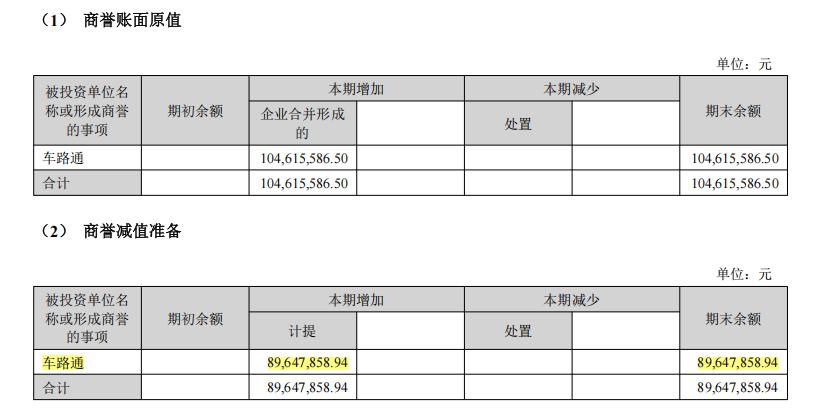
This acquisition generated about 105 million yuan of goodwill. By the end of 2025, Genvict Technology accrued a goodwill impairment of 89.6479 million yuan. In April this year, the transaction consideration was also reduced from 74.424 million yuan to 66.86 million yuan.
What's more embarrassing is that Chelutong failed to meet the performance commitment, and the relevant party needs to pay a compensation of 17.9703 million yuan. As of August 26 this year, Genvict Technology has only received a total of 3 million yuan.
Of course, a failed merger and acquisition does not prove that the transformation direction is wrong.
But it at least shows that the new business after ETC is not as easy to make money as it was in 2019.
What Genvict Technology needs is a business that can truly take over the ETC business.
Who will take over the ETC business
In fact, Genvict Technology did not start looking for new businesses just now.
After the ETC boom receded, this company has been expanding along its most familiar capabilities in communication, recognition and roadside equipment.
The path closest to ETC is pre-installation.
In the past, most ETCs were post-installed, and car owners would go to the bank or service outlets to apply for the service after buying the car. Pre-installed ETC is directly integrated into the car before delivery, and the customers have changed from ordinary distribution channels to automakers.
In 202