A pivotal year for autonomous driving: will "systematic capability" determine the final outcome?
The autonomous driving track is ushering in the final inflection point of the cutthroat technology competition.
With the intensive implementation of global autonomous driving laws and regulations and the full supplementation of compliance details, the industry has completely terminated the extensive development model of "no applicable rules, testing priority, and unregulated trial and error".
Core issues that have long hindered industrial development, including accident responsibility definition, commercial operation boundaries, cross-regional supervision, and product access, are being resolved one by one by the global compliance system. The unified technical regulations of the United Nations, new regulations on intelligent connected vehicles in China, and special regulatory policies in Europe and the United States are implemented simultaneously, removing institutional barriers for the large-scale commercial application of autonomous driving.
The implementation of policies and regulations has completely rewritten the industry's competition logic. Systematic capabilities composed of local compliance capabilities, scenario implementation capabilities, commercial operation capabilities, and full-chain risk control capabilities have become more critical winning chips for autonomous driving enterprises.
The Global Race for Autonomous Driving Legislation
The prerequisite for the large-scale implementation of autonomous driving is the two-way adaptation between technical maturity and legal compliance.
2026 has become a key inflection point for global autonomous driving legislation. The three core markets of China, the United States and Europe have simultaneously completed the upgrading of top-level legislation and supporting rules, forming differentiated regulatory logic. At the same time, relying on the United Nations "Global Technical Regulation on Autonomous Driving Systems" (ADS GTR) to build a unified global safety baseline, the cost of repeated certification in cross-border markets is reduced.
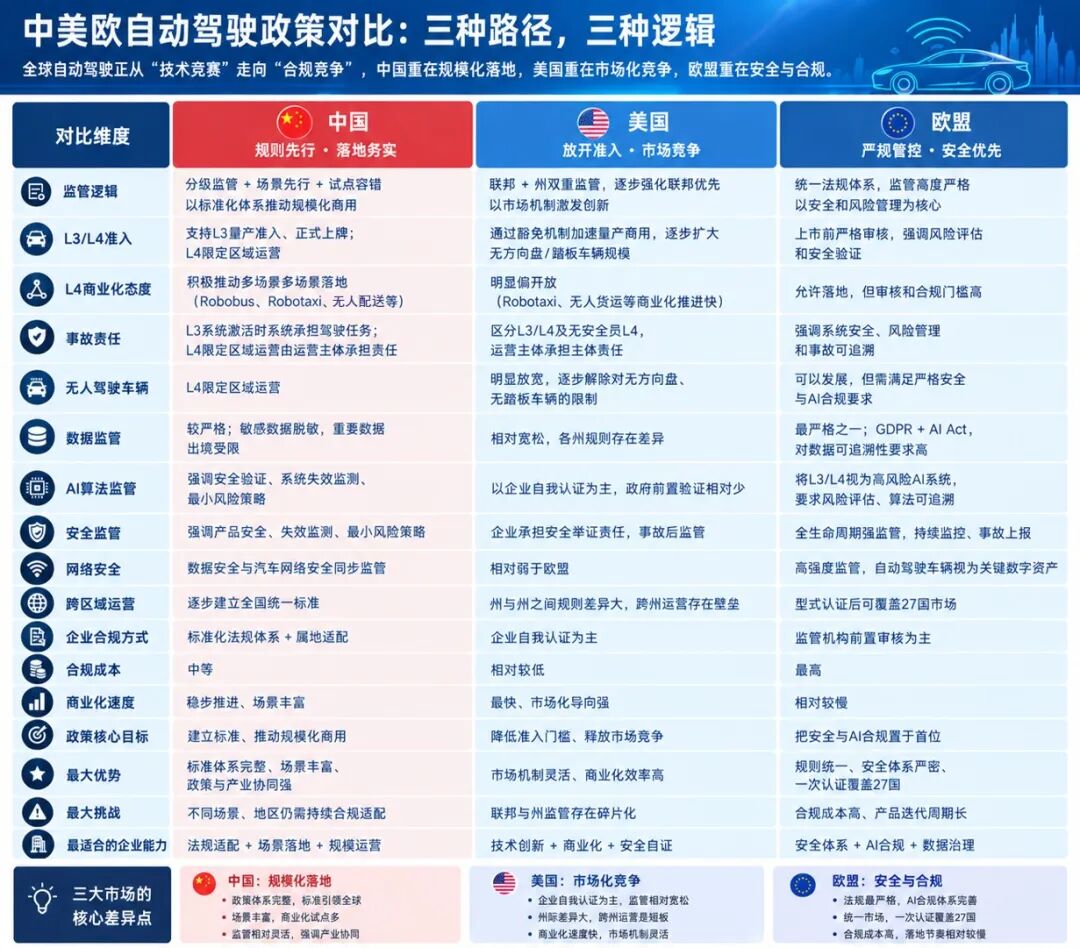
China — Prioritizing rules, pragmatic implementation, and taking the lead in building global standards
China's domestic autonomous driving legislation adopts the ideas of hierarchical supervision, scenario priority, and pilot fault tolerance.
The national standard GB/T 40429 "Road Vehicle Driving Automation Classification" clearly defines the classification of L0-L5 driving automation, laying the basic framework for all regulations. The "Administrative Measures for the Pilot Access of High-level Autonomous Driving Vehicle Products" is the core regulation for the mass production and implementation of L3 and above autonomous driving in China, fully supporting L3 autonomous driving vehicles to apply for motor vehicle product access and obtain official license plates. More importantly, this regulation clarifies that when the L3 system is activated, the system undertakes the driving task, and accidents are held accountable according to the logic of product defects, while the driver has the obligation to take over after receiving the takeover request; L4 vehicles operate in limited areas, and the operating entity bears the main responsibility.
The "Road Traffic Safety Law (Revised Draft)" adds special clauses related to autonomous driving, confirming the legal status of autonomous driving systems at the legal level for the first time, filling the previous legal gap of "who is the driver", and clarifying the accident responsibility boundaries among vehicle manufacturers, operating entities and users.
The "Several Provisions on the Administration of Automotive Data Security" restricts the frequently collected data of autonomous driving, including external vehicle images, geographic information and pedestrian information, requiring desensitization, minimum necessary collection, and exit approval, which directly restricts the compliance boundary of the autonomous driving data closed loop.
At the same time, China took the lead in promoting the formation of the world's first global technical regulation for autonomous driving — the United Nations Global Technical Regulation on Autonomous Driving Systems. This regulation defines mandatory requirements for ADS (Autonomous Driving System) minimum safety performance, risk assessment, system safety verification, human-machine interaction, and failure detection, covering L3 and L4 level autonomous driving vehicles. This is the world's first unified technical regulation for high-level autonomous driving. China has written the domestic complex mixed traffic scenarios (non-motor vehicles, pedestrians, electric bicycles) into the global standard text, instead of directly copying the rules of European and American highway/simple urban road conditions.
The core logic of China's domestic legislation is neither blindly relaxed nor conservatively lagging behind. It supports the large-scale commercial application of autonomous driving with a standardized system, ensures the benign iteration of the industry with a compliance bottom line, not only holds the safety red line, but also opens up policy space for the full-scenario implementation of Robobus, Robotaxi, unmanned freight, automatic parking and other scenarios.
The United States — Loosening access, simplifying supervision, and leaning towards free market competition
The United States has long had the contradiction of dual federal and state supervision, and the rules of each state are very different. California allows Robotaxi to operate for a fee, while some states prohibit L4 manned vehicles from driving on roads. The new version of the "Autonomous Driving Act" attempts to establish the priority of federal supervision and weaken the power of each state to set restrictions separately.
At the federal level, the "2026 Autonomous Driving Act" (SELF DRIVE Act, 2026 new version of the congressional review draft), the National Highway Traffic Safety Administration (NHTSA) "Exemption Regulation for Autonomous Vehicles", "Federal Motor Vehicle Safety Standards" (FMVSS) and other regulations provide an institutional framework for accelerating the implementation of autonomous driving. At the state level, the new autonomous driving regulations of the California Department of Motor Vehicles (DMV) and the special unmanned freight act of Texas have lifted the restrictions on road testing and commercial deployment of autonomous driving for heavy trucks and medium-sized passenger vehicles, while comprehensively strengthening safety supervision and law enforcement means.
In January this year, the U.S. House of Representatives reviewed the draft of the "2026 Autonomous Driving Act", proposing to raise the annual exemption limit for vehicles without steering wheels and pedals from 2,500 to 90,000, and establish federal priority. The two parties reached a rare consensus, and the legislative deadlock that has lasted for nearly ten years is expected to be broken.
It is worth mentioning that the exemption clauses of this regulation will no longer be limited to test vehicles, but directly target mass-produced commercial vehicles. After the enterprise submits an exemption application, if NHTSA does not make a rejection ruling within 12 months, the application will take effect automatically, greatly shortening the approval cycle. In terms of liability rules, the regulation clearly distinguishes between L3/L4 and L4 vehicles without safety drivers, the operating entity is the responsible entity, and it is no longer mandatory to equip a human driver in the vehicle. At the same time, the regulation officially lifts the federal ban on autonomous heavy trucks on roads, further opening up the commercialization channel of trunk unmanned freight.
The characteristics of the U.S. regulatory idea are that enterprises are mainly responsible for self-certification, regulatory agencies do not conduct pre-full-process verification, enterprises prove safety by themselves, keep safety reports, and present evidence after accidents, and the safety burden of proof falls on vehicle manufacturers/operators. The disadvantage is that each state still retains the local power of road access, insurance and operation permission, there are still barriers to cross-state operation, and the requirements for data security and algorithm transparency are weaker than those of the European Union.
The European Union — Strict regulation, safety priority, and binding with the AI compliance system
In June this year, the meeting of the contracting parties to the United Nations World Forum for Harmonization of Vehicle Regulations (WP.29) has approved DCAS UNR 171 series 02 (corresponding to the urban NGP function regulation) and UNR ADS (corresponding to the L3-L5 autonomous driving regulation).
Among them, DCAS UNR 171 series 02 will become a mandatory EU regulation 6 months later. This new regulation means that by the end of 2026, autonomous driving technology will be able to legally enter the global market including the European Union. UNR ADS is currently a framework regulation, which will accelerate the approval and implementation of Robotaxi (L4) in various regions.
The European Union classifies L3 and L4 autonomous driving systems as high-risk AI systems, which are subject to strict supervision by the "Artificial Intelligence Act" (AI Act). This is a unique legislative framework in the world.
According to this act, before autonomous driving vehicles are launched on the market, they must complete risk assessment, system testing, algorithm traceability verification, human-machine safety verification, and establish a continuous monitoring system; after launch, they must continuously collect safety incidents, and report major risks to regulatory agencies; the algorithm cannot be a black box, and needs to have the capability of accident traceability.
This year, the EU's "General Safety Regulation" (GSR) continues to be upgraded, and the safety access threshold for commercial vehicles is further raised. Among them, Event Data Recorder (EDR) and Advanced Driver Monitoring System (ADDW) are included in the mandatory standard equipment list. For L3 autonomous driving, the system failure warning, takeover boundary and Minimum Risk Strategy (MRS) are mandatory, and the vehicle must be able to stop safely when the system fails.
The "ADS Regulation" targets L4 autonomous driving, distinguishing between manned Robotaxi and unmanned freight; in 2026, it will lift the upper limit of the commercial quantity of L4 Automated Valet Parking (AVP).
In terms of data and privacy, restricted by the "Data Governance Act", pedestrian images and personal biometric information collected by external perception must meet the requirements of the "General Data Protection Regulation" (GDPR); in terms of network security, autonomous driving vehicles are key digital assets, which must comply with the NIS2 Network Security Directive to prevent remote intrusion and system hijacking.
The EU regulation has an extremely high access threshold, and the pre-market regulatory review is strict, setting mandatory obligations for algorithm interpretability, data retention, network security and accident record keeping. The advantage is that it unifies the 27 EU member states market, and once EU type approval is obtained, products can be sold and operated in all member states. The cost is high compliance cost, longer product iteration cycle, and slower industrial implementation pace.
Looking at the global legislative landscape, it is not difficult to find that the gap between rules is being narrowed, and the technology gap is shrinking. Enterprises that once relied on the advantages of a single algorithm or a single scenario to break through can hardly establish long-term barriers under unified compliance standards and a mature market environment. When everyone gets the "admission ticket", what really widens the gap is whether they can build a complete system that adapts to regulations, scenarios and commercialization.
Six Core Capabilities of the Autonomous Driving System
In the past, the capital market and industry public opinion blindly believed in the "myth of on-board intelligence". Everyone competed on the number of lidars, the parameters of computing power chips, the number of cities covered by urban NOA, and the speed of algorithm iteration, believing that as long as the technology was leading enough, they could win the market.
However, the commercial reality after the implementation of regulations has completely broken this perception: technology that can run in test sites may not be able to run in the real market; products that can realize intelligent driving may not be able to make profits in compliance.
On-board intelligence solves the problem of "whether the vehicle can drive"; while systematic capabilities solve the full-dimensional problems of compliance, implementation, profitability and continuous iteration.
The so-called autonomous driving systematic capability has long gone beyond the scope of a single technology. It is a complete ecosystem covering regulation adaptation, technology closed loop, data iteration, operation services, safety risk control and industrial collaboration.
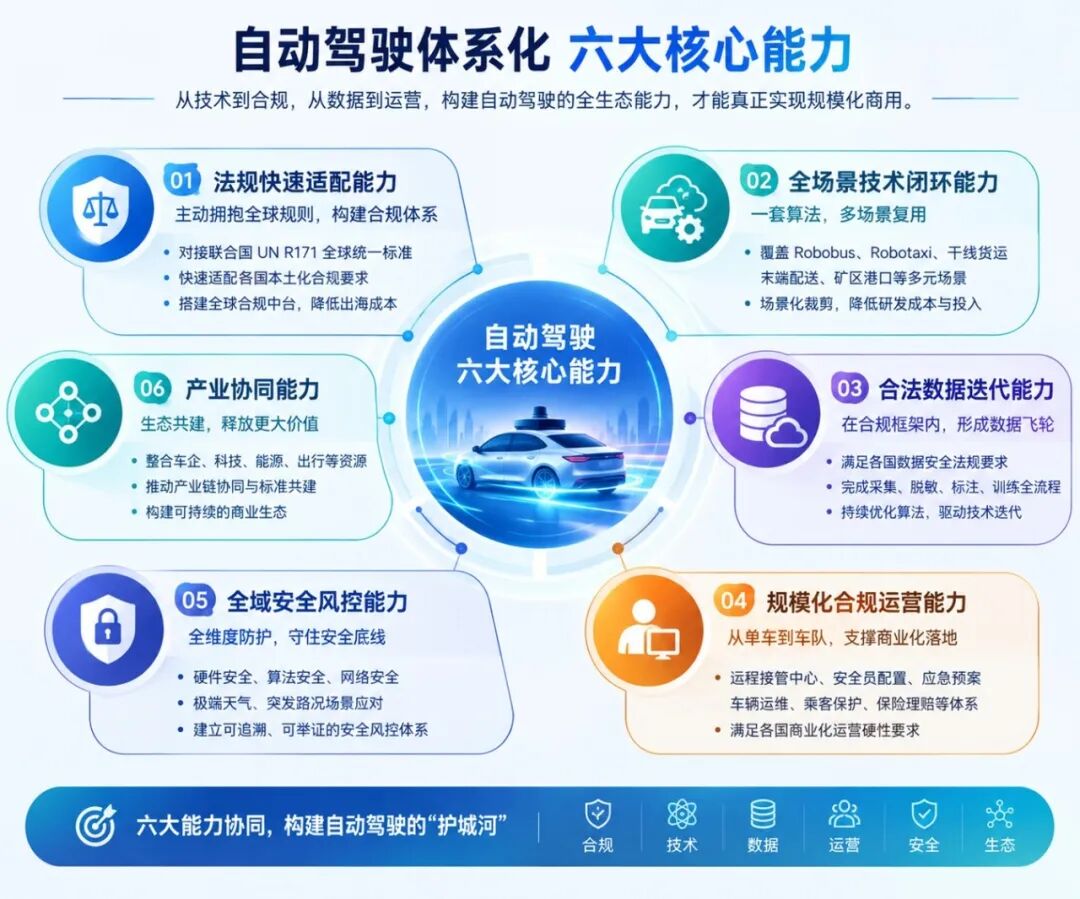
It mainly includes the following six core capabilities:
Rapid regulation adaptation capability. Global rules continue to iterate, and the policy rules of various countries and regions are significantly different. Top enterprises no longer passively abide by the rules, but deeply participate in standard formulation and adapt to the compliance system in advance, which can not only connect to the UN R171 global unified standard, but also quickly meet the local compliance requirements of China, the United States and the European Union. Enterprises with strong system capabilities can build a global compliance middle platform, uniformly carry out risk assessment, document system and safety proof, carry out local adaptation for different markets, and greatly reduce the compliance cost of overseas expansion.
Full-scenario technology closed-loop capability. Autonomous driving technology will no longer be limited to single scenarios such as urban roads and highway assisted driving, but form general capabilities covering Robobus, Robotaxi, trunk freight, end distribution, special driving in mining areas and ports, and quickly adapt to the safety standards and operation needs of various scenarios. Relying on the systematic technology base, the same set of core algorithms and perception architecture can be scenario-tailored without developing from scratch for different scenarios, realizing effective control of R&D costs and investment.
Legal data iteration capability. The core of autonomous driving is data iteration, but under the new regulations, data can no longer be "collected at will and used infinitely". The laws of various countries set strong constraints on the collection, storage, cross-border transmission, annotation and training of vehicle-end perception data. China's "Several Provisions on the Administration of Automotive Data Security" requires desensitization when collecting sensitive personal information such as face and pedestrian images, and important data cannot be arbitrarily transmitted out of the country; the EU's "General Data Protection Regulation" and "Artificial Intelligence Act" require that training data can be traced, and accident-related data must be retained for many years; each state in the United States has different requirements for video data storage. Enterprises with systematic capabilities can complete data collection, desensitization, annotation, training and closed-loop iteration within the compliance framework, build a compliant data flywheel, not only meet the data security regulations of various countries, but also continuously optimize algorithms to form a positive cycle of technology iteration.
Large-scale compliant operation capability. The regulations of various countries have mandatory obligations for commercial operating entities: remote takeover centers, safety driver allocation, emergency response plans, vehicle operation and maintenance, user notification, accident traceability, insurance claims, and passenger protection. Taking the new autonomous driving regulations in California as an example, operating enterprises must record every takeover and every system abnormality, regularly submit safety reports to regulators, and purchase special autonomous driving liability insurance. This whole set of operation system includes personnel, platforms, processes, insurance and work order systems, which is the core support for large-scale commercial implementation, and also a barrier that small and medium-sized players cannot cross.
Global safety risk control capability. From vehicle hardware safety, algorithm decision-making safety, network data safety, to scenario safety in extreme weather, sudden road conditions and human-machine interaction, build a full-dimensional, traceable and provable safety risk control system, which perfectly adapts to the strict safety regulatory requirements of various countries. The EU "Artificial Intelligence Act" mandates the establishment of safety risk classification, continuous monitoring and incident reporting; China's "Administrative Measures for the Pilot Access of High-level Autonomous Driving Vehicle Products" requires products to have failure monitoring and minimum risk strategies; the U.S. "Federal Motor Vehicle Safety Standards" have mandatory test items for collision safety and system failure. It can be seen that safety risk control is not a one-time test, but the full life cycle management of products.
Industrial chain collaborative implementation capability. Link upstream and downstream resources such as chips, sensors, vehicle manufacturing, high-precision maps, operation and maintenance services, and regulatory platforms to achieve the optimal matching of technology, cost and production capacity, and solve the industry pain point of high-level autonomous driving that "technology is feasible, cost is too high, and mass production is difficult".
From the perspective of industry practice, different enterprises are taking differentiated system construction paths. Represented by L4 autonomous driving companies such as Moovit, WeRide, and Pony.ai, they are laying out multi-scenario technology bases, compliant data closed loops, remote operation platforms and vehicle industry chain cooperation, while participating in the formulation of domestic and foreign autonomous driving regulations and standards, supporting the commercialization and overseas implementation of Robobus, Robotaxi, unmanned freight and other businesses.
Take Moovit as an example, its technical route of "front-mounted mass production + fusion of vision and solid-state lidar" has been continuously verified. Relying on the engineering capabilities accumulated in more than 20 cities in China, the autonomous driving solution can quickly adapt to the market with controllable cost; at the same time, it has accumulated a large amount of exclusive data that fits the characteristics of bus models, effectively shortening the cycle of algorithm training and vehicle adaptation. The technical team has a deep understanding of the traffic laws, road right rules and local driving habits of the target market, integrates compliance requirements into the system decision logic, safety boundary and operation process, and links with leading local public transport operators to jointly expand the market.
Under the industrial consortium model, autonomous driving enterprises act as connectors, coordinating vehicle manufacturing, autonomous driving technology, local operation and policy resources, and forming a complete solution that can be delivered externally. This ecological integration model has strong replicability and can support the rapid implementation of autonomous driving overseas.
Vehicle enterprises and intelligent driving solution providers represented by Huawei Qiankun and Xpeng are based on the mass-produced passenger vehicle track, focusing on opening up the industrial collaboration of vehicles, chips, software and data governance, and promoting the large-scale deployment of high-level intelligent driving on the premise of meeting domestic access and data compliance.
Overseas enterprises such as Waymo and Tesla are also building their own systems. The former focuses on the polishing of the full-chain safety