Even after partnering with Doubao, CaoCao Mobility still cannot get rid of the "traffic anxiety".
On September 9, Caocao Mobility announced a partnership with Doubao, the AI product under ByteDance, to launch AI ride-hailing services in Beijing, Hangzhou and Suzhou. According to official introductions, when users ask Doubao for local life information such as routes, locations, food, leisure and entertainment, Doubao can directly generate travel plans combined with the destination, and call Caocao Mobility's transport capacity to fulfill the order. Users can even put forward demands such as "large space" and "pre-ventilated car", and the system will match the corresponding vehicle model. In the future, the two parties also plan to extend their cooperation to fields including intelligent vehicle control and even Robotaxi.
According to public reports, Caocao Mobility is currently the only mobility service capacity partner accessed by Doubao. This means that outside the aggregated entrances such as Amap where multi-platform ride-hailing services compete with each other, Caocao has temporarily obtained a relatively scarce new traffic entrance.
This is not the first time that Caocao Mobility has adopted an "AI narrative" for its business this year.
In June this year, Caocao Mobility just released its RoboX strategy, announcing a full transformation to AI, and put forward the "Double 100,000 Plan" of deploying a total of 100,000 Robotaxis and 100,000 Robovans by 2030. From intelligent driving and intelligent customized vehicles to AI Agent and Robotaxi, and now directly accessing Doubao, Caocao Mobility is trying to rebrand its identity from a ride-hailing company to a "physical AI mobile technology platform".
The story certainly sounds appealing. But the question is, for Caocao Mobility today, what it really lacks is a new AI story, or a proven and healthy business model?
The answer is probably not that simple.
I. Expanding Scale, But Still Difficult to Make Profits
Let's first look at Caocao Mobility's latest performance report.
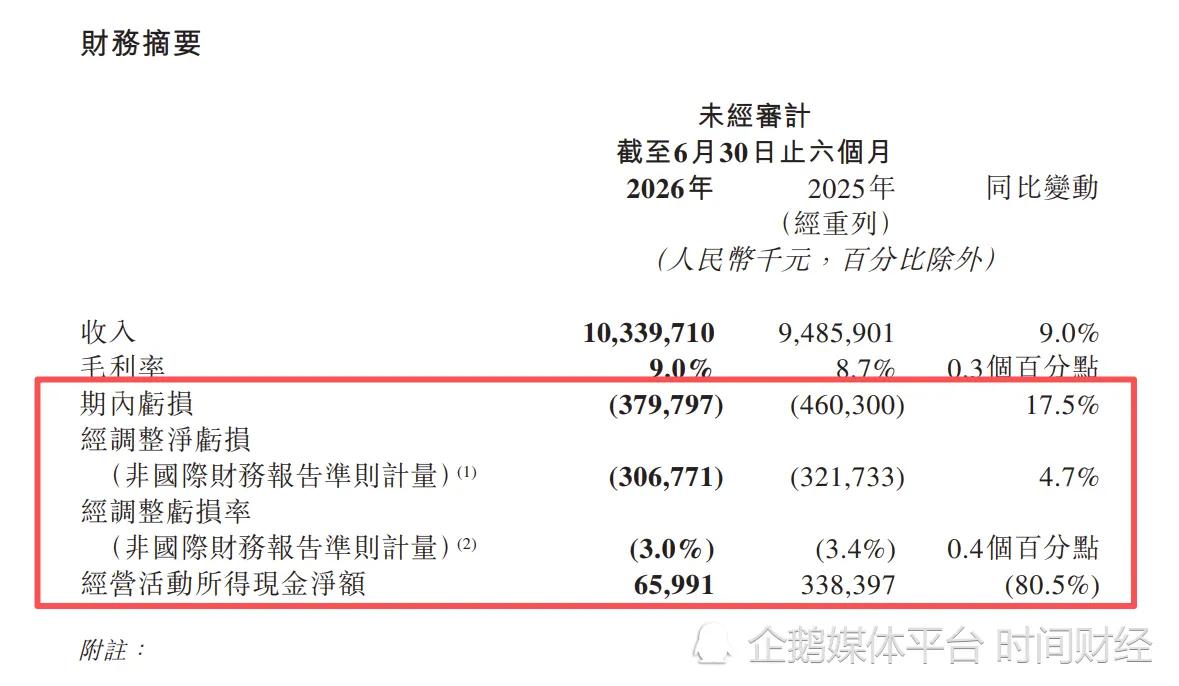
In the first half of 2026, Caocao Mobility's revenue exceeded 10 billion yuan for the first time in a half-year period, reaching 10.34 billion yuan, a year-on-year increase of 9%; its GTV reached 12.445 billion yuan, a year-on-year increase of 13.6%; the average monthly active users reached 44.6 million, a year-on-year increase of 17.1%.
Judging only from these figures, Caocao Mobility is still in a stage of expansion. And it must be admitted that this is not a fully deteriorating financial report.
During the same period, Caocao Mobility's gross margin improved from about 8.7% to 9.0%, with a loss of about 380 million yuan in the period, narrowing by 17.5% year-on-year; the operating loss also narrowed from 482 million yuan in the same period of the previous year to 262 million yuan. The scale effect that the company has repeatedly emphasized over the past few years is indeed being partially realized.
But this is exactly where the problem lies: in 2025, its full-year revenue has exceeded 20 billion yuan, and the revenue from travel services reached 18.564 billion yuan; in the first half of 2026, it achieved another 10.3 billion yuan in revenue. For a platform with annual revenue already at the 20-billion-yuan level, the market no longer cares about "whether it can continue to grow", but when such a huge transaction scale can be stably converted into profits?
So far, this answer is not clear.
In the first half of this year, Caocao Mobility still lost about 380 million yuan, with an adjusted net loss of about 307 million yuan; the net cash generated from operating activities was only 65.991 million yuan, compared with 338 million yuan in the same period last year, down 80.5% year-on-year.
The explanation given by the company in its financial report is that the change in working capital is caused by the time difference between receipt and payment. This kind of fluctuation in accounting and business rhythm cannot be simply equated with "cash flow deterioration by 80%". But when looking at the balance sheet as a whole, the pressure still exists objectively.
As of the end of June, Caocao Mobility's cash and cash equivalents were about 1.563 billion yuan, and the total borrowings were about 7.363 billion yuan, of which about 4.941 billion yuan were recorded in current liabilities and needed to be repaid within one year; in the same period, current liabilities exceeded current assets by about 3.785 billion yuan.
The financial report even clearly states that the above situation constitutes "events and conditions that may cast significant doubt on the Group's ability to continue as a going concern". This does not mean that Caocao Mobility will soon be unable to continue its operations, nor does it mean that the company has defaulted on its debts, but at least it shows that beyond scale expansion, the company's liquidity management is not a problem that can be ignored.
This is also the most awkward part of Caocao Mobility: it is not that it has no scale, on the contrary, it already has a considerable scale. But it still cannot convert the scale into sufficient profits, and convert the turnover into cash that truly belongs to shareholders.
II. Cost Structure Is Not Lean Enough, While Traffic Is Increasingly Not Belonging to Itself
It is actually inaccurate to only attribute Caocao Mobility's losses to "heavy assets". Caocao was born with a very obvious automaker gene. As a mobility platform incubated by Geely, it chose a path different from pure matching platforms such as Didi very early: customized vehicles, self-operated transport capacity, driver management, vehicle operation, and even later autonomous driving, hoping to obtain service standardization and cost advantages through stronger control over "vehicles".
Compared with platforms that are only responsible for matching orders, Caocao can design vehicles around the ride-hailing operation scenarios, and make special optimizations in space, energy consumption, durability, maintenance and intelligent vehicle control; in the Robotaxi era, relying on Geely's complete vehicle manufacturing and supply chain capabilities, it can indeed become an important asset.
Therefore, some claims on the market that "Geely has dragged down Caocao" are unfair. A more accurate statement is that the advantages Geely brings to Caocao also come with costs.
Customized vehicles and a deeper vehicle operation system give Caocao capabilities different from pure Internet platforms, which also means that it has historically undertaken heavier pressure on vehicles, depreciation, maintenance, financing and operation management.
Caocao itself is obviously aware of this. Since around 2023, the company has continuously expanded its cities with an asset-light model. In 2024 alone, Caocao entered 85 new cities with the asset-light model, that is, local transport capacity partners purchase and own the vehicles, and Caocao mainly undertakes the role of platform and operator, instead of owning all the vehicles by itself.
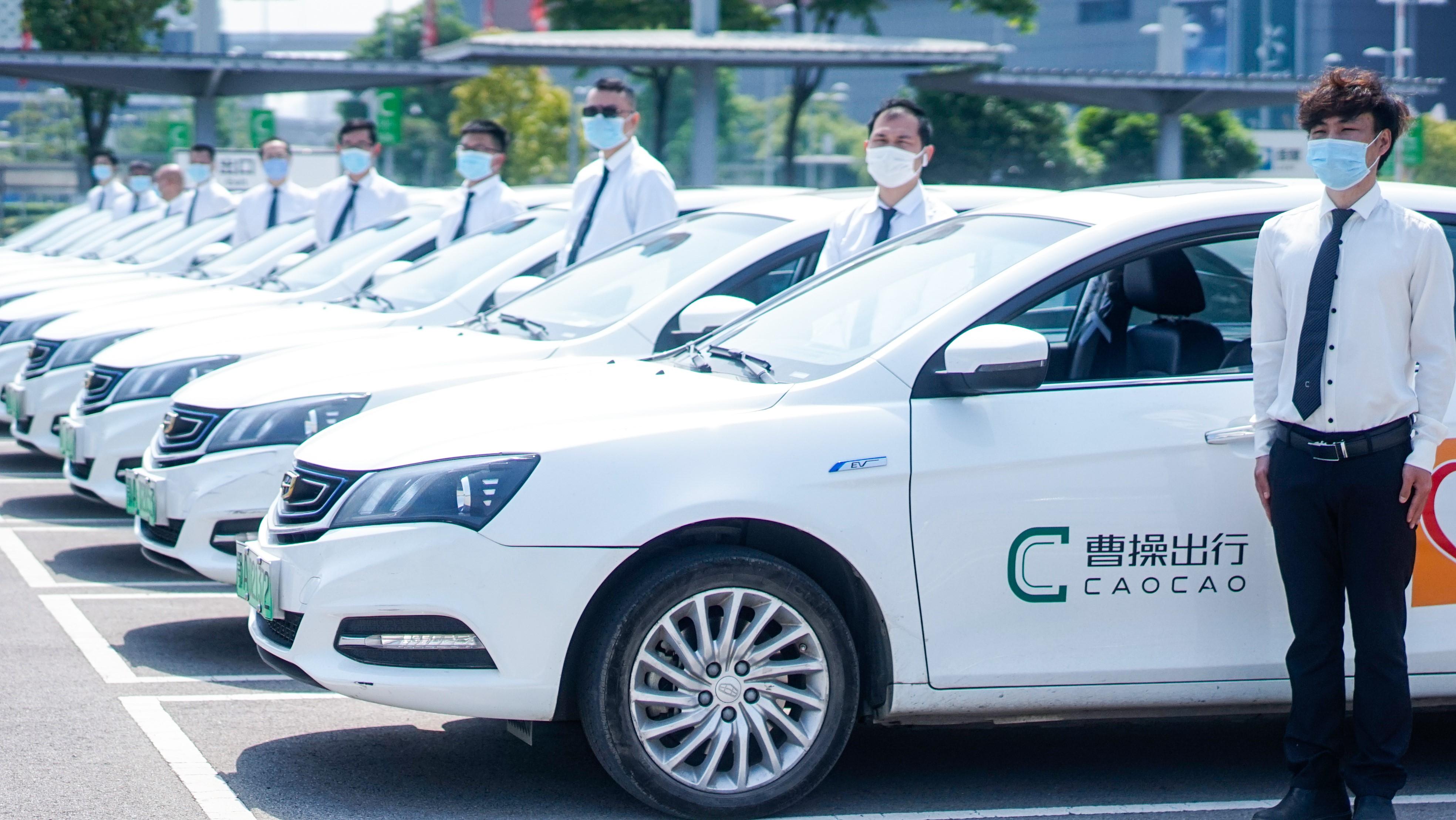
Today's Caocao can no longer be simply summarized as "pure heavy-asset B2C". Its biggest problem is that while gradually making its assets "light", it has not grasped "traffic" in its own hands.
According to Caocao Mobility's listing prospectus, in 2022, 2023 and 2024, the proportion of orders from aggregated platforms was 51.4%, 74.1% and 85.7% respectively; calculated by GTV, the contribution proportion of aggregated platforms also rose all the way from 49.9% to 85.4%. That is to say, by 2024, more than 8 out of every 10 Caocao Mobility orders were not generated by users actively opening the Caocao Mobility App, but came from third-party entrances such as Amap and Baidu.
In 2021, Caocao Mobility paid about 277 million yuan in commissions to aggregated platforms; by 2025, this figure has risen to 1.565 billion yuan, with a cumulative increase of about 465% in four years and an average annual compound growth rate of about 54%; during the same period, Caocao Mobility's travel service revenue grew from about 6.9 billion yuan to 18.564 billion yuan, with a cumulative increase of about 166% and an average annual compound growth rate of about 28%.
In other words, in the past few years, the growth rate of commissions paid by Caocao to external entrances is almost twice the growth rate of travel service revenue. In 2025 alone, the company's sales and marketing expenses reached 1.803 billion yuan, of which aggregated platform commissions accounted for 1.565 billion yuan.
Based on the 18.564 billion yuan of travel service revenue in that year, roughly calculated, for every 100 yuan of travel service revenue, the corresponding aggregated platform commission has reached about 8.4 yuan.
8.4 yuan seems insignificant when viewed alone. But Caocao's full-year gross margin in 2025 was only about 9.4%. Of course, aggregated commissions are listed in sales and marketing expenses, and cannot be simply deducted from gross profit in accounting; but from the perspective of business reality, for a business whose gross profit is only single-digit to about 10%, every 100 yuan of revenue needs to spend several more yuan to purchase external traffic, it is not difficult to understand how tight the profit margin will be.
III. Aggregated Platforms Cannot Explain All Losses
Peer T3 Mobility provides a counterexample.
In 2025, the proportion of T3 Mobility's orders from aggregated platforms was as high as 85.9%, almost the same level as the 85.7% previously disclosed by Caocao; T3 also needs to pay a large amount of commissions to external entrances such as Amap and Tencent Mobility, and its aggregated platform commissions in 2025 reached 1.388 billion yuan.
In other words, "working for aggregated platforms" is not a dilemma unique to Caocao, but a common problem for mid-tier ride-hailing companies except for a few platforms with strong own traffic.
But the difference is that T3 has achieved annual profitability for the first time in 2025.
Although the net profit of 7.44 million yuan is almost negligible compared with the revenue of 17.1 billion yuan, and the net profit margin is even less than 0.1%, far from establishing a solid profit moat, at least in the financial sense, it has crossed the break-even line.
In terms of gross margin, T3's gross margin increased from 0.4% in 2023 to 10% in 2024, and further reached 13.0% in 2025; while Caocao's gross margin was about 9.4% in 2025 and about 9.0% in the first half of 2026. The improvement reasons disclosed by T3 include increasing unit customer price, reducing subsidies for drivers and passengers, disposing of some old vehicles, optimizing depreciation and exiting some high-cost long-term leases.
This shows that the dependence on aggregated platforms is very serious, but it is not a sufficient explanation for Caocao's long-term losses.
Since both platforms are highly dependent on external entrances, and one of them has touched the break-even line, the problem Caocao has to face is actually very clear — in addition to channel fees, how much more costs can it continue to cut in vehicle structure, driver cost, subsidy efficiency, fleet operation, asset turnover and unit economic model?
Channels can be changed at any time, but operation efficiency can only be solved by itself. Looking at the cooperation between Caocao Mobility and Doubao from this perspective, things become more interesting: it is indeed in urgent need of a new traffic entrance, but what it lacks is not just traffic.
IV. What Damages the Brand More Than Losses Is That Platform Governance Cannot Keep Up With Scale
According to reports from Guangming Online, in April this year, a "fake-licensed vehicle" incident in Shanghai once pushed Caocao Mobility to the forefront of public opinion.
According to the investigation results later announced by the Shanghai traffic management department, the vehicle shown in the passenger's online order to pick him up was a Tesla, but the actual arriving vehicle was a BYD; the driver requested offline payment, and even verbally intimidated the passenger after the passenger refused. Subsequent investigations found that the involved vehicles did not have ride-hailing operation qualifications, and the drivers did not obtain employment qualifications, which belonged to the illegal passenger transport called "no driver certificate and no vehicle certificate" by the regulatory authorities.
After investigating the involved platform Caocao Mobility, the regulatory authorities publicly pointed out that the platform had obvious shortcomings and management absence in "fake-licensed vehicle" identification, dynamic supervision, risk warning and other aspects, and launched an investigation into the platform's suspected problems of dispatching ride-hailing information to unqualified personnel and vehicles.
Caocao Mobility also dealt with the incident later.
According to media reports, the platform confirmed that the situation reflected by the passenger was basically true, permanently banned the account of the involved driver, compensated and apologized to the passenger, and stated that it would upgrade the vehicle-driver verification system. Caocao also emphasized that the involved driver was not its own driver, and the related vehicle was online on multiple ride-hailing platforms at the same time.
Of course, a single incident cannot explain the problem. According to statistics from Tianyancha, the operating entity of Caocao Mobility has received a total of 1492 administrative penalties, with a total penalty amount of 12.7082 million yuan. In May 2026 alone, there were 20 penalties, mostly related to the fact that the vehicles providing services did not obtain the "Online Appointment Taxi Transport Certificate".
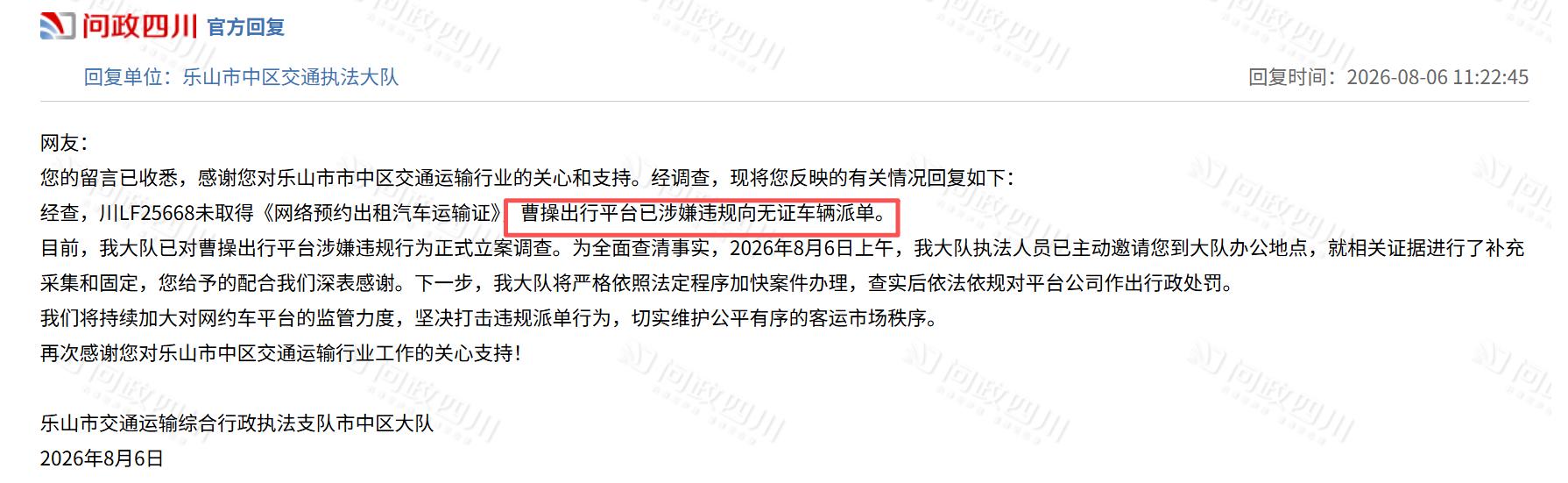
In addition, in Leshan, Sichuan, Caocao Mobility was also officially filed for investigation by the traffic law enforcement department for long-term dispatching orders to unlicensed vehicles: in accordance with the "Interim Measures for the Administration of Online Appointment Taxi Business", the platform is suspected of dispatching ride-hailing information to unqualified personnel and vehicles, facing a maximum fine of 30,000 yuan; the inconsistency of online and offline drivers and vehicles has been identified as a major hidden danger of work safety, and the enterprise and relevant responsible persons also face a maximum fine of 100,000 yuan.
More macro data can also provide some reference.
According to the data of March, April, May and June 2026 released by the Ministry of Transport's ride-hailing supervision information interaction system, among the top ten platforms in terms of monthly order volume, Caocao Mobility's order compliance rate ranked around eighth for many times, continuously lagging behind some peers such as T3, Ruqi and Xiangdao.
Of course, this does not mean that all Caocao's orders have problems, nor can "low ranking" be equated with "non-compliant platform", but at least it shows that among the leading platforms in the industry, Caocao's compliance rate still has obvious room for improvement.
This is particularly ironic for Caocao. Because what it has always wanted to sell to the market is not "the cheapest vehicle", but the quality and standardization built by customized vehicles, driver management and digital operation.
Once the service end frequently has problems of inconsistency between drivers and vehicles, online and offline, brand commitment and actual performance, the "quality travel" mind that Caocao spent a lot of costs to build in the past seems to be unable to hold its ground.