HardKrypton Live at IFA | Physical AI Reaches a Watershed, Dreame's Robotic Vacuum Cleaners Pioneer New Scenarios with New Technologies
From the Internet to the mobile Internet, and then to artificial intelligence, every technological leap not only expands the boundary of human cognition of the world, but also continuously transforms the modes of production and life. Nowadays, artificial intelligence is moving from the digital world behind the screens to the physical space. Physical AI that can perceive the environment, understand tasks and execute actions has become a key direction of global scientific and technological innovation.
New directions bring new opportunities, but also raise new questions. The fact that robots can dance, run and cross obstacles undoubtedly demonstrates technological progress; however, to move from laboratories to households and from exhibition booths to daily life, a more down-to-earth question still needs to be answered: can they actually get practical work done?
At present, some physical AI products are still in the stage of concept verification and single-point demonstration. The seemingly smooth movements may be standard performances pre-set by codes; the conceptual prototypes depicting the future have not been put into continuous and complex real tasks; the demonstrations built quickly based on open-source solutions cannot replace the scenario verification of engineering reliability. Technology demonstration has its value, but when physical AI enters the critical stage of industrialized development, the evaluation criteria must be further aligned with real-world application scenarios.
The ability to translate technological capabilities into user value will become the key watershed for the development of physical AI. On September 4, IFA 2026 opened in Berlin, Germany. Dreame vacuum cleaners made their appearance with the ECHO series service robots, exploring a new path for physical AI to enter households by taking real demands as the entry point.
Complete one household chore, get through one whole scenario
When deploying service robots, Dreame vacuum cleaners did not start from the imagination of "being able to do everything", but first focused on one specific household chore.
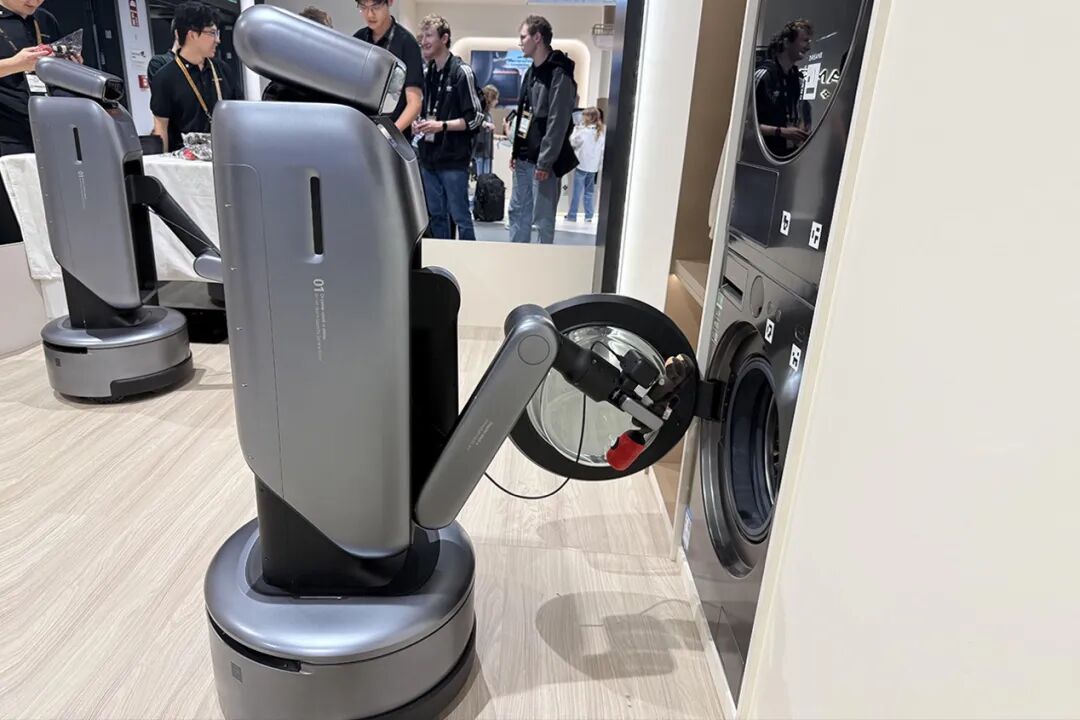
The S1 single-arm wheeled service robot of the ECHO series unveiled this time focuses on the high-frequency and rigid-demand scenario of household washing and drying, and is specially designed to address the pain points of users in links such as clothes collection, transportation, and connection between washing and drying. It does not simply complete a single grasping action, but is built around the complete washing and drying process, including collecting scattered clothes across the whole house, dragging the laundry basket, docking with washing and drying equipment, so that the robot can truly participate in the household laundry care process.
This operation link seems ordinary, but behind it is an important leap of service robots from "completing one action" to "doing one thing well".
A household is not a laboratory with limited variables. Clothes are soft and varied in shape, their placement positions are not fixed, and factors such as light, occlusion, friction and collision may affect the operation at any time. The robot not only needs to identify clothes and equipment, but also needs to complete spatial positioning, flexible grasping, equipment interaction and process connection. Deviation in any link may interrupt the entire task.
To solve these problems, the S1 single-arm wheeled service robot is expected to be equipped with two basic models: MLLM and VLA. MLLM is responsible for real-time voice interaction, supporting 10 languages and 22 dialects to understand the task demands expressed by users; VLA combines language instructions and visual information to further translate "what to do for me" into "what the robot should specifically do", realizing the connection from natural language understanding to action decision-making.
Technology must finally be implemented on products. The ECHO S1 adopts a liftable robotic arm, the height of the whole machine can be adjusted between 1570mm and 2275mm, the length from the shoulder center to the wrist center of the robotic arm is 1150mm, and the maximum load of the single arm is 5kg, so as to adapt to washing and drying equipment of different heights and undertake tasks such as clothes collection, laundry basket dragging and clothes transfer. The adoption of the single-arm solution is not a simple "subtraction", but a product trade-off made around the efficiency, reliability and cost of the washing and drying scenario.
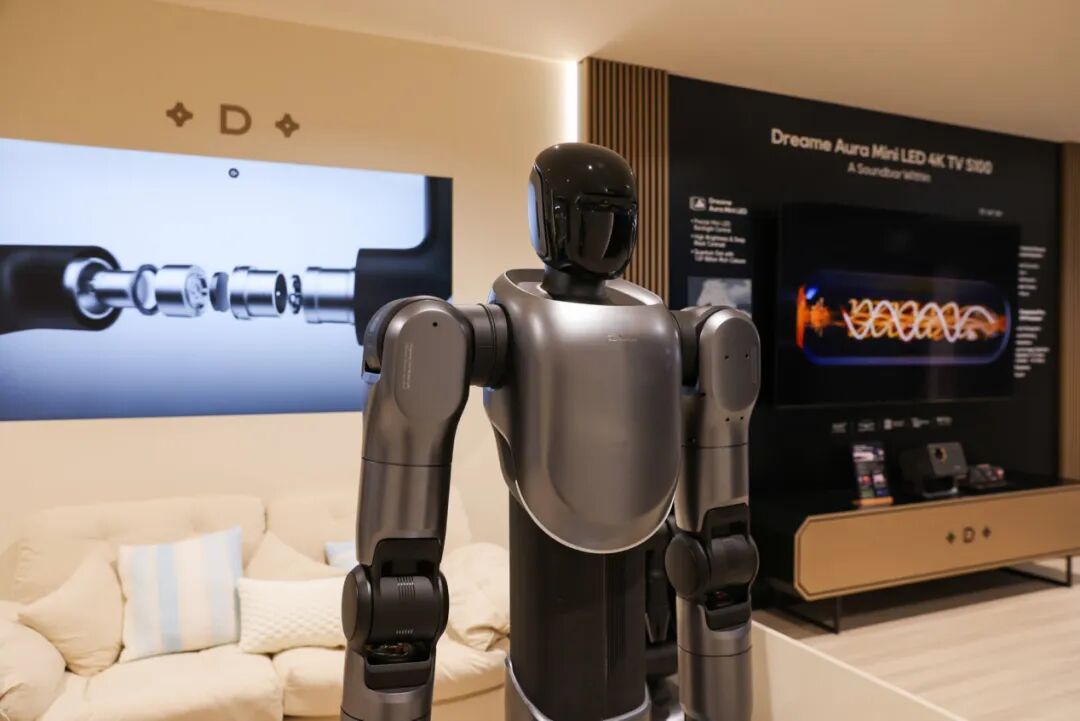
At the same time, the P1 dual-arm robot is a product of the ECHO series built for the future all-round robot housekeeper, exploring more general robot service capabilities.
Relying on dual-arm cooperation, omnidirectional mobile chassis and modular design, P1 can cover commercial service scenarios such as making freshly prepared drinks in catering, picking and placing goods, and instant retail delivery, and also has the ability to expand to household service scenarios, such as tasks like item sorting and transportation.
From one single action to one complete scenario, what the ECHO series explores is a key link in the implementation of household service robots. It does not measure capabilities by the number of actions, but verifies value by whether the task can be fully closed; it does not rush to pursue "being good at everything", but first makes one high-frequency household chore solid and detailed.
Expand from cleaning to services, technological accumulation opens up new applications for physical AI
In fact, Dreame vacuum cleaners did not start from scratch when entering the service robot track from the field of sweeping robots.
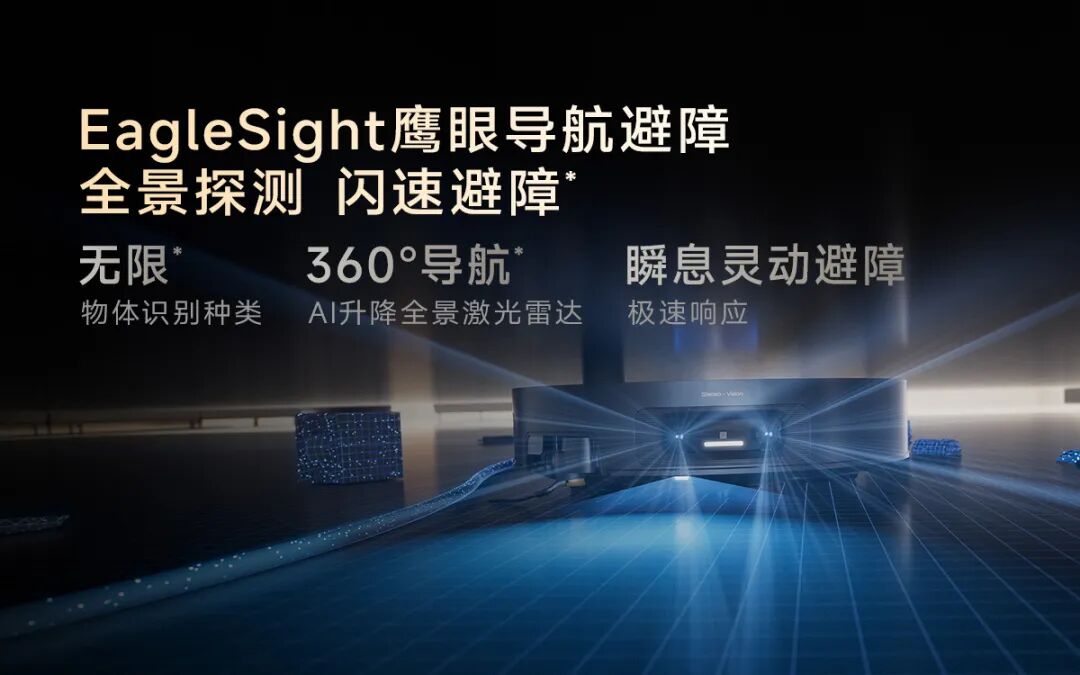
The sweeping robot is one of the products where robot technology has realized large-scale application at an early stage. It runs in real households every day, and needs to independently complete environment perception, spatial mapping, path planning, movement obstacle avoidance, cleaning operations and automatic recharging, which involves a number of technologies such as visual algorithms, navigation control, motion control, precision structure and energy management.
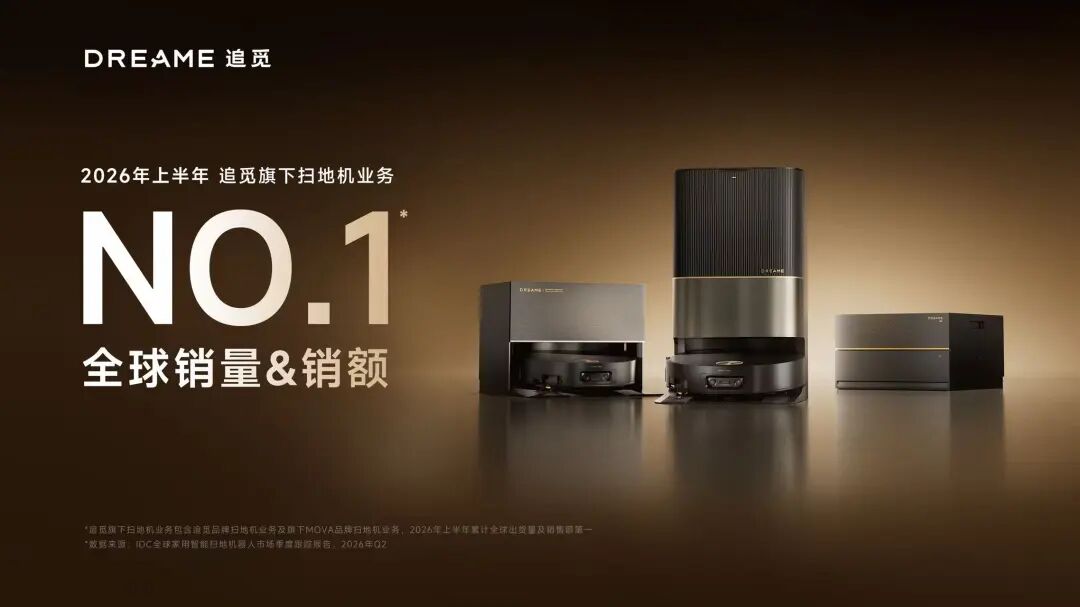
According to IDC data, in the first half of 2026, Dreame's global sales share of vacuum cleaner business reached 26.1% and the sales revenue share reached 31.2%, ranking first in the world in both sales volume and sales revenue. It is equivalent to that for every 4 vacuum cleaners sold globally, 1 is from Dreame. The globally leading market scale also provides Dreame vacuum cleaners with abundant feedback from household scenarios, enabling continuous iteration and optimization of robot technology.
These long-term accumulated capabilities and huge user base provide a realistic foundation for Dreame vacuum cleaners to deploy service robots. ECHO S1 and ECHO P1 share underlying capabilities such as embodied intelligence models, robotic arm control and visual algorithms. The R&D, manufacturing, supply chain coordination and reliability verification system formed by Dreame in the field of intelligent cleaning helps shorten the distance between the technical prototype of robots and mature products.
More importantly, to serve families, the first step is to understand families. The long-term entry of vacuum cleaners into real residences and participation in daily life enables Dreame to continuously recognize the complexity of household space, the differentiation of user demands and the subtle problems in the long-term operation of products. The cognition formed based on real products and real scenarios determines that the R&D of service robots cannot start from the technical list, but from specific problems in daily life.
Focusing on this idea, Dreame vacuum cleaners have formed a product path of parallel exploration of vertical tasks and diversified services. ECHO S1 focuses on links such as clothes collection, transportation and connection between washing and drying in laundry tasks to improve efficiency and reliability; ECHO P1 focuses on exploring comprehensive service capabilities such as item transportation, environment sorting, intelligent care and safety patrol. One extends from specific tasks, and the other accumulates general capabilities for complex scenarios, jointly expanding the application boundary of physical AI in household and commercial spaces.
However, it should be noted that household service robots are still in the early stage of development. The household environment is complex and changeable, which puts forward high requirements for safety, stability, cost and certification.
In response to this, the internal choice of Dreame vacuum cleaners is as follows: gradually accumulate experience, find problems and optimize capabilities, and then gradually enter more complex household scenarios. This path conforms to the law of technology and also the law of industry. Physical AI is not a simple superposition of a certain algorithm, a certain model or a certain hardware, but a systematic engineering composed of perception, decision-making, execution, manufacturing and scenario verification. Only by connecting the technology chain, product chain and application chain can robots move from prototypes to formal products, and from being usable to being user-friendly.
Move from technological boom to deep industrial practice, Chinese technology brands open up new space with practical efforts
Scientific and technological innovation requires both looking up at the stars and keeping feet on the ground.
It is a fact that it is impossible for service robots to enter thousands of households overnight. Complex household chores need to be disassembled into individual actions, single-point capabilities need to be connected into complete tasks, and the success in the laboratory has to undergo repeated tests of long-term operation in the real physical environment. This requires a spirit of "Yugong Moves Mountains": identify the direction, make persistent efforts, conquer technologies one by one, and get through scenarios one by one.
In this sense, the deployment of service robots by Dreame vacuum cleaners not only reflects the expansion of product boundaries, but also a pragmatic attitude to promote the implementation of physical AI: it does not follow the narrative of "all-powerful housekeeper" that can be achieved in one step, but starts from high-frequency demands such as washing and drying; it not only puts forward future visions, but also continuously discovers and solves problems through real scenarios.
From sweeping robots solving floor cleaning to service robots trying to undertake complex tasks such as laundry care and item transportation, Dreame vacuum cleaners are exploring new scenarios with new technologies and responding to new demands with new products. Such exploration does not win temporary attention by showing off skills, but creates long-term value by actually getting work done; it does not replace arduous R&D with grand concepts, but promotes the solid implementation of physical AI through continuous investment.
Therefore, the ability to actually get practical work done is a question that physical AI must answer when moving from the technological boom to the deep industrial practice. Defining products with real demands, solving problems with systematic capabilities, and promoting implementation with a down-to-earth spirit, Chinese technology brands are moving forward steadily on this new track, and will also open up a broader space for artificial intelligence to empower production and life.