Guangzhou, Shenzhen and Hong Kong combined top the global ranking again!
On September 8, the World Intellectual Property Organization (WIPO) released the *2026 Global Innovation Index Top 100 Innovation Clusters Report* at its headquarters in Geneva.
The report shows that the "Shenzhen-Hong Kong-Guangzhou" innovation cluster has ranked first in the world for the second consecutive year. Previously, the "Shenzhen-Hong Kong-Guangzhou" cluster ranked second globally for five consecutive years from 2020 to 2024, and claimed the top spot for the first time in 2025.
This year, it successfully defended its title, consolidating its position as the world's largest innovation cluster.
01
Who are the top 10 global innovation clusters?
Here is the TOP 10 list:
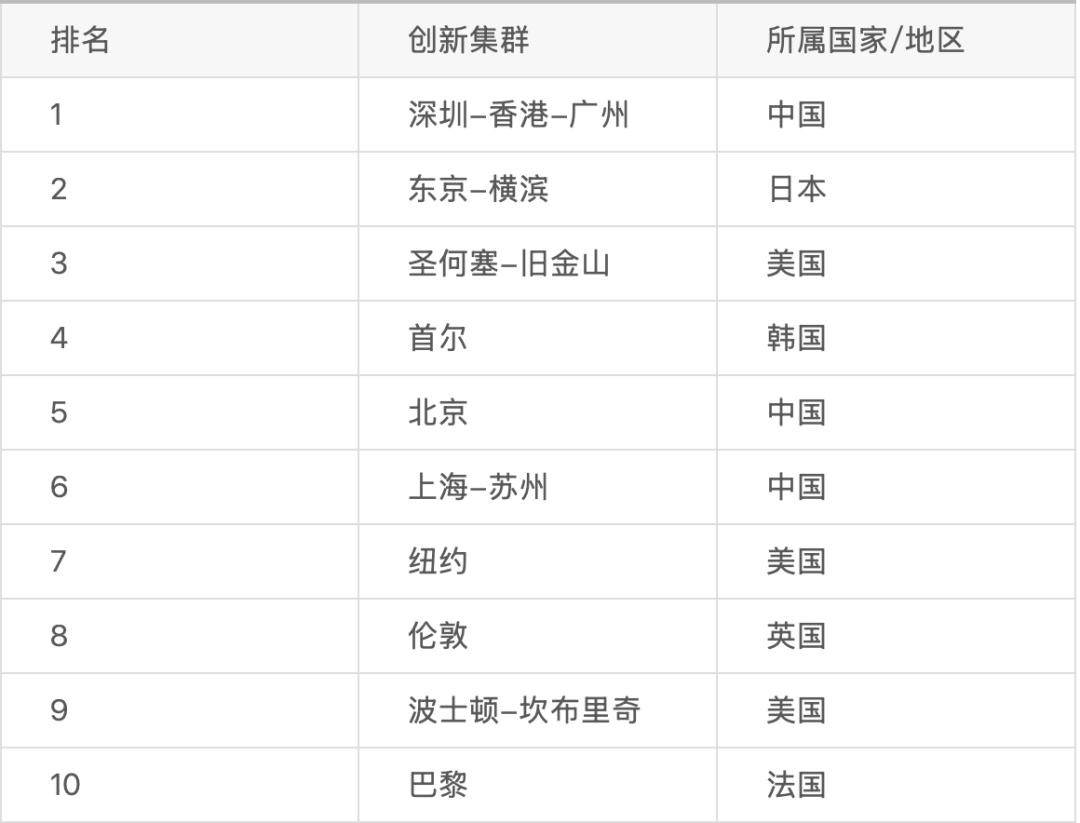
Among the top 10, China takes three seats: Shenzhen-Hong Kong-Guangzhou ranks first, Beijing ranks fifth, and Shanghai-Suzhou ranks sixth. Hangzhou ranks 13th, Nanjing 15th, Wuhan 17th, and Macao-Zhuhai has entered the top 100 for three consecutive years.
A total of 25 innovation clusters in China have made it to the global top 100 this year, ranking first in the world for the fourth consecutive year, which means China accounts for a quarter of the global top 100 list.
18 of the 25 Chinese clusters have moved up in the rankings. Among them, Ningde jumped from 99th to 75th, rising 24 positions at one go.
Some may ask, is this list reliable?
The answer is: extremely reliable. The World Intellectual Property Organization is a specialized agency of the United Nations, the "supreme authority" in the global intellectual property field. The Global Innovation Index Cluster Ranking was launched in 2017, ranking the world's top 100 innovation clusters every year. In other words, this is the "official certification" in the global innovation sector, not some unqualified unofficial list.
More importantly, this list does not rely on expert "scoring", but directly looks at three hard metrics:
First, the number of PCT international patent applications. It counts the location of inventors in patent applications filed through WIPO's Patent Cooperation Treaty. Patents are the "hard currency" of innovation, and this data cannot be falsified.
Second, the number of published scientific papers. It counts the affiliated institutions of authors of published scientific research papers. Papers represent the depth of basic research.
Third, the volume of venture capital transactions. It counts the location of enterprises that receive venture capital. Capital is the smartest type of fund, and where it flows indicates where opportunities lie.
In simple terms, papers correspond to "whether it can be developed", patents correspond to "how to develop it", and venture capital corresponds to "whether someone is willing to fund the development" — combining these three dimensions, the real innovation vitality of a region can be fully demonstrated.
02
Where exactly does the Guangdong-Hong Kong-Macao Greater Bay Area stand out?
Let's start with the data. During the data period of this ranking, the three core indicators of the "Shenzhen-Hong Kong-Guangzhou" cluster are: 120,095 PCT patent applications, 215,866 scientific papers, and 7,325 venture capital transactions.
The data is more intuitive when converted to density: there are 2,259 patent applications, 4,060 papers, and 138 venture capital transactions per million people. The three indicators lead in a balanced manner with no obvious shortcomings. In addition, 7 enterprises from the Greater Bay Area are shortlisted in the top 50 of 2025 global PCT applications, and Huawei has ranked first in the world for 8 consecutive years.
However, data alone is not enough. The real competitiveness of the Greater Bay Area lies in its unique "mixed operation model":
Hong Kong boasts top-tier universities and an international capital market. The assets under management of private equity funds in Hong Kong are close to 250 billion US dollars, ranking second in Asia. The two major innovation and technology flagship projects, Hong Kong Science Park and Cyberport, have witnessed the birth of about 20 unicorn enterprises to date.
Shenzhen has the world's strongest engineering and industrialization capabilities. In 2025, Shenzhen submitted 19,660 PCT international patent applications, ranking first among all cities in China for 22 consecutive years.
Guangzhou is the talent supply hub of the Greater Bay Area, with 1.68 million enrolled college students ranking first among all cities in China, continuously delivering talents to the entire innovation cluster. Top universities including Sun Yat-sen University and South China University of Technology, as well as a large number of major research institutes, are rooted here, with strong comprehensive strength in science, education, culture and public health.
The three cities complement each other's advantages, and cross-border collaboration under the "One Country, Two Systems" framework has formed a one-of-a-kind innovation model that cannot be found anywhere else in the world.
Compared with the Yangtze River Delta, the differentiated advantages of the Greater Bay Area are as follows:
First, it has a higher degree of internationalization. Hong Kong is a free port with free flow of capital, talents and information, and seamless connection with the international market.
Second, it has larger space for institutional innovation. "One Country, Two Systems" endows the Greater Bay Area with a unique policy testing ground — the four major platforms of Hetao, Qianhai, Hengqin and Nansha, which can carry out many rule alignment practices that cannot be implemented in the Yangtze River Delta.
Third, it has stronger market-oriented implementation capabilities and outstanding dominance in end industries, giving birth to a large number of national super brands in the fields of smartphones, home appliances, new energy and consumer electronics. It has a sound C-end industrial ecosystem, extremely fast market response and iteration speed, and realizes an efficient closed loop from technological innovation to commercial monetization.
In comparison, the advantage of the Yangtze River Delta lies in its "depth", with a long industrial chain, solid manufacturing foundation and profound basic research accumulation; the advantage of the Greater Bay Area lies in its "flexibility", with flexible systems, active capital, sensitive market, fast iteration and efficient implementation.
The Yangtze River Delta is more profound, more robust and better at making breakthroughs rooted in underlying technologies; the Greater Bay Area is more agile, more open and better at rapid commercial realization. It can be said that these two top innovation highlands, one deep and one flexible, one steady and one fast, one defensive and one offensive, jointly prop up the ceiling of China's scientific and technological innovation.
This article is from the WeChat Official Account "City War", written by Tinghai Moyu, and published by 36Kr with authorization.