A female professor from Zhejiang University is about to launch an IPO in Hong Kong.
A professor from Zhejiang University has joined the queue of robotics IPO candidates.
According to PE Daily - Daily IPO, Zhejiang Jabez Technology Co., Ltd. has recently submitted a new listing application to the Main Board of the Hong Kong Stock Exchange, aiming to go public under Chapter 18C.
The helm behind the company, Xiong Rong, is a professor at the College of Control Science and Engineering of Zhejiang University, and one of the earliest pioneers in China's robotics competition field.
Xiong Rong's story is deeply imprinted with the marks of the times. In 2001, she led her Zhejiang University students to develop the first generation of football robots for the university, and in the following decades, she led the team to win many championships. In March this year, the International Federation of Robotics announced the list of "11 Women Shaping the Future of Robotics 2026", and Xiong Rong was the only Chinese face on the list.
In 2016, Xiong Rong founded Jabez Technology in Hangzhou with several of her lab students. Over the past ten years, a long line of investors have gathered behind the company. At present, a large number of robotics enterprises are rushing to the capital market intensively, and Jabez Technology has also stood at the gate of the Hong Kong Stock Exchange.

Xiong Rong (Official website of Zhejiang University)
Female Professor from Zhejiang University Starts a Business with Her Students
Preparing for Hong Kong IPO
The story begins in Taicang, Suzhou.
When she was in junior high school, Xiong Rong passed by a computer training course offered by the county, signed up on a whim. After a summer vacation, she not only mastered the BASIC language, but also witnessed the scene of a computer playing chess against a human for the first time. In the 1990 college entrance examination, she applied for the Department of Computer Science of Zhejiang University.
Seven years later, she graduated with a master's degree from the Department of Computer Science of Zhejiang University, stayed at the university and joined the State Key Laboratory of Industrial Control Technology as a lab assistant. Her daily work was to manage the lab's email and servers, design web pages, and occasionally participate in some basic software development.
The turning point came in 2000. Chu Jian, then director of the laboratory, heard that football robot research was emerging abroad, and asked Xiong Rong if she would like to give it a try. She had a computer science background and was not proficient in machinery and electrical control, and even did not have a clear concept of "robot", but she felt that there was a practical thing to devote herself to, so she agreed.
Without an existing team, she posted a recruitment post on the BBS of Zhejiang University, and finally started from scratch with 3 recruited students, forming the "founding team" of Zhejiang University's robotics program.
At that time, China's robotics industry was just in its infancy, and there were very few robotics books available on the market. She spent all her spare time in the library, searching through all the materials, documents and professional papers she could find, and also took her students to many places for research.
Hearing that Northeastern University had a self-developed football robot system, she made a special trip there to learn from their experience. But when she saw the system that had been developed for two years, which even wobbled when walking in a straight line, she couldn't help feeling disappointed: When will we be able to develop our own robots?
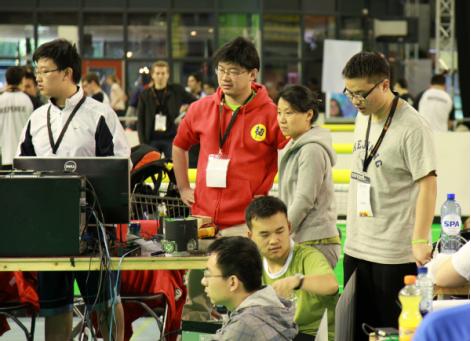
Xiong Rong guides students to participate in competitions (Official website of Zhejiang University)
A year later, Xiong Rong and her students developed the first generation of FIRA football robots of Zhejiang University, and since then they have competed in robotics events at home and abroad. The team led by Xiong Rong from Zhejiang University has won the Small Size Robot World Cup four times, including a 1-0 victory over the German ER-Force team in the 2019 final.
In March this year, the International Federation of Robotics announced the list of "11 Women Shaping the Future of Robotics 2026", and Xiong Rong was on the list, and was the only Chinese face selected.
The story of Xiong Rong and robots has always been accompanied by a group of students.
At that time, the laboratory was like a small startup company, with little experience from predecessors. Students recalled that the room was often filled with the burnt smell of welding circuit boards. In 2015, the team developed China's first set of trackless autonomous navigation AMR intelligent handling robots. Around 2016, the practical application demand for industrial mobile robots gradually emerged, and the attention of the market and capital also gathered. They felt that they could no longer lock their achievements in the laboratory.
Therefore, in July 2016, Xiong Rong founded Jabez Technology in Hangzhou with several of her students. At the time of establishment, the company's registered capital was 5 million yuan, with Xiong Rong holding 49% of the shares, and Chen Shouxian, who later served as CEO, holding 2.4% of the shares at that time.
Chen Shouxian participated in robotics competitions with Xiong Rong as early as his student days, and won the world championship with the team. Most of the core team of Jabez Technology also came from the robot laboratory of the Institute of Intelligent Control of Zhejiang University. The teachers and students who used to debug robots and stay up late to compete together have since become partners in starting a business side by side.
The initial direction of the startup was not clear. Chen Shouxian once recalled that around 2017, the team successively investigated service robot scenarios such as hotels and shopping malls, and for a time they were like people holding a hammer looking for nails everywhere. After comparison, they found that the requirements for positioning accuracy, reliability and environmental adaptability in industrial sites are more suitable for the mobile robot technology that the team has accumulated for many years. Xiong Rong believes that the team also has the ability to develop unmanned driving systems and service robots, but finally chose to focus on industrial intelligent logistics, valuing its value for the upgrading of the manufacturing industry.
In order to introduce AMR to a leading domestic panel enterprise, Jabez Technology sent a team to station in the factory, spent two or three months sorting out dozens of processes at the module production end, and then repeatedly coordinated with the customer, and finally customized a special robot, and put in about 200 units at one time.
Jabez Technology's products were gradually polished in the factory. In 2018, the first AMR product EMMA V1 achieved commercialization. In 2020, the company launched the outdoor mobile robot LUNA 2, in 2021 launched the commercialized omnidirectional heavy-load OMNI and fork-type FOLA series, entered the field of mobile manipulation robots in 2022, and launched the embodied intelligent mobile chassis NERA-P in 2025.
Capital also continued to pour in. Only half a year after its establishment, Jabez Technology received angel investment from Ginkgo Valley Capital, and then successively introduced institutions such as Paladin, Autel, Yunyi Investment, Huiyou Investment and Hongrong Capital. In 2021, ByteDance's Quantum Leap and Lenovo Venture Capital took shares, followed by Xianghe Capital leading the B+ round, with Shenzhen Venture Capital and others participating in the investment. After that, Supcon Technology, Fangguang Capital and many local state-owned capitals in Zhejiang successively increased their investments. In early 2026, the company completed the C++ round of financing, with a post-investment valuation of 2.13 billion yuan.
Ten years of entrepreneurship was finally written into the prospectus.
From 2023 to 2025, the revenue of Jabez Technology was 74.95 million yuan, 110 million yuan and 260 million yuan respectively. In the first half of 2026, the company's revenue was 169 million yuan, a year-on-year increase of 25%, 891 robots were delivered, and the amount of contracts on hand at the end of the period was about 500 million yuan.
Among them, the industrial AMR selected at the beginning of the startup still supports the revenue. In the first half of 2026, the robot solution contributed 147 million yuan, accounting for 87.3% of the total revenue.
Robotics Companies Are Queuing for IPO
The listing bells of robotics companies are ringing one after another.
Huayan Robotics, Estun, Locobot, Seer Robotics, and Luoshi Robotics have successively completed their listings on the Hong Kong Stock Exchange. On August 19, Unitree Technology landed on the Sci-Tech Innovation Board. In early September, Mech-Mind was listed on the Hong Kong Stock Exchange, and UD Robotics has also completed its prospectus.
The queue is still getting longer. According to incomplete statistics from PE Daily, there are more than 50 robotics-related companies queuing at the gate of the Hong Kong Stock Exchange alone: Agibot, Deep Robotics, and Leju Intelligent have entered the IPO process; companies such as Exechon Dynamics, Cross Dimension Intelligence, Zhipingfang, and Zibianliang have also successively released listing signals. At the same time, many companies such as Starsea Map, Zhongqing Robotics, Songyan Power, Xingdong Era, Xingchen Intelligence and Fourier Intelligence have completed share reform and entered the IPO preparation stage.
To a certain extent, this is the "ten-year appointment" that the first generation of Chinese robotics startups have collectively ushered in.
Around 2015, the artificial intelligence and intelligent manufacturing track heated up, and a large number of scientific research achievements from university laboratories began to migrate to the industrial end, and a number of enterprises such as Jabez Technology emerged one after another. Ten years later, those VCs, industrial capitals and local state-owned capitals that have bet all the way finally ushered in the moment of exit returns.
A group of Chinese robotics enterprises are flocking to the capital market, striving to open the door to the public market before the financing window narrows.
Capital is accelerating to gather in a few leading players. Since 2026, industry leaders have successively obtained large-scale financing of several billion yuan in just a few months, while the financing pace of mid-tier and lower enterprises has slowed down significantly.
After all, robotics is a long and capital-intensive business. From technology R&D, prototype testing to supply chain construction, on-site debugging and after-sales maintenance, every step forward requires capital.
For companies that are still continuing to invest and have not yet achieved stable profitability, IPO is a key step to access public market financing and M&A tools, and create exit conditions for early shareholders. Enterprises that stay outside the market for a long time will continue to face the pressure of subsequent financing, valuation and cash consumption.
The system provides a new financing entrance for these companies that have long invested in R&D. The Hong Kong Stock Exchange, in Chapter 18C, provides a listing and financing channel for special technology companies that fail to meet the financial eligibility tests of Chapter 8 of the Main Board for their product commercialization and business expansion, and sets corresponding qualification, disclosure and investor protection requirements at the same time.
But going public does not mean reaching the shore.
In March this year, Huayan Robotics' public offering received more than 5000 times of subscriptions, but its share price once fell below the issue price on the first day of listing. Two months later, Yifei Technology did not introduce cornerstone investors nor set up a greenshoe mechanism, but its share price rose by 80% on the first day of trading, with a market value of over 13 billion Hong Kong dollars. As more and more robotics IPOs are launched, the answers given by the secondary market are different.
The primary market focuses on technical routes, team background and imagination space, while the secondary market will further question gross margin, customer concentration, payment collection cycle and cash flow.
Zhou Zhifeng, Managing Partner of Qiming Venture Partners, once summarized to PE Daily three key points for robotics and embodied intelligence enterprises after entering the public market: the ability of large-scale commercial implementation, whether the technical route can converge, and whether the hardware cost, gross margin and supply chain management ability can be broken through. In his view, 2027 will become an important verification window for robotics and embodied intelligence enterprises.
The moment of test has really come.
This article is from the WeChat official account "Daily IPO", author: Chen Jia, authorized by 36Kr for release.