Who is the most profitable among the 17 design institutes of PowerChina? Some earned 500 million yuan in the first half of the year, while some lost 40 million yuan, sharing the same parent but having completely different fates.
The 16 design institutes under PowerChina are facing divergent development outcomes, and the way out lies in full-industry-chain transformation.
As learned from Foresee Energy, PowerChina recently released its first-half performance report. The group's attributable net profit reached 3.821 billion yuan, down 29.56% year on year. But when breaking down the data of its 16 subordinate design institutes, some recorded a net profit of 500 million yuan, while some suffered a loss of 46.56 million yuan.
Under the same corporate brand, the gap in profit is more than 10 times.
Looking at the performance of these 17 design institutes, the real questions worth exploring are: why are the profitable ones able to make money? Where are the underperforming ones lagging? All of these institutes originated from China's hydropower construction after the founding of the People's Republic of China. After 50 years of development along different paths, why have they ended up in completely different situations under the same corporate system today?
01
Profitable Design Institutes
No Longer Rely on Drawing Blueprints for Profit Long Ago
CHIDI's net profit hit 530 million yuan to rank first, followed by EDI with 512 million yuan. The total profit of the two exceeded 1 billion yuan, which is more than the sum of the 3rd-ranked Northwest Institute to the 10th-ranked Guizhou Institute.
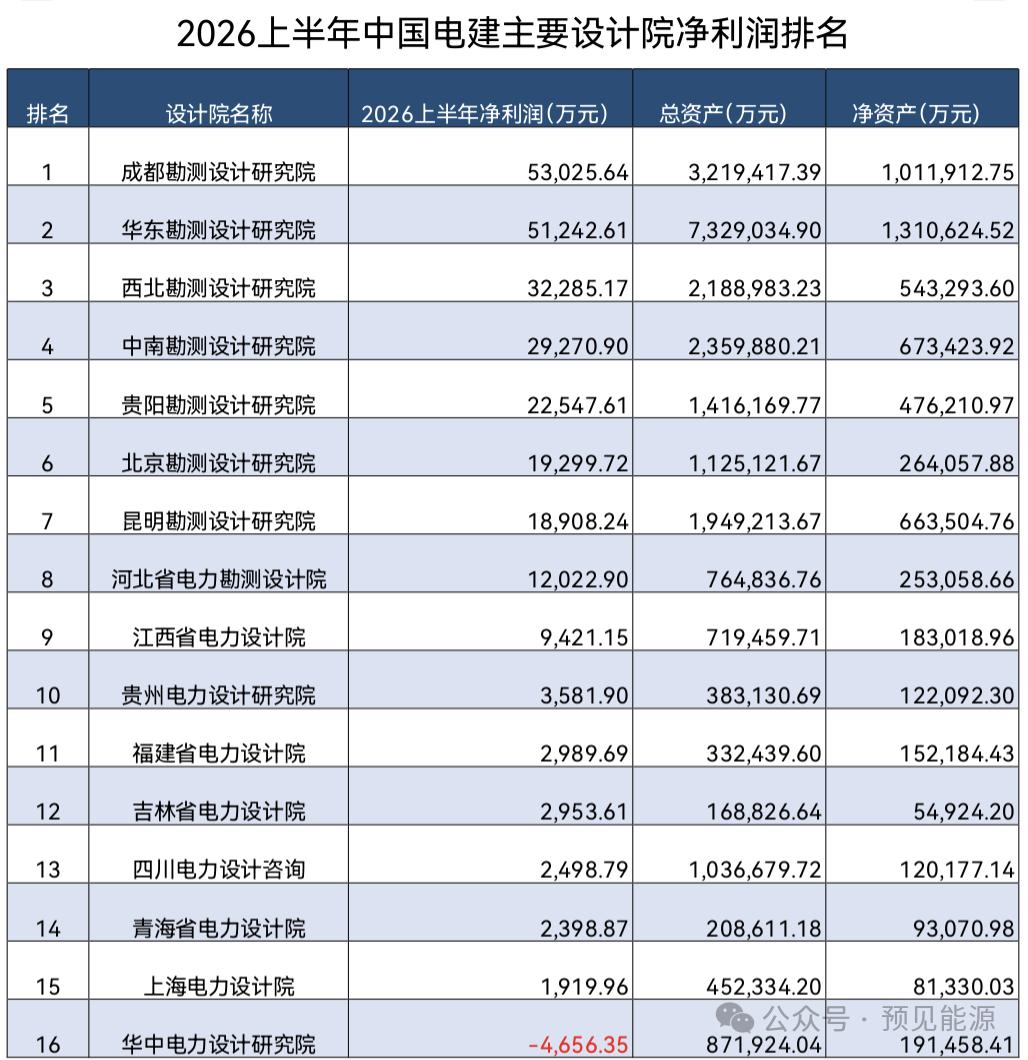
Note: The ranking is sorted out by Foresee Energy based on the data of major holding and participating companies disclosed in PowerChina's 2026 semi-annual report, excluding HydroChina Corporation, whose performance has not been disclosed separately.
What is the secret behind their success?
CHIDI was founded in 1950 as the Southwest Hydropower Engineering Office, and has been engaged in hydropower survey and design for more than half a century. The real turning point came in 2003, when it undertook the turnkey contracting of the Liuhong Hydropower Station on the Meigu River, marking its first transformation from "drawing blueprints" to "managing projects". Over the past 20 years, it has opened up the whole chain of planning and consultation, survey and design, construction, investment and operation, and has built a "technical moat" for high-altitude hydropower and new energy. In early 2026, three high-altitude photovoltaic projects in Puxi, Rangtang, Aba, Suorong, Litang, Garze, and Maoniu Ping, Yanyuan, Liangshan, were put into operation successively. The Xiaojinchuan River Basin Photovoltaic Base, the country's first integrated water-solar-storage-pumped storage project, was also delivered by CHIDI under the EPC mode of design and construction.
EDI was established in 1954, and it also started with hydropower survey and design in the early stage. But it turned to new business nearly 20 years earlier than its peers, and in 2005, it plunged into the survey and design of offshore wind power, becoming one of the first batches of domestic design institutes to engage in this field. The 20-year window period is long enough for it to fully master the relevant technologies, experience and customer relationships. In March, it signed an EPC contract for the RTC 2.1GW + 7.75GWh solar-storage project with Masdar (Abu Dhabi Future Energy Company), with a total amount of 13.962 billion yuan. One overseas order is equivalent to the annual revenue of many other peers.
However, EDI also made a move that puzzled many people — it listed and transferred 3% equity of Zhejiang Kecheng Pumped Storage Power Station on May 28, with a reserve price of 5.5155 million yuan. On June 9, it listed 5% equity of the Jinshuitan Pumped Storage Power Station.
Pumped storage is clearly a popular track under the "Dual Carbon" goals. Data from the National Energy Administration shows that in 2026, State Grid plans to invest 31 billion yuan in the pumped storage sector, but EDI is divesting its related assets.
To put it plainly, this is an open secret in the industry: In the early stage of a pumped storage project, design institutes usually intervene by taking a small share of equity in order to lock in the design turnkey contract. After the design contract is signed and the project enters the substantive promotion stage, the design institute will gradually exit the financial equity. The 3% equity held by EDI corresponds to a subscribed capital contribution of about 47.62 million yuan, while the paid-in capital is only 5.4 million yuan. This is not a profitable deal, but more like a financial cleanup.
EDI's logic is very simple: my core competitiveness lies in design and technical services, not in being a minority shareholder of the project. Instead of tying up funds in long-cycle projects, it is better to free up capital to take on more large EPC orders.
This is the business logic of leading design institutes: design fees are only the entry ticket, and EPC turnkey contracting is the real source of profit. Everyone starts from the same starting line, but makes different choices at the fork in the road.
02
From 300 Million Yuan to 70 Million Yuan
Only 6 Ranks Apart
The 4th-ranked Central South Design Institute recorded a net profit of 293 million yuan, while the 10th-ranked Guizhou Design Institute recorded 36 million yuan. There are only 6 positions between them, but the profit has shrunk by 88%.
Central South Design Institute was founded in 1949, and has a longer history than CHIDI and EDI. In the early stage, it was also engaged in hydropower survey and design, and started to participate in the investment of hydropower and wind power projects in 2004. Beijing Design Institute was established in 1953, and got involved in pumped storage in 2004, taking a leading position in China, but it only maintained its basic business. Northwest Design Institute started with hydropower survey in the upper reaches of the Yellow River in 1950, and later plunged into the construction of large new energy bases in desert, Gobi and barren areas, and is operating in a relatively good condition.
Although HydroChina Corporation still bears the name of "design institute", its business essence has changed. It is no longer the kind of design institute that we usually understand as making a living by drawing blueprints and collecting design fees.
According to the industrial and commercial registration information, HydroChina Corporation still holds the class-A design qualification for electric power industry and the class-A design qualification for water conservancy industry. Its business scope also lists "survey and design of hydropower, new energy projects, industrial and civil buildings".
However, qualifications and business scope alone can no longer explain the real situation. The real change took place at the end of 2021 — PowerChina carried out in-depth restructuring and integration of HydroChina Corporation and its subordinate new energy companies, and established PowerChina New Energy Group Co., Ltd. The intention of this restructuring is very clear: to transform HydroChina Corporation from a "design-oriented" company into a platform for new energy investment and operation.
After the restructuring, HydroChina Corporation is positioned as the " strategic implementation entity of PowerChina's new energy industry " and " important investment and financing platform ". Its main business has shifted from earning design fees to earning investment returns.
All these institutes are looking for their own development paths, but their upper limits are different.
What is the problem with these mid-tier design institutes? Their businesses are highly homogeneous. Others can do what you can do, and others can provide the same services as you. The profit margin has been compressed to the extreme, and the revenue recognition of one large EPC project can even change the ranking.
What's more troublesome is that the scale of traditional hydropower projects is limited. In the first half of 2026, PowerChina's energy and power business newly signed contracts reached 386.265 billion yuan, down 10.46% year on year. With too many monks and too little porridge, the mid-tier design institutes are naturally facing tight operating conditions.
They are still stuck in the traditional mode of "taking projects - doing design - collecting design fees". But how much proportion can the design fees account for in the total investment of a project? For a project worth hundreds of millions of yuan, the maximum design fee is only a few million yuan. As for EPC turnkey contracting, the contract amount is dozens of times higher. Even if you take a different path like HydroChina Corporation, you can only stay in the middle tier.
This is where the gap lies: leading design institutes eat the whole fish, while mid-tier design institutes can only gnaw on the fish bones.
03
A Loss of 46.56 Million Yuan
Sends a Warning to All Participants
At the end of the ranking list, Central China Design Institute recorded a net loss of 46.5635 million yuan.
Its predecessor is Henan Electric Power Survey and Design Institute established in 1958, which has the comprehensive class-A qualification for engineering design. With qualifications, long history and good background, how could it suffer losses?
The direct reason is that its business structure cannot keep up with the changes of the industry. PowerChina made it very clear in its semi-annual report that it will "vigorously promote the transformation from traditional engineering contracting to full-cycle solution services". But transformation requires a large amount of real capital investment — R&D investment, talent introduction, and new business expansion are all rigid expenditures. These costs are not a problem in years of good harvest, but when the industry goes down, these costs become the last straw that crushes the profit.
The deeper problem is that the market of traditional power design institutes is being squeezed from both ends. Upstream, leading players like CHIDI and EDI are seizing the market share downwards by virtue of their technology and scale; downstream, private design companies and engineering turnkey contractors are grabbing the market share upwards by virtue of their flexibility and low cost. The Central China Design Institute sandwiched in the middle has neither technical barriers to defend, nor cost advantages to expand.
In the first half of 2026, PowerChina's overall attributable net profit decreased by 29.56% year on year. The pressure at the group level is transmitted to its subsidiaries, and those with weak anti-risk ability will naturally fall first.
The whole industry is going through an elimination round: those who run slowly will be eliminated.
04
The Way Out for Design Institutes Does Not Lie in CAD Drawings
The success of CHIDI and EDI is essentially the same logic: transforming the design institute from an asset-light company that "sells blueprints" into a comprehensive service provider that "delivers solutions".
CHIDI relies on its in-depth technical strength. High-altitude photovoltaic and integrated water-solar-storage-pumped storage projects are not businesses that anyone can do. Once the technical barrier is established, the profit margin is guaranteed.
EDI relies on its broad market layout. When the domestic market becomes saturated, it expands overseas. A 13.9 billion-yuan overseas solar-storage order directly widens the gap between it and the mid-tier design institutes.
Guiyang Design Institute is building the "Mountain Integration & Ocean Intelligence" technical brand, creating a full-industry-chain engineering digital solution. Beijing Design Institute has entered the hydrogen production track — the total investment of the integrated hydrogen production and storage demonstration project in Jiuyuan District is nearly 1.5 billion yuan. Central South Design Institute has established emerging business companies focusing on digital intelligence technology and energy storage engineering.
The whole industry is changing. The future of design institutes does not lie in CAD drawings, but in every link of the full project cycle. To survive, they must first complete the closed loop of "planning - design - investment - construction - operation".
This article is from the WeChat official account "Foresee Energy", written by Zhao Jianan, and published with authorization from 36Kr.