After the explosive surge in its monthly active users, Soda Music has finally forced TME to take action.
Recently, the news that "Hongguo's daily active users exceed the total of iQiyi, Youku, Tencent Video and Mango TV" topped the trending searches, once again bringing the value of free traffic to the forefront of the industry.
Data shows that as of July 2026, the daily active users (DAU) of Hongguo Short Drama have reached 168 million, a year-on-year increase of up to 107%, exceeding the sum of about 155 million DAU of "iQiyi, Youku, Tencent Video and Mango TV"; its monthly average daily usage duration per user has reached 125 minutes, which is roughly equivalent to the duration of watching two standard full-length dramas in a row every day, far exceeding that of long-video platforms.
The rise of Hongguo at least proves one thing: when the Internet enters stock competition, free of charge has not lost its attractiveness. On the contrary, as long as the product is light enough, the content supply is rich enough, and the business model is viable, free of charge can still become an efficient tool to generate new users and extend usage duration.
Similar changes are also taking place in the online music industry.
Recently, Tencent Music has launched an independent app called "Free Music" on Huawei AppGallery. Unlike highly mature comprehensive music platforms such as QQ Music and Kugou Music, the new product has almost positioned itself directly in its name: free of charge.

This is not the first time Tencent Music has stepped up its efforts in the free market this year.
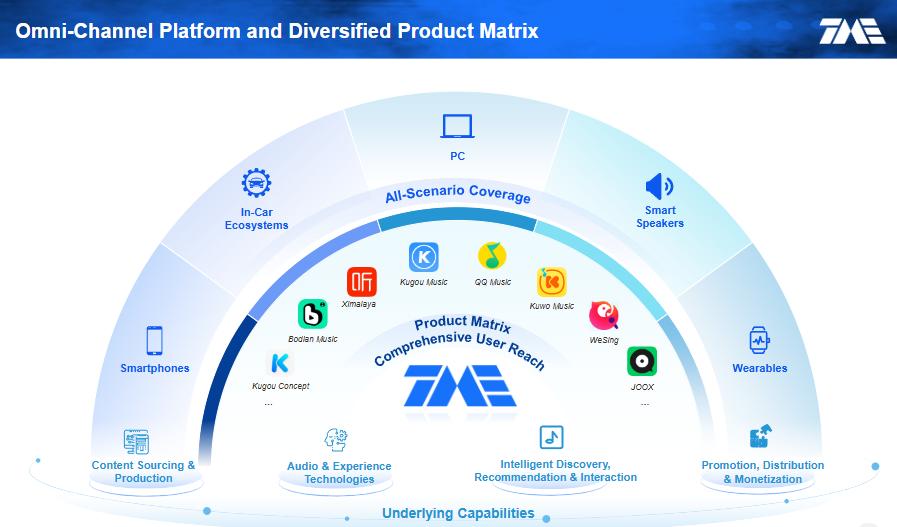
In the second quarter of this year, it also launched the free version of Kugou Music. At the same time, through Tencent ecosystem entrances such as WeChat Pay, it diverted traffic to lightweight products such as Boud Music and Kugou Concept Edition, continuously competing for price-sensitive users with limited willingness to pay.
So at a time when the payment system is becoming increasingly mature and copyright barriers are gradually solidified, why does Tencent Music re-compete for light free users? Is this just another regular "horse racing" inside the company, or a signal that the online music industry has bid farewell to the single paid growth and restarted the free traffic competition?
Tencent Music Quietly Launched "Free Music"
Judging from the current product interface, "Free Music" is not completely occupied by advertisements and tasks, but retains a complete content distribution framework similar to QQ Music.
The homepage still looks like a standard music app, with scenario-based recommendations, popular hit songs, AI playlists, charts and personalized playlists forming the main content, providing different music entrances according to time, popularity and user preferences.
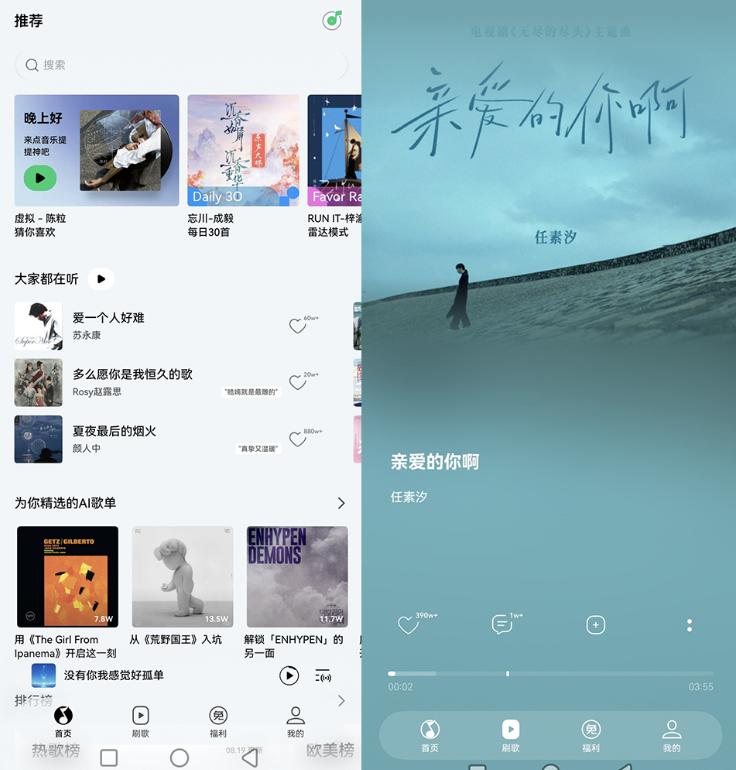
The bottom navigation bar "Home, Swipe to Listen, Benefits, My" forms four core entrances, among which "Swipe to Listen" and "Benefits" each occupy an independent Tab, outlining the product logic of this product that is different from traditional music apps.
Among them, "Swipe to Listen" adopts the short-video-style information flow interaction. After entering the page, similar to Qishui Music, the album cover is used as the background, the song name and singer information are placed at the bottom of the page, and interactive functions such as collection, comment and addition are retained, which are interconnected with the QQ Music system. Users do not need to enter the playlist or search for songs first, just swipe up and down to switch to the next song continuously.
The "Benefits" page directly takes "watch ads to listen for free" as the core prompt, and the free listening duration becomes a right that can be obtained through user behaviors. Watching a video can add 30 minutes, browsing an ad for 5 seconds can add 30 minutes, and daily check-in can add 10 minutes, and the accumulated duration obtained can be used for subsequent music listening.
From the perspective of product mechanism, the so-called "free" of "Free Music" does not mean that the platform gives up monetization. Users still need to exchange for music listening duration by watching advertisements, completing tasks and staying active, and the platform obtains advertising value from users' attention and usage behaviors. This is also the most intuitive similarity between "Free Music" and Qishui Music at present.
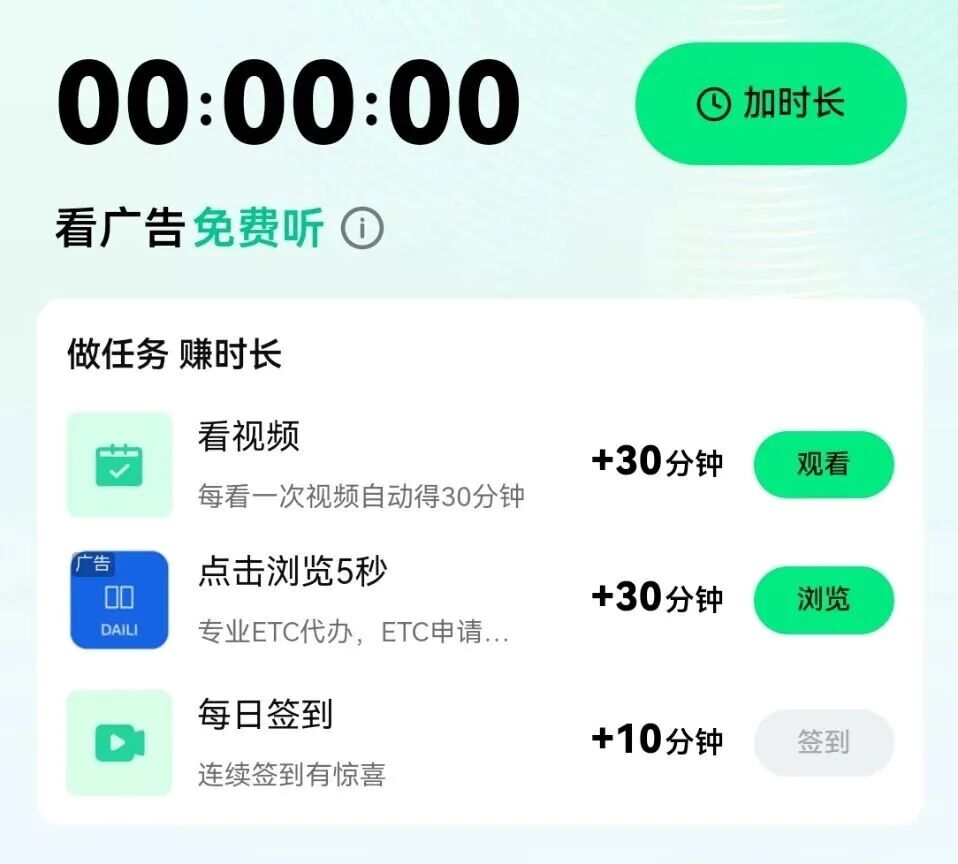
The difference is that Qishui Music has formed a layered system where free use and VIP/SVIP subscription coexist, while judging from the currently exposed version, no clear membership entrance has been seen in "Free Music", and the product focus is more concentrated on "let users keep listening for free".
As mentioned earlier, this is not the first time Tencent Music has tried "free of charge".
As early as December 2020, Boud Music, a product under Tencent Music's Kuwo Music, was launched internally with a free mode. It focuses on a minimalist interface, personalized recommendation and up-down swipe to switch songs, and takes young users as an important target group.
At that time, Xiao Mi, the product leader, summarized user needs into three cores: playback experience, song-finding experience and emotional value, and emphasized that the team focused on recommendation algorithms, striving to let users quickly find their favorite songs. Talking about the original intention of the product, she specifically focused on Generation Z, aiming to create an exclusive music product that fits the habits of young groups. However, more than 5 years have passed, Boud Music has now become the "QQ Music Lite Version", and its model is closer to Qishui Music.
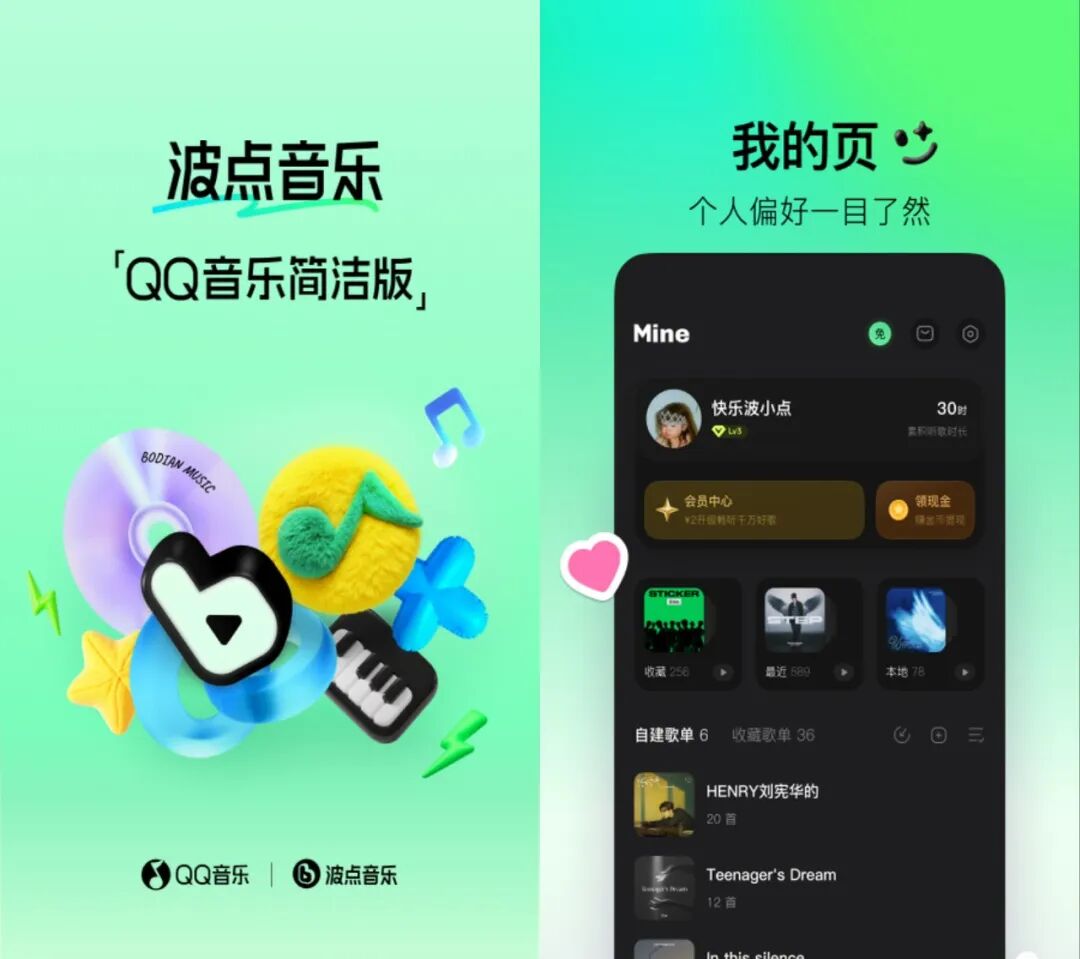
Comparing the two products of Free Music and Boud Music, both are lightweight, emphasize algorithm recommendation, and have the way of listening to songs by swiping up and down, but the problems they solve are not completely the same: Boud Music is more like answering what kind of music app young people need, while Free Music currently focuses more on answering how to serve those light users who are unwilling to pay continuously.
Another "free of charge" path of Tencent Music has also been launched inside mature products for a long time.
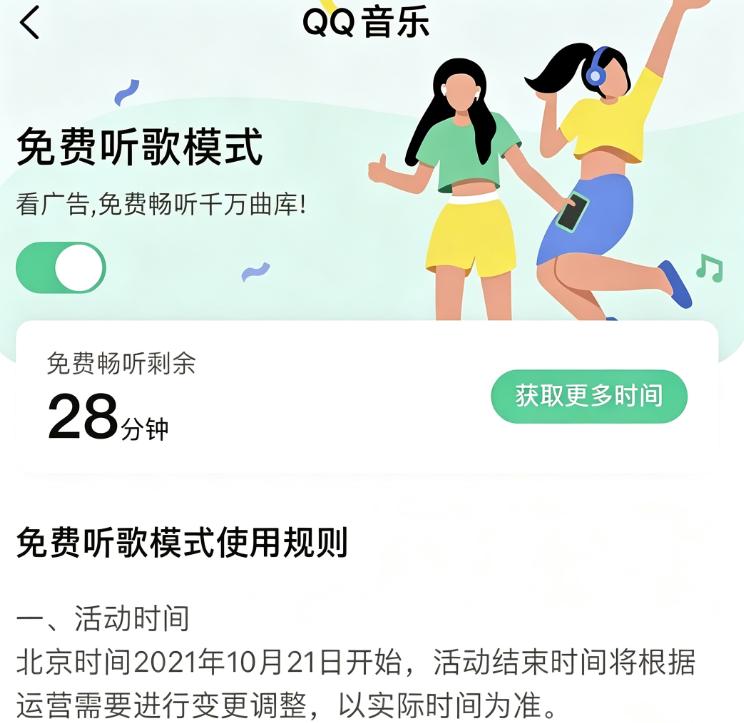
Since October 2021, QQ Music has tested "watch ads to listen to music for free" for some non-green diamond and non-payment package users. Users can get 30 minutes of free music listening time by watching 15-second ads, including some member songs that could only be previewed originally.
The difference is that at that time, "free listening to music" was only a mode in the huge product system of QQ Music, and users were still in a mature app with member subscription as the main axis.
In the second quarter of this year, this set of operation ideas for pan-traffic was further extended outward, forming a complete lightweight product matrix strategy including Boud Music, Free Music, Kugou Free Version, etc., which is no longer limited to the function pilot of a single product.
At the same time, the platform has also completed the capability integration with WeChat AI assistant Xiaowei. Relying on the huge user base of WeChat, more users can complete song search, generate playlists and play music through voice commands, and can also share tracks with friends with one click, expanding user reach boundaries and distribution capabilities from the ecological level, and improving product conversion rate and user participation.
It can be seen that the platform seems to be completely separating the two sets of user operation logic of paid and free: for high-value paid users, continue to deepen the membership system and tap the payment depth; for the large number of pan-users who have the demand for listening to music but are unwilling to subscribe continuously, rely on ad incentives, task rights and algorithm-driven lightweight products to complete retention.
The launch of "Free Music" this time also sends a clearer signal: Tencent Music seems to be turning "free of charge" from an auxiliary operation means in mature products into an independent product positioning for light users.
Why Does Tencent Music Re-compete for Free Users?
It is not difficult to understand that Tencent Music is refocusing on free users. The traffic problems that have been covered by paid growth in the past few years are resurfacing.
The most direct pressure comes from Qishui Music. QuestMobile data shows that, in June this year, the monthly active users of Qishui Music have reached 167 million, a year-on-year increase of 68.7%, exceeding NetEase Cloud Music and gradually approaching the monthly active scale of 189 million of QQ Music.
At the same time, ByteDance's other product, Tomato Music, also maintains rapid growth, with a year-on-year growth rate of 39.7%, and the two have become one of the music apps with the fastest monthly active growth rate in that month. In contrast, the monthly active users of QQ Music in June decreased by 0.7% year-on-year, and Kugou Music, Kuwo Music and The Kugou Singing decreased by 10.7%, 18.5% and 29.7% respectively.
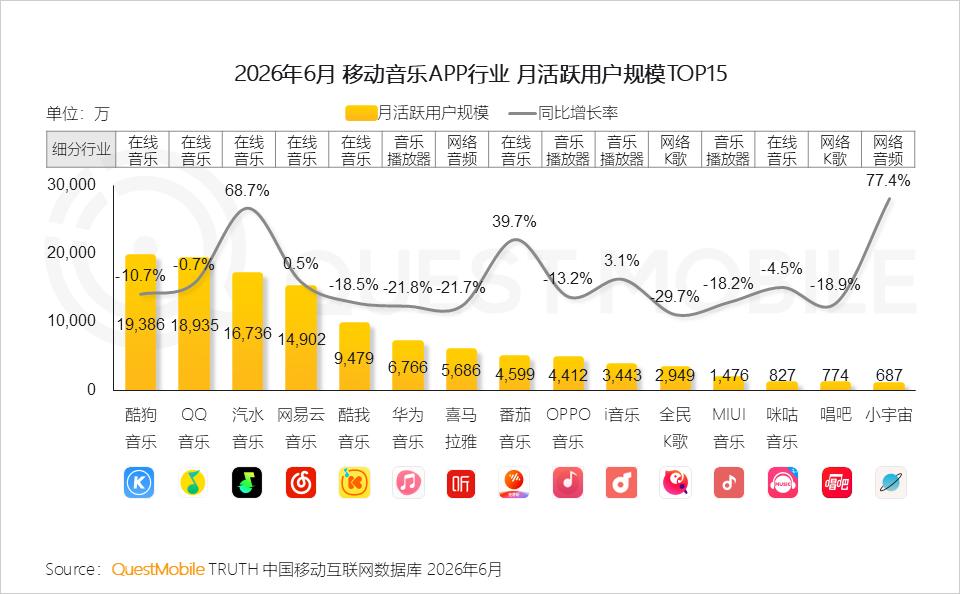
Of course, if we only look at the absolute scale, the basic market of Tencent Music has not been shaken yet. Kugou and QQ Music are still at the forefront of the industry, and it also has Kuwo, The Kugou Singing and the newly acquired Ximalaya under its banner. However, the user growth directions of the two sides have shown obvious differentiation: the user scale of traditional music apps tends to shrink, while Qishui Music still maintains a year-on-year growth rate of nearly 70%.
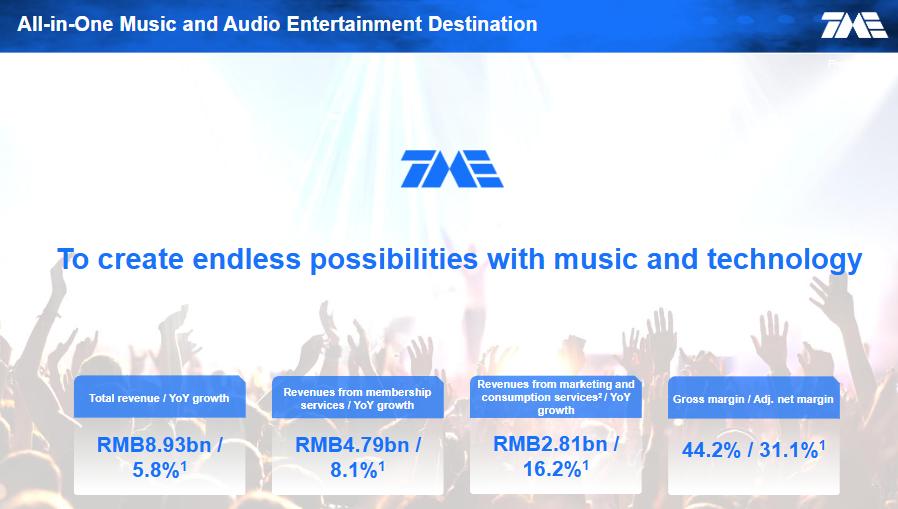
This change has also begun to be reflected in Tencent Music's financial performance. In the second quarter of this year, Tencent Music achieved a total revenue of 8.93 billion yuan, a year-on-year increase of 5.8%; among which, music-related service revenue was 7.61 billion yuan, a year-on-year increase of 11.0%, and membership service revenue was 4.79 billion yuan, a year-on-year increase of 8.1%. Looking at these figures alone, the company still maintains growth, and there is no significant change in its fundamentals.
However, if we break down the revenue structure, the growth pressure will be more obvious. Tencent Music completed the acquisition of Ximalaya on May 18, and consolidated part of its performance for the first time in the second quarter. According to the official financial report, Ximalaya contributed 407 million yuan in revenue during the consolidation period.
If this part of new revenue is simply excluded, Tencent Music's original business revenue in the current quarter is about 8.523 billion yuan, which is only an increase of about 1% compared with 8.44 billion yuan in the same period last year. This means that a considerable part of the 5.8% revenue growth in the report comes from the newly consolidated business, and the original business has been close to a low-speed growth state.
Since 2026, Tencent Music has announced that it will no longer disclose core operating indicators such as online music MAU, paying user numbers and ARPPU on a quarterly basis, instead, it will use indicators such as membership service revenue, SVIP growth, IP business and music-related service revenue.
The management has also begun to talk about traffic pressure directly. On the Q2 2026 earnings call, in response to questions raised by Goldman Sachs analyst Lincoln Kong about subscription business and market competition, Liang Zhu, CEO of Tencent Music, admitted that affected by intensified industry competition, the growth of music-related business has slowed down, and the pressure is mainly concentrated on the traffic level.
Observing from the dimension of revenue contribution, high-value users and SVIP super members are less impacted, and the pressure is mainly transmitted to the casual or light users group. Liang Zhu also mentioned that the platform will rely on lightweight products to tap the growth opportunities of light users, focusing on Boud Music and the newly launched Kugou Free Version this quarter.
In the past few years, Tencent Music's growth logic was mainly to increase the payment rate and single user value. But when the core paying users gradually stabilize, the continuous loss of light users will narrow the entrance of the entire user funnel. Compared with core users who are willing to buy memberships, concert tickets and digital albums, this group of people has low per capita value, but they determine the width of the platform's user pool and the scale of the crowd that can be converted to members, SVIP and other music consumption in the future.
What Qishui Music is competing for is exactly this group of users: lower consumption threshold, lighter product, stronger free attribute, and relying on algorithm recommendation to reduce the cost of active search and song selection.

Therefore, Tencent Music's strategy has clearly turned to "two-pronged approach". Upward, through SVIP, concerts, artist IP, peripheral products, digital albums and Ximalaya's long audio and other rights, continue to improve the core user value; downward, through ad-supported mode and lightweight products, continue to expand the free user pool.
In this light, the product "Free Music" is more like another puzzle that Tencent Music makes