Robots have filled the "last centimeter" gap, and the war of tactile perception has kicked off.
From a single sensor to new infrastructure, the next 100-billion-yuan track has emerged.
Recently, senior investor Patrick Liu shared a story on WeChat Channels:
In 2021, he observed an early roadshow of Pansini Tactile Technology, where founder Xu Jincheng firmly stated that "once robots rise, tactile perception will definitely become an infrastructure." But Patrick Liu did not invest, on the grounds that "the market size is too small and application scenarios are too few." At that time, the valuation of this company was less than 100 million yuan, but six years later, Pansini's valuation has exceeded 10 billion yuan, making it one of the most sought-after unicorns in the embodied intelligence track.
Patrick Liu later reflected: When HSG invested in Unitree, which was still developing robot dogs, in 2019, they proceeded from the end point of the robotics industry to reversely deduce what kind of founders they should target today; but this time they asked the wrong questions from the very beginning. The real question to ask should be: If robots are bound to enter the physical world, what kind of capabilities will evolve from "optional" to "infrastructure"? One of the answers is exactly tactile perception.
In 2026, a growing number of voices in the industry refer to this year as the "first year of tactile perception".
"Changes on the demand side are very obvious." Fu Yihui, Vice President of Marketing and Ecology of Tashan Technology, told Shuzhi Qianxian that in the first five months of this year, the company's existing orders for robot sensors alone have exceeded 4 times the total revenue of related businesses last year, with tens of thousands of tactile sensors delivered monthly. Li Zhiqiang, founder and CEO of Yimu Technology, also felt that "in the past six months, we have seen a demand surge almost every one or two months. Enterprises developing robot brains and data collection systems are all seeking cooperation with us, hoping to add tactile capabilities to their products." On the scenario side, the upgrading and transformation of traditional industrial robotic arms has also begun to integrate tactile capabilities.
However, despite the boom, the industry remains sober-minded: tactile perception is still in its early stage, and industrial demand has significantly outpaced the actual technological development. Although leading enterprises are seizing the high ground of tactile data, the process of building high-quality datasets is extremely difficult. Mu Yao, a tenure-track assistant professor at Shanghai Jiao Tong University, revealed that he once tried to build tactile datasets with many institutions, only to end up "heartbroken several times", and finally turned to simulation engines to scale up high-precision force and tactile data. The competition for tactile infrastructure has only just begun.
01
The First Year of Tactile Perception and the "Last Centimeter"
A piece of tofu is gently picked up by a robotic gripper without breaking or slipping, with just the right amount of force. This is a scene demonstrated by Tashan Technology at a recent exhibition. Not far away, the visual-tactile gripper of Dahuan Robotics is holding an empty paper cup. When grains are continuously poured into the cup until it is full, the paper cup does not fall off or get crushed; in front of the booth of Saiwei Technology, a two-finger robotic arm picks up a triangular pyramid, cylinder, cone and cuboid, and the computer screen synchronously identifies each shape... These seemingly unrelated "skill demonstrations" all point to the same core: tactile perception.
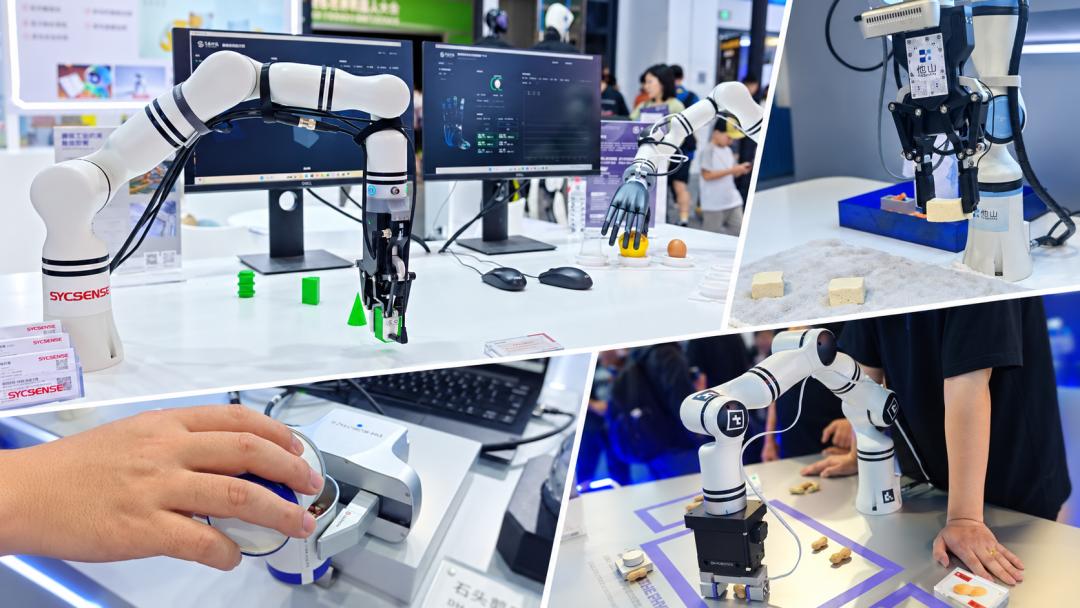
Tactile perception is not a new thing. But for robots, tactile perception is no longer a simple signal of "whether it has touched something", but a multimodal physical interaction perception system that has begun to undertake more complex missions.
Why has tactile perception suddenly risen? The fundamental reason is that robots can no longer stay at the stage of performance and demos, but have to start working for real. In the past few years, vision has always been the core of intense competition among all players. Robots can complete many tasks with preset programs, and tactile perception has a very low presence. However, with the continuous maturity of world models and VLA, when robots enter the real environment and need to complete more and more complex operations, relying solely on vision is no longer enough — eggs will be crushed when grasped, cups will slip when held, and people cannot tell how much force to use when tightening screws.
The problem arises at the moment of contact with objects. Zhao Haonan, CTO of Qianjue Robotics, once pointed out that in the fine operation of the "last centimeter", vision has three fatal flaws: occlusion makes it impossible to observe the core contact area; key states such as the magnitude of contact force, the tendency of object slippage, fine adjustment during insertion and extraction, and deformation of soft objects cannot be directly "seen" through pixels; visual feedback lags, and when a mistake is spotted, the result is already irreversible. These gaps must be filled by tactile perception. "A dexterous hand without tactile perception is just an advanced fixture," said Zhao Haonan.
What exactly can tactile perception provide? Duan Jianghua, founder of Daimeng Robotics, believes that tactile perception is not just "force". The tactile information of human hands is very rich, and there are more than a dozen dimensions of modal information that contribute to operation. Tightening screws and opening doors rely on rotational torque; inserting keys and cards rely on tangential force. In addition, sliding detection, texture judgment, and softness and hardness identification are all key tactile information for performing tasks. For example, holding a paper cup that is being filled with water steadily relies on real-time monitoring of sliding trends and dynamic adjustment of gripping force.
The value of tactile perception has been verified in real scenarios. For example, Duan Jianghua said that in the shaft-hole assembly task, the success rate was only more than 10% without tactile perception, and it rose to more than 80% after tactile perception was introduced. More importantly, some tasks can only reach the "success rate ceiling" of 70% or 80% through visual training alone, and no more data can further improve the performance. After introducing tactile data, the success rate can immediately rise to a usable level. Daimeng's partners have also tested and found that training the model with tactile data only requires one-tenth of the original amount of data to achieve the same model performance.
In fact, many veteran workers in factories are unwilling to wear gloves. Even if their hands are worn out, they have to use their hands to feel the working state of screws or precision instruments, because the hand feel brought by tactile perception cannot be replaced by vision or other sensors. The fundamental reason why 2026 is called the "first year of tactile perception" is not that tactile technology has matured overnight, but that the development of robots has reached a stage where they have to use tactile perception seriously. As Jensen Huang said, Tactile perception is the last piece of the puzzle for embodied intelligence. If it is not completed, the entire territory cannot be finished.
02
From Optional to Standard, the Inflection Point Appeared in Q4 Last Year
"Tactile sensors have been relatively niche before 2024, and everyone was having a hard time at industry gatherings," recalled Li Yanhui, CEO of SuperSensing. The turning point began in 2024 when the demand for tactile perception from dexterous hands began to be taken seriously, and it became increasingly clear in 2025. With the rapid outbreak of embodied intelligence, tactile perception was quickly pushed into the spotlight.
The trend observed by Fu Yihui from Tashan Technology is more specific: in 2024, some embodied customers began to pay attention to tactile perception, but there was still controversy over "whether tactile perception is needed"; in 2025, customers began to ask about specific dimensional indicators, and the real inflection point appeared in Q4, when leading manufacturers successively placed batch orders for thousands of hands. Entering 2026, more and more academic papers and industrial applications have incorporated tactile data into the core system, and the industry has formed a deterministic consensus.
The demand side is exploding rapidly. Fu Yihui revealed that taking dexterous hands as an example, the proportion of dexterous hands equipped with tactile solutions was only about 20% in early 2025, and rose to about 60% by Q4 last year, and it is still continuing to increase. The once high-end optional function is becoming the mass-production standard for dexterous hands. The coverage is also expanding. Originally only on the fingertips, it has now expanded to the finger pads, palms, and even the upper arms, forearms, thighs, calves and other embodied electronic skins. Some enterprises even began to try to deploy tactile perception on the soles of the feet.
At the recent WRC, according to incomplete statistics from Shuzhi Qianxian, at least more than ten dexterous hand manufacturers on site, including Xinuo Future, BrainCo, InTime Robotics, Lingxin Qiaoshou, Aoyi Technology, Dahuan Robotics, and ZWhand under Zhaowei Electromechanical, all emphasized tactile capabilities in their product introductions.
Demand groups are also rapidly diversifying: not only dexterous hand enterprises, but also robot brain companies, data collection manufacturers, and even scenario-side enterprises have begun to enter the market in batches. Relevant personnel from Pansini revealed that "brain companies have begun to add tactile data". Fu Yihui said that in the past two years, some fast-moving scenario parties have talked to most robot and dexterous hand manufacturers, and finally found that the key to solving the landing problem lies in tactile perception, so they took the initiative to find them to solve the scenario landing problem.
Wu Chenjie, Marketing Director of Saisense Technology, told Shuzhi Qianxian that they have provided tactile solutions for four directions: dexterous hands, humanoid robot electronic skins, companion robots, and bionic robots. At present, the main shipment is still for dexterous hands, companion robots are becoming an emerging direction, and humanoid robots are beginning to pursue full-body tactile perception for scenarios such as handshakes and interactions. Wu Chenjie revealed that the company expects shipments to multiply several times this year, with revenue reaching the 10 million yuan level.
Tactile perception is accelerating from laboratory verification to mass application, and order data is the most direct proof. Tashan Technology expects the order volume at the end of the year to be more than 10 times that of last year; Yaole Technology expects orders to increase 10 times this year, and nearly half of the increment comes from embodied intelligence. Zhu Xiaohui, CEO of Huaweiike, also revealed that shipments increased from 10,000 sets last year to an estimated 50,000 sets this year, "a large reason is that tactile perception has changed from an optional configuration to a standard one". In February 2026, Lingxin Qiaoshou even signed a strategic agreement with Fulai New Materials to purchase an additional 100,000 sets of tactile sensors, setting the world's publicly available single delivery record. Up to now, more than 30,000 sets have been delivered cumulatively.
The capital side has also reacted rapidly. Since 2026, 100-million-yuan level financing in the tactile track has become the norm, and the valuations of both Pansini and Yimu Technology have exceeded 10 billion yuan. Tashan Technology announced a several-hundred-million-yuan Series B financing in July, with industrial parties such as Joyson Electronics, Taiping Innovation, and Aux participating, which is already the third round of financing within half a year. More notably, industrial capital from automobiles, home appliances and other fields has begun to lay out the subdivision track. Pansini's new 1-billion-yuan financing in early August was jointly participated by national and local level funds, as well as a trillion-level industrial leader. Tactile perception is evolving from a one-man show of startups to a collective action of the entire industrial chain.
03
Chaotic Competition of Technical Routes: No "Default Option"
A consensus on tactile perception has been formed, but there is still no standard answer in the industry as to which specific path to take. At present, at least four main routes are competing on the same stage.
Piezoresistive is the most mainstream solution in the early stage, with the advantages of mature technology, low cost and easy mass production. Fulai New Materials, Moxian Technology and other enterprises adopt this route. Many dexterous hands of Lingxin Qiaoshou also use it as standard, while capacitive, visual-tactile and other solutions are optional. However, the shortcomings are also obvious: traditional solutions have inherent deficiencies in tangential force perception, and most products can only stably measure normal force; in addition, they have large hysteresis, are prone to heat generation leading to temperature drift, and are difficult to meet the requirements of high-precision continuous signal collection in fingertip scenarios.
Capacitive has high sensitivity, low hysteresis, low power consumption, no heat generation, and is suitable for dynamic continuous signal collection. The shortcoming is that weak signals are easily interfered by parasitic capacitance and electromagnetic interference, requiring high-cost conditioning circuits and shielding designs. Tashan Technology, Saisense Technology and other enterprises are representatives of this route. "We tried all mainstream paths from the very beginning," Fu Yihui said. After comprehensive evaluation, they finally chose the capacitive route. At present, Tashan has reduced the power consumption of tactile sensors to the microwatt level, and overcome the most troublesome anti-noise problem of the capacitive route, covering more than 200 enterprise customers.
Magnetic Hall effect (electromagnetic) has the advantage of "consistency out of the factory", eliminating the trouble of individual calibration, and can naturally realize synchronous measurement of 3D force or even 6D force, with high sensitivity, good robustness and strong durability. Pansini Perception is the representative of this direction. But the cost is that it is easily interfered by external magnetic fields, cannot grasp magnetic objects, and needs to be overcome through hardware shielding and algorithm compensation; in addition, the precision manufacturing process leads to high unit cost.
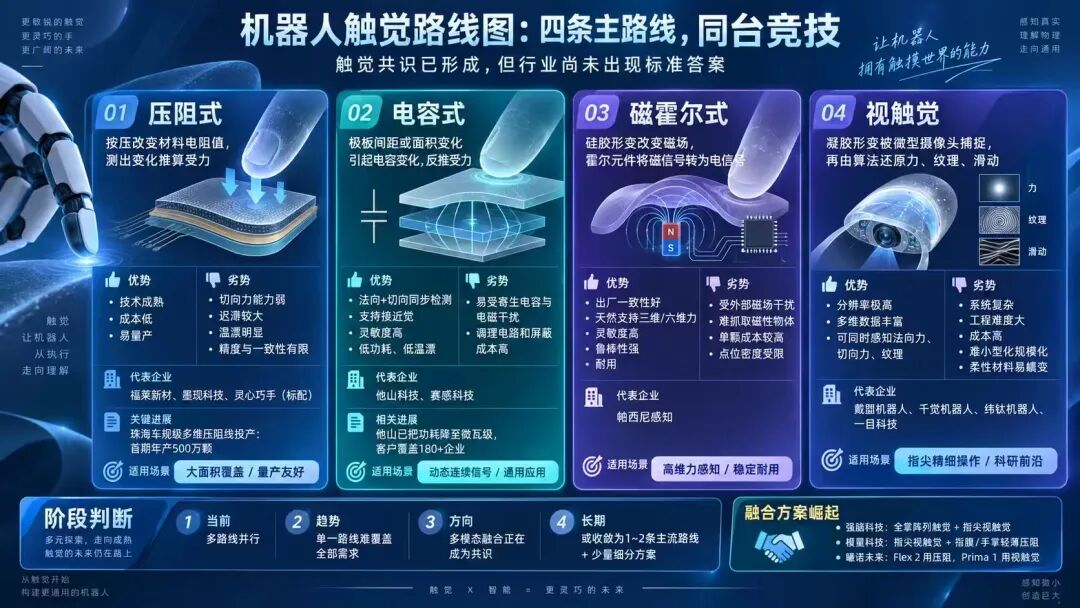
Visual-tactile is the most popular direction recently. Daimeng Robotics, Qianjue Robotics, Weitai Robotics, Yimu Technology and other enterprises all take this direction. The core advantage is that it has extremely high resolution, can transform tactile problems into image collection and calculation problems, and can obtain multi-dimensional data such as normal force, tangential force, and texture at the same time. It is the only route that is expected to reach and exceed the resolution and multimodal information capability of human hands. However, the system is complex and costly, it is difficult to achieve miniaturization and large-scale application in the short term, and the robustness and consistency of extremely flexible materials will creep after hundreds to thousands of uses.
In addition, there are many other routes in the market such as piezoelectric and fabric tactile. The competition among various routes is far from reaching the final stage. When a single technology cannot meet the full perception requirements, multimodal fusion is becoming an inevitable trend.
At present, some players have begun to try combined solutions. For example, Huaweiike has launched a series of products adopting different routes such as piezoresistive, piezoresistive + electromagnetic; Modulus Technology has simultaneously deployed piezoresistive tactile modules and 6D force visual-tactile modules. A large number of dexterous hand manufacturers are also adopting fusion routes. For example, BrainCo adopts the combined solution of "full-palm array tactile + fingertip visual-tactile".
Li Yanhui from SuperSensing believes that the underlying physical quantity perception is no more than six categories: sound, light, electricity, force, heat and magnetism, each path has its physical limitations, and it is difficult to produce a "hexagonal warrior" with a single technology. He judged that in as fast as three years or as slow as five years, the market will definitely converge to several technical lines that account for 80% of the share. Fu Yihui from Tashan Technology also said, "In the humanoid robot track, only 1 to 2 mainstream routes may finally survive."
04
From Selling Hardware to Selling "Tactile Infrastructure"
In Q2