The "mountain techwear" trend has fallen out of fashion, but Salomon's CEO says their growth has only just begun | New Look Exclusive Interview
Text by He Zhexin
Edited by Qiao Qian
In 2016, a running shoe mold was nearly sent to the incinerator.
It belonged to Salomon XT-6, an off-road running shoe designed for completing ultra-long distances in harsh environments. The person who stopped this mold was Jean-Philippe Lalonde, a Frenchman who once led the high-end fashion line of Arc'teryx. He thought the shoe silhouette was "extremely potential" — replacing the red, black and white colorways for competitions with low-saturation or sporty hues could derive countless combinations. Starting from this unburnt mold, he gradually built up Salomon's Sportstyle product line, which has also become the fundamental base of the brand.
In 2023, Scott Mellin, then Chief Brand Officer of Salomon, found from a boutique in Paris that "young guys were all wearing their fathers' XT-6", and everything that happened later has become history.
In just three to five years, Salomon expanded from Annecy, France to the whole world. Its revenue grew by 29% in 2025, exceeding 2 billion US dollars, twice that of 2022, with footwear contributing nearly 70% of the total. This ski brand founded in the Alps in 1947 is now recognized by most consumers for XT-6, as well as the co-branded and daily wear models derived from this pair of shoes. In a sense, XT-6 represents Salomon.
It was the Gorpcore trend that swept the globe after the pandemic that made people who do not ski or hike put on XT-6: a trend style that brings outdoor sports equipment into daily urban outfits, emphasizing functionality, technical sense and mountain aesthetics.
However, at the moment, Guillaume Meyzenq, Global CEO of Salomon, believes that this trend has passed.
"Gorpcore is completely dead," he said in an interview with 36Kr.
It sounds like a brand that took off with a trend is undermining its own position when its CEO announces the end of that trend. But Meyzenq's argument goes in the exact opposite direction.
"We do not have two separate narratives. Sportstyle and sports performance are not separated. When people buy for the sportstyle, they are also getting a product with sports performance."
In his account, two things happened in the past decade. "At first, the outdoors became a source of inspiration for urban consumers, who suddenly wanted to go to the mountains, or just go to nature to feel the atmosphere. Later, people in cities truly began to love sports, and look for brands that can deliver outdoor technologies. So Gorpcore is over — people no longer pursue the 'outdoor look', but actually start exercising in their urban lives."
This is a very favorable framework for the brand — if the boom is aesthetic-driven, the brand will collapse when the tide recedes; if it is function-driven, XT-6 has inherent outdoor attributes, and it will still exist even when the trend changes.
Under this judgment, Salomon shifted its focus to apparel and multi-scenario outdoor running this year.
Meyzenq told us that at least 50% of the floor area of new large-format stores opened by the brand in the future will be dedicated to apparel display. New products are launched in line with the training season: the winter version of the high-performance FALCON FLY competitive running apparel was released at the beginning of the year, followed by the spring training version, and the summer collection made of ultra-light 7D yarn woven fabric was launched in June, providing support for 26 runners of the second phase of the S/PRO Marathon Elite Training Camp.
On the running shoe line, the Gravel Running family, which the management regards as the key to opening up the running category, continues to launch new products. The management has repeatedly emphasized that the Sportstyle product line is still the biggest growth driver, but they continue to invest heavily in road running and gravel running — in their own words, the new gravel running series is "opening up the running category for Salomon in an unprecedented way".
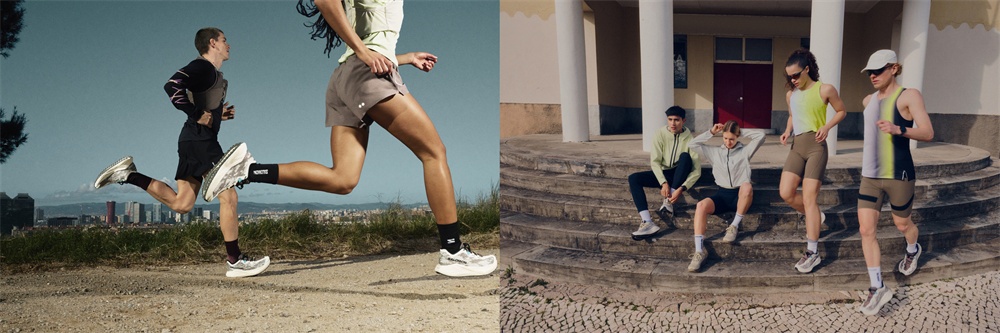
AERO GLIDE 4 GRVL running shoe (left) / Salomon FALCON FLY spring collection competitive running apparel (right)
In terms of channels, the management has been sticking to the same strategy in multiple earnings calls: opening a small number of brand flagship stores in key core urban markets, paired with screened and upgraded wholesale distribution, to enhance the brand's presence and awareness. This strategy is called the epicenter strategy.
Salomon has been systematically expanding its distribution in North America since two years ago, at the cost of short-term margin pressure, but the expansion has shown results. At present, the brand covers vertical outdoor and running stores such as REI and Fleet Feet in North America, high-end department stores represented by Nordstrom, and mass distribution channels such as Foot Locker and JD Sports.
"In Europe, the United States and Japan, the approach is to open flagship stores in core cities to showcase the complete brand experience and tell the best brand stories, and achieve scale expansion through dealer channels," he said. "But it is different in China: you have to open your best stores in the best locations." Guillaume Meyzenq paused for a while, "But narrative alone is not enough, we also need a sufficient scale of high-quality physical stores."
As a result, the "small number of stores" that works in Europe and the United States has reached a different order of magnitude in China. In the second quarter, Salomon added a net of 13 stores in Greater China, reaching 315 stores in total (including directly-operated stores and partner stores), and the full-year target is still a net increase of 45 stores. The company believes that this market can theoretically accommodate 400 to 500 stores in the long run, and claims that it is operating "the most efficient and profitable sports shoe stores in this industry" in Greater China and Asia.
On August 10, Salomon's flagship store at Beijing China World Mall officially opened. We took this opportunity to talk with Guillaume Meyzenq about the outdoor sports market in his eyes, Chinese consumers, as well as the past and future of Salomon.
The following is the content of the exclusive interview, which has been edited on the premise of retaining the original meaning.
36Kr: The flagship store at Beijing China World Mall is much larger than previous stores, with a large area dedicated to apparel. What percentage of the total floor area does apparel take up?
Meyzenq: About 60% of the retail space is used for apparel display. In the past, our stores usually covered 200 to 250 square meters, most of which were footwear-driven. The advantage of footwear is high efficiency: you only need a wall to display the shoes. Apparel has more SKUs, which requires larger space for visual display to present the richness of products.
Last year, we decided to further expand the apparel product line — opening new stores, and also renovating and expanding some old stores. These larger stores are the "new generation" stores we built for the upgrading of the apparel category. Large-format stores can have an average of 50% of their floor area for apparel display. At present, Salomon has 315 stores in China, and we will continue to focus on first-tier and second-tier cities in the future.
36Kr: What are the differences in the price range, application scenarios and target groups of apparel?
Meyzenq: People who buy our apparel are the same group of people who buy our shoes. Salomon's product lines are mainly divided into two categories: "Performance" and "Sportstyle", which follow a consistent logic derived from the mountains, and are not separated from each other. Salomon's sports categories include skiing, outdoor sports, trail running, road running, gravel running, etc. Footwear design is driven by the functions of these sports, and apparel follows the same logic, without a separate set of narratives. When consumers enter the Salomon ecosystem, we can provide a complete set of product solutions including footwear, apparel and equipment. The Sportstyle series complements our sports categories. The integration of footwear and apparel is one of the important manifestations of Salomon's transformation from a mountain sports equipment brand to a contemporary mountain sports culture brand.
36Kr: Leaving apparel aside, another major move of the brand is running shoes. There are no professional running stores like those in Europe and the United States in China. How do you plan to develop the running business?
Meyzenq: Let's first talk about why we are engaged in running. 25 years ago, we judged that trail running would become an independent sport. At that time, it was very niche, with only a few competitions around the world, but we believed it would become a source of inspiration for consumers. Therefore, Salomon has been insisting on developing the S/LAB series of trail products. In 2009, we pioneered the trend of hydration vest, and at one time almost all the trail running hydration vests on the market were developed in our laboratory in France. We made customized adaptations for athletes, optimized the hydration backpack into a more fitted vest design, retaining functionality and practicality while enhancing the lightweight feature that trail runners value most. Today, the hydration vest has even gone beyond the trail running sport and become a trendy item for Gorpcore outfits.
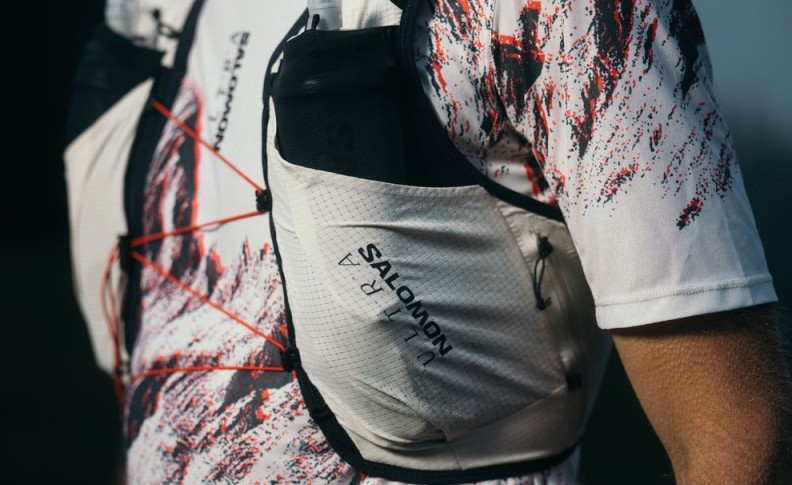
S/LAB Ultra 10 hydration vest
The new GRVL multi-terrain running series expands the brand's running category, and continues to gain attention in the professional running field in North America and EMEA (Europe, Middle East and Africa) markets. Even in the Chinese market, which used to be dominated by Sportstyle, professional performance products have begun to stand out — in the first half of 2026, the sales proportion of the GRVL series in China and even around the world increased significantly.
The special feature of running is that it is community-driven. On the one hand, our strategy is to participate in top large-scale events such as Shanghai Marathon, and directly connect with runners in the professional exhibition area and on the track; on the other hand, we use store resources and equipped coaches to build community running groups for users. This sport seems to be an individual activity, but the younger generation wants to run in a community. We are doing this in both Europe and China.
To sum up, Salomon's direction in China is "dual development of road and trail", with trail running and road running advancing in parallel. Our goal in this track is to become a high-end running brand. Based on mass runners and user communities, we carry out advanced training through the "GO Wild" community to extend road runners to trail running.
36Kr: It is said that your relationship with athletes is very different from that of other sports brands. Could you elaborate on that?
Meyzenq: We have a team of elite athletes called Team Salomon around the world, and Chinese athletes are an important part of it. With the support of this system, they can choose to focus on competing in international events according to their own development direction, or stay in China to participate in top local events. At the same time, we also have a "Future Team" program, which is dedicated to discovering and supporting potential new talents, providing them with financial support, customized equipment and professional training, helping them focus more on their own growth, improve their athletic ability, and thus devote themselves to the development of sports. Whether in the United States, China or France, our cooperation model with athletes is consistent around the world, providing them with pure and complete 360-degree professional services.
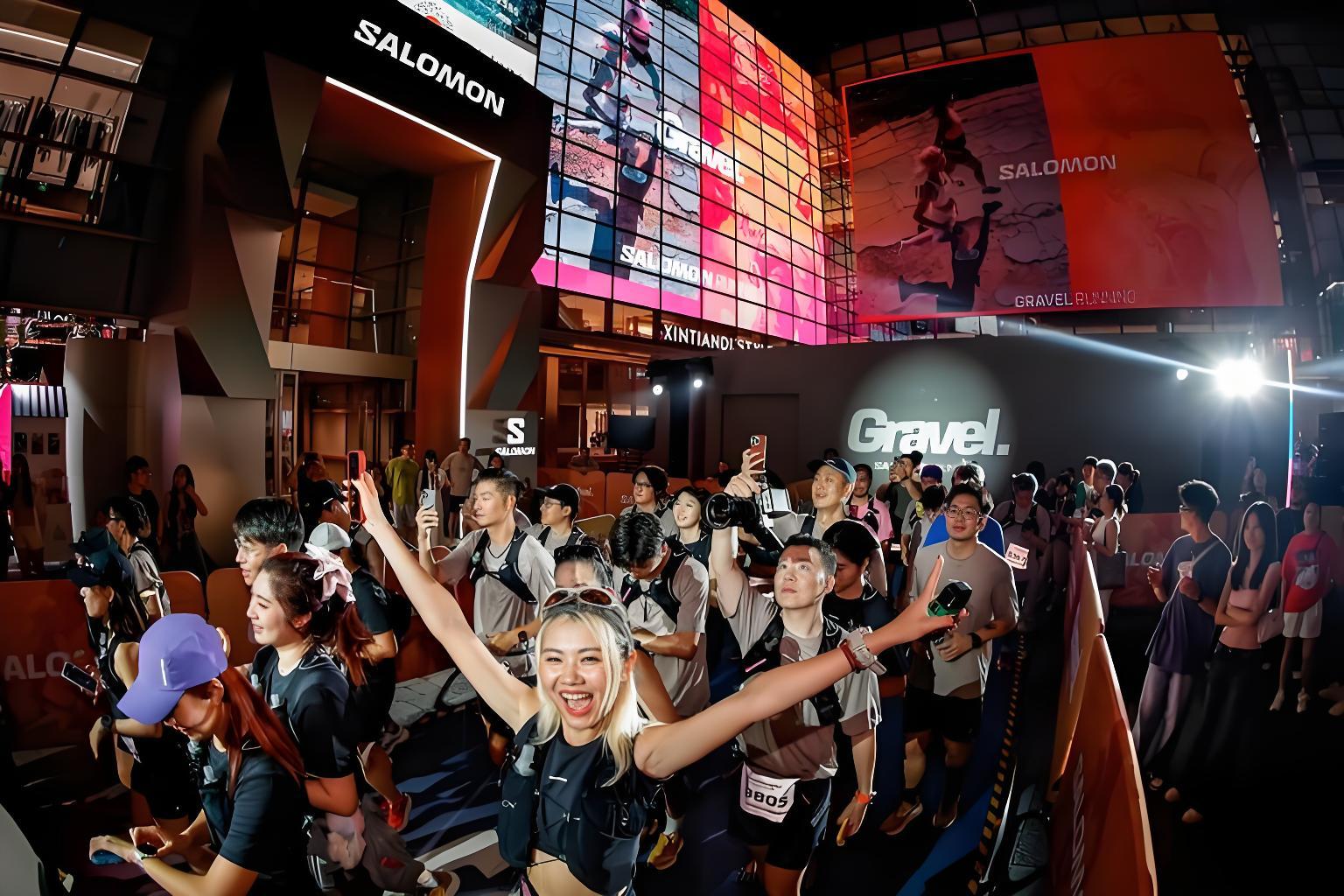
The world's largest Gravel Running event "Gravel Unbound Challenge" will be held in China, kicking off in Chengdu on September 13 and Shanghai on September 20, with more than 1000 participants in total
36Kr: Both skiing and trail running are just starting in China. Why do you believe the brand can really encourage people to exercise, instead of people just wearing the "exterior" of sports?
Meyzenq: The direction we set five years ago was to change Chinese consumers' perception of outdoor and their lifestyles. At that time, Salomon's core user base was less than 100,000 people, and today it is close to 10 million people, expanding 100 times in five years. The way to reach users is through communities, events and GO Wild trail races. Pan-outdoor users grow into semi-professional trail runners or hikers through our training, community managers and KOLs. When these links form an ecosystem, what Salomon needs to do is not only to build it, but also to make it solid enough — the participating people are the foundation, and the events and activities are the thickness, thus forming a positive cycle.
Let me give you another example. There is an event in the Olympics called Ski Cross: four people start at the top of the slope at the same time, and the one who reaches the bottom first wins. This sport was promoted by Salomon. We designed special skis for it, created a series of races, and then the International Ski Federation adopted it and it became an Olympic event. So what we do is far more than manufacturing ski equipment.
In China, skiing is still niche at present, but there are already 800 trail running races, compared with only 10 to 20 races 10 years ago. We sponsor events, support elite athletes, and hold the Golden Trail World Series around the world. In addition, considering that trail running has a higher technical threshold, we have also established running training and learning academies to help more people understand and participate in it. For example, trail running in the mountains is different from marathon, you have to learn to cope with the temperature difference caused by altitude, learn to run at night, and so on. We are very committed to turning this sport into a culture, not a temporary trend. Only culture can last long.
36Kr: Talking about trends, some reports say that the super cycle of running is slowing down, and you also said that Gorpcore is officially over, but it used to be the main driving force of the brand. What is driving the brand now?
Meyzenq: We do not have two separate narratives. Sportstyle and sports performance are not separated. When people buy for the sportstyle, they are also getting a product with sports performance.
The reason why I say Gorpcore is over is that two things happened in the past decade. First, the outdoors became a source of inspiration for urban consumers, who suddenly wanted to go to the mountains, or just go to nature to feel the atmosphere. Second, people in cities began to look for technical functions, and look for brands that can deliver outdoor technologies. So Gorpcore is over — it is not accidental, because people's attitude towards urban lifestyles has completely changed.
People want to stay "active" in their daily lives. For example, people wear electronic devices to record their steps, and often feel that the day is not good if they do not walk 10,000 steps. Imperceptibly, people begin to want to go out more, spend more time outdoors, and participate in more diverse activities. In such scenarios, the functional attributes of shoes and clothes become crucial. Wearing a pair of XT-6 is far more adaptable and comfortable than wearing a pair of sports shoes derived from tennis, skateboarding or basketball, because this pair of shoes is originally made for such purposes.
Is this a trend? I don't know. I think outdoor will always be a niche market, but no matter what the next trend is, people will still value professionalism and functionality. Consumers' awareness is getting clearer, and no matter how the trend changes, they will still reserve a place for sports shoes in their shoe cabinets. So my view is that trends may change, but functionality will continue to exist as a long-term value.
36Kr: There are too many sports brands exploring "niche" sports in the Chinese market, and the shopping malls in first-tier cities are crowded with them. Niche is a good selling point, but it also easily makes consumers switch between different brands and reduce loyalty. What do you think of this?
Meyzenq: First of all, we can still be regarded