Li Auto and Xiaomi are shifting away, and CATL's customer list is shrinking.
On September 8, the A-share share price of CATL (300750.SZ) closed at 335.49 yuan, down 3.65% for the whole day, with the intraday low hitting 326 yuan, marking a new low since mid-March this year. On that day, the market value of this leading power battery enterprise shrank by 54 billion yuan to 1.48 trillion yuan. Calculated from the intraday high (about 468 yuan) on May 7, the cumulative decline of its share price in four months has approached 30%. Its Hong Kong stock also moved lower, with the share price once falling by more than 4.5%, hitting a new intraday low since March 10, and finally closing at HK$562, down 1.83%.
In the afternoon of September 9, CATL's A-share share price fluctuated and rebounded, closing at 336.84 yuan, up 0.4%, with a total market value of 1.56 trillion yuan. Its Hong Kong stock showed a differentiated trend, briefly rising above the break-even line in the afternoon, then gradually falling back and closing flat for the whole day.
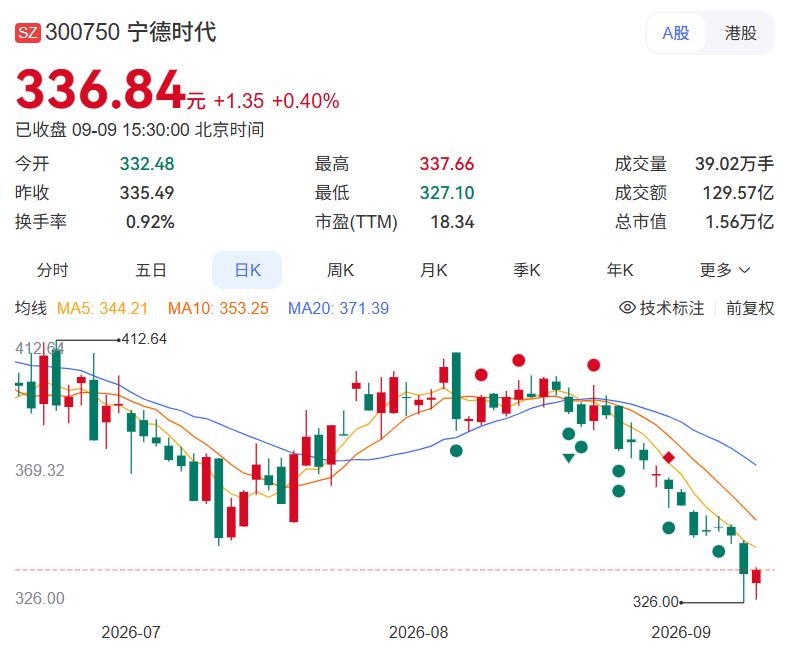
Image source: Screenshot from Baidu
Multiple intertwined factors led to the decline, including downward energy storage demand, rumors of reduced production schedules for power batteries, and falling futures prices of lithium carbonate. Among them, the most concerned one was the major announcement released by Li Auto the previous day.
Li Auto announced that its self-developed batteries have been installed on three models: Li Auto L8, L6 and i8, and will be fully rolled out to all its subsequent models. The signal captured by the market is very clear: Li Auto, a major customer of CATL, is preparing to "reduce reliance on CATL".
01. Who is "reducing reliance on CATL"?
Li Auto's transformation was foreshadowed long ago.
Since Li Auto launched its first model Li Auto ONE, CATL has been its core supplier. In April 2023, the two sides reached a comprehensive strategic cooperation, and Li Auto's first pure electric vehicle MEGA became the world's first mass-produced model equipped with CATL's 4C Qilin battery. In September 2025, the two sides also signed a five-year comprehensive strategic cooperation agreement.
But shortly after, Li Auto took other actions. In October 2025, Li Auto and lithium battery company Sunwoda jointly registered and established a joint venture, where Li Auto leads the product, process and material design of batteries, while Sunwoda mainly acts as a contract manufacturer. Just a few months later, Li Auto invested 2.65 billion yuan to increase the capital of Sunwoda Power, a subsidiary of Sunwoda, and became its second largest shareholder.
The brand-new generation Li Auto L8 launched in June 2026 is fully equipped with batteries supplied by Sunwoda, and CATL has completely withdrawn from this model line.
On September 7, Li Auto took a further step and officially announced that its self-developed batteries would be installed on all its models. According to Li Auto's official disclosure, the first batch of new generation MEGA deliveries still adopts CATL's 5C ternary lithium batteries, but users who lock in orders after 3 p.m. on September 7 will be fully switched to Li Auto's self-developed 5C ternary lithium batteries, and deliveries are expected to start in November. The brand-new i9 to be launched in mid-September will follow the same arrangement, and the switch will be completed after the production capacity of self-developed batteries ramps up.
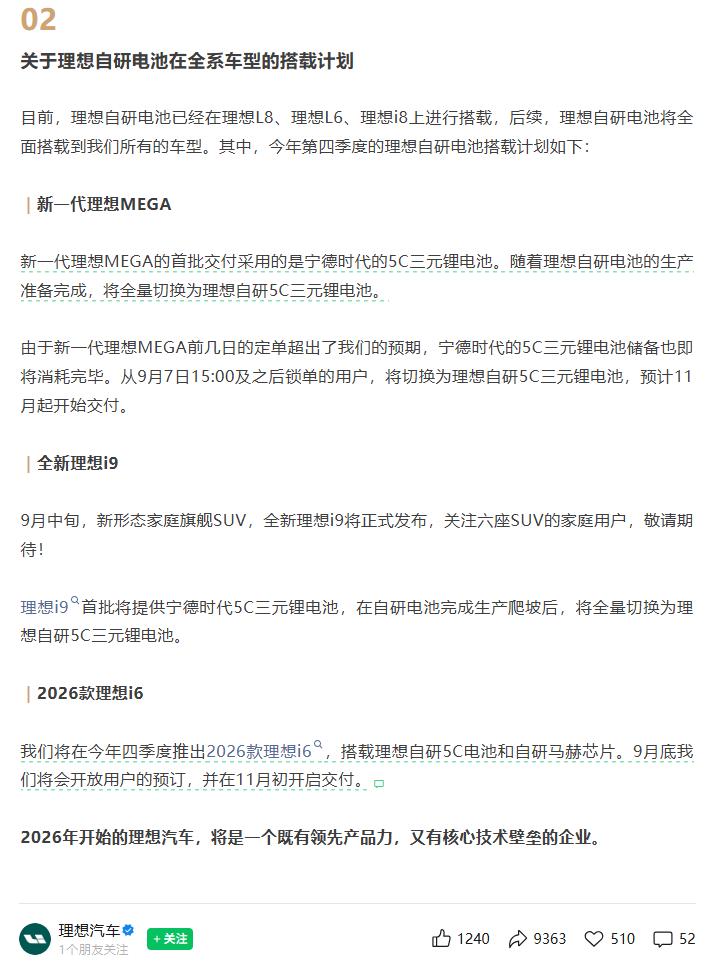
Image source: Li Auto Official WeChat Account
Moreover, Li Auto may also plan to introduce CALB as a power battery supplier. On September 8, in the new product publicity of the 411th batch of "Announcement of Road Motor Vehicle Manufacturers and Products" released by the Ministry of Industry and Information Technology, 5 Li Auto models completed the application. Among them, the energy storage unit manufacturers of 2 models are CALB, and the other 3 are Sunwoda.
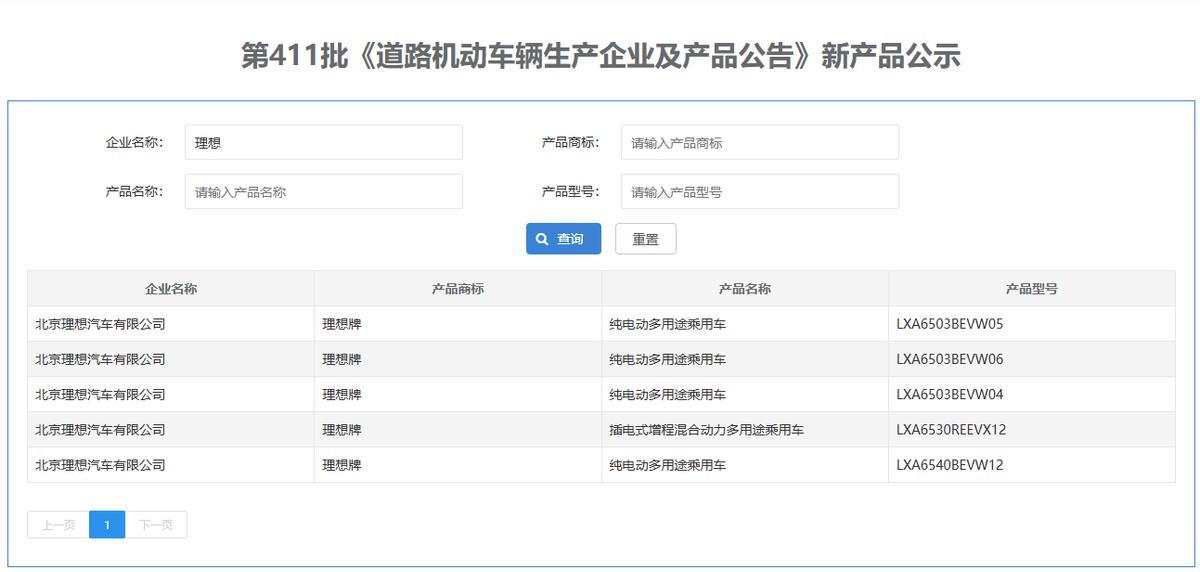
Image source: Screenshot from the Ministry of Industry and Information Technology
From a loyal ally to a peer, Li Auto's purpose is very straightforward: "We hope to master the core technical barriers for the future in our own hands, just like top enterprises such as Apple, Huawei and Tesla."
In fact, Li Auto is not an isolated case. On September 4, Xiaomi Auto officially announced its "Dragon Armor Battery" and reached strategic cooperation with CALB and Sunwoda, and all models of its Pengcheng series will be equipped with this battery. In the Hongmeng Smart Mobility system, AITO, which has long been exclusively supplied by CATL, introduced CALB and Gotion High-Tech this year. CALB will supply 81kWh battery packs for AITO, which will be installed on the AITO M6. Last year, Leapmotor and CALB established a joint venture at a ratio of 49 to 51. In November of the same year, the power battery intelligent manufacturing base project started construction in Jinhua, and is scheduled to be put into operation in June 2026.
Looking at traditional automakers, in March this year, Chery released its full series of Rhinoceros batteries, planning to gradually verify their installation on vehicles. In 2025, Geely integrated its battery business and established Jiyao Tongxing, planning to increase the self-supply ratio of its own cells to 30% in the next two years. GAC, Changan and SAIC are also respectively promoting the installation of self-developed or solid-state batteries. Changan's self-developed "Golden Shield" solid-state battery has clearly announced that it will start vehicle installation verification.
From "using no batteries other than CATL" to "cooperating with multiple suppliers in parallel", and then to "producing batteries by themselves", automakers have more and more choices, and CATL's position in the customer list is changing from "the only option" to "one of the options".
02. Automakers are fighting for the initiative
The motivation for automakers to switch batteries is not complicated.
The most direct one is cost. Power battery is the most expensive single component of pure electric vehicles, accounting for about 40% of the total vehicle cost. With a global market share of about 40%, CATL has strong bargaining power, which is jokingly called "Ning Tax" by the outside world. For automakers, introducing multiple battery suppliers and even promoting self-developed batteries is essentially to grasp more bargaining chips, which is a conventional move to "ensure delivery and reduce costs".
A deeper consideration is the right to speak. In the era of fuel vehicles, the engine was the core of automakers, and profits and pricing power were in their own hands. Under the wave of electrification, the value center has shifted to power batteries. Automakers are unwilling to pin their lifeline on a single supplier. What Li Auto said about "mastering core technical barriers in their own hands" exactly expresses this strategic intention.
However, the acceleration of independent battery R&D and production by automakers does not mean that CATL's industry advantages will collapse rapidly. At least according to the existing data, its fundamental base is still solid. Data from South Korean agency SNE Research shows that in the first half of 2026, CATL's global power battery installation volume was 242.7 GWh, a year-on-year increase of 25.3%, and its market share rose to 39.9%, ranking first among global power battery installation enterprises. CATL has won the global No.1 position for 9 consecutive years.
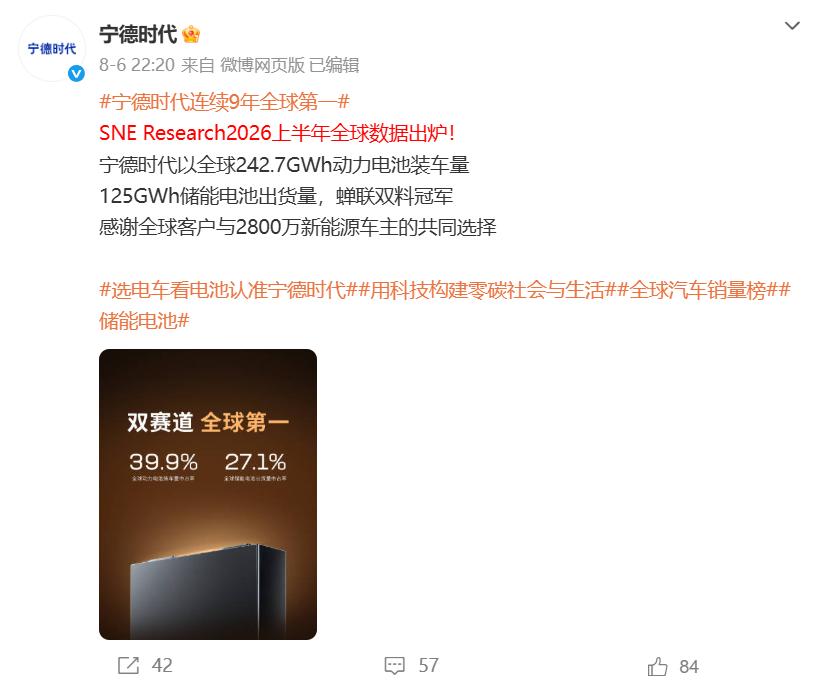
Image source: Screenshot from Weibo
In the domestic market, according to the statistics of China Automotive Battery Industry Innovation Alliance, CATL's installation share in the domestic passenger car market reached 46.7% in the first half of the year, and the installation volume share of ternary batteries even increased by 4.3% year-on-year to 75.2%.
However, behind the high market share, the logic of supply and demand game in the industrial chain has changed. In the past, CATL benefited from the "exclusive supply" dividend, and automakers could not bypass it. Now automakers have learned to "place multiple bets", and CATL's bargaining power and gross margin are facing head-to-head competition from manufacturers such as CALB, Gotion High-Tech, Sunwoda and EVE. With lower quotations and higher cooperation flexibility, these manufacturers are gradually seizing orders from leading automakers. A detail is that CATL, which used to exclusively supply AITO for a long time, now has to compete on the same stage with CALB and Gotion High-Tech in the AITO system.
03. Transforming from a battery manufacturer to an energy company
If you only look at the interim report, CATL's performance is impeccable. In the first half of the year, it achieved revenue of 2769.17 billion yuan, a year-on-year increase of 54.8%. The net profit attributable to shareholders was 432.84 billion yuan, a year-on-year increase of 41.98%, making an average net profit of more than 100 million yuan per day. The capacity utilization rate of the battery system reached 94.86%, close to full production.
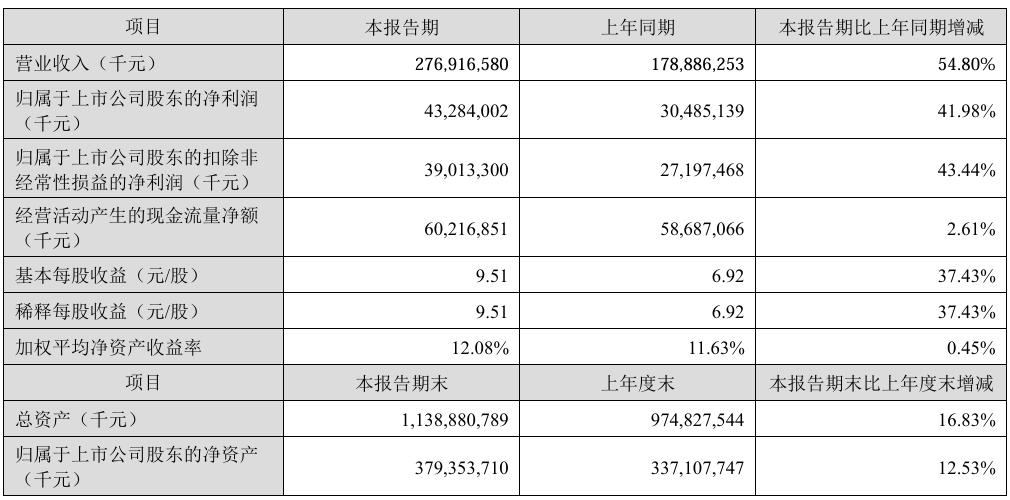
Image source: Screenshot of the interim report
But if you break down this performance, its quality may not be as good as the growth rate shows.
Energy storage is becoming a stronger growth engine, but this new track is not easy. In the first half of the year, the revenue of power battery systems was 1921.25 billion yuan, a year-on-year increase of 46.02%, but the gross margin decreased by 1.78 percentage points year-on-year. The revenue of energy storage battery systems surged 87.54% year-on-year to 532.61 billion yuan, becoming the fastest-growing of the three major sectors. However, it should be noted that the gross margin of energy storage battery systems also decreased by 1.56 percentage points. Both businesses are facing profit pressure: the scale is getting larger and larger, but the profit margin is getting thinner and thinner.
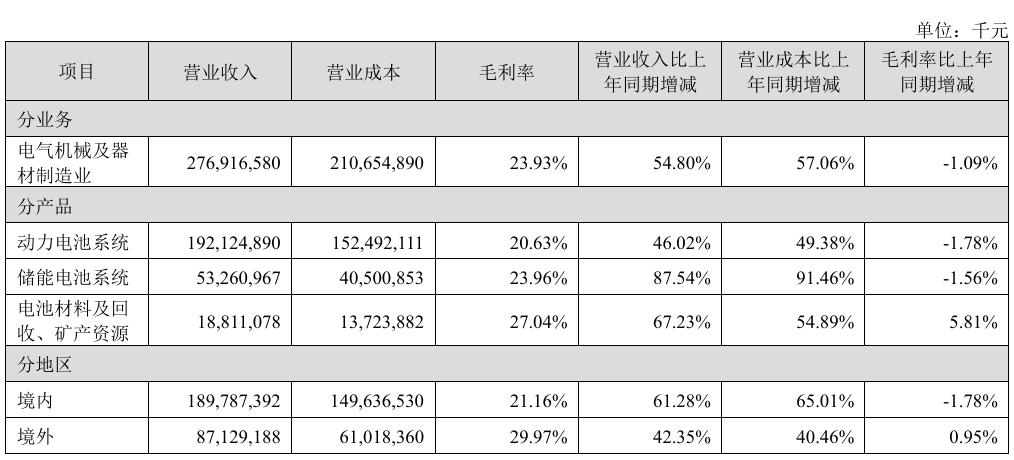
Image source: Screenshot of the interim report
Looking at its other new layouts, CATL is cooperating with Century Internet to build the next-generation digital energy infrastructure for the AI era. It plans to jointly build 400,000 tons of copper foil production capacity with Taijin New Energy, HKC New Materials and other partners in the next three years. In the low-altitude economy sector, its subsidiary AutoFlight has completed the conversion flight of the world's first 5-ton eVTOL aircraft "Sky Dragon", entering the airworthiness certification stage. The 2-ton cargo model "Carryall" has obtained the type approval certificate issued by the Civil Aviation Authority of Indonesia, becoming the world's first eVTOL model to obtain VTC. In terms of technology, the third-generation Shenxing and Qilin batteries have a peak charging rate of 15C, which only takes 6 minutes to be fully charged at room temperature. CATL is transforming from a battery manufacturer to an energy solution provider.
However, many of these new stories sound prosperous, but when placed in its total revenue of 2769 billion yuan, they are only in the initial stage, which cannot contribute much revenue or affect profits in the short term. They determine CATL's future development, but cannot support its current valuation.
What the market cares more about at present is another thing. On July 24, CATL launched a share repurchase plan of 200 billion to 400 billion yuan, with a maximum repurchase price of 573 yuan per share. All the shares obtained from this repurchase will be cancelled, making it the largest repurchase plan in the history of A-share market. But by the end of August, the company announced that "no repurchase has been implemented yet". The commitment was made and the market expectation was fully raised, but two months passed and not a single share was bought, which was interpreted by many investors as "insufficient confidence", further amplifying this round of emotional sell-off.
The 400 billion yuan repurchase has not been implemented for a long time, while the alternative actions of automakers are accelerating day by day. For CATL, the real suspense no longer lies in its financial reports and share price, but in whether it can stabilize its market position and turn the new businesses beyond batteries into real tangible orders.
This article is from the WeChat Official Account "Qujie Business", written by Hao Wen, and republished with authorization from 36Kr.