Apparel stores are breaking away from traditional conventions, and driving in-store foot traffic via online channels has become a new growth driver.
The new business of apparel stores is starting outside the physical premises.
A moment of fascination on the screen can turn the products, styling matching and services accumulated by a store over years into reasons for consumers to make a special trip to visit, and also enable brands to rediscover the growth potential of offline physical stores.
In April this year, Staccato settled in Douyin Local Life, showcasing its seasonal footwear collections, styling outfits and co-branded series through short videos, livestreams and creator content, and connected offline consumption with in-store vouchers. Three months later, 209 of its stores across 65 cities nationwide have accessed this business.
It is not only women's shoe brands that are making attempts. UR, 361°, Josiny and other brands are also testing similar paths: reaching consumers through content, letting stores undertake experience and order fulfillment, and then turning a single in-store visit into a sustainably managed membership relationship.
Apparel brands are re-understanding the relationship between content and physical stores. Content platforms no longer only serve the functions of brand exposure or online product sales, but also begin to participate in customer acquisition and transactions of offline stores.
For brands that own hundreds or even thousands of physical stores, a new business proposition has emerged: how to convert content traffic into verifiable, deal-closing and sustainably operated in-store business?
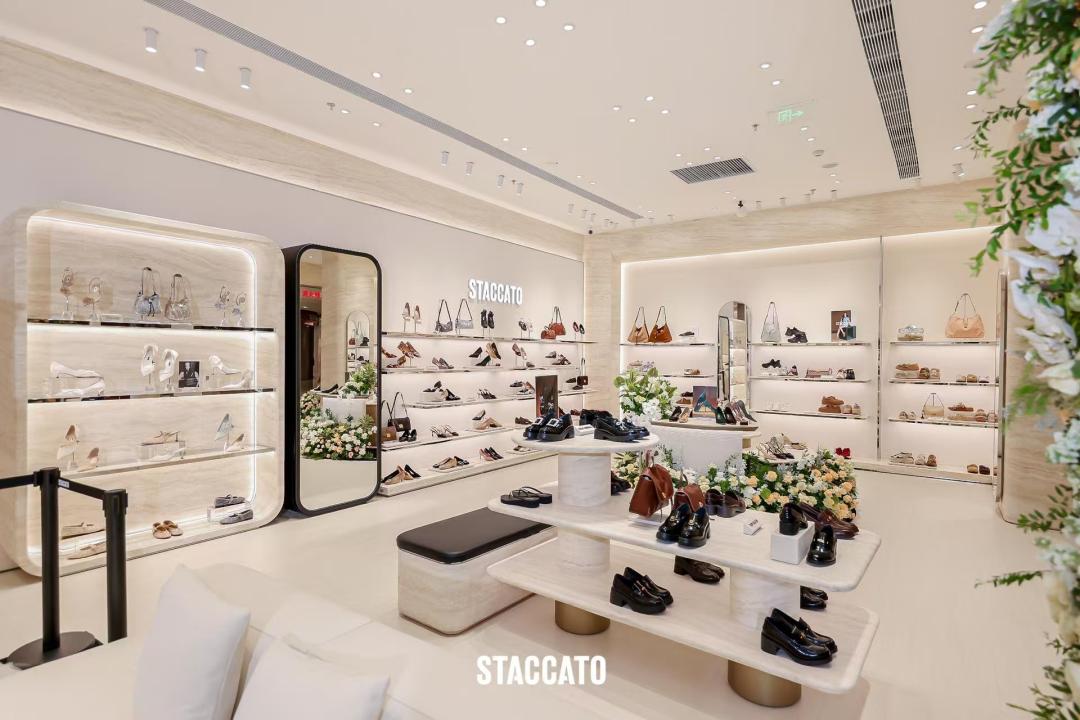
Staccato offline store
Consumer decision-making moves forward, stores need new customer acquisition entrances
Apparel is a business that needs to be noticed.
In the past, such attention was largely distributed by location. Shopping malls brought people to the front of stores, window displays made people stop, and shopping guides introduced products to customers. Site selection, display and service together constitute the basic skills for stores to compete for business.
The rise of content platforms has changed this set of attention distribution methods.
What color is becoming popular, how to match a coat, and which pair of shoes is more suitable for commuting or vacation — consumers can get answers through videos and livestreams before going out. Content puts the products on hangers into specific life scenarios, and also makes shopping decisions happen earlier.
Accenture's consumer survey shows that in 2025, when respondents have clear shopping needs, 60% of them search for product and service information through e-commerce websites; 50% of respondents obtain information through livestream rooms or video platforms such as Douyin, Kuaishou and Bilibili, while this proportion was only 22% in 2021. At the same time, the proportion of people choosing to go to shopping malls and physical stores for experience dropped from 48% to 38%.
Although this is a cross-category survey, it points to a common trend: consumers' information entry points have changed. In the past, getting fashion information and completing purchases often happened offline at the same time; now, the link of understanding products mostly happens on the Internet, and purchases are scattered across different channels.
For apparel stores, customer acquisition methods must also change accordingly. In the past, opening a store in a place where customers often passed by meant taking the lead; now, brands also need to enter consumers' consideration range before they decide "where to go". Good locations are still important, but stores cannot only rely on natural passenger flow, they also need to actively introduce themselves and create reasons for visits.
The entire apparel market does not leave much waiting space for physical stores.
Data from the National Bureau of Statistics of China shows that in 2025, the retail sales of clothing, footwear, hats and knitted textiles of entities above designated size increased by 3.2%, and the retail sales of clothing products in online retail sales of physical goods increased by 1.9%. Both data are in the low single-digit growth range. For apparel brands, improving the operating efficiency of existing stores has become more urgent.
This does not mean that consumers are unwilling to go shopping. Shopping malls are still bustling, but passenger flow will not be evenly distributed to every store. Consumers may walk into a shopping mall for a meal, a movie or a friend gathering, but apparel stores still need to fight for a separate chance to be selected.
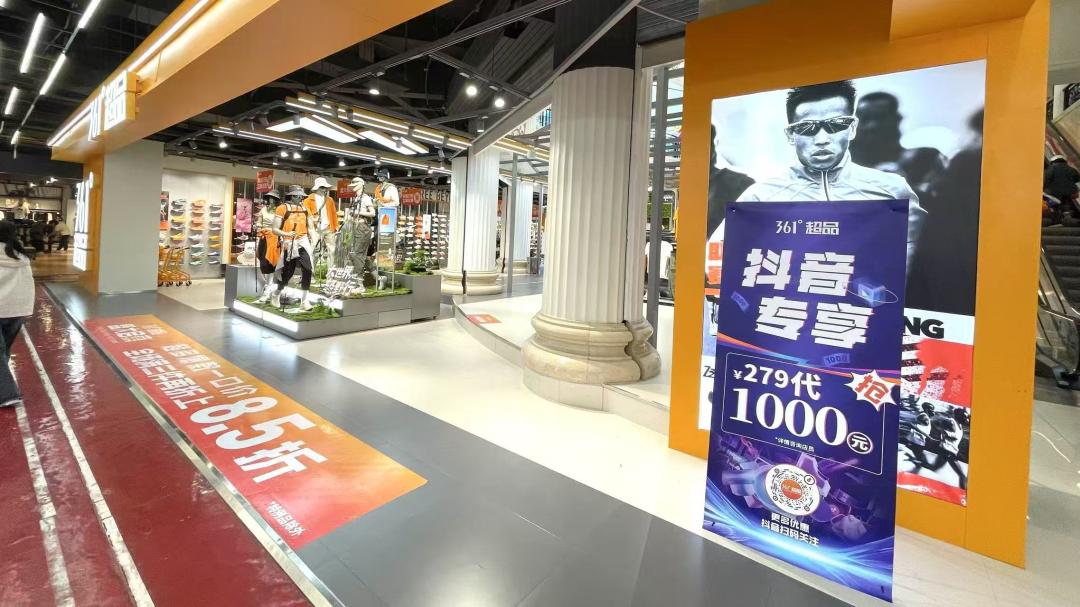
361° Super Flagship Store
Qian Hua, head of new retail at 361°, believes that people passing by the door, regular customers in the hands of shopping guides, and passenger flow brought by joint operation in shopping malls used to be the main customer sources of stores, "but all of these have been shrinking in recent years".
At the same time, the value of offline stores has not disappeared. Sizes, versions and wearing feelings vary from person to person, and fitting and matching still help consumers make the final judgment. The problem is that these values need to be noticed in advance before consumers arrive.
Stores still have irreplaceable experience advantages, but they need a new customer acquisition entrance to turn these advantages into reasons why consumers are willing to make a special trip to visit.
From content to verification, how a single in-store visit turns into business
Introducing products to consumers is only the starting point of this path.
At the Douyin Local Life Brand Retail Industry Summit held on September 2, Lv Tao, head of KA Brand Retail Industry of Douyin Local Life, mentioned that the real product and service value of offline stores is often difficult for consumers to perceive in advance. The role of content is to present these advantages to consumers, so that they can form the reason for visiting before arriving at the store.
Staccato, the mid-to-high-end main women's shoe brand under Belle International, showcases its seasonal products. Women's shoe styling, creator store exploration and co-branded product display let consumers first see how a pair of shoes can be worn and what scenarios it is suitable for, and then decide whether to go to the store for fitting. According to Luo Zheng, Chief User Operation Officer of Belle Group, the GMV of Staccato generated from in-store orders after being attracted by content accounts for 69% of the total.
In Luo Zheng's view, these short videos and livestream content are equivalent to opening an "online window" for physical stores.
The reason for visiting can also be more specific. When Josiny launched its new "Wilderness Series" products, it combined the online premiere with the "One-Day Store Manager" event at Wuhan stores. New product content first attracts attention, and offline activities then provide clear motivation for travel. For consumers, going to the store can not only see new styles, but also participate in activities, so the original interest that was put off for "when I have time" is more likely to turn into a definite trip.
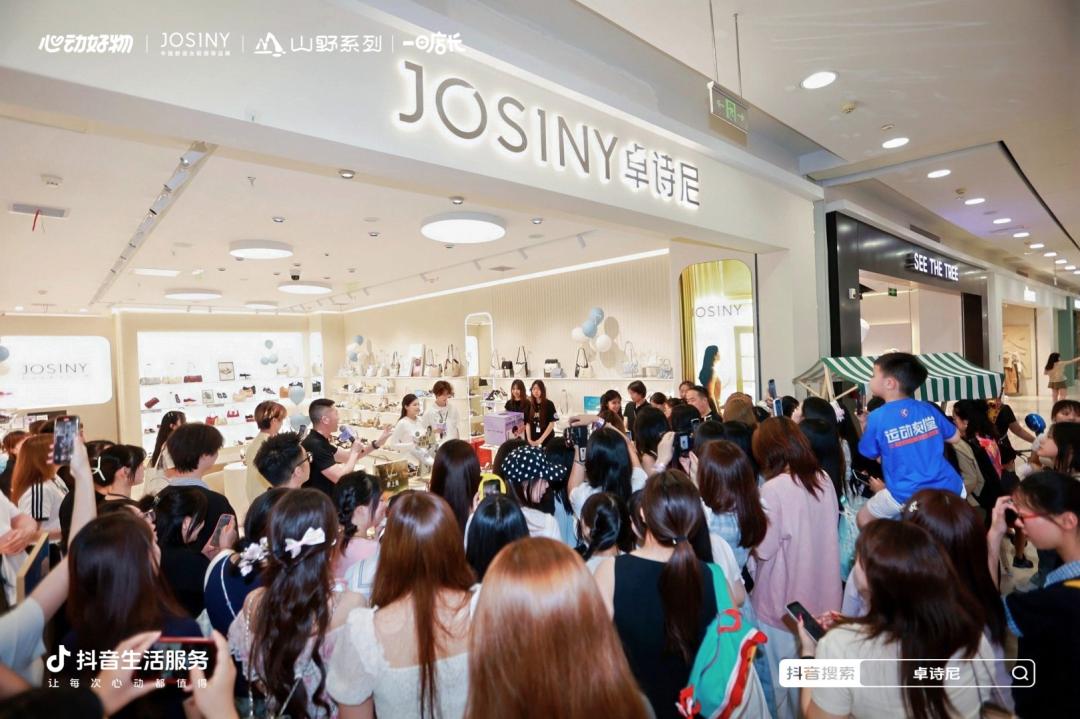
Josiny "One-Day Store Manager" Event
Stores themselves have also begun to stand in front of the camera. Some regional livestreams of 361° use dialects, and introduce products in combination with the habits of local consumers. Compared with the unified brand expression, employees who are familiar with the store and local customers can more clearly explain what the store has and who it is suitable for.
The Internet can introduce a product to people far away, but in-store transactions ultimately happen within a distance that a person is willing to travel. Therefore, content should not only arouse consumers' interest, but also answer two more specific questions: where the favorite product is, and what can be obtained after arriving at the store.
The carrier connecting online interest and offline consumption is often a voucher.
UR initially tested in-store vouchers in regions such as Shanghai and Guangzhou, and then gradually expanded its coverage. Taking the "500 yuan for 600 yuan" voucher it once launched as an example, consumers first lock in an in-store consumption right online, and then select styles, try on and match according to the applicable rules after arriving at the store.
This mode reserves the space of "shopping around" for apparel consumption. Keeping fitting offline means that brands still have the opportunity to help consumers find the choices that truly suit them with richer products and on-site services.
However, for the apparel in-store business, selling vouchers does not equal the final transaction. The voucher purchase rate, verification rate, actual product transaction amount after arriving at the store, and member conversion rate correspond to different links from consumers generating interest to completing purchases, and jointly determine whether this business is truly established.
It only takes a few seconds for a voucher to complete the transaction on the mobile phone, but what consumers will finally buy still needs to be confirmed in the store.
As Chen Peixun, head of KA Brand Retail Industry Operation of Douyin Local Life, pointed out at the summit, whether consumers are willing to walk into the store, what they actually buy, and whether they finally complete the verification can better reflect the real consumer demand. Whether content can bring business still needs to find answers in physical stores.
Some people enter the store because of a pair of shoes in the video, but find that another style is more suitable for them; some people who originally only paid attention to a single product may also find a complete set of matching under the suggestion of shopping guides. Based on his own business observation, Luo Zheng mentioned that consumers who come to the store with vouchers have higher joint purchase rate and repurchase rate, and lower return rate.
The value of offline experience is embodied in this more sufficient selection process and more complete purchase results.
After visiting the store and completing the transaction, the business is not over yet.
It is introduced that within three months after Staccato settled in Douyin Local Life, more than 30,000 new brand members were added. Luo Zheng also noticed that there is a group of young consumers online who have not made purchases but have paid attention to the brand. If only relying on transaction records, it is difficult for brands to identify these potential customers; through the content and in-store link, brands have the opportunity to establish connections before purchases happen.
As early as the second half of 2024, 361° began to promote the connection between platform business and its own member system, observe voucher purchase, verification and subsequent purchase behaviors together, and then provide services and rights according to consumers' purchase cycle.
As a result, a more complete business link is gradually formed: content creates interest, vouchers promote actions, stores complete experience and transactions, and member operations extend the consumption relationship. What apparel brands get is not just a single transaction, but also a customer who can be continuously operated.
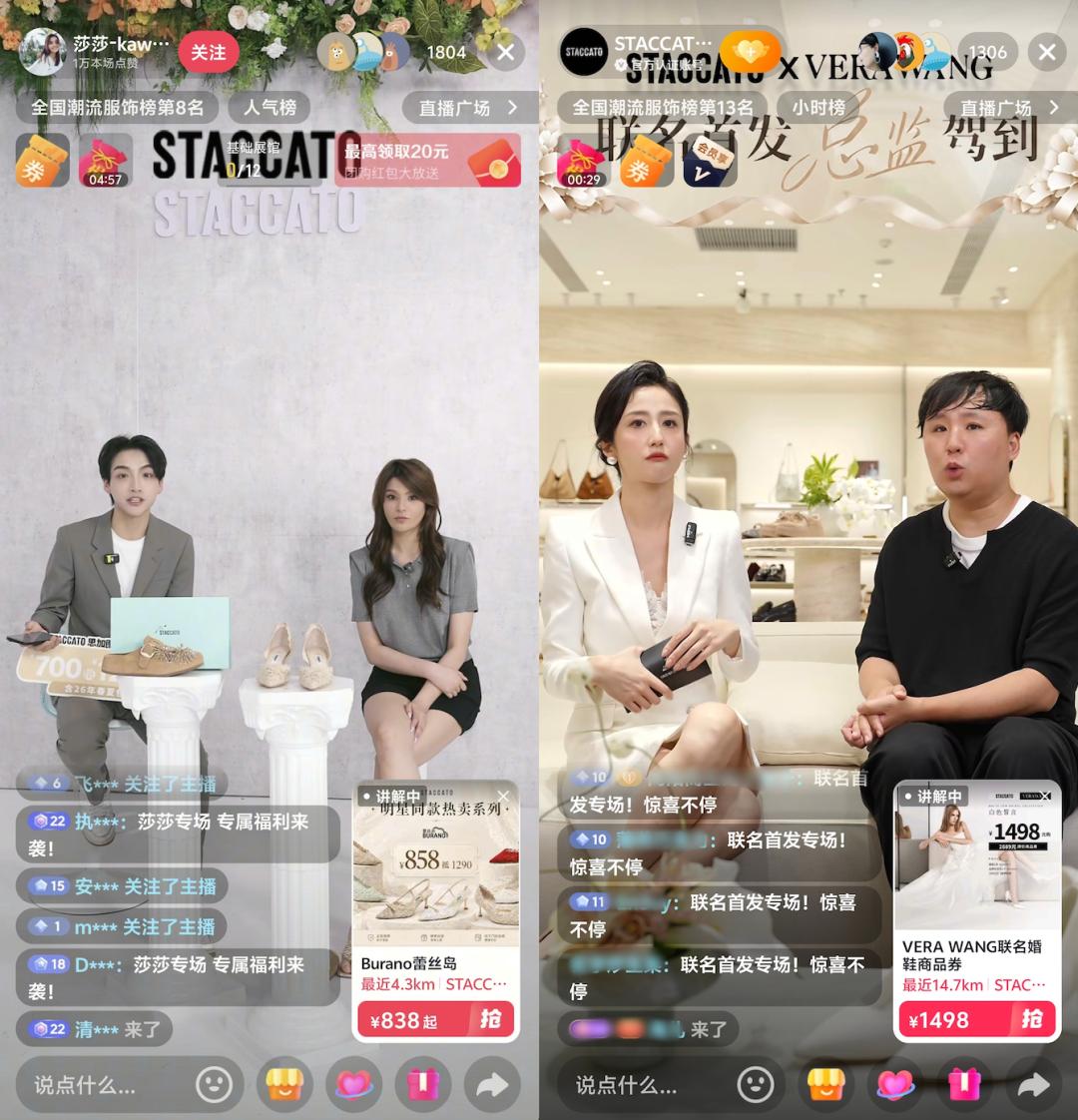
Staccato Douyin Livestream Scene
From traffic attempts to long-term operation, apparel in-store business is maturing
As more and more brands enter the market, the "content-to-store" path is moving from a single traffic attempt to a more systematic long-term operation.
Compared with catering, apparel consumption has a lower frequency, and interest may not be immediately converted into transactions; fitting and matching take time, and store services are also difficult to be greatly compressed. Stores are scattered in different regions, and a set of arrangements from the headquarters may not cover all needs; in the franchise system, brands also need to coordinate the interests between different operators.
These industry characteristics determine that the apparel in-store business cannot only rely on a single activity or a livestream, but needs to establish continuous content supply, smooth store fulfillment and a stable operating mechanism.
First of all, low-frequency consumption requires brands to make content operation a daily routine.
Staccato's data shows that the top 10 videos in terms of play volume only contribute less than 10% of the relevant transactions, and a large number of transactions come from daily content with unremarkable data performance.
Hit works can help brands get attention, but transactions may not happen on the products displayed in hit content. Consumers may get to know the brand through one piece of content, and finally complete the purchase in other content or store scenarios. This means that apparel brands need to jump out of the pursuit of a single hit, and maintain stable reach between two purchases.
Secondly, the interest brought by content needs to be smoothly undertaken by physical stores.
In the early stage when 361° accessed the relevant business, the number of stores open for verification was insufficient, and consumers might not find applicable stores after purchasing vouchers; even if they arrived at the store, shopping guides needed to open a special software to complete the verification, which increased the cashier time. After that, the brand gradually expanded store coverage, re-trained employees, and connected the verification function to the daily cashier system, so that the whole process became smooth gradually.
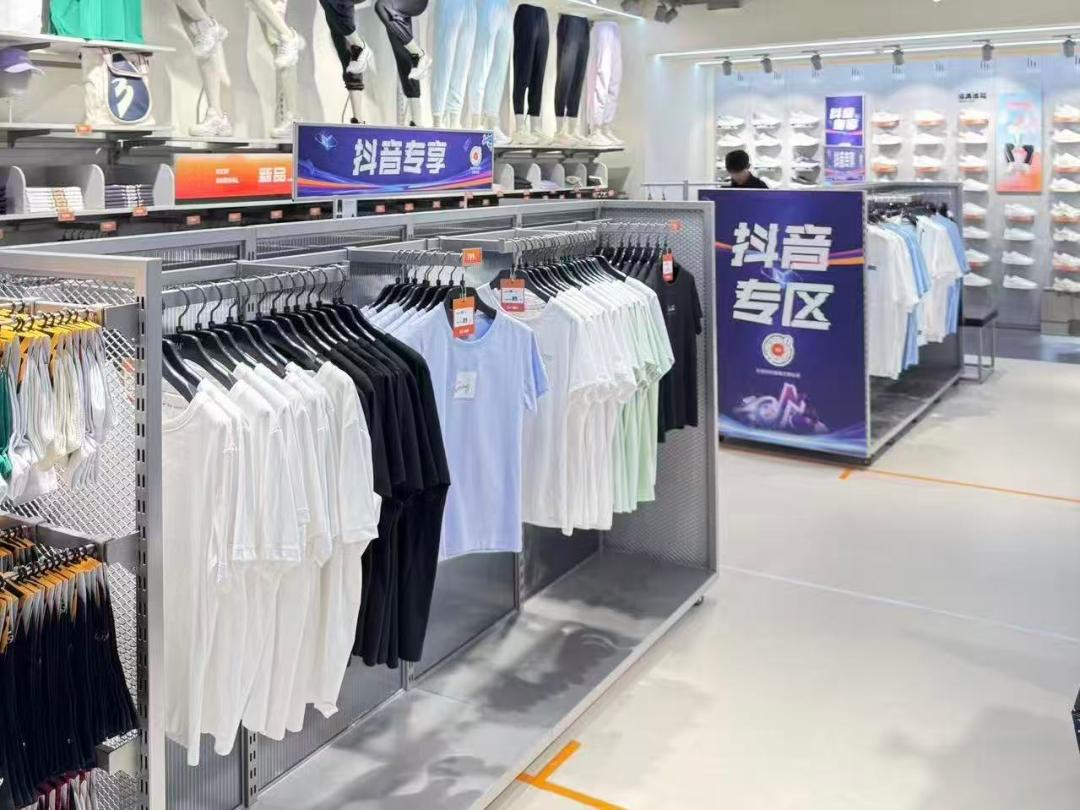
361° Store Douyin Special Zone
Staccato adopted a series of measures such as time-limited verification, in-store rights and subsequent reminders, to increase the verification rate of creator livestreams from about 3% to more than 20%. This shows that the improvement of the verification rate does not rely on a single preferential measure, but is the result of the combined effect of voucher design, user reminders and store undertaking.
Thirdly, the scattered store network requires brands to take into account both national unification and local differences.
Luo Zheng believes that national communication needs to maintain brand consistency, and local services can have their own expressions. This means that the headquarters needs to keep product quality and service standards, and leave space for local operators to create content and organize products at the same time.
The brand joint operation model that Douyin Local Life is promoting also provides a division of labor idea: brands organize products and content uniformly, and channels are responsible for store services and fulfillment. According to platform disclosure, more than 250 brands have participated in the past year, covering more than 30,000 channel stores, and the monthly year-on-year growth of relevant transaction volume exceeds 500%.
As systems, stores and channels are gradually connected, online content is no longer just a marketing action at the headquarters level, but begins to enter the daily operation of each store.
At the same time, the apparel in-store business is also shifting from simply relying on low-price promotions to the joint operation of products, content, services and rights.
From the perspective of a single brand, Staccato adheres to full-price operation, maintains the same quality, price and rights online and offline, and consumers are still willing to pay; Douyin Local Life data shows that merchants that operate both products and vouchers only account for 7%, but contribute 64% of the transaction volume, and their increment is 3 times that of a single operation mode.
This means that vouchers are more suitable for expanding coverage and improving sales momentum, and products, content and services are the core of attracting new customers, creating profits and building brand value. When brands no longer only focus on how many vouchers they sell, but also observe verification, joint purchase, member conversion and repurchase, the apparel in-store business has entered a more mature operation stage from traffic attempts.
