DeepSeek has made major adjustments to its interview process, and the new questions will definitely leave even fresh graduate ACM gold medalists completely stumped.
DeepSeek redesigned the entire interview process for its large-scale social recruitment of 150 people.
According to Cui Tianyi, the person in charge, this written test has completely removed all ACM-style coding problems, replacing them with a series of system design problems that require practical engineering experience to answer well.
Fresh ACM gold medal graduates will definitely be confused by this, but senior engineers with high proficiency should find it very handy to complete.
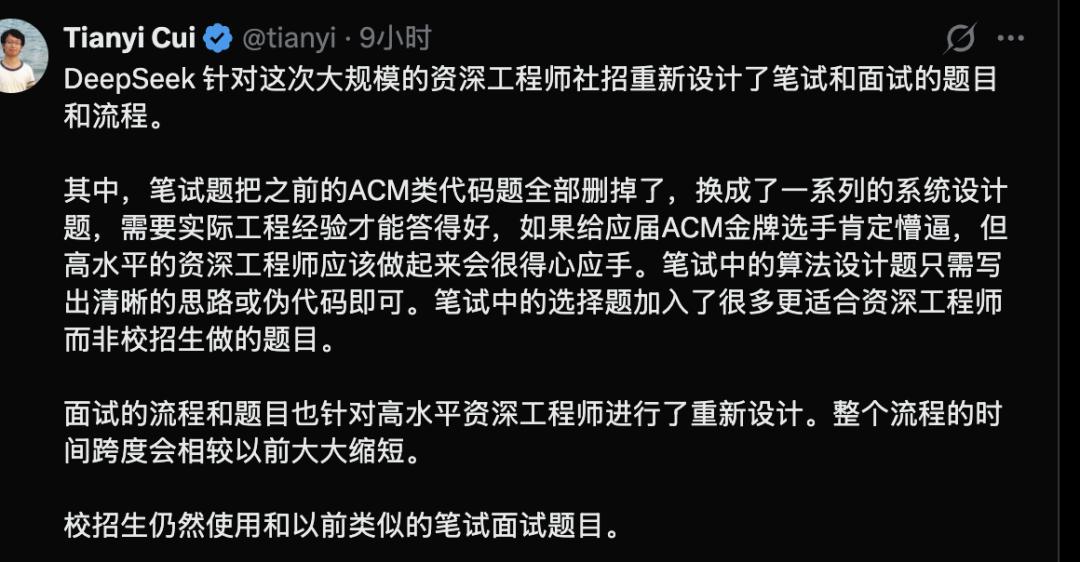
The algorithm design questions in the written test no longer require writing complete runnable code, and only clear ideas or pseudocode are needed.
The multiple-choice section also adds a large number of questions that are more suitable for senior engineers than campus recruits, and the overall time span of the interview process will be greatly shortened.
It should be noted that campus recruits still use written test and interview questions similar to the previous ones, and this change is only for senior engineers recruited through social recruitment.
In other words, DeepSeek has completely separated the assessment systems for social recruitment and campus recruitment.
Many people in the comment section agree that doing ACM problems in the AI era no longer makes much sense.
However, some people complain that this recruitment "focuses on senior engineers with 2-10 years of work experience", which is essentially a beautified version of the 35-year-old age limit, isn't it?
If an undergraduate graduates at the age of 22 and a master's student graduates at the age of 25, 10 years of work experience just corresponds to the age range of 32 to 35.

DeepSeek Makes Major Overhaul After Its Interview Process Sparks Controversy
Apart from the much-discussed experience of a former Huawei genius young talent complaining about DeepSeek's interview process, DeepSeek's interviews have long been a frequent target of complaints online.
DeepSeek's previous recruitment process had long received concentrated feedback from candidates on two types of problems: first, the written test content did not match the job level, and second, the overall experience of the process was not stable enough.
It is naturally insufficient in discrimination to use the same set of questions to evaluate an engineer who has designed large-scale distributed systems in production environments, handled online faults, and made architecture trade-offs, and a fresh graduate who has completed 500 LeetCode problems.
Judging from the information disclosed so far, the idea of DeepSeek's this adjustment is to shift the assessment focus for senior social recruitment engineers from "handwritten algorithm problems" to "system design and engineering judgment".
All ACM-style coding problems are replaced with system design problems. These problems have no standard answers, and they test candidates' ability to make trade-offs in real engineering scenarios:
What are the constraints, why the current solution is selected, what are the defects and risks of the solution, how to quickly locate the fault after it occurs, and what quantitative benefits are finally brought.
These questions exactly correspond to the description of the senior engineer portrait in DeepSeek's recruitment document:
You personally solved the highly difficult or highly complex problems recognized by the whole team, or you formulated the technical solutions for them
Problems that even cross-team colleagues from upstream and downstream cannot easily find the root cause of always end up with you and get solved by you
Algorithm design questions only require writing clear ideas or pseudocode instead of complete implementation, which actually shifts the assessment focus from "whether the code can run" to "whether the solution design is reasonable".
The shortening of the overall time span of the interview process also targets the problem that was frequently complained by candidates before. Previously, some candidates had to wait for several weeks after passing the written test to get an interview arrangement, and the promotion pace varied greatly between different teams.
From the perspective of the trend of the entire AI industry, DeepSeek's this adjustment also hits a key node.
With the rapid popularization of AI code generation tools, the discrimination of simply assessing the speed of handwritten code is declining, and it is more necessary to evaluate candidates' abilities to discover problems, break down requirements, design systems and verify results.
Reference link: [1]https://x.com/tianyi/status/2097371778364669954?s=20
This article is from the WeChat Official Account "QbitAI", author: Meng Chen, published with authorization from 36Kr.