Is OpenAI plagiarizing and threatening mathematicians? The "AI Conquers Millennium Problems" show has finally turned into a fierce battle between OpenAI and Anthropic.
OpenAI announced today that it has found a solution to the Navier-Stokes problem, one of the long-standing major unsolved problems in the mathematics community. If the relevant proof is finally validated, it will undoubtedly be a significant achievement.
However, just as the outside world was preparing to celebrate, the news quickly fell into controversy: some questioned whether OpenAI had used unpublished research results from other researchers; in addition, OpenAI was also accused of having tried to influence the attribution of authorship and contribution recognition for who should be credited for this achievement in the final paper.
One side of the controversy is Tristan Buckmaster, a mathematician at New York University, and Levent Alpöge, who is employed by Anthropic but participated in the research in a personal capacity. The two used a variety of different large language models during the research process, including Anthropic Claude, OpenAI's Codex tool and its cutting-edge model Astra; the other side involves OpenAI mathematician and AI researcher Sebastien Bubeck and his internal research team.
Buckmaster questioned whether OpenAI quickly launched research in the same direction after learning that they were close to a breakthrough, and further asked whether the research drafts, prompts and dialogue content he and Alpöge had uploaded to Codex for a long time had been used for the training or iteration of OpenAI's models.
At the same time, he also claimed that OpenAI had proposed two achievement publication plans to him, one of which required that the final paper should not include Alpöge's name. Bubeck later publicly denied that he had ever asked to remove Alpöge's authorship, and OpenAI CEO Sam Altman later also released his own account of the incident.
This turned a major progress that should have focused on mathematics itself into a debate about AI scientific research rules, achievement ownership, data usage and academic ethics in the era of large models.
1 What exactly is this breakthrough?
The Navier-Stokes problem is one of the 7 Millennium Prize Problems proposed by the Clay Mathematics Institute in 2000, and solving each problem comes with a $1 million bonus. These problems have plagued the mathematics community for a long time, and only one of them has been solved since the prize was established.
The Navier-Stokes equations describe fluid dynamics and are used to study how liquids and gases move. To understand it in an extremely simplified way, one of the core problems is: in the three-dimensional case, whether smooth solutions of the Navier-Stokes equations always exist, or whether some singular behavior may occur in a finite time. Research on whether "finite-time blowup" is possible has therefore become an important path in the related direction.
But it needs to be distinguished that the results currently made public by Buckmaster and Alpöge do not claim that they have completely solved the Navier-Stokes Millennium Prize Problem.
Buckmaster stated on Mastodon that he and Alpöge have published three research results, involving the incompressible porous medium equation, the Boussinesq equations, and the proof of smooth-driven finite-time blowup of the three-dimensional incompressible Euler equations. The most core explanatory document among the relevant materials has no signature and no title.
The statement reads that they have published three results this time, proving the finite-time blowup of the incompressible porous medium, Boussinesq equations and three-dimensional incompressible Euler equations under smooth driving conditions. At the same time, they believe that the hypodissipative Navier-Stokes equations also have the possibility of finite-time blowup, but the relevant paper has not been made public yet, and the corresponding Lean formal verification has not been completed, so there is no complete manuscript that can be formally presented. The team made this research direction public, hoping to provide new ideas for the research of the unforced Euler equations.
In other words, Buckmaster and Alpöge have made a series of key breakthroughs highly related to the Navier-Stokes problem, but they do not claim that they have finally conquered the million-dollar-level Millennium Prize Problem.
2 "The research idea was not generated out of thin air by AI"
Buckmaster specially emphasized in the statement that the basic idea of this set of research was not originally created by them, nor was it generated from scratch by large models.
The core theoretical route originates from the driven blowup construction that Diego Córdoba and Luis Martínez-Zoro have studied for a long time. Previous related studies have obtained blowup results under relatively rough driving conditions. On this basis, Buckmaster and Alpöge continued to advance with the help of a variety of AI tools, iterated the relevant results to smooth driving conditions, and finally made new progress in the incompressible porous medium, Boussinesq equations and Euler equations.
Buckmaster's view is that the core innovative idea of the whole work must be traced back to the previous research of Córdoba and Martínez-Zoro. He even said that based on this complete set of research results, Luis Martínez-Zoro is fully qualified to compete for the Fields Medal.
Buckmaster also specially explained that his cooperation with Alpöge is personal academic research. Although Alpöge is employed by Anthropic, Anthropic did not participate in the project, and there is no official cooperation agreement between their respective institutions. The relevant research expenses are borne by individuals, not an Anthropic project.
During the research process, the two used multiple AI products at the same time, including Anthropic Claude, OpenAI Codex, GPT-5.6 Sol, and the Astra model used in the later stage. Among them, Astra is mainly used for paper sorting and research argument verification, rather than generating the entire research direction from scratch.
Buckmaster said that the early progress of the project was quite slow, and they needed to continuously read literature, sort out research directions, and repeatedly test various preliminary ideas. The first important result obtained was to prove that the incompressible porous medium equation can have finite-time blowup under smooth driving conditions, and then the relevant results of the Boussinesq equations and Euler equations were further obtained.
But the proofs initially generated by AI did not reach the level that could be published directly.
Buckmaster described that the earliest proof manuscripts were "extremely poor in quality", and even one of the roughest and most chaotic mathematical proofs he had ever seen. The team then used Lean for formal verification, and then spent a lot of time reorganizing the proof logic, rewriting the machine-generated raw materials into more fluent, more rigorous, and more academically readable text.
He also admitted that the Boussinesq equations and Euler equations papers that were forced to be made public in advance still have obvious traces of AI generation, and there is still a gap from the rigor required by traditional mathematical papers, and the manuscript of the Euler equations is particularly rough.
According to the original plan, they were going to spend a few more weeks completely rewriting the AI-generated proofs into standard academic papers, and completing formal verification at the same time, instead of hastily releasing a preprint that had not been fully polished.
But external events changed the plan.
3 Rumor: Has Anthropic conquered a major mathematical problem?
The turning point of the incident was that a rumor suddenly emerged within the industry: Anthropic has conquered a top public mathematical problem. At the same time, Alpöge received news that their research progress might have leaked into OpenAI.
Buckmaster therefore took the initiative to contact a senior OpenAI mathematician. In the email, he explained that the news that "Anthropic has conquered a major mathematical problem" has been circulating in the industry recently, and although he cannot confirm 100% that the rumor points to his project, multiple sources show that what the outside world is talking about is very likely the research he and Alpöge are conducting.
He also emphasized again that this is not an Anthropic project, but a private research of the two people. There is no institutional cooperation agreement between the two sides, and no official Anthropic resources are used. He himself paid for the scientific research expenses generated by using OpenAI tools. Although there was a formal institutional cooperation with DeepMind before, this research has no institutional endorsement.
Buckmaster also told the other party that they have reliable research results, and the papers and Lean formal verification will be made public later, but the reason why they did not release it immediately is that they hope to first sort out the machine-generated original proofs into complete arguments that human mathematicians can really read and review.
His original intention was to clarify the facts through private communication, so as to prevent the outside world from continuing to misinterpret personal research as "Anthropic conquering a mathematical problem".
OpenAI gave a reply the same day.
According to Buckmaster's recollection, the anonymous mathematician said that if he was willing to reveal more research details, unnecessary competition between the two sides could be avoided; OpenAI would also be happy to see mathematicians use their models to complete major research, and is willing to provide more computing resources for free.
The two sides then agreed to communicate online. Buckmaster said that OpenAI was very anxious about this communication and repeatedly requested to hold a meeting as soon as possible. Sebastien Bubeck later joined the meeting, and the two sides had two rounds of communication in the afternoon of the same day, while Alpöge himself did not participate.
Buckmaster specially emphasized that Bubeck was not the original OpenAI mathematician who corresponded with him via email, which is also a point that is easily confused in some subsequent discussions.
4 During the communication, OpenAI revealed that its internal model had found a solution
It was during this communication that Buckmaster learned the information that really made him alert.
OpenAI said that its internal model has completed the proof of finite-time blowup for the driven Navier-Stokes equations.
Alpöge then asked for specific details in text, and the response was: this proof involves the existence of driven blowup in three-dimensional real space and three-dimensional torus, applies to a specific category of smooth driving conditions, and the complete proof is about 100 pages long.
Buckmaster said that he had never seen this proof, so he could not evaluate its correctness, nor could he confirm what mathematical methods were used in it. But what made him suspicious was the research route itself.
The "driven" research route described by OpenAI is highly close to the direction previously pioneered by Diego Córdoba and Luis Martínez-Zoro, which is a very niche research path that only a small number of teams have been deeply engaged in for a long time. Buckmaster and Alpöge also chose this direction precisely. Therefore, when OpenAI revealed that it also started from the driven Navier-Stokes, Buckmaster immediately thought there was something abnormal.
Initially, OpenAI gave him the impression that the internal research model only got a very basic problem description, and then found the entire proof on its own with almost no human intervention. But as the communication continued and the OpenAI team kept supplementing information, Buckmaster thought the situation was actually more complicated.
According to his account, OpenAI's internal research was not simply "input the Navier-Stokes problem and then let the model solve it by itself", but a systematic research process: start with the unforced problem, then gradually let the model deal with relatively simple problems such as the Euler equations, and continuously iterate the research route; the prompts displayed externally were also repeatedly polished by Codex, and the whole process consumed a lot of computing resources.
Buckmaster then asked about the specific time when OpenAI first launched this research direction.
The other party never directly answered this question, and the final time information revealed showed that the time when OpenAI launched the relevant model to tackle key problems was a few days after Buckmaster and Alpöge's research progress had been transmitted into OpenAI. This further aggravated his doubts.
According to the public information from OpenAI, their solution process is roughly as follows:
August 28: The new model starts training → September 1: Hear that "the Anthropic-related team may have conquered the Millennium Prize Problem" → Ten thousand-level Agents attack multiple mathematical problems at the same time → About 100 Agents first spend 50 hours breaking through the unforced Euler → Judge that Navier-Stokes is the most promising → Deploy resources and feed the Euler results to the Agents → Different Agent groups explore in parallel, and Codex continuously summarizes cross ideas → About 10,000 Agents find the finite-time blowup solution of Navier-Stokes after 88 hours → GPT-6 Astra spends another 17 hours doing Lean formal verification → September 6: The whole project is completed → September 8: Make the paper and Lean proof public.
No answer: Were private research data in Codex used for training?
Buckmaster then raised the most critical question in the whole incident. He asked OpenAI: Has the internal model ever accessed, or been trained on, the project sessions that he and Alpöge have uploaded to Codex for a long time? Because throughout the research period, they have been putting paper drafts, research ideas and a large number of intermediate materials into Codex.
"I asked if this model was trained on our Codex session data, or had access to these sessions. We put all drafts into Codex throughout the whole project. I was told that the model would not access user data. I asked the training question again, but got no answer." Buckmaster said.
This is the core of the current controversy and also the issue that has not been confirmed yet.
Buckmaster therefore suspected that OpenAI might have used their research prompts, dialogues and drafts in Codex to train or optimize the model, and finally let the model solve the problem along the same highly specialized research route. But he also clearly admitted that he had no evidence to prove that OpenAI did so.
He has not seen OpenAI's proof, nor does he know what research process the internal model specifically used, so he cannot "conclusively confirm" that OpenAI misappropriated their data. He thinks what is really worth paying attention to is that when he explicitly asked "whether the model was trained using these dialogues", the other party did not give a positive answer.
5
Authorship Controversy: OpenAI threatened: Why ruin your academic career?
More intense conflicts subsequently emerged over how the results should be published. Buckmaster said that OpenAI proposed two plans to him:
The first plan is that Buckmaster's side first publishes the phased research results of the Euler equations, and OpenAI will publish its own Navier-Stokes proof the next day.
The second plan is that Buckmaster publishes a paper on the Navier-Stokes equations alone, noting that the proof was completed using OpenAI's large language model, but the paper does not include Alpöge's name.
According to Buckmaster's account, Sebastien Bubeck twice proposed that Alpöge should not be included in the authors, the core reason being that Alpöge is employed by Anthropic, OpenAI's competitor.
Buckmaster also said that OpenAI stated that if OpenAI finally publishes the results after Buckmaster's team, they are willing to recognize the pioneering value of Buckmaster's team's previous work and consider them the human research team that was closest to solving this Millennium Prize Problem.
Buckmaster rejected the two plans. According to his account, he then told the other party that if OpenAI insisted on releasing the results in the current way, he would disclose the entire communication process.
Buckmaster further claimed that the other party pressured him with words like "why would you ruin your own academic career?", and he asked in return why disclosing scientific research controversy would ruin his academic career. The communication then further deteriorated.
Alpöge later also received an invitation for a separate communication, and the other party hoped to communicate with him bypassing Buckmaster, implying that Buckmaster's decision at that time might not be rational. Alpöge refused and requested that both of them must participate in subsequent communications.
Bubeck emailed again later that night hoping to continue the communication, but Buckmaster did not reply.
However, Bubeck has since publicly denied the most sensitive authorship accusation. He explicitly refuted the claim that "he asked Buckmaster to remove Alpöge's authorship" and posted the chat records:
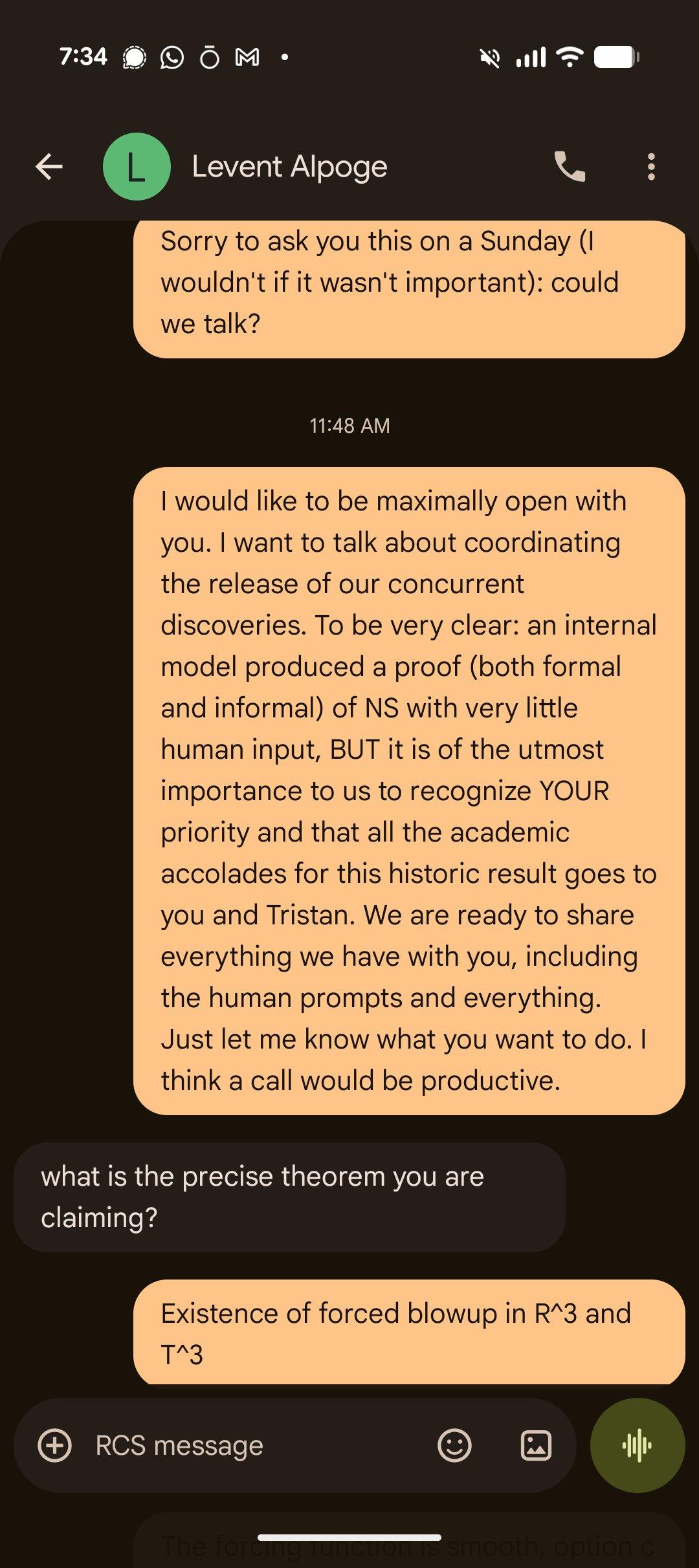
The tweet is as follows:
I want to clarify a few things: The content in the screenshot is that I took the initiative to contact Levent, hoping to coordinate the release time of the results of both sides. I hope it can be seen clearly from that message that we communicated this matter with the utmost goodwill at that time. I never, never asked to remove Levent from the author list of his own research results, which can also be seen from my text message. During the call with Tristan, I was surprised to learn that they had only solved the Euler problem, not the Navier-Stokes problem. After knowing this, we discussed together the possible follow-up approaches. One of the plans was for Tristan, as the lead author, to reorganize and write OpenAI's Navier-Stokes proof. It was in this context that I said "things would be simpler if Levent was not an employee of Anthropic", because I thought it was not appropriate for an Anthropic employee to be credited for OpenAI's research results. More importantly, the other party also admitted that they used Anthropic's internal model when proving Euler blowup. Therefore, in my view, I cannot regard Levent as a completely independent academic researcher. I originally wanted to propose another plan, but I didn't have time to finish it: we can give them access to OpenAI's internal model, let them try to continue to complete their