Is Anthropic, valued at 2 trillion US dollars, worth buying?
In April this year, a buyer offered Anthropic a valuation of about 600 billion U.S. dollars. By August, some investors predicted that Anthropic's valuation at the time of its IPO could reach 2 trillion U.S. dollars or even higher. In fact, to support such a valuation, Anthropic needs to maintain rapid growth continuously in the next few years, but the catch-up by OpenAI has added new uncertainty to this expectation.
Just last week, OpenAI launched Astra with stunning performance, and many developers began to reconsider whether to switch from Claude Code to Codex. This has also made the market ask again: If a single model update from a competitor can attract users away, what exactly does Anthropic rely on to maintain long-term growth?
We believe that even with intensifying competition, Anthropic's product taste and organizational cohesion still lead the industry. We are also optimistic about the potential of the Claude tag and the company's investment in the AI for Science field. However, how much revenue these opportunities can generate depends, in addition to model capabilities, on whether Anthropic can access the enterprise context and retain customers through channels and product ecosystems.
Jon Ma, co-founder of investment data platform Artemis and former investor at Insight Partners, gave a more optimistic forecast for this issue. We have compiled his latest article Anthropic 2030: in his view, Anthropic is still worth buying at a valuation of 2 trillion U.S. dollars, and the company's ARR will reach 1 trillion U.S. dollars by 2030. In the long run, Anthropic is the AWS of the AI era and has the opportunity to become the world's first company with a valuation of 10 trillion U.S. dollars.
01
Anthropic will become the world's first company with a valuation of 10 trillion U.S. dollars
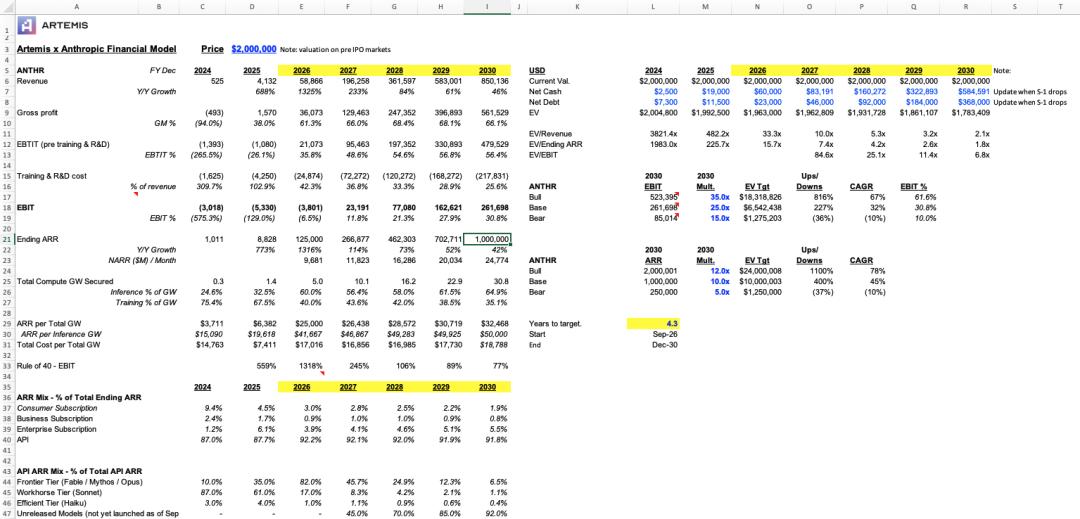
Anthropic will become the world's first company with a valuation of 10 trillion U.S. dollars, because enterprises have strong demand for its frontier models and full range of products. The figure below is a financial model built by Artemis combining internal estimates and third-party research such as SemiAnalysis.
• From the perspective of AI expenditure, open-source models have not yet posed a substantial threat to Anthropic: although Artemis has shifted part of its token usage to open-source models, 97% of its AI budget is still spent on Anthropic.
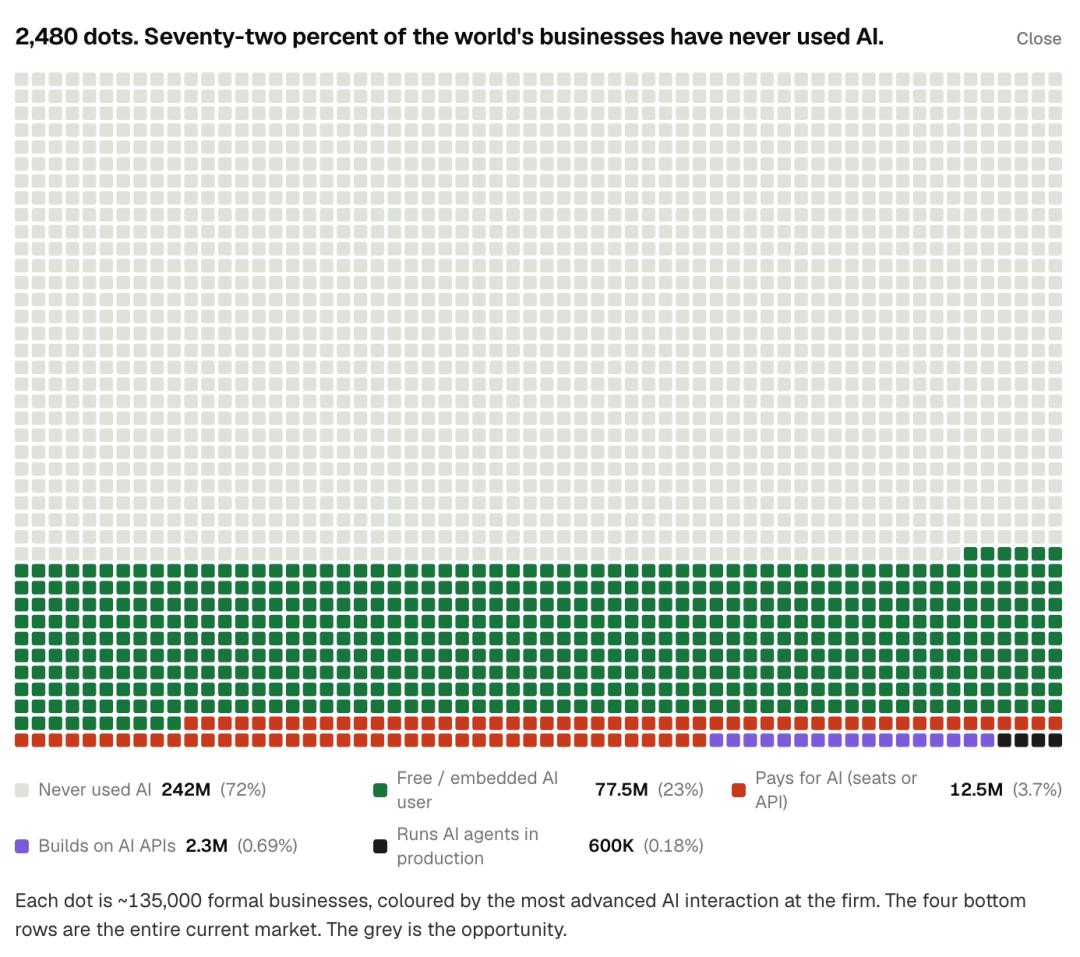
• Less than 1% of enterprises worldwide are using agents, and the popularization of agents is still at the very early stage of the S-shaped growth curve. The demand for tokens will grow exponentially.
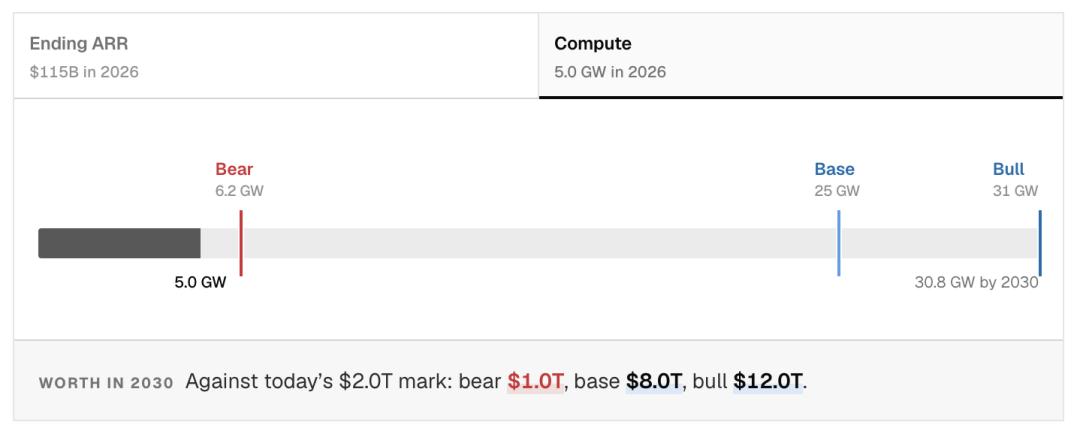
• Computing power constraints will be resolved: Anthropic may raise more than 100 billion U.S. dollars in net funds through IPO, setting a new record for IPO fundraising scale. In addition, the company has a very capable CFO, Krishna Rao, who previously worked at Blackstone. With sufficient funds and the help of this CFO, Anthropic may lock in more than 30 GW of computing power by 2030.
Therefore, at a valuation of 2 trillion U.S. dollars, Artemis is clearly bullish on Anthropic. However, considering the risks such as the threat of open-source models, the gradual catch-up of OpenAI's models, and the rising cost of computing power, it is not so certain whether it is still worth buying after the valuation exceeds 3 trillion U.S. dollars.
02
Thesis: Anthropic is the AWS of the AI era
In 2015, many people were not optimistic about AWS. In their view, AWS was a severely loss-making cost center within Amazon, and the products it provided were as undifferentiated as electricity. Moreover, at that time, people were not sure how large the cloud computing market was, and they also worried that competitors such as Google and Microsoft would drive down AWS's prices.
By 2026, Amazon has become the recognized winner in the cloud computing market. AWS's business has long gone beyond the original S3, and has established strong competitiveness with its one-stop product portfolio, scale advantages and developer ecosystem.
This year, Anthropic is facing similar doubts: although the company has raised and spent billions of dollars, with the development of open-source models, its cutting-edge models may still lose their differentiated advantages.
However, in Artemis's view, with its excellent team, Anthropic can continue to improve its model capabilities, and at the same time develop a full set of one-stop AI products that make enterprise customers highly dependent. Enterprises in all industries around the world can use this set of products to easily build, expand and maintain AI systems. This product will include cutting-edge models for specific fields such as drug discovery, as well as tools to ensure AI security, meet compliance requirements, and optimize performance.
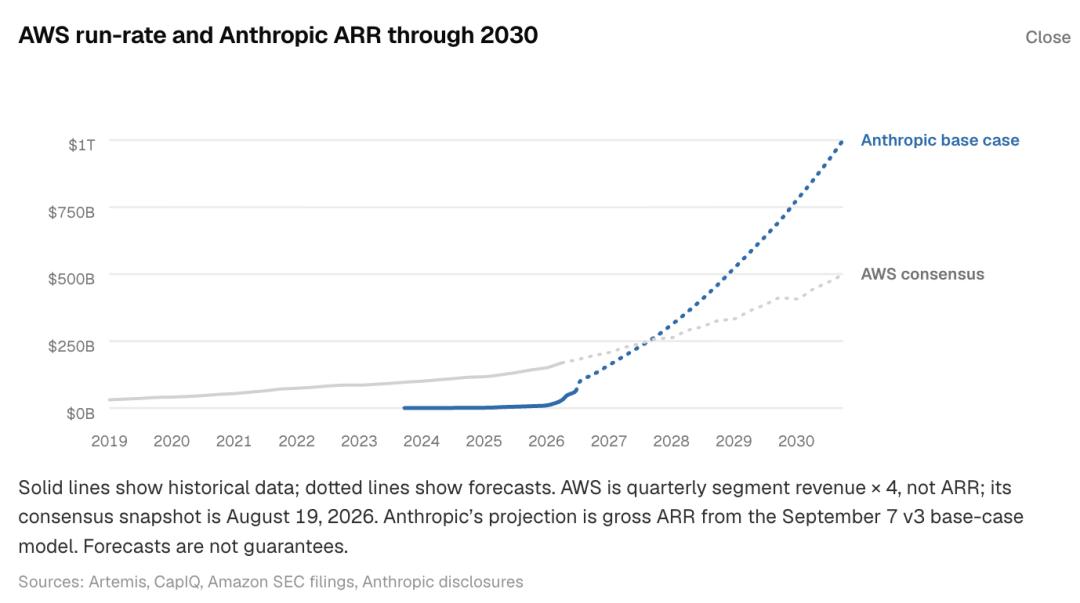
Eventually, like AWS, Anthropic will make it difficult for enterprise customers to leave its platform, and gradually increase its gross profit margin to nearly 70%. Artemis predicts that by 2027, Anthropic's ARR will exceed AWS's annualized revenue.
03
What is the essence of Anthropic's business?
To judge Anthropic's business, the core is to see whether it can do three things well:
1. Recruit excellent researchers to develop cutting-edge models;
2. Acquire computing power and control the cost at 10-15 USD/MW;
3. Sell tokens at a relatively high price through API, for example, let each MW of computing power bring 50 million USD of ARR.
Corresponding to specific indicators, we can focus on the following aspects:
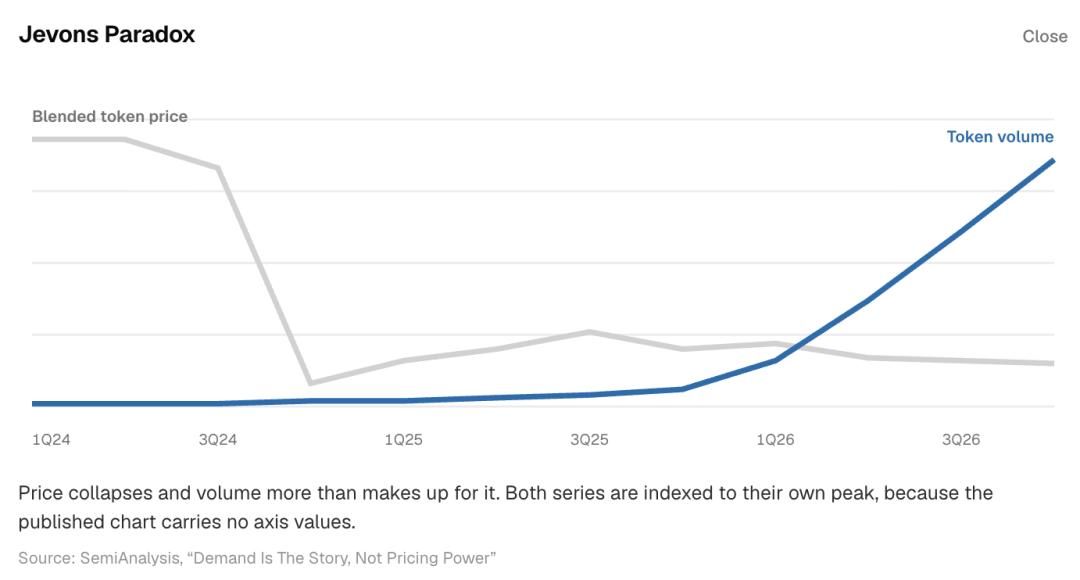
• Demand: Artemis estimates that Anthropic's net new ARR per month has reached 10 billion to 15 billion U.S. dollars. Although the price of tokens is declining, the usage of tokens is still growing, and enterprises' demand for cutting-edge models and deployed agents has high certainty.
• Supply: It is reported that in order to meet the computing power demand by 2030, Anthropic has locked in 15-16 GW of computing power. But to support 1 trillion U.S. dollars of ARR, the company needs at least 20 GW of training computing power. Artemis believes that by 2030, Anthropic can reach this computing power scale. In contrast, by 2030, OpenAI plans to lock in at least 30 GW of total computing power.
• Gross profit margin: The difference between the ARR brought by each MW of computing power and the corresponding computing power cost determines Anthropic's long-term profitability, and also determines whether this is a good business.
In addition, there are two points that need attention:
• Anthropic is essentially doing an API business for enterprises. 90% of the company's ARR comes from APIs, and personal subscriptions contribute very little. To reach a valuation of 10 trillion U.S. dollars, Anthropic needs to sell models directly to enterprises, and also sell through platforms such as AWS Bedrock, Gemini Enterprise Agent Platform and Microsoft Foundry.
• When evaluating ARR, look at the net amount. When investors value Anthropic, they will first deduct 15%-20% of the commission charged by AWS, Gemini and Microsoft from the revenue. In addition, they will exclude revenue from two types of customers: Meta, and Chinese AI labs that use Anthropic models for distillation.
04
Upside: What will happen to Anthropic if everything goes well?
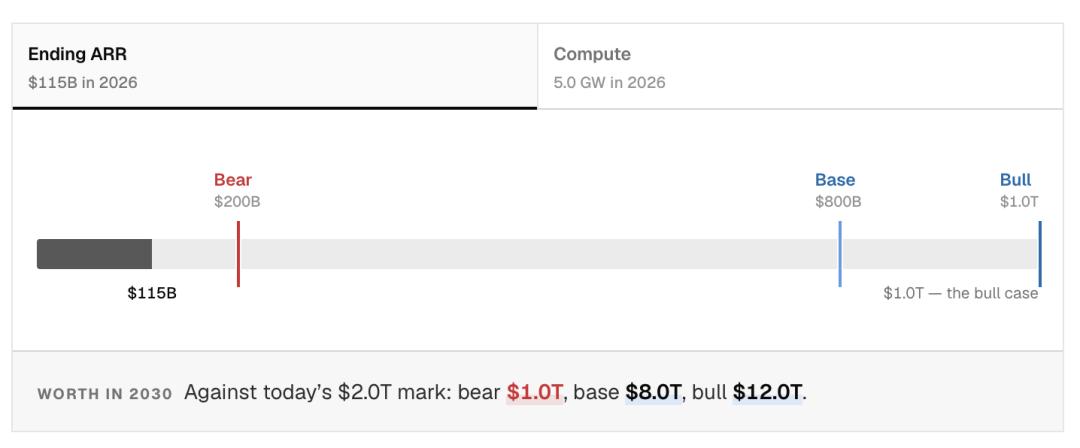
According to Artemis's forecast, by 2030, Anthropic can lock in at least 30.8 GW of computing power, which can support 1 trillion U.S. dollars of ARR.
Assuming that the total cost of per MW of computing power is 18 U.S. dollars, and per MW of inference computing power can bring 50 million U.S. dollars of ARR, then after Anthropic's business enters a stable stage, the gross profit margin can reach 66%, the EBIT can reach 30%, and the total expenditure on training and R&D will drop to about 25% of the revenue.
In this case, Anthropic will have very considerable profits. Moreover, with the continuous popularization of agents among more than 300 million enterprises around the world, the company will continue to grow rapidly.
05
Downside: What problems may arise in Anthropic's future?
Artemis also listed the existing risks of Anthropic, and sorted them according to the possibility of each risk from high to low:
• High risk: Codex and OpenAI Astra will take away Anthropic's market share
After Artemis tried Astra and Fable last weekend, it found that the gap between OpenAI and Anthropic has narrowed significantly, and customers may switch to OpenAI. In the Artemis team, some engineers have already started to switch from Claude Code to Codex. The following user feedbacks also support this observation.
Head of Blockchain Data at Artemis: "I've been using Codex a lot lately, and I like the way it communicates with me. Some people use Claude Code and Codex together, let Claude Code do the planning, and then let Codex execute. But for me, the two are interchangeable, and I only use Codex now. I used to use Claude Code in the terminal a lot, but now I prefer Codex in the ChatGPT app."
Fintech Analyst at Artemis: "OpenAI's Codex is really easy to use, and it's obvious that it's designed for programming. Through the GUI, users can more intuitively see what the agent is doing, which is much better than the early Claude Code's CLI. As the first generation of CLI AI coding tools, Claude Code has done a good job, but I think the next generation of tools will be GUI applications."
A product manager working at a company with a valuation of 3 billion U.S. dollars has always been a big fan of Claude Code and Claude Harness. This weekend, he said: "I have to say, Astra is really amazing."
• High risk: The switching cost between different models is very low
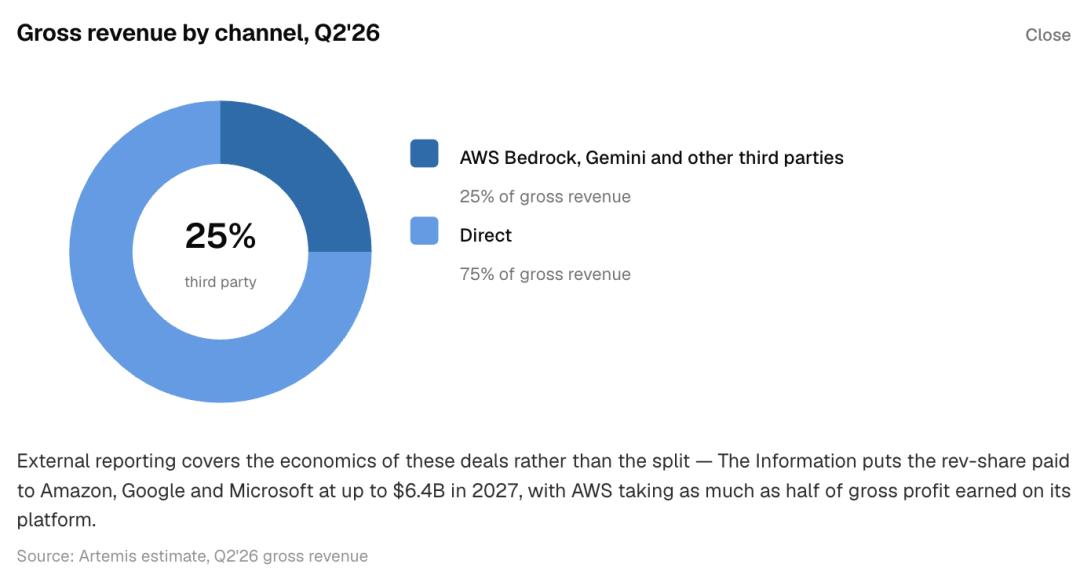
In Q2 2026, 25% of Anthropic's total revenue came from third-party platforms such as AWS Bedrock and Gemini Enterprise Agent Platform. When enterprises call Anthropic's API through AWS Bedrock, it is easy to switch to OpenAI's Astra or other open-source models. Therefore, if Anthropic's model is not SOTA, the company will face a dilemma: enterprises can easily switch to other models, and Anthropic may lose a lot of revenue as a result.
• Medium risk: Agents such as Grokbot and Instinct do not rely on Anthropic's models
Although Grokbot uses xAI's model, it can also compete with Claude Cowork and others. If agents such as Instinct and newly emerging AI applications also choose open-source models or other companies' cutting-edge models, Anthropic may need to expand to the application layer, may need to acquire ready-made harness or applications, and may be forced to develop new products by itself, just like the previous launch of Claude Code, Claude Design and Claude Cowork.
• Low risk: Anthropic cannot get enough computing power
Anthropic has locked in nearly 15 GW of computing power, but to support 1 trillion U.S. dollars of ARR, it needs to get another 15 GW. If the IPO can raise more than 100 billion U.S. dollars, the company will get the funds needed to purchase computing power. However, the relationship between computing power suppliers and Anthropic is also relatively complicated: Amazon, NVIDIA, Google and SpaceX are simultaneously Anthropic's suppliers, shareholders and competitors (Amazon has Titan, SpaceX has Grokbot, and NVIDIA is also expanding to upper-layer software business with the help of Hugging Face).
• Low risk: Anthropic no longer launches cutting-edge models
If model research encounters technical bottlenecks, or researchers make enough money through IPO and no longer invest as much as before, Anthropic may stop launching cutting-edge models.
At present, all incentives at Anthropic give researchers the motivation to continue working, but as the company's valuation rises, the equity rewards they hold will also increase significantly: when the company's valuation is 100-200 billion U.S. dollars, a share of equity reward is worth 5-10 million U.S. dollars, and when the company's valuation reaches 3 trillion U.S. dollars, this reward will be worth hundreds of millions of U.S. dollars. When the equity reward held by a researcher is worth 150 million to 300 million U.S. dollars, will they still have the same motivation to work?
06
Is Anthropic worth 2 trillion?
In general, compared with high-growth software companies and AI companies, whether measured by EV/ARR or EV/NTM Revenue, Anthropic's current valuation of 2 trillion U.S. dollars is relatively low, and even if the valuation reaches 3 trillion U.S. dollars, it is not too high.
