The Shanghai AI team has taken the top spot worldwide.
On September 8, a Chinese team appeared at the ECCV 2026 workshop in Malmö, Sweden.
BitInfinit, a Shanghai-based company, recently teamed up with the team from Wuhan University, defeated 27 other global teams with its self-developed Arko series of models and a score of 96.39, claiming the global first place in the ECCV 2026 CAD Challenge. This score is nearly 5 times the baseline set by the organizing committee with GPT-5.5's highest-intensity reasoning mode.
But as most people's first reaction goes: how could a seemingly unfamiliar startup reach the top of the world's top computer vision competition?
The answer lies in its technical path. While global tech giants are still trying to "understand" industrial drawings with general large models, BitInfinit has offered a completely different answer with its dedicated physical 3D models —
Led by Dr. Zhou Pingyi, the No. 2 figure of Huawei's PanGu large model, BitInfinit has independently developed the Arko series of foundational models, which are capable of generating CAD from text, images, point clouds/meshes, and support a CAD editor with natural language interaction. What it outputs is not a visual mesh only for rendering, but editable and manufacturable industrial-grade STEP/STL files, enabling AI to truly understand the geometry, assembly and manufacturing logic of the physical world.
This has also made BitInfinit one of the most popular AI startups this year. The post-90s team behind it has secured 4 consecutive rounds of financing in the past six months — Pedaily learned that BitInfinit has completed tens of millions of yuan in Pre-A round financing, which was oversubscribed by industrial investor Transition Capital, listed company CVC and existing shareholders, and the simultaneously launched Series A has also received TS (term sheet) from many well-known institutions. More far-reachingly, in this global competition for physical 3D infrastructure, Chinese players are gradually moving to the front row.
Global Physical 3D Competition
Shanghai Team Takes the Crown in One Go
The weight of this championship is self-evident.
ECCV (European Conference on Computer Vision) is one of the three top conferences in the field of computer vision, held every two years, representing the highest academic specification in this field in Europe. In 2024, ECCV received about 13,000 submissions, with an acceptance rate of only 19.0%, and the oral presentation acceptance rate was as low as 1.5%. In other words, the selection of each paper is the result of repeated screening from nearly 10,000 submissions.
The CAD Challenge that BitInfinit topped this time is jointly organized by top international industrial and academic institutions such as Stanford University, the University of California, Berkeley, and Prometheus, which is specially designed to verify "whether AI can generate manufacturable industrial-grade CAD models".
The strictness of this competition lies in that it does not pursue visual "similarity", but requires engineering "authenticity". Participants need to output a standardized STEP format BRep geometric model based on 3D renderings and engineering drawing views (including HLG views with hidden lines grayed out). The system uses the OCCT geometric kernel to score comprehensively from four dimensions: surface, edge, vertex and topology, and determines the final ranking by superimposing the proportion of valid samples.
More importantly, each account is limited to 3 submissions per day, with a total of no more than 30 times; among the 927 samples in the test set, any result that is missing, cannot be opened by OCCT, fails to mesh or times out is regarded as invalid. This mechanism filters out a large number of solutions that "can be demonstrated but cannot be implemented", leaving only teams with real strength in geometric accuracy and engineering availability.
Quite meaningfully, the organizing committee of this edition also set up a reference system called "GPT-5.5 Extra-High-Thinking Baseline". That is, during the competition evaluation window, the organizing committee used GPT-5.5 to enable the highest-intensity reasoning mode, ran offline once on the complete test set and solidified the historical results, to measure the capability gap between the participating solutions and the general large model.
The results are out: BitInfinit won the first place with a score of 96.39, while the GPT-5.5 baseline was only 19.32, which is only one fifth of the former.
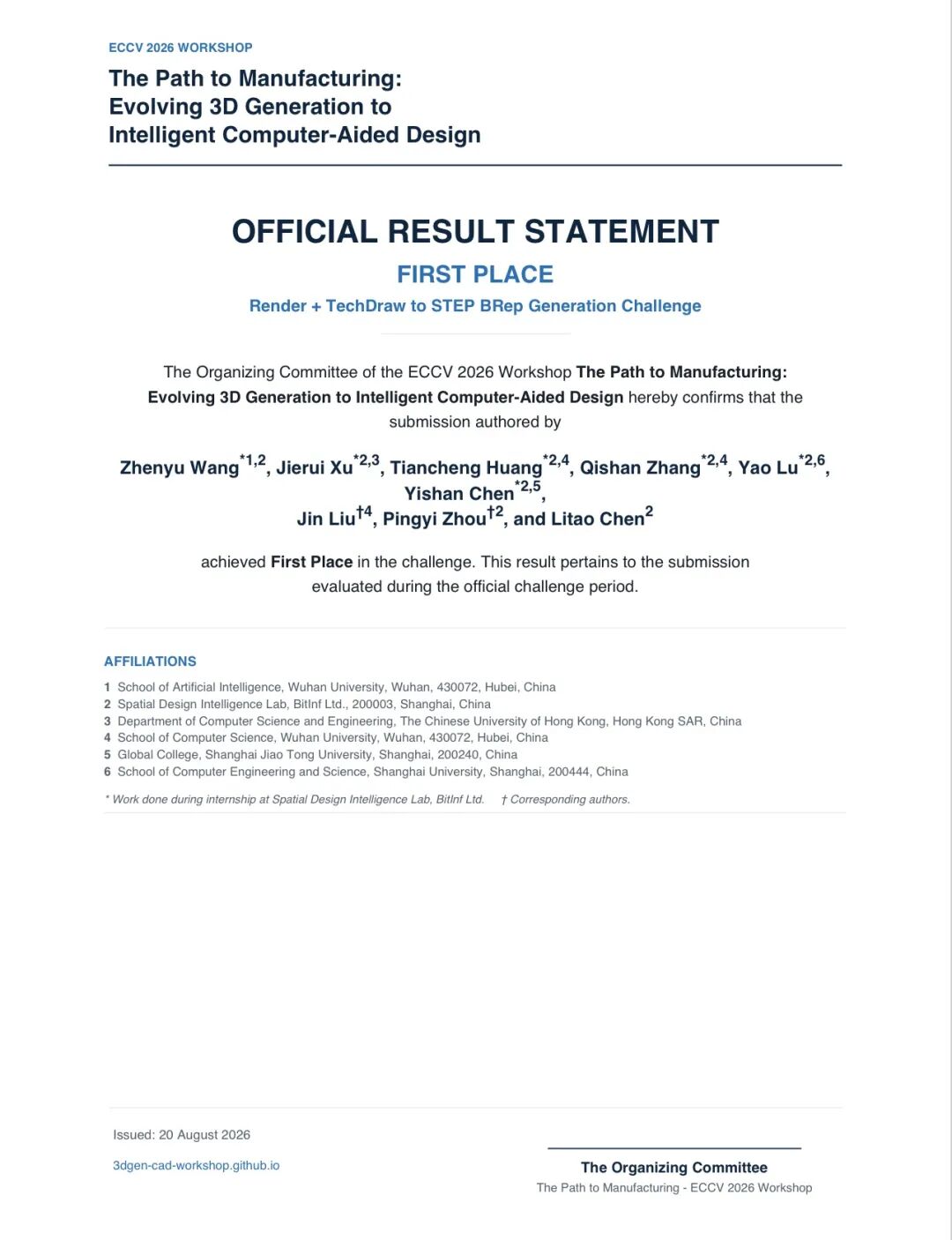
This means that even the powerful general multimodal large models are only good at image semantic understanding, and have not done in-depth optimization for industrial geometry, manufacturing and assembly constraints, so it is difficult to directly output processable and manufacturable CAD files.
Simply put, general large models can recognize parts in pictures, but cannot understand engineering details such as wall thickness, screw aperture, assembly tolerance. Because these key engineering knowledge are not scattered in the public graphic and text materials on the Internet, but precipitated in engineers' CAD drawings, iterative modification records, and design decisions made after repeated trade-offs.
And this is exactly the key to BitInfinit's victory at this ECCV event: they specially built a complete set of model systems for physical engineering scenarios, to understand the real constraints and needs of the manufacturing industry from the bottom up. This capability also lays an indispensable technical foundation for intelligent design, engineering simulation, automatic manufacturing and even the entire Physical AI wave.
4 Rounds of Financing in Half a Year
The No. 2 Figure of Huawei PanGu Emerges
This is not an accidental victory.
In the past few years, enterprises such as Meshy and Tripo have promoted the rapid development of vision-to-3D generation, and the fields of games, film and television, virtual digital humans have seen an explosion. The core goal of such solutions is to output visually realistic 3D mesh models for content creation.
But the needs of industrial manufacturing follow a completely different logic. The gap between the two lies in: visual 3D pursues "whether the rendered picture is amazing", while the standard of physical 3D is "whether the model can be truly manufactured, assembled and used". Trivial topological misalignment and surface deviation in visual 3D may lead to problems such as parts that cannot be snapped together, injection molding cracking, and loose complete machines in industrial production.
In the actual R&D process of consumer electronics, precision machinery and home parts, senior engineers often need several days or even weeks of modeling, verification and repeated rework to complete a qualified CAD model. A large number of valuable design ideas and assembly experience are often deposited in the personal minds of engineers, which are difficult to be digitally retained and reused on a large scale.
BitInfinit has anchored this direction since its establishment.
In 2025, Li Shiqi, who has many years of overseas AI To C entrepreneurial experience, joined hands with Dr. Zhou Pingyi, the No. 2 figure of Huawei's PanGu large model, and the cutting-edge team to found BitInfinit in Shanghai.
The head of pre-training Zhou Pingyi, co-founder & No. 2 figure of Huawei PanGu large model, is one of only about 3000 scientists in the world who have led the pre-training of trillion-parameter large models. He has participated in the R&D of three generations of models including PanGu Alpha 200 billion Dense and Sigma trillion MoE, published 25 top conference papers, with more than 1000 Google Scholar citations and 2 US patents.

For AI-native interaction, taking "manufacturability" as an important standard for physical 3D model training and evaluation, BitInfinit has reconstructed the entire design process of physical 3D generation. Its self-developed Arko series of models can generate engineering models with dimension parameters, assembly relationships and motion joints, which can be directly used for 3D printing and industrial manufacturing.
Overall, BitInfinit's technical architecture is divided into three layers: the bottom layer is the end-to-end data engineering system of 2.1 million sets of physical 3D datasets, covering three major fields of consumer electronics, mechanical structure and home life; the middle layer adopts "continuous pre-training + post-training + Agent framework" to form a complete closed loop of "understanding-planning-modeling-evaluation-optimization"; the top layer is a product matrix for C-end Makers and B-end industrial customers.
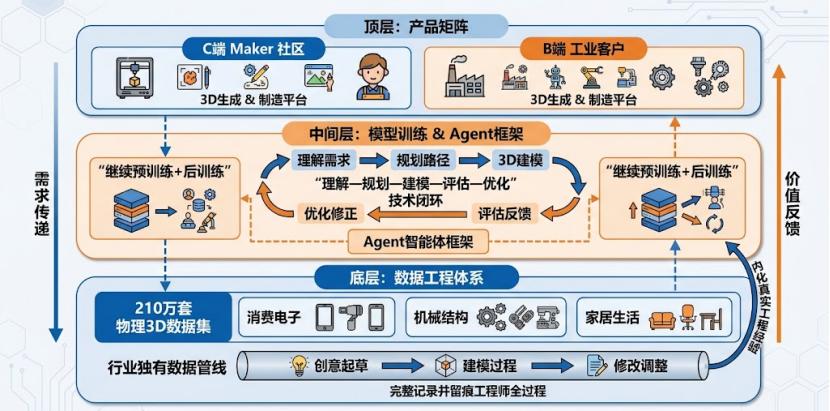
The core barrier of this system lies in the deep coupling of data pipeline, engineering knowledge precipitation and geometric kernel. BitInfinit completely records and traces the whole process of engineers from creative drafting, modeling to modification, and internalizes real engineering experience into the native capability of the model. Its self-developed Arko series of models are built based on parametric modeling language and OpenCascade geometric kernel, directly outputting editable and manufacturable industrial-grade STEP/STL files, instead of visual meshes only for display.
More importantly, BitInfinit has formed a positive data flywheel: every high-value engineering experience generated by user modeling, modification and debugging will be recycled to iterate the model, "the more you use it, the more the model understands engineering".
Surprisingly, this series of achievements are made by a startup that has been established for only one year. Pedaily learned that BitInfinit has built a data engineering team of 100 people, and carried out in-depth industry-university-research cooperation with Shanghai Jiao Tong University, Tongji University and East China University of Science and Technology. The company has not only been selected into the NVIDIA Inception Program, but also become an official partner of Zhipu AI.
Investors are flocking in. BitInfinit revealed that after announcing the Angel round and Angel+ round of financing in July, the company closed the Pre-A round of financing in less than a month, and the Series A financing is currently in progress.
"GPT-6 Astra shows everyone the amazing performance of large models in the field of 3D modeling, but it is essentially a visualization model and cannot be directly used in actual industrial production. AI-CAD model outputs parametric CAD source code and generates manufacturable solid files, which can be applied to industrial manufacturing." Zheng Hualiang, founder of Transition Capital, talked about the investment logic.
He believes that China has the world's largest manufacturing scenario and massive local process data, which is an advantage that overseas giants can hardly replicate. "We believe that AI-CAD models will be first created by Chinese companies. What BitInfinit is doing is to allow users to no longer learn complex CAD operations, but describe their needs. Once this model technology matures, the early prototype verification cycle of hardware will be greatly shortened, releasing a large amount of hardware innovation supply. At the same time, this model is also of great significance to China: it makes up for the design shortcomings of a large number of small and medium-sized manufacturing enterprises and non-standard industries in China, reconstructs the competition track of industrial software, greatly shortens the link from 'idea to product', and further enhances the innovation vitality under China's complete manufacturing system."
Liu Hongchun, founding partner of Rongyi Investment, said: "We are optimistic about BitInfinit. The team comes from the original team of Huawei PanGu large model. The CEO, CTO and chief scientist form a complete closed loop from R&D to commercialization, who not only understand the bottom layer of large models, but also the 3D manufacturing scenario; more importantly, its flywheel of 'data pipeline → dedicated model → Agent' — the pipeline continuously supplies high-quality 3D data, the model iterates at high frequency, and the Agent circulates feedback in real use. The data pipeline is exactly the first driving force. Rongyi has a deep overall layout in the field of physical AI and large models, and has participated in projects such as Unitree Robotics, Galaxy Universal and Westlake Xinchen early. We are firmly optimistic about BitInfinit and are willing to accompany it for the long term."
The Chinese Narrative of the "Prometheus Project"
On the other side of the ocean, the physical AI track has set off huge waves.
The weather vane was November 2025. Amazon founder Jeff Bezos came back out of retirement, teamed up with former Google executive Vic Bajaj, and founded Prometheus, an industrial AI company. The company has been operating in secret until it announced a $12 billion Series B financing in June this year, with a valuation of $41 billion (more than 270 billion yuan), making it one of the world's most valuable industrial AI startups overnight.
"Prometheus wants to build a 'general artificial intelligence engineer'." This is the answer given by the two founders in their first interview in June this year. What they want to do is to let AI truly establish cognition of the three-dimensional physical space and understand the world around them. The industry calls it the "Prometheus Project".
To accomplish this, the globally recognized core bottleneck lies in the lack of "manufacturing Internet data".
This is a meaningful gap. Over the past three decades, global manufacturing capacity has continued to shift to China, and massive industrial drawings, geometric constraints and physical parameters have been deposited in Chinese factories. However, in China, most entrepreneurial teams still gather in the visual rendering 3D generation, and there are not many enterprises that truly aim at manufacturable CAD output and lay out physical 3D data infrastructure.
BitInfinit is one of the few teams that stand out in this industry vacuum. It relies on China's industrial data to train AI models that truly understand the physical world. This also constitutes the core of this startup's long-term narrative — benchmarking against the "Prometheus Project" and taking a domestic independent route: complete the whole set of model training relying on domestic computing power, and make up for the shortcomings of domestic physical 3D infrastructure.
If the competition of AI in the past focused on understanding text and recognizing images, the core contest in the future will be to understand the geometry, assembly logic and manufacturing rules of the real physical world. There are completely different technical paradigms and data systems in between.
For a long time, in the field of AI underlying foundation, the right to speak of many hard-core tracks is in the hands of overseas institutions. The significance of BitInfinit's victory in the ECCV CAD Challenge lies precisely in this — it not only represents the systematic confirmation of China's "structured 3D + AI CAD + Physical AI" route by the world's top academic evaluations, but also proves that in the global competition of physical 3D foundation, Chinese companies are fully capable of competing on the same stage with overseas giants.
But this team is also clearly aware that the physical 3D track is still in its early stage as a whole. The acquisition cost of high-quality engineering data is high, and the constraints of real manufacturing are complex. There is still a considerable gap between laboratory benchmarking and real factory scenarios.
Only when AI truly starts to assist engineers in compressing the R&D cycle, lowering the innovation threshold of the real industry, and transforming the capabilities on papers and rankings into the productivity of the manufacturing industry, can the value of physical 3D infrastructure be truly implemented. In this process, every set of high-quality physical datasets and every set of foundation models that are well versed in engineering constraints are the cornerstones leading to this goal.
The road ahead is long and far, and this competition is far from over. Perhaps in the near future, the foundation model company with the largest 3D Token call volume in the world will come from China.