It's hard to comment. The major breakthrough in the Navier-Stokes equations that OpenAI just officially announced has been torn apart by mathematicians.
A math-history-level blockbuster event has been turned into a serialized drama by OpenAI.
Shortly after being accused of snatching research results by mathematicians, OpenAI made an urgent official announcement:
An unreleased internal model with capabilities significantly outperforming GPT-6 Astra has solved the Navier–Stokes existence and smoothness problem.
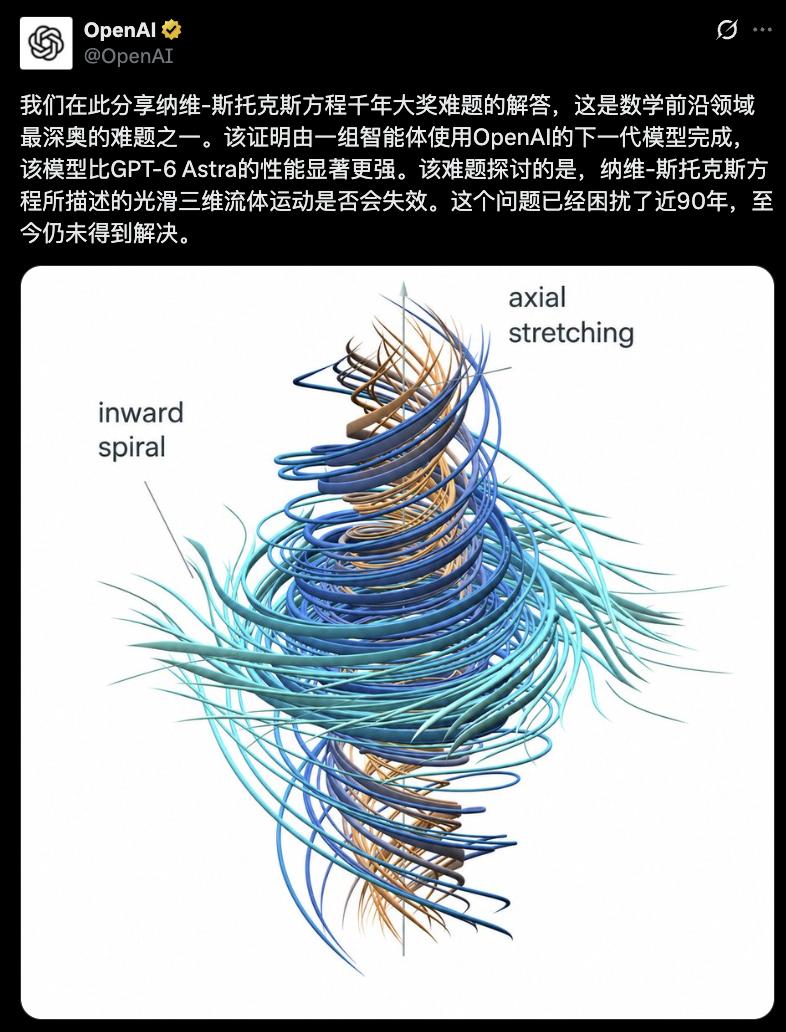
This is one of the seven Millennium Prize Problems with a $1 million reward, and only the Poincaré Conjecture has been successfully solved in the past.
Now OpenAI announces that the second one has also been conquered.
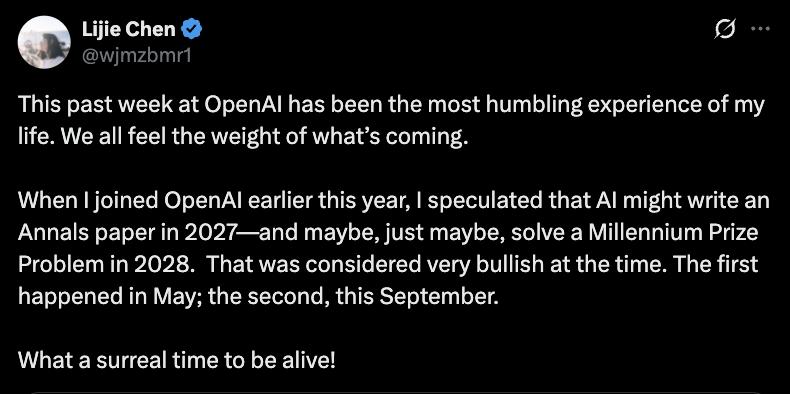
Chen Lijie said that when he joined OpenAI earlier this year, he predicted that AI would be able to solve a Millennium Prize Problem in 2028, but he never expected the progress to be completely dragged forward by AI at an incredible speed —
One problem solved in May, two more solved at once in September.
Moreover, OpenAI's statement also spoiled the next-generation model:
The one that actually completed the proof is not GPT-6, but an internal OpenAI model that is still under training, whose capabilities are far more powerful than Astra which was released only a few days ago.
Astra can only play a supporting role this time, responsible for checking the homework. (doge)
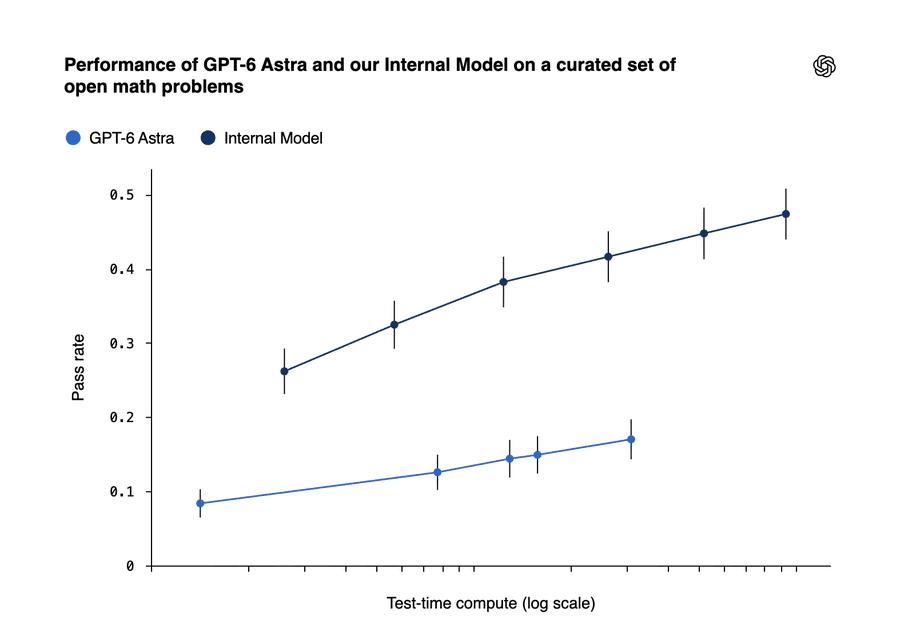
To solve this problem, OpenAI directly mobilized approximately 10,000 Agents, who worked in parallel for 88 hours, sent 2.7 million messages, and consumed about 130 billion output Tokens.
After the Agents finished writing the proof, GPT-6 Astra ran for another 17 hours to formalize the entire proof into the Lean version and check for vulnerabilities step by step.
Scientific American opened with a line that goes:
This could be the most important day in the mathematics community for at least 20 years.

At this point, AI mathematics has directly kicked open the door to a new historical era!
However, before the mathematics community could send out their applause, things started to go wrong...
Rumors say that OpenAI took sudden action because it heard that someone outside was about to solve the problem.
The team that was preempted had been using OpenAI Codex all along, and their undisclosed drafts, proofs and intermediate derivations were all stored in it.
Shortly afterwards, OpenAI was also accused of trying to remove one of the Anthropic researchers from the author list.
Wait a second, what we were just discussing is really a mathematical proof, right???
10,000 Agents, 88 Hours to Solve a Millennium Prize Problem
Let's first talk about what exactly OpenAI proved.
The Navier–Stokes equations describe how fluids move.
The vortex at the bathtub drain, the airflow around an airplane, the flow of blood in blood vessels, and even the changes of weather systems can all be explained by these equations.
But mathematicians have been unable to prove for nearly a century that:
Will a 3D fluid that is initially smooth and normal remain smooth forever under the description of the equations?
Or is it possible that a "singularity" suddenly appears in a finite time, making values such as velocity rush to infinity?
The latter is usually called finite-time blowup in mathematics.
Fluids in the real world of course cannot move at infinite speed. If such a singularity can really appear, it means that under certain extreme conditions, the Navier–Stokes equations can no longer be used as a continuum model to describe fluids.
This problem has remained unsolved since 1934. In 2000, the Clay Mathematics Institute included it in the seven Millennium Prize Problems. Anyone who can prove that it is always smooth, or find a counterexample that will cause blowup, can take away the $1 million prize.
The answer OpenAI gave this time is:
Blowup will indeed happen.
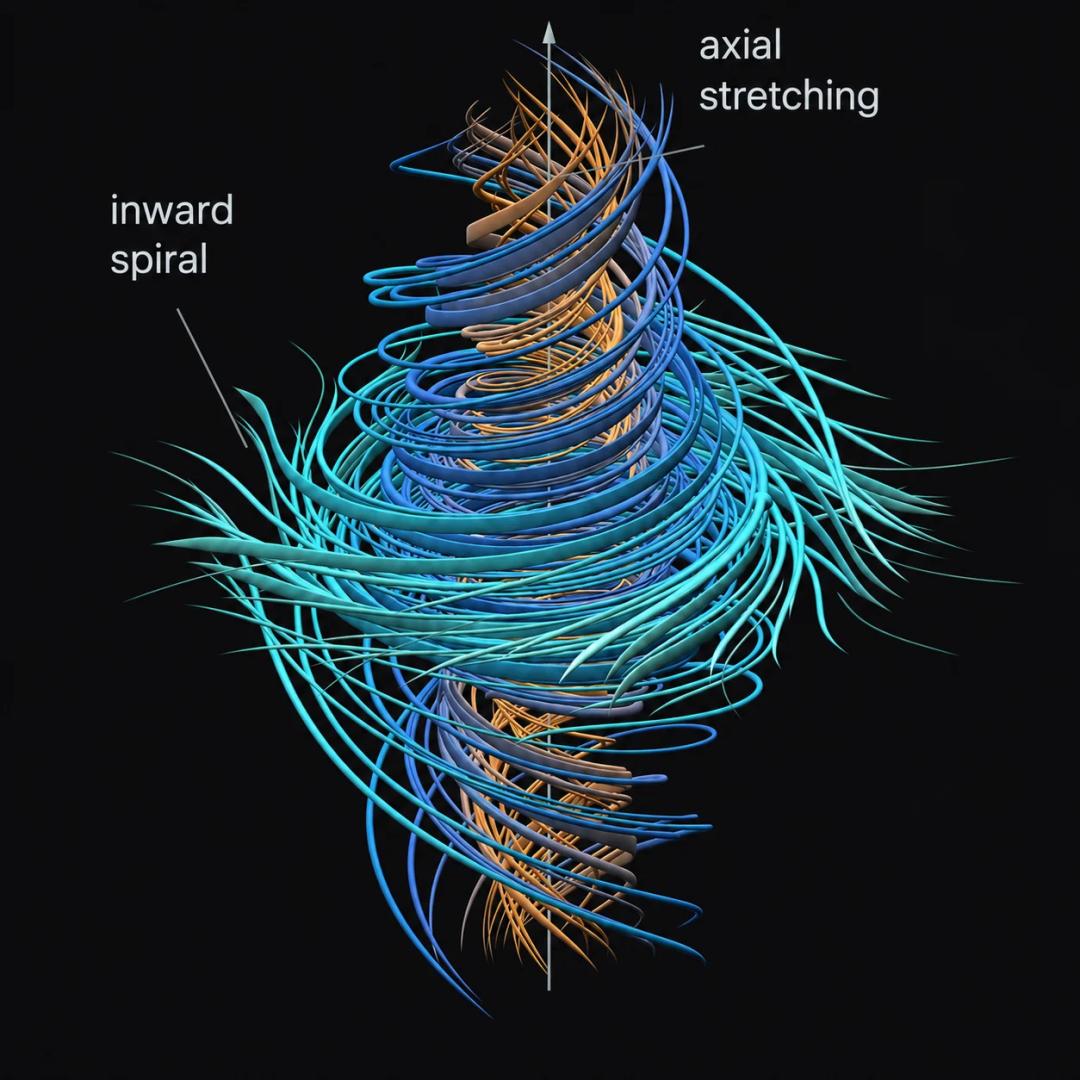
It constructed a smooth fluid that was initially at rest, and applied a smooth external force to it.
The vortices inside the fluid keep shrinking and stretching towards the center, like a spaghetti that is twisted thinner and thinner; at the same time, the rotation speed keeps increasing, and finally rushes to infinity in a finite time.
Throughout the whole process, the total energy of the fluid remains finite.
OpenAI stated that this proof completes cases C and D in the official problem statement of the Clay Institute, and the Navier–Stokes Millennium Prize Problem is thus solved.
However, the process of finding the answer is quite interesting.
On September 1, OpenAI heard rumors that someone might have solved a Millennium Prize Problem.
Coincidentally, the company was training a new internal model that showed "unprecedented" capabilities in mathematics tests, so it simply threw all the unsolved Millennium Prize Problems to it for a trial.
Different Agent groups were responsible for different versions of the problem, could read cached internet materials, run codes, and exchange findings within the group.
Initially, nearly 100 Agents spent about 50 hours first solving a relatively simple blowup problem of the Euler equations without external force.
Seeing that this route was promising, OpenAI immediately transferred all the Agents working on other problems to this task.
While the Agents tried different methods, Codex summarized the effective clues of each group, then redistributed the intermediate results, and the number of participating Agents subsequently expanded to about 10,000.
After 88 hours, the proof emerged.
The whole process generated a total of 4.9 million Agent messages and approximately 300 billion output Tokens, of which the Navier–Stokes problem alone consumed 130 billion Tokens.
OpenAI also revealed that this experiment cost millions of dollars.
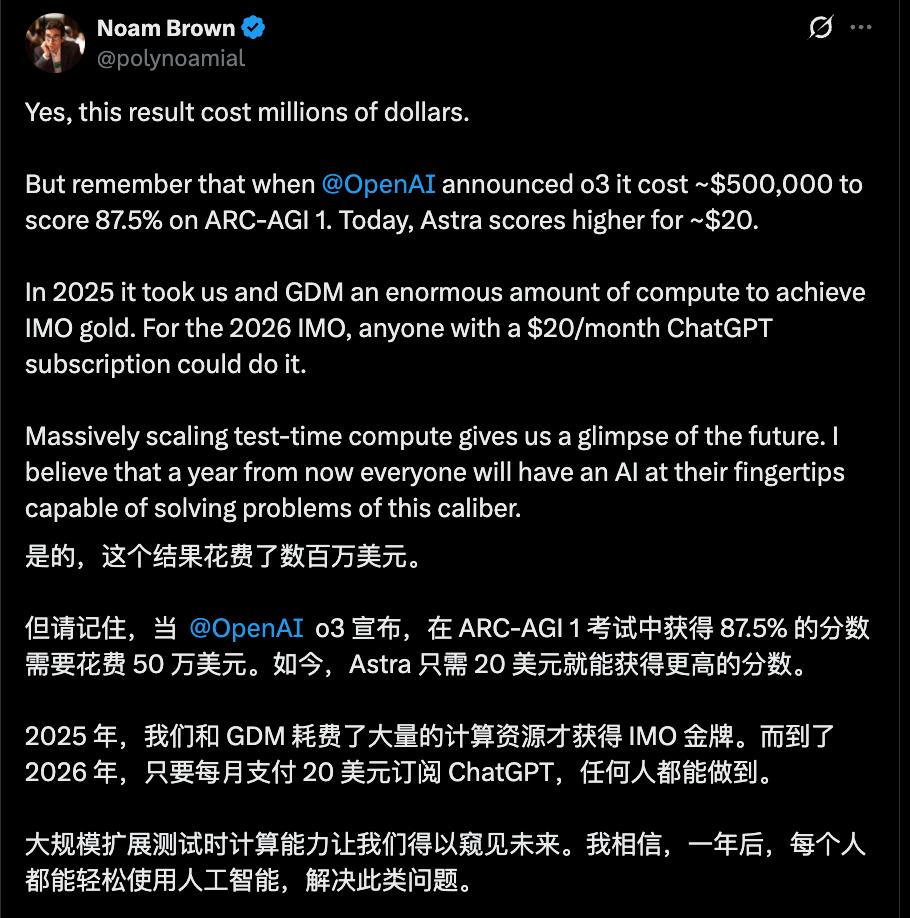
A million-dollar problem, solved with millions of dollars in computing power...
The good news is that the problem is solved, the bad news is that the prize money seems not enough to even cover the electricity bill (doge).
Of course, OpenAI also made it clear that it does not plan to claim this $1 million prize.
But at this point, the other two researchers could not stay calm anymore.
Where Did OpenAI Learn This Route From?
Mathematician Tristan Buckmaster from New York University and Anthropic researcher Levent Alpöge have been studying fluid equation blowup for the past year.
The direction they took is exactly the one later used by OpenAI to conquer Navier–Stokes:
Construct finite-time blowup through a sufficiently smooth external force.
This route was first proposed by mathematicians Diego Córdoba and Luis Martínez-Zoroa.
The two have been conducting research along this direction for many years, but the external force they obtained before was not smooth enough, and there was still a key step missing to truly complete the problem.
After Buckmaster and Alpöge took over the research, they continued to push forward with the help of models such as Claude and Codex.
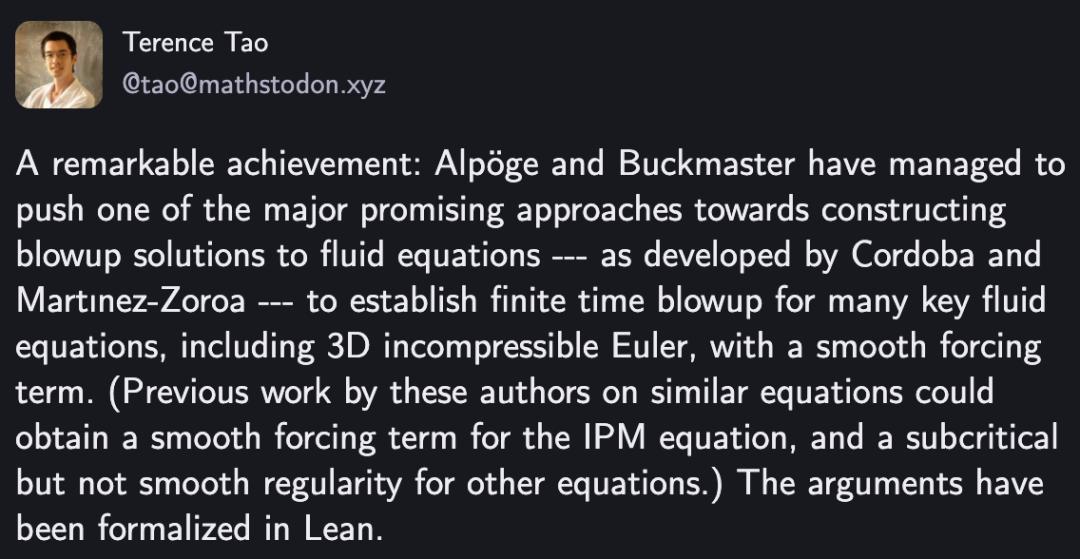
On August 15, the two made a breakthrough, proving that the 3D incompressible Euler equations, the Boussinesq equations, and the incompressible porous medium equations can all produce finite-time blowup under the action of smooth external forces.
On August 22, the Euler equations results were verified by Lean.
After reading it, Terence Tao also gave very high praise:
"A remarkable achievement."
Terence Tao further judged that there are no fundamental obstacles to advancing from this set of methods to the viscous Navier–Stokes equations for the time being.
In other words:
Although Buckmaster and Alpöge have not officially solved Navier–Stokes, they have almost paved the way to the final answer.
The two originally planned to spend a few more weeks sorting out the proof before publishing it, mainly because the original version given by AI was really too hard to read...
Even after sorting out, the published version can only be called "AI garbage".
So the two of them thought at that time that the results could be released a few days later, and at least the paper should be modified to look like it was written by a human.
Obviously, Silicon Valley does not follow this kind of rhythm, and they did not get the chance to revise the manuscript slowly.

In early September, the news that "Anthropic has solved a major mathematical problem" began to spread.
On September 1, OpenAI heard the news and launched the Agent project.
On September 3, Buckmaster took the initiative to contact OpenAI, explaining that they had not yet solved Navier–Stokes, and revealing that their results would be released soon.
On September 5, 10,000 Agents of OpenAI completed the proof.
In other words, while the mathematicians were still modifying the AI draft, OpenAI had already mobilized 10,000 Agents and millions of dollars in computing power, and rushed across the finish line at full speed.
Then, the problem arose.
Buckmaster and Alpöge had been using Codex during their research, and put the paper drafts and a large number of derivations into the sessions.
When the result given by OpenAI happened to follow this rarely taken "smooth external force" route, Buckmaster immediately became alert and asked OpenAI:
Did the internal model access their Codex sessions, or was this data used during training?
According to Buckmaster, he was told that the model did not actively retrieve user data; but when he continued to ask about the training data issue, he did not get a clear response.
OpenAI publicly denied that any researcher or Agent had viewed the two's work, claiming that they did not come into contact with the specific content until the paper was published.
However, it also left a very subtle statement at the same time:
Although the possibility is very low, it cannot be ruled out that the de-identified data generated by the two using OpenAI products once helped improve the model.
Wow, they didn't specifically look through your paper, but they can't guarantee that the model didn't benefit from the data left by you when using the product...
Now, the matter has completely changed from a mathematical problem to an academic property right problem in the AI era.
The AI assistant you are using has unexpectedly become a competitor.
"Remove the Anthropic employee from the author list"
What happened next was even more intense.
According to the four-page public statement from Buckmaster, after OpenAI learned that the two sides' research directions were close, it proposed two publishing plans to him.
The first plan:
Buckmaster and Alpöge publish the Euler equations results first, and OpenAI releases the Navier–Stokes proof the next day.
The second plan:
Buckmaster writes the paper on behalf of both sides, and publishes the Navier–Stokes results obtained by OpenAI's internal model.
But Buckmaster claimed that OpenAI researcher Sebastien Bubeck stated twice that he hoped to exclude Alpöge from the author list.
Why?
The reason is very simple, Alpöge works for Anthropic.
Mathematical achievements can be discussed, but it is not convenient for people from competing companies to be on the same author list.

Buckmaster rejected both plans, and said that if OpenAI published in this way, he would make the whole process public.
Then the conversation gradually slipped from a mathematical paper to a Silicon Valley business war drama...
According to Buckmaster's account, OpenAI asked Buckmaster
Why would you ruin your own career?
Buckmaster was also very puzzled, I am a scholar, making the facts public, how is that ruining my career?
The other party then replied:
"If you don't want me to be friendly, then I don't have to be friendly."
Whoa, I