Few people buy range-extended electric vehicles, but Xiaomi Pengcheng insists on selling them.
"Xiaomi Auto believes that extended-range electric vehicles have huge potential!" Before the official launch of Xiaomi Pengcheng N70 and N90, Xiaomi Auto once again clearly voiced strong support for the extended-range track! However, no matter how many slogans are chanted, it is difficult to reverse the downward trend of the domestic extended-range vehicle market.
According to data from the China Passenger Car Association, among the top 10 best-selling models in August, except for the Fangchengbao Bao 7 that offers a hybrid version, all others are pure electric models. This is no accident. Since the beginning of this year, the performance of the pure electric market has been far better than that of the extended-range market and the plug-in hybrid market.
From January to August this year, the cumulative retail sales of new energy vehicles in China reached 6.674 million units, a year-on-year decrease of 12.1%. Among them, BEV pure electric models accounted for the highest proportion and had the smallest decline, with sales of 4.469 million units, down 3.9% year on year; PHEV plug-in hybrid models sold 1.6 million units, down 27.1% year on year; EREV extended-range models sold 606,000 units, down 19.3% year on year.
From a market perspective, extended-range vehicles may be in a slightly better situation than plug-in hybrid vehicles, after all, they are not the new energy sub-segment with the largest decline; but in terms of market base, the extended-range vehicle market is only half the size of the plug-in hybrid vehicle market, which is still a veritable "niche" track in the broad category of new energy vehicles.
It is precisely supported by these data, coupled with the declining sales of brands such as AITO and Li Auto, that more and more people are beginning to question why Xiaomi, which used to be best at following market trends, chose to go against the tide and enter the declining extended-range vehicle market this time?
Until September 7, at Xiaomi's autumn flagship new product launch event, four new extended-range models of the Xiaomi Pengcheng series were officially launched:
Xiaomi Pengcheng N70 Pro, 209,900 yuan; Xiaomi Pengcheng N70 Max, 239,900 yuan; Xiaomi Pengcheng N90 Max, 269,900 yuan; Xiaomi Pengcheng N90 Max Explorer Edition, 299,900 yuan.
Targeting the 200,000 to 300,000 yuan price range, Xiaomi did not continue the usual narrative of building large six-seat flagship SUVs or large five-seat flagship SUVs. Instead, it made a bold self-adjustment and returned to the original expectation that the public had for Xiaomi's car-making endeavor — cost-effectiveness.
01
Xiaomi Extended-Range Vehicles: Redmi-style Strategy
There are quite a few new energy vehicle brands that focus on cost-effectiveness in the market. Whether it is Leapmotor, which is known as "half the price of Li Auto", or BYD, which has a strong market presence, all have reaped market dividends by effectively reducing costs and improving efficiency.
But why are so many people convinced that the N70 and N90 are extremely cost-effective, even though the top-end Xiaomi Pengcheng model is priced at nearly 300,000 yuan?
The first reason lies in the reference frame.
Regardless of pre-marketing efforts, ordinary consumers have always regarded the Xiaomi Pengcheng N90 as a 9-series flagship SUV, comparable to full-size flagship models such as Li Auto L9 and AITO M9. The starting prices of these two models are as high as 459,800 yuan and 479,800 yuan respectively.
The Xiaomi Pengcheng N90 Max is also a full-size model, with a body length of 5280mm and a wheelbase of 3080mm, which is basically the same as the Li Auto L9 and AITO M9 in terms of dimensions; its space performance is on par with the two competitors, and it even has more creative functional designs; it is also fully equipped with intelligent and comfort features.
Such a fully-equipped Xiaomi Pengcheng N90 Max is launched at a price of only 269,900 yuan, achieving dimensionality reduction competition with a price gap of nearly 200,000 yuan. That is absolutely a typical example of outstanding cost-effectiveness.
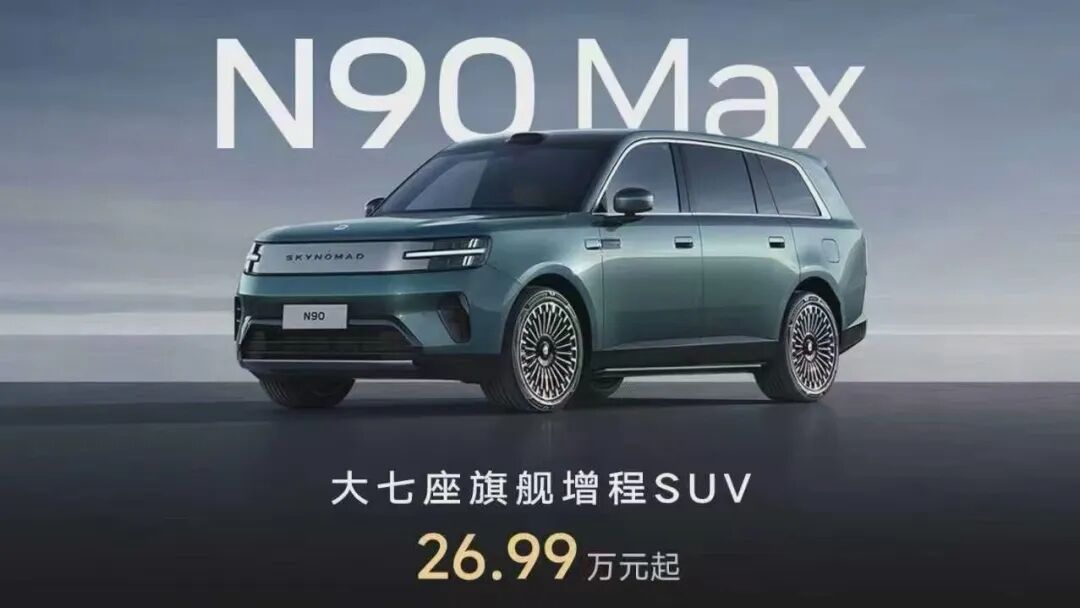
In fact, if a 269,900-yuan large extended-range SUV only has a few more configurations than its competitors at the same price point, its significance is limited.
What is truly disruptive is that once consumers form the perception that "a vehicle of this size, space and intelligence should only cost over 200,000 yuan", the original price logic of products priced above 300,000 yuan will be severely impacted.
Therefore, although the Xiaomi Pengcheng series seems to enter the 200,000 to 300,000 yuan price range, its disruptive influence has already spread to the 300,000 to 400,000 yuan automobile market.
In fact, when it was revealed that Xiaomi Pengcheng would use batteries from CALB and Sunwoda, it was already determined that the product line would follow the cost-effective route.
This "Redmi-style strategy" has been repeatedly used by Xiaomi in its past mobile phone and home appliance businesses: first identify the product value that consumers have already recognized, then leverage its supply chain, large-scale production and technology integration capabilities to bring the experience that used to belong to higher price ranges down to a more accessible level.
Now, applying the same methodology to the automotive industry, the Xiaomi Pengcheng N70 targets the large five-seat segment, while the N90 targets the large seven-seat segment. In effect, the two benchmark products jointly squeeze the 200,000 to 400,000 yuan family SUV market from both upper and lower ends.
What Xiaomi Pengcheng really wants to capture is not just "extended-range vehicle users", but the car purchase budget that most consumers in this price range are holding off for now. Even if Xiaomi Pengcheng converts just one user from its competitors, it is a net gain for Xiaomi Auto.
02
Is the Extended-Range Market Salvageable?
Judging from sales performance, the dividend period for extended-range vehicles is indeed fading. However, with the arrival of Xiaomi Pengcheng, people have once again raised more expectations for the extended-range market. This change is not only because Xiaomi Pengcheng sells at a low price, but also because the value of extended-range vehicles is being redefined.
In the past few years, extended-range vehicles expanded rapidly with the product logic of "supporting both charging and refueling, no range anxiety". But as pure electric range continues to increase and charging speed keeps accelerating, the initial differentiated advantage of extended-range vehicles is being weakened.
At present, although consumers are willing to pay for "one more energy replenishment option", they are not willing to pay a higher premium for the extended-range configuration itself. Especially under the general downward trend of the market, this problem evolves into: where exactly are the opportunities in the extended-range market?
The answer is definitely positive. But one point that must be made clear is that the extended-range market has moved from the previous stage of general growth to a stage of structural competition.
In the 200,000 to 300,000 yuan price range, there is still strong consumer demand for family SUVs. This is the market support behind Leapmotor D19's monthly sales exceeding 10,000 units and the BYD Tang gaining high popularity immediately after its launch.
This time, Xiaomi Pengcheng is precisely positioned at this intersection. Upwards, it can attract the target customers of AITO and Li Auto through its pricing; downwards, it can attract the customer groups of BYD and Leapmotor with its product strength and brand power.
Therefore, whether it is Li Auto, AITO, Leapmotor or BYD, all of them are affected by the launch of Xiaomi Pengcheng.

As for the product itself, factors including whether the daily pure electric range is long enough, whether the fuel consumption at low battery level on highways is low enough, whether the interior space can meet family travel needs, whether the intelligent cockpit and assisted driving have reached the mainstream level, and whether the chassis and safety configuration can support the overall vehicle quality... all these factors will become part of the purchase decision.
Especially under the fierce internal competition in the industry, more and more high-end configurations and functions will be deployed in affordable models. In this regard, the solution brought by Xiaomi Pengcheng is to build a great car that happens to be an extended-range vehicle; rather than building an extended-range vehicle that is simply piled with a large number of configurations.
Being an extended-range vehicle is never the end goal. The overall product definition of the vehicle and the perceived value it brings are the key to winning market favor.
Of course, this does not mean that Xiaomi Pengcheng is the only possible form of extended-range vehicles in the future; instead, it emphasizes that even Pengcheng, backed by Xiaomi's strong brand power, has lowered its stance to launch cost-effective vehicles, which means the high premium of extended-range vehicles has become invalid; the next stage will be a competition of high product strength and high value.
From this perspective, Xiaomi Pengcheng's decision to enter the 200,000 to 300,000 yuan price range is essentially seizing the first-mover advantage to take the "pricing power" and "definition power" after the extended-range market is restructured.
So going back to that original question — is the extended-range market really salvageable?
In fact, the extended-range market has not completely cooled down, it has only bid farewell to the extensive dividend era; in this period, low-quality extended-range products that only fill the market will continue to be eliminated; models that truly fit users' actual needs still have strong vitality.
The extended-range vehicles that can sell well in the future will most likely have three characteristics:
First, the price is sufficiently competitive, making consumers feel that they are buying a complete family SUV, not a compromise made due to energy replenishment anxiety. If a limit has to be set, 300,000 yuan is a very important threshold, and extended-range vehicles priced above 300,000 yuan will face great sales pressure.
Second, the product strength is sufficiently comprehensive, achieving a good balance among space, comfort, intelligence, performance and energy replenishment efficiency. In short, all the configurations that should be present are included, and all the functions that should be available work perfectly.
Third, the user scenarios are sufficiently clear, and the pure electric mileage is long enough to truly meet the comprehensive needs of urban commuting, long-distance highway travel and multi-person family trips. It will be even better if there are some interesting creative designs, such as roof tents and face-to-face seat arrangements.
This article is from the WeChat Official Account "Auto Community" (ID: iAUTO2010), written by Zhang Zhidong, edited by He Zengrong, and published with authorization from 36Kr.