Interim Report of A-Share Humanoid Robot Sector: Up to Which Future Year Has the Valuation Been Priced In?
The 2026 semi-annual reporting season has come to an end. The humanoid robot sector, as one of the most hyped narrative tracks in the A-share market over the past two years, after we dismantled the semi-annual report data of more than 60 concept stocks item by item, we arrived at a conclusion that is significantly misaligned with the sector's market popularity:
The body segment with the highest conceptual purity is exactly the segment with the weakest profitability; while almost none of the truly profitable companies generate earnings relying on the humanoid robot business.
This is a fact verified by cross-checking three financial statements: excluding Unitree Robotics, the new listing that just landed on the A-share market in August, the total attributable net profit of the four leading traditional body manufacturers is -96 million yuan; the total revenue of the three leading core execution component (reducer) players is less than half of Inovance Technology's single-quarter revenue; the total profit of the five pure-play targets in the sector in the first half of the year is 900 million yuan, corresponding to a total market value of about 140 billion yuan.
Following the industrial chain sequence of "body - components - materials - valuation", this paper reviews this transcript one by one, and tries to answer two questions: What stage is the industry actually at? What stage has the market pricing advanced to in advance?
01
The Body Segment: The Financial Truth of the Chain Leader
The "chain leader" of the humanoid robot industrial chain should be the body manufacturer. They occupy the top of the industrial chain value distribution, and are supposed to be the first to benefit from the "first year of mass production".
The fact presented by the semi-annual report is: .
The total of four representative body manufacturers: total revenue of about 6 billion yuan, attributable net profit of -96 million yuan, net profit margin of -1.6%.
Note: The "four leading body manufacturers" selected in this paper mainly refer to established A-share body manufacturers including ESTUN, SIASUN, Effort, and STEP. These four companies are four representative companies with main business of complete machine manufacturing and long listing history selected from the A-share "humanoid robot" concept sector; as a company that just went public in August, including Unitree Robotics in the statistics will significantly change the statistical conclusion, so it is specified separately in the analysis.
This figure needs to be understood in two coordinate systems:
The first coordinate system is the industry scale. As a general automation platform company, Inovance Technology achieved attributable net profit of 2.81 billion yuan only in the first half of 2026. The four body manufacturers combined are far behind Inovance, and their total profit is still negative.
The second coordinate system is the narrative popularity. These four companies are the main carriers of the "humanoid robot" narrative before Unitree's A-share listing, with a total market value of more than 60 billion yuan. The gap between the nearly 100 million yuan semi-annual loss and the 60 billion yuan market value is the gap between narrative and the real industry.
It needs to be emphasized that we do not deny the attribute of body manufacturers in the investment period, and early losses in the cutting-edge hardware industry are normal strategic costs. The problem lies in the structure of losses: ESTUN's 68.22% asset-liability ratio (the highest among the four), SIASUN's profit statement that is still losing money (attributable net profit of -189 million yuan in H1 2026), indicating that a considerable part of the pressure does not come from "investing for the future", but from "paying off debts from the past".
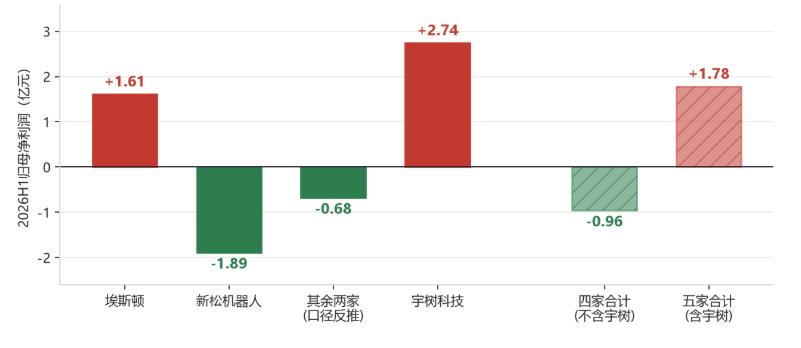
Figure:
ESTUN is worthy of separate analysis, because it is the domestic body manufacturer with the most thorough strategic layout.
Over the past decade, ESTUN has built a full industrial chain layout of "core components + body + integration" through continuous acquisitions (UK TRIO, Germany Cloos, etc.), and its market share once ranked first among domestic players. This route is benchmarked against the Fanuc model, that is, "support body expansion with profits from component business".
But the semi-annual report exposed the financial cost of this route:
In 2024, the attributable loss reached 811 million yuan, which cleared out all the historical burdens accumulated during the acquisition expansion period at one time;
In H1 2026, the asset-liability ratio was 68.22%, which decreased slightly compared with the same period of the previous year, but still the highest among the four body manufacturers;
Profitability recovery relies on leverage. The 161 million yuan attributable net profit in the first half of the year corresponds to the highest debt repayment pressure in the industry —— and about 91 million yuan of this 161 million yuan comes from non-recurring gains such as equity disposal, and the non-recurring profit is only about 70 million yuan after deduction.
The control group is also clear: Tesla has the automotive business to provide cash flow, Figure has the endorsement of Silicon Valley capital and computing power partners. The full industrial chain self-research of A-share domestic body manufacturers essentially uses a high-leverage balance sheet to compete against the diversified cash flow of global giants.
Our current judgment is: the reshuffle of the body segment has not yet ended. Before the large-scale landing of downstream orders in 2027, "full-stack self-research" is more like a high-stakes gamble rather than a moat. The premise of winning the gamble is to wait for the order volume to expand exactly before the cash flow breaks.
This time difference is the largest risk exposure in the body segment.
02
Core Components: Scale Illusion and the Reality of the "First Year of Mass Production"
The core assumption of the market for humanoid robot components is that segments such as reducers, ball screws, and motors will deliver performance first.
The verification result of the semi-annual report has two layers.
The first layer is scale. Leading domestic harmonic reducer player Green Drive achieved revenue of 349 million yuan in H1 2026, up 38.6% year-on-year, attributable net profit of 70 million yuan, up 31.3% year-on-year; RV reducer target Zhongda Drive achieved revenue of 597 million yuan, attributable net profit of 28 million yuan. The total revenue of the three leading reducer players is about 5.5 billion yuan, less than half of Inovance Technology's single-quarter revenue.
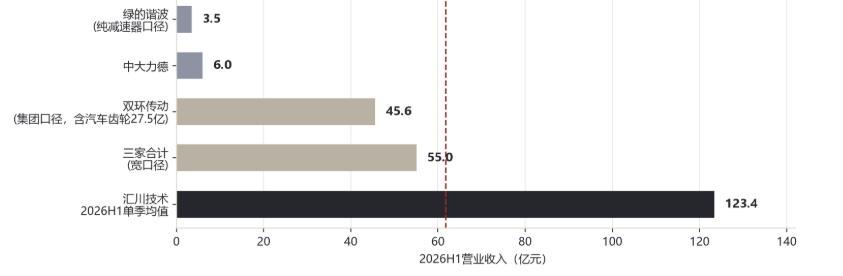
Figure: Breakdown of revenue caliber of the three leading reducer players in H1 2026
In the first semi-annual report of the "first year of mass production", leading core execution component players achieved simultaneous high growth in revenue and profit, but unit profit continued to narrow (gross margin dropped by more than 8 percentage points compared with 2023), which indicates that the current growth is still driven by the recovery of traditional demand such as industrial robots and auto parts, as well as the profit-concession penetration into the complete machine supply chain. Humanoid robot orders have not yet formed an independent and observable profit contribution to the financial statements.
The second layer is profit quality. Green Drive's gross margin dropped from 40.56% in 2023 to 32.26% in H1 2026; Zhongda Drive's net profit margin is 4.6%. The precision manufacturing industry has formed a profit structure of "hard labor", behind which is the price strategy of domestic manufacturers taking the initiative to make concessions to enter the complete machine supply chain.
Regarding the attribution of Green Drive's gross margin decline, a more complete explanation is given here: The gross margin decline is the result of the superposition of multiple factors. On the one hand, domestic manufacturers have actively adopted competitive pricing strategies to enter the complete machine supply chain; on the other hand, according to Green Drive's semi-annual report disclosure, the company faces significant labor cost growth during the capacity expansion period, which directly pushes up the unit manufacturing cost.
The essence of the scale illusion is:
The market values component companies according to the 2028 revenue curve, while the financial statements are still settled according to the 2025 industrial demand.
Outside the component segment, there is another set of companies worthy of being included in the control group: automotive Tier 1 suppliers.
Sanhua Intelligent Control (actuator / thermal management) recorded 2.044 billion yuan of attributable net profit in H1 2026, Tuopu Group (actuator assembly) recorded 1.023 billion yuan of attributable net profit in H1 2026. These two are the most frequently mentioned potential actuator suppliers for global leading humanoid robot complete machine manufacturers, while the four body manufacturers are still in the loss range in the same period —— the semi-annual profit of either of these two companies is enough to wipe out all the losses in the body segment and leave a surplus.
This control group reveals the real path of industrial undertaking:
The production capacity, process and customer verification of humanoid robot components are most likely to be transferred from the automotive supply chain, rather than newly built by "pure concept stocks". Automotive Tier 1 suppliers rely on the lean manufacturing capabilities accumulated in the era of fuel vehicles and electric vehicles to wait for orders, without paying any financial cost for the market narrative.
In other words, the "pure-play targets" with the highest valuation in the sector are not necessarily the targets with the greatest elasticity when the industry volume expands; while the companies that truly have the undertaking capacity, their robot business accounts for nearly zero in the current financial statements. This is the structural information most easily ignored by hot money in the semi-annual report.
03
The Localization Paradox: Why Does Gross Margin Decline in Segments Where Substitution Is Completed
The most counterintuitive finding of this paper comes from the verification of the relationship between "localization rate - gross margin".
In traditional cognition, the higher the localization rate, the thicker the substitution dividend. However, the semi-annual report data shows an inverse relationship:
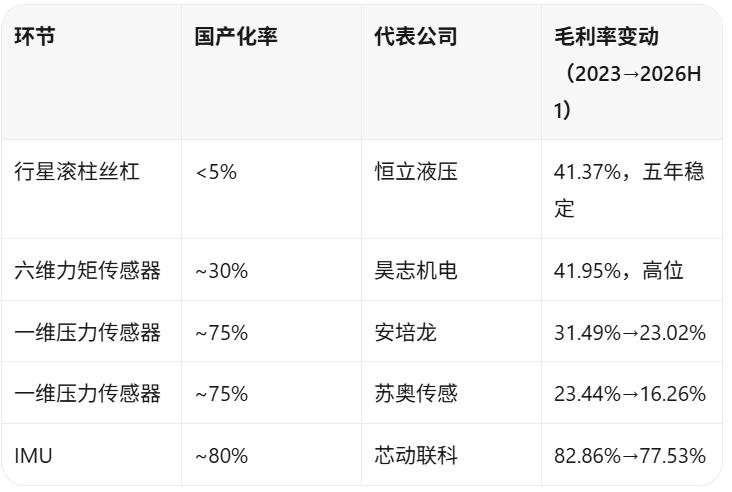
The rule is very clear: In segments where the localization rate exceeds 70%, the gross margin almost all declines across the board.
The mechanism is not complicated. When more than three domestic suppliers gather in a single segment, the complete machine manufacturers gain bargaining power, and "supporting domestic products" quickly evolves into "competitive bidding procurement"; suppliers make concessions to maintain market share, then expand production to dilute costs, and insufficient capacity utilization instead pushes up unit costs. Ampleon's attributable net profit of only 3.5 million yuan in the first half of the year is a typical sample of this mechanism.
This scenario has been fully staged in the power battery industry (2018-2020) and the photovoltaic industry (2020-2022): the day when substitution is completed is the beginning of involution.
The screening inference drawn from this is also counterintuitive: to invest in the humanoid robot supply chain, investors should avoid segments with the highest localization rate, and focus on segments with a localization rate below 30% and whose leading players' main business cash flow is sufficient to support long-term process investment.
This is exactly the reason why the ball screw segment (Hengli Hydraulic: the excavator main business contributes more than 2 billion yuan of cash flow per year) and the pressure sensor segment (Ampleon: rely on fundraising to expand production) show completely different states in the financial statements.
04
Concept Purity Test: Who Is the "Also-Ran" in the List
We conduct a purity test on the concept stock list with two simple criteria: whether the robot business contributes to revenue, and whether the gross margin reflects technical content. For example, the following companies are typical "also-rans":
○ Tongyi Co., Ltd. (ball screw concept): Attributable net profit of about -6.26 million yuan in H1 2026, turning from profit to loss, gross margin of about 7.9%, main business is modified engineering plastic distribution, which has no revenue correlation with ball screw manufacturing.
Huayi Technology (IMU concept): Attributable net profit of 7.35 million yuan in H1 2026, but the total loss in 2024-2025 exceeded 100 million yuan, and the profit recovery cycle is very long;
○ Rifeng Machinery (processing equipment concept): Although it turned losses into profits in H1 2026 due to divestment of overseas loss-making assets (attributable net profit of +50 million yuan, of which about 33 million yuan is asset disposal income, non-recurring profit after deduction is only +16 million yuan), revenue shrank by 57% year-on-year, and its main business has no revenue correlation with the robot narrative.
Our statistics show that among more than 60 concept stocks, only 3 and a half companies meet the three criteria of "robot business entering the revenue structure, gross margin reflecting technical barriers, and positive main business cash flow": Green Drive, Inovance Technology, Hengli Hydraulic, and Shuanghuan Transmission (counted as half, because its profit base is in automotive gears).
The 5% "gold content rate" is the evidence of overheated sector pricing.
05
Valuation: Which Year Has the Market Prepaid to
Finally, we examine the valuation layer.
Five pure-play humanoid robot targets —— Green Drive, Zhaowei Electromechanical, Shuanghuan Transmission, Mingzhi Electric, Keli Sensing —— recorded a total attributable net profit of 900 million yuan in H1 2026, with a total market value of about 140 billion yuan, and the median static PE is more than 90 times.
It needs to be specially pointed out that this 900 million yuan profit is not the profit of the "humanoid robot business", but the sum of the profits of all businesses of these companies (including traditional main businesses such as industrial robots, automotive gears, control motors, sensors, etc.). That is to say, these five companies are the targets with the highest correlation with the humanoid robot industrial chain in the A-share market, but their main profit still highly relies on the traditional main business, and the proportion of humanoid robot-related revenue in their respective financial statements is still at a very low level (most of them are less than 5%).
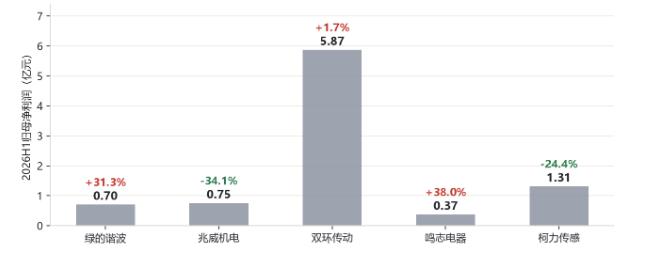
Figure:
Let's make a sensitivity reverse calculation: assuming that the global humanoid robot shipment reaches 500,000 units in 2028, the single-unit value of A-share suppliers is 20,000 yuan