Lessons from Novartis's two consecutive Phase III trial failures
In September 2026, the global innovative pharmaceutical industry suffered two consecutive heavy blows, and the one that took the hits was precisely the most robust player in the field.
The first setback came with Pelacarsen, Novartis's high-stakes Lp(a)-targeting drug, which failed to significantly reduce the risk of major cardiovascular events in patients in its global Phase III Lp(a)HORIZON study. Shortly afterwards, del-desiran (AOC 1001), the world's first antibody-oligonucleotide conjugate (AOC) drug, also missed its primary endpoint in the Phase III HARBOR study.
Two Phase III failures in just a few days, both involving Novartis, both First-in-Class (FIC) global pioneering drugs, and both acquired at huge real-money costs: del-desiran was one of the three AOC assets Novartis obtained in its approximately $12 billion acquisition of Avidity in February 2026; Pelacarsen was the right Novartis secured from Ionis for a cumulative total of more than $400 million.
The consecutive setbacks of the two FIC drugs are enough to shake the industry in any era. The impact of this incident goes far beyond Novartis's own pipeline profit and loss statement — Lp(a) and AOC, two brand new tracks that have been high on expectations, have their future trajectories and destinies tied to these two sets of clinical data. When a giant vessel violently tosses in the vast ocean, the waves it stirs up will spell catastrophic disaster for the small skiffs trailing behind.
01
Reduced by 80%, Then What?
Before the Lp(a)HORIZON results were released, Lp(a) was almost the most perfect story in the cardiovascular field.
Epidemiological studies have repeatedly confirmed that high levels of Lp(a) are independently associated with the risk of myocardial infarction and stroke; human genetics studies have also backed this up, showing that genetic variants that lower Lp(a) are accompanied by reduced cardiovascular risk. The causal chain seemed seamless, with only one last puzzle piece missing: could lowering Lp(a) with drugs translate into a reduction in clinical events?
Pelacarsen was supposed to complete this puzzle. As an antisense oligonucleotide (ASO) drug, it precisely targets apolipoprotein(a), the constituent component of Lp(a), and reduced Lp(a) levels by 72%-80% in Phase II studies, almost reaching the level of "deep silencing". With 8,323 participants across 42 countries and peak sales forecasts as high as $3 billion to $6 billion, Lp(a)HORIZON carried the collective expectations of the entire track.
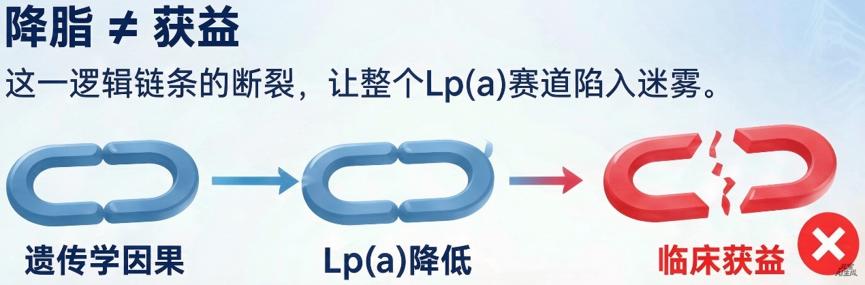
However, the puzzle piece failed to fit. Lp(a) did drop, but the cardiovascular benefits did not materialize.
Lipid lowering ≠ clinical benefit. These five words have severed not just a clinical trial, but the logical foundation of the entire track: it is not just a technical setback, but an earth-shattering shake to the very concept of "causality". A harsh question has been placed on the table: is lowering Lp(a) really an effective treatment strategy? If nearly 80% reduction still brings no benefit, is it "the reduction is not enough", or "lowering it is useless at all"?
"Lowering it even further" is one path. The pipelines under development at Amgen and Eli Lilly use siRNA technology to reduce Lp(a) by more than 90% — if 80% is not enough, what about 95%? Will a higher reduction rate be the ticket to clinical benefit, or an endless numbers game?
"Earlier intervention" is the other path. If the pathogenic effect of Lp(a) is established very early in life, and intervening in adulthood may be too late, then administration should be started in advance before Lp(a) accumulates to the pathological threshold, to cut off the risk ahead of the disease progression. This approach comes with long follow-up periods, huge population screening costs, and unpredictable regulatory risks.
Both paths carry extremely high costs, and both are betting on a biological hypothesis that has just been shaken by a Phase III failure. Who knows? No one has the correct answer. The only thing certain is that capital will not pay for "uncertainty".
In the short term, investment from pharmaceutical companies and capital in the Lp(a) track will inevitably slow down significantly, or even come to a halt. Before the scientific fog clears, no rational enterprise will continue to pour billions of dollars into pursuing a question that "may have no answer". The winter for Lp(a) drug R&D has arrived ahead of schedule.
02
An Expensive Stress Test
If the failure of Lp(a) is the collapse of causal logic, then the setback of AOC is more like an "imperfect signal".
del-desiran (AOC 1001) is the world's first antibody-oligonucleotide conjugate drug to advance to Phase III, carrying additional symbolic significance: verifying the clinical feasibility of the brand-new AOC drug class. Its mechanism uses antibodies targeting transferrin receptor 1 (TfR1) to precisely deliver siRNA to muscle tissue, for the treatment of myotonic dystrophy type 1 (DM1).
The results of the HARBOR study are mixed: the primary endpoint — video hand opening time (vHOT) — did not achieve statistically significant improvement, which is a clear signal of failure; however, signs of clinical activity were observed in secondary endpoints and exploratory analyses, and the safety profile was consistent with previous data with no new hidden risks identified.
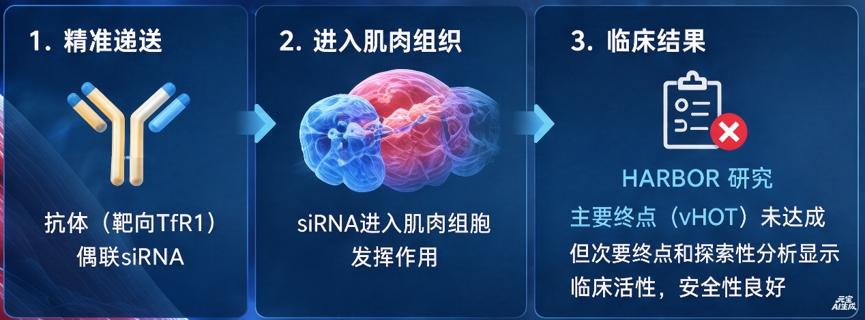
In other words: the targeting and delivery mechanisms are likely effective, the drug reached the target tissue, exerted biological activity, and did not cause unacceptable toxicity. The problem may lie in "insufficient magnitude of clinical benefit", or "the selected primary endpoint is not sensitive enough to capture the real improvement of patients".
Compared with the fundamental crisis faced by Lp(a), the problems of AOC are at the level of "technical optimization". It does not falsify the AOC platform, but is more like an expensive stress test that exposes the imperfections of the first-generation AOC molecules in target selection, drug potency, and clinical endpoint design.
But the capital market never makes such fine distinctions. For enterprises in the AOC track that are in the financing stage, especially Biotechs, the Phase III result of del-desiran is a heavy blow: investor confidence has been shaken, valuation logic needs to be reshaped, and the threshold for subsequent financing has risen sharply. AOC Biotechs that used to get valuation premiums just for the label of "track leader" now have to face the hard question directly: "del-desiran didn't make it, what makes you different?"
The spark has not been extinguished yet. In Novartis's pipeline, del-zota targeting Duchenne muscular dystrophy has received FDA priority review, and del-brax targeting facioscapulohumeral muscular dystrophy is also planning to meet with the FDA. These follow-up candidates must, under the shadow of del-desiran's failure, come up with more rigorous clinical designs and clearer differentiated advantages to prove that the value of AOC is not a flash in the pan.
03
An Industry That Only Pays For Results
The two failures point to the same cold rule of the innovative pharmaceutical industry: this industry only pays for results.
R&D investment, failure rate, the elegance of scientific hypotheses — these are all internal perspectives of the industry. What patients, governments, and payers see is only one thing: how much health benefit has been obtained for the money spent.
Pelacarsen's Phase III trial cost hundreds of millions of dollars, and 8,323 patients devoted their precious time and trust to it. If it ultimately cannot reduce cardiovascular events, then for payers, no matter how elegant the underlying biological hypothesis is, how solid the genetic evidence is, and how respectable the R&D team's efforts are, it is not a drug worth paying for. The same applies to del-desiran — good safety and signs of activity are valuable signals in the scientific sense, but they do not carry enough weight on the decision-making scale of "whether to pay".
Results are the only currency. Enterprises bear all the risks: financial, scientific, time-related, and team-related, while society only looks at the final outcome. If you succeed, the rewards are generous; if you fail, everything goes back to zero. No one will pay a premium for "almost succeeded".
04
The Vast Ocean Belongs Only To Giant Vessels
The "double 10 law" of innovative drugs has long been rewritten: nowadays, the average R&D cost of a new drug exceeds $2.6 billion, the average time from target discovery to marketing exceeds 12 years, and the failure rate of FIC drugs in the clinical stage exceeds 85%; in fields like Alzheimer's disease, the failure rate is close to 100%. The more high-impact the track, the higher the capital investment and risk required for FIC drugs rise simultaneously.
This leads to the question: what kind of enterprise can keep sailing in the ocean of FIC development in high-impact tracks?
The answer for now is: international pharmaceutical giants like Novartis.
With this understanding, it is easy to see that the "follow" and "me-too" strategies of Chinese pharmaceutical companies are never derogatory terms, but highly rational survival strategies. For an industry in the catch-up stage, choosing verified targets and mature technical paths to push the failure rate down from 85% to below 20% is the only realistic path to keep enterprises alive and allow the industry to grow. Small boats dare not sail into the deep sea, because a single storm is enough to capsize them.
Novartis can afford the failure of Pelacarsen: billions of dollars went down the drain, the stock price fell by more than 10%, but the sun rises the next day as usual, the R&D pipeline operates normally, and investors still have confidence in Novartis's long-term value, because it has a sufficiently diversified pipeline portfolio, stable annual revenue of more than $50 billion, and century-accumulated brand trust. When a giant vessel is hit by huge waves, it will toss and take on water, but it will not sink.
But what if it is a Biotech that only has this one core pipeline? A single Phase III failure means an 80% plunge in market value, layoffs, downsizing, forced acquisition, or even bankruptcy liquidation. That is why after Novartis announced the two pieces of bad news, the capital market's first reaction was not just to focus on Novartis itself, but to immediately keep a close eye on the stock prices of AOC Biotechs such as Avidity Biosciences and Dyne Therapeutics. These companies do not have the scale of Novartis, and cannot digest such bad news.
The "unsinkability" of giant vessels comes from four aspects: diversified pipelines that do not put all eggs in one basket; sufficient cash reserves that can withstand simultaneous failures of multiple projects without breaking the cash flow; continuous investment capacity that will not abandon an entire direction just because of one setback; and a long-termist capital structure — patient capital is willing to accompany the giant vessel through cycles, and will not flee in a hurry just because of the fluctuations in a quarterly report.
05
The Mission of Giant Vessels
The "turbulence" caused by Novartis's two consecutive Phase III failures is a wake-up call for the entire industry.
It reminds everyone: the essence of innovative drug development is to explore routes in uncharted waters. Reefs are not marked on nautical charts, and storms can arrive without warning. The most promising-looking targets may turn out to be a beautiful illusion; the most elegant technical platforms may stumble over the choice of a clinical endpoint.
It also reminds China's innovative pharmaceutical industry: we are at a critical stage of transformation from "following" to "original innovation", and more and more local enterprises are starting to venture into the deep sea areas that they have never stepped into before. This courage is respectable, but deep-sea navigation requires far more than courage. It also requires tonnage, reserves, diversified risk hedging mechanisms, and patience from the whole of society.
The value of Novartis's two failures does not lie in declaring the end of a certain track, but in obtaining precious information about "what does not work" for the entire industry at the cost of billions of dollars. The Lp(a) story is not over yet — science will not end because of a single failure, but it requires smarter hypotheses, more ingenious verification, and more patient capital. The same goes for the AOC story: the value of the delivery technology has been indirectly proven, and the remaining problems are to find the right indications, the right endpoints, and the right molecular design. Each of these "remaining problems" requires huge investment, and each comes with the risk of another failure.
Only enterprises that have both abundant capital, established scientific depth, and the ability to adhere to long-termism are qualified to continue exploring.
For China's innovative pharmaceutical industry to go far, it must have its own "giant vessels". Not just large in market capitalization, but "large" in terms of pipeline depth, technical accumulation, talent density, capital patience and global vision. Only in this way, when encountering setbacks like Pelacarsen and del-desiran, can they avoid being crushed, learn from failures, and keep moving forward.
The vast ocean of innovative drugs never belongs to the lucky ones who avoid storms by chance. It belongs to the giant vessels that have been repeatedly battered by storms but still refuse to turn back. Because only giant vessels have the fuel to start the next journey after failure; only giant vessels can be pulled back from the verge of sinking; and only giant vessels can turn all the "no entry" signs into a thoroughfare leading to patients in the end.
Storms never stop. But the giant vessels are still sailing.
This article is compiled based on public materials, for information exchange only, and does not constitute any investment advice.
This article is from the WeChat official account "Yi Yao", author: Yan Song, published with authorization from 36Kr.