Just now, OpenAI announced that it has cracked the millennium problem. Chen Lijie, the legendary talent from Tsinghua University's Yao Class, remarked: This is truly an incredible era.
AI is entering the deep uncharted waters of the mathematical world.
Just now, OpenAI announced, its internal AI system has completed a solution to the existence and smoothness problem of the Navier-Stokes equations, and simultaneously released the relevant paper as well as the Lean formalized proof.
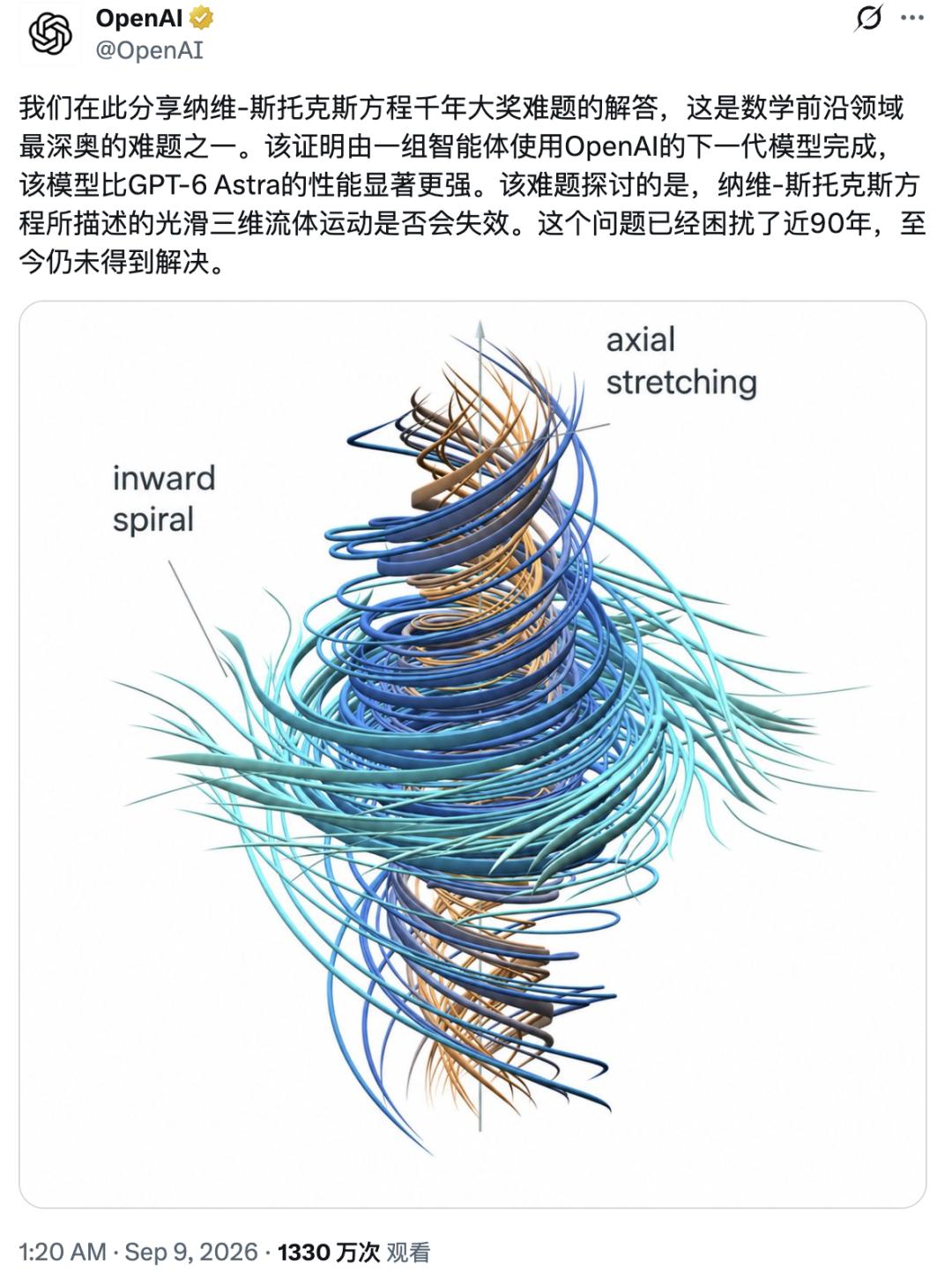
The Navier-Stokes equations are not only one of the Millennium Prize Problems, but also the core theoretical foundation of modern fluid mechanics, and it is reportedly the long-term research direction of Chinese mathematician Wei Dongyi.
OpenAI stated that this proof was completed by an internal multi-agent system, and the model capability behind it significantly exceeds GPT-6 Astra. If this achievement is finally recognized by the mathematical community, it means that AI has begun to participate in solving problems that top mathematicians have been studying for decades or even hundreds of years in the past.
10,000 AI Agents, Taking on a Centuries-Old Mathematical Puzzle
The Navier-Stokes equations are the core mathematical model describing fluid motion.
From aircraft design and weather prediction to blood flow research, all rely on this set of equations. But one key question has remained unanswered for a long time: under the condition that the initial state of three-dimensional incompressible fluid is smooth, is it possible to generate singularities in a finite time.
The so-called singularity refers to the situation where the fluid velocity increases infinitely in a finite time.
If this happens, it means that the existing continuum model fails, and it is necessary to further track the motion law of individual particles.
This problem has plagued the mathematical community since Navier and Stokes proposed the relevant equations in the 19th century. In 1934, mathematician Jean Leray proved that the generalized solution of the equations exists, but whether the smooth solution exists forever still has no answer.
In 2000, the Clay Mathematics Institute included the existence and smoothness of the Navier-Stokes equations in the seven Millennium Prize Problems, and offered a prize of 1 million US dollars.
OpenAI stated that its internal system finally proved that a fluid that is initially smooth and stationary can form singularities in a finite time after being subjected to the action of smooth external forces.
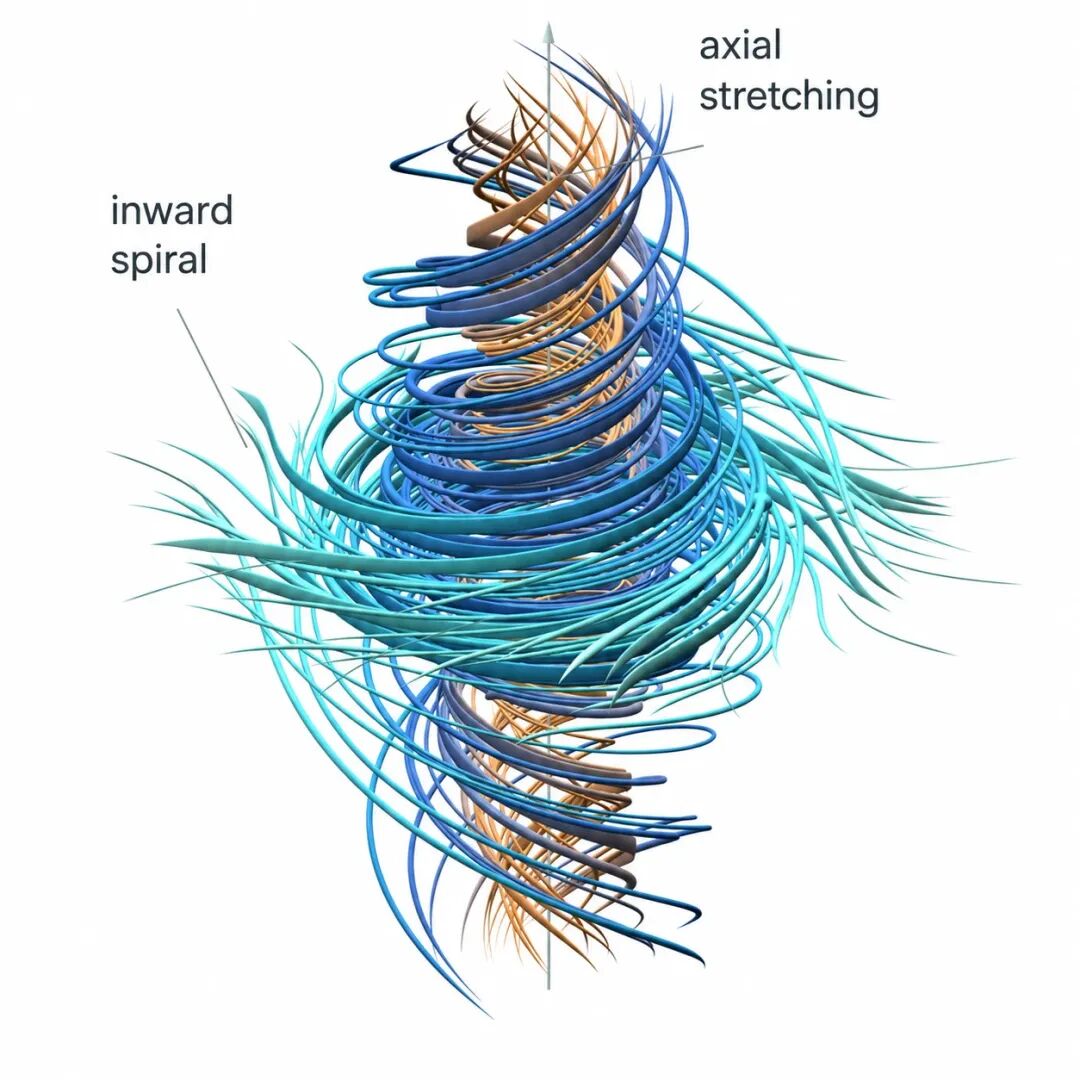
The research team constructed a special vortex structure. The fluid rotates continuously around the center, shrinks inward gradually, and undergoes axial stretching at the same time. As the spatial scale shrinks, the fluid velocity continues to increase, but the overall energy remains finite.
OpenAI said that the key to the proof process is to make multiple mathematical terms describing fluid motion grow simultaneously and maintain a precise balance, so as to realize the formation of singularities without the intervention of infinite external forces.
To complete this task, OpenAI did not only rely on a single model, but deployed a collaborative system composed of multiple Agents.
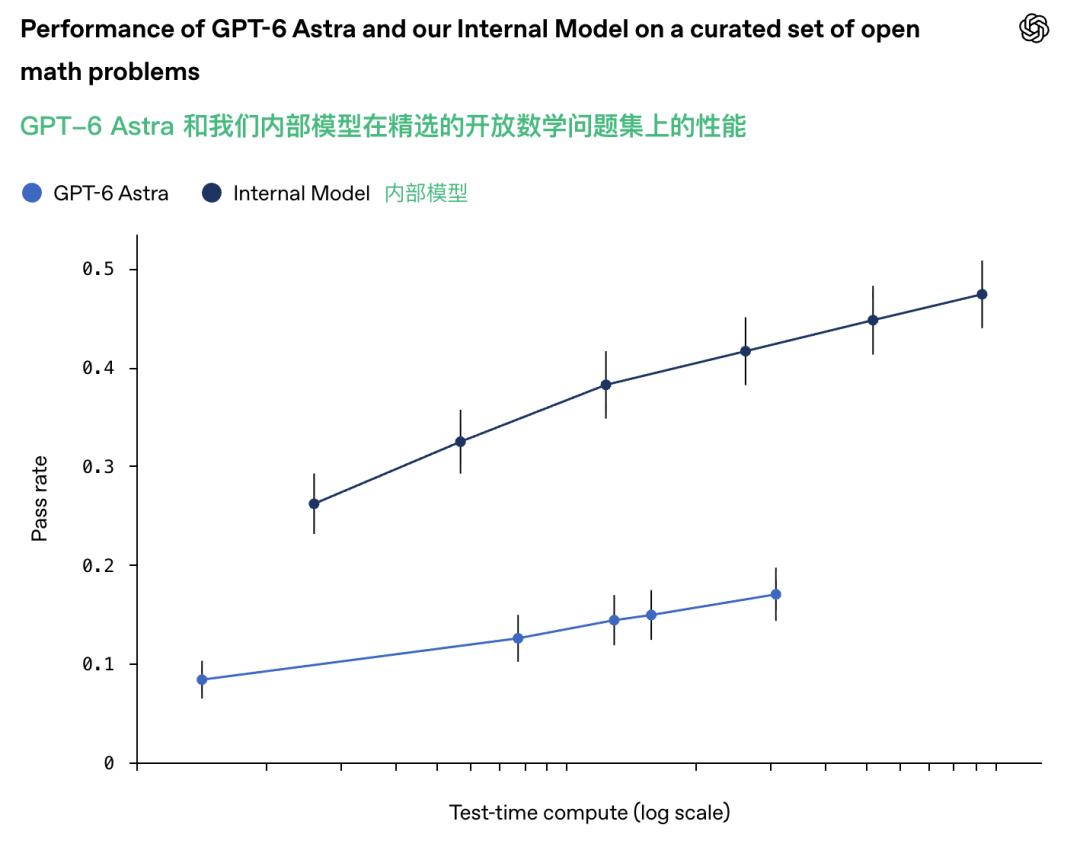
Starting from September 1, the research team let different Agent groups explore all the unsolved Millennium Prize Problems. Different teams tried to prove the two directions of singularity existence and non-existence respectively, to avoid the search process falling into a single path.
In the Navier-Stokes problem, the number of Agents involved in the work reached about 10,000.
OpenAI stated that the system had previously solved a related regularity problem of the Euler equations. After about 100 Agents worked for 50 hours, they completed the counterexample proof of this problem, which became an important clue for the team to continue studying the Navier-Stokes problem.
Finally, the AI Agent got the solution to the Navier-Stokes problem on September 5. It took about 88 hours from starting the task to getting the result, and then another 17 hours to complete the Lean formal verification.
Throughout the whole process, the Agents sent a total of about 4.9 million messages and consumed about 300 billion output Tokens. Among them, the tasks related to the Navier-Stokes problem generated about 2.7 million messages and consumed about 130 billion output Tokens.
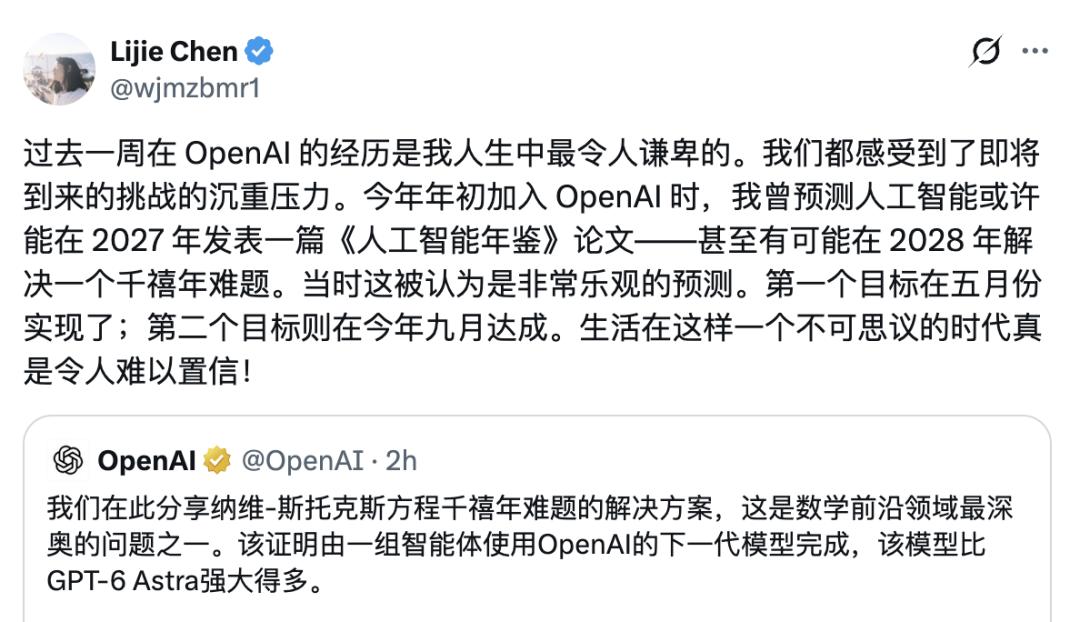
OpenAI researcher Chen Lijie also publicly responded to this incident.
Chen Lijie, born in 1995, once won the global first place in the International Olympiad in Informatics. He is a legendary graduate of the Yao Class at Tsinghua University, later obtained a doctorate in computer science at MIT, and currently serves as an assistant professor in the EECS department of the University of California, Berkeley, and joined OpenAI to be responsible for the research of large model mathematical reasoning.
He said that earlier this year he predicted that AI might publish top mathematical papers in 2027 and solve a Millennium Prize Problem around 2028. But the actual development speed exceeded expectations. "This is an incredibly incredible era." Chen Lijie wrote.
AI Solves the Puzzle, But Who Came Up With the Answer First?
However, after OpenAI announced this achievement, disputes over research priority and process transparency also emerged.
The dispute stemmed from a public statement by Tristan Buckmaster, an expert in fluid mechanics at the Courant Institute of New York University.
Before OpenAI released the results, Buckmaster was cooperating with Levent Alpöge, a researcher at Anthropic, to use large models to study multiple open problems in fluid mechanics.
Buckmaster said that they had previously completed a number of related breakthroughs, including the finite-time blowup solutions of the incompressible porous media equation, the Boussinesq equation, and the three-dimensional incompressible Euler equation under the condition of smooth external forces.
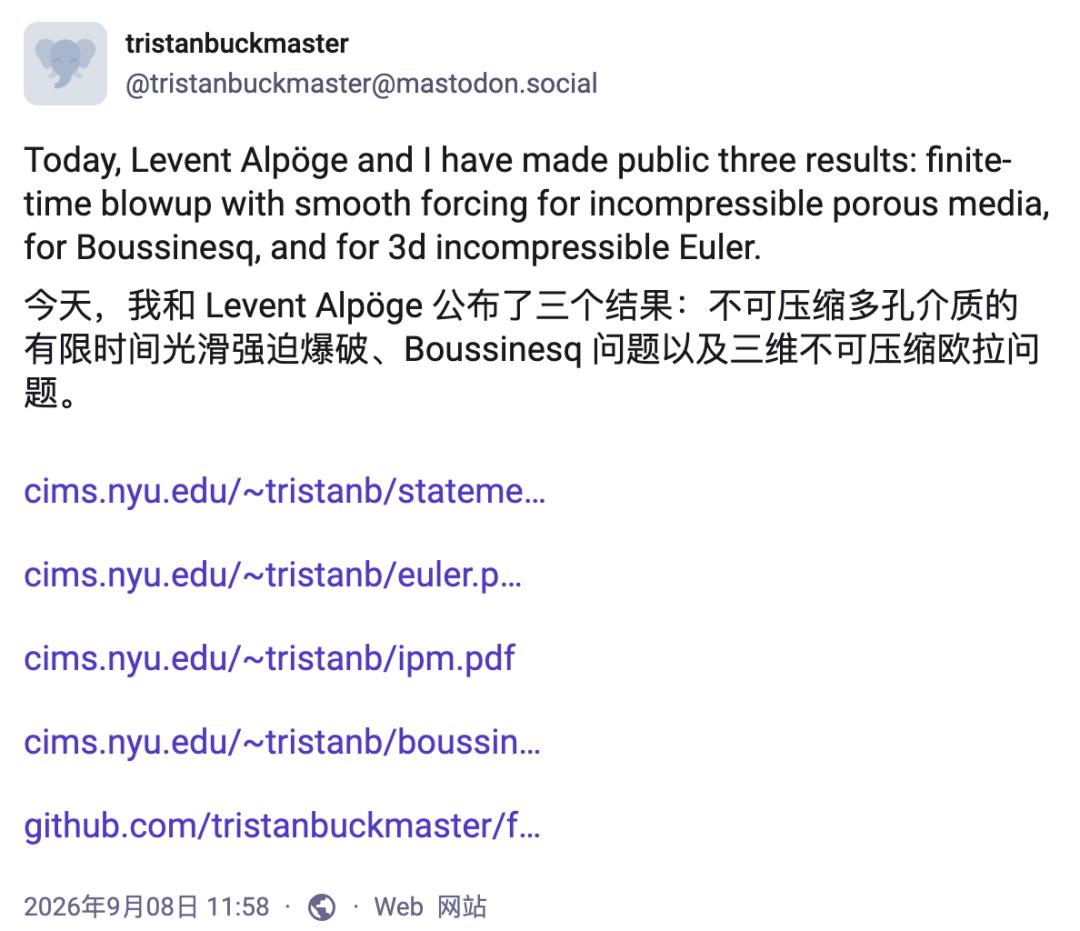
These works are based on the research directions proposed by mathematicians Diego Córdoba and Luis Martínez-Zoroa over the years, and large language models have helped them further advance the relevant proofs.
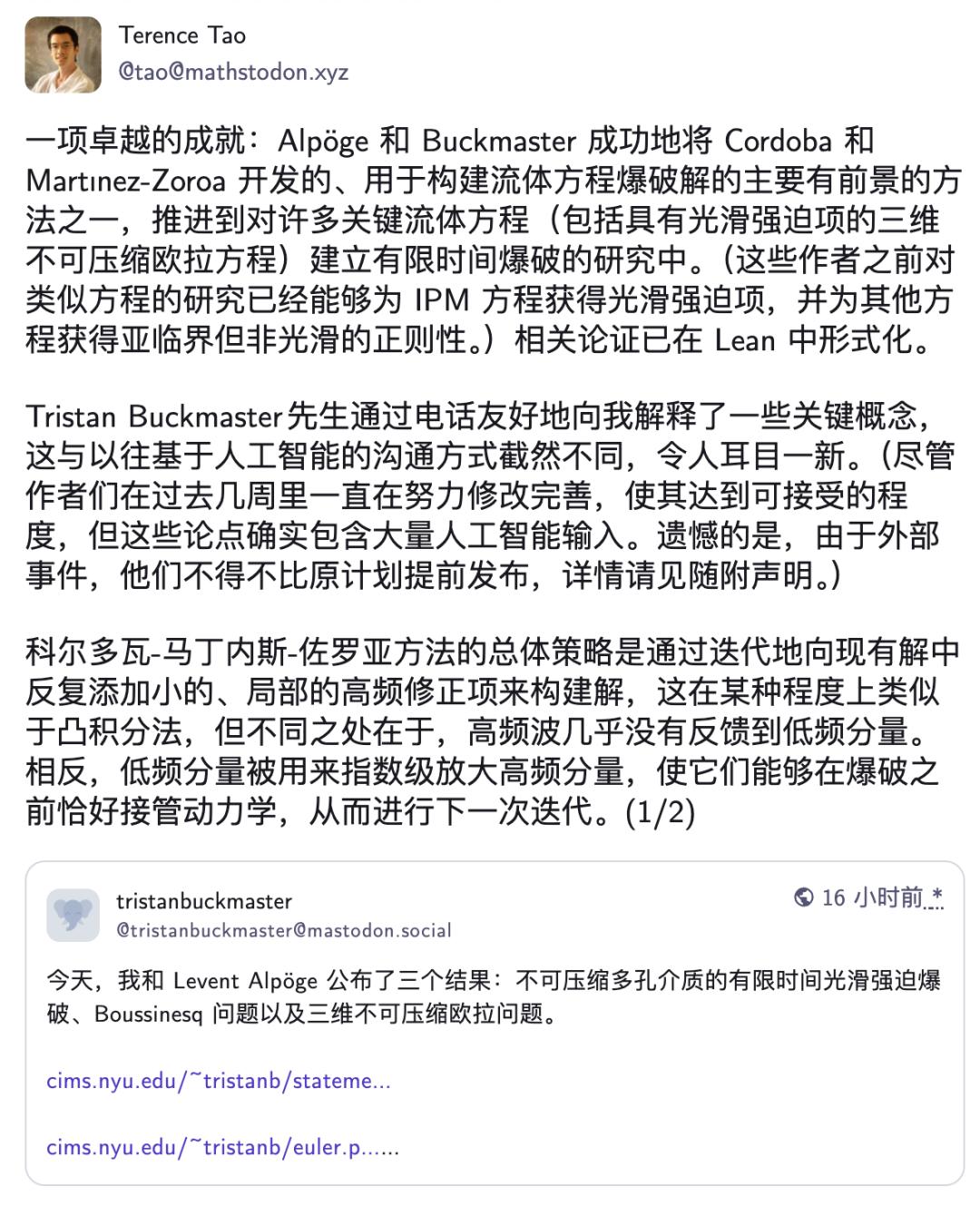
Terence Tao's Evaluation
Buckmaster said that they used multiple models, including Anthropic's Claude, OpenAI Codex, and GPT-5.6 Sol and Astra. Among them, Astra was mainly used for paper sorting and proof review.
He said that the team made a real breakthrough on August 15, when they obtained the relevant results of the Boussinesq and Euler equations, and then completed the verification using Lean.
In early September, after learning the news that there were rumors that Anthropic might have made a breakthrough in a major mathematical problem, Buckmaster took the initiative to write to an OpenAI mathematics researcher to explain the research progress of both sides and clarify the relevant situation. The OpenAI researcher then replied, hoping to learn more details to avoid duplicate competition in similar research directions.
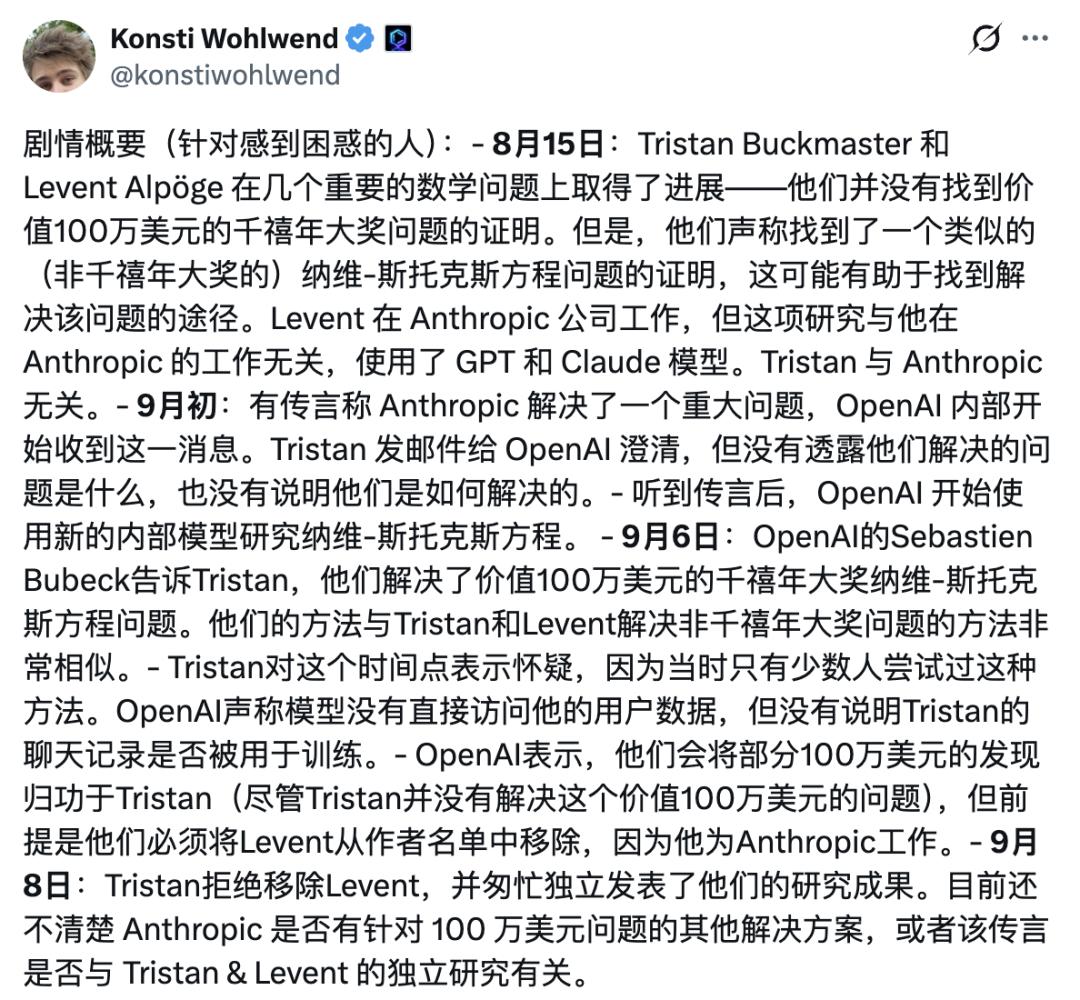
According to the email records made public by Buckmaster, he explained to OpenAI that his cooperation with Levent was personal research without any institutional cooperation background, and they had already prepared to publish papers and formalized proofs.
Subsequently, the two sides launched communication.
Buckmaster said that the OpenAI researcher told him that the internal model had generated a proof of the Navier-Stokes problem with external forces, and said that the relevant paper was about 100 pages in length.
However, in the process of communication, Buckmaster believed that OpenAI's initial description of the research process was incomplete.
He said that he was initially told that this work was mainly completed by the model, and only the problem itself was input. But in the subsequent communication, he learned that OpenAI actually organized a complete research team, first let the model solve simpler problems, including the Euler equations, and then gradually advance to the Navier-Stokes problem, while consuming a large amount of computing resources.
Buckmaster also raised the question of whether OpenAI might have access to their previous research data in Codex.
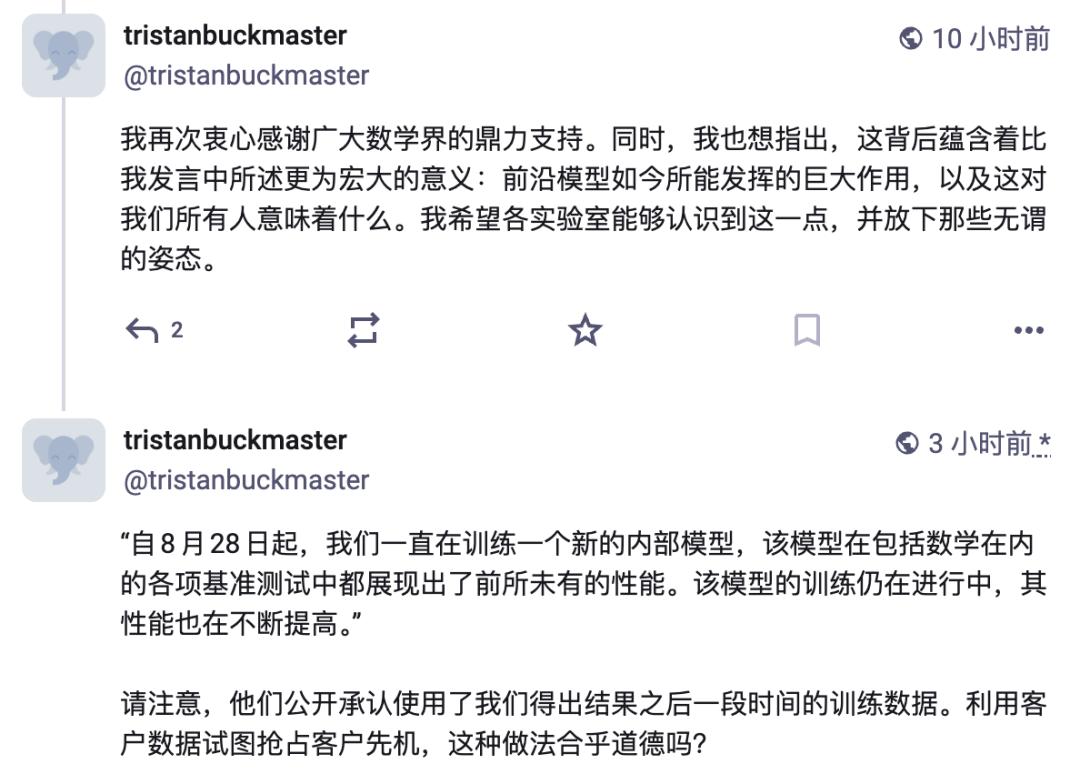
He emphasized that he had not seen OpenAI's proof, nor did he directly accuse OpenAI of using user data. He only hoped to make the whole incident public to avoid the outside world misunderstanding the source of the work of both sides.
OpenAI denied using user data to solve this problem.
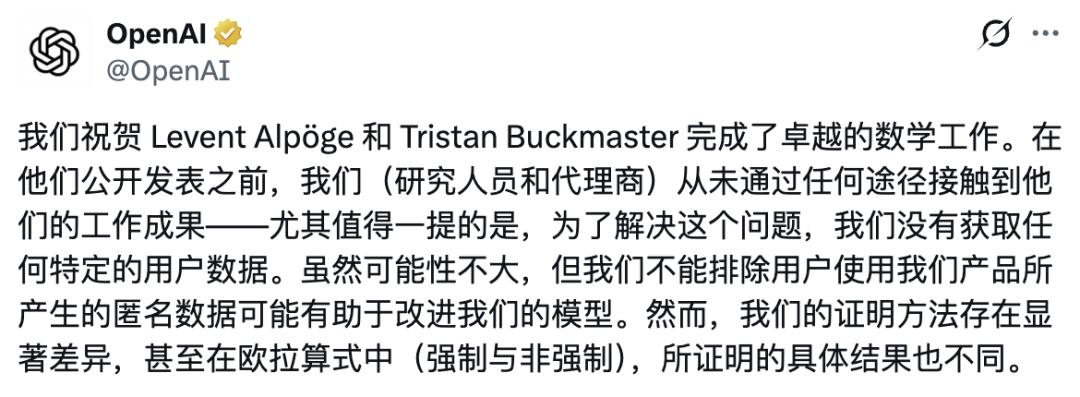
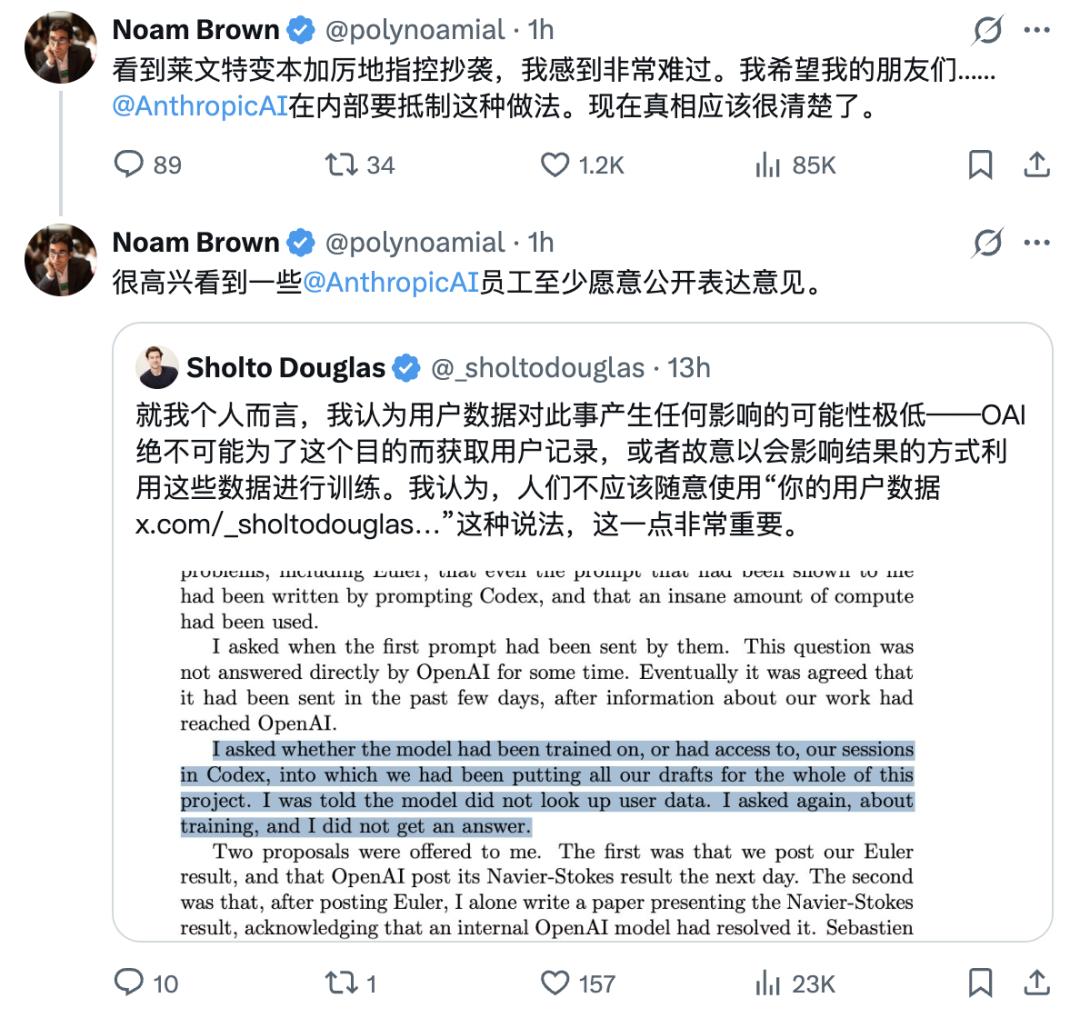
OpenAI researcher Noam Brown publicly responded that he regretted the plagiarism allegations raised by the outside world and believed that the facts were already clear.
Anthropic employee Sholto Douglas also said that from the perspective of technical process, the possibility that OpenAI obtained and used user research data to affect the results is very low.
In addition to this academic dispute, as AI begins to participate in basic scientific research in the future, many rules in the traditional academic system will face re-examination. Who should be the author of the paper, how to calculate research contributions, and whether AI-generated proofs count as real discoveries, these problems have no ready-made answers.
In the past, tools only amplified human capabilities.
But when tools begin to put forward hypotheses, find paths and complete proofs, what humans are facing is no longer a more powerful calculator, but a new type of scientific research collaborator.
The mathematical community is experiencing a turning point similar to when computers entered scientific research, except that this time, the change comes from machines that can participate in thinking.
This article is from the WeChat official account "APPSO", author: APPSO that discovers tomorrow's products, published with authorization from 36Kr.