Li Auto's self-developed batteries have been officially installed in its production vehicles. Has the automotive industry fully entered the era of independent R&D?
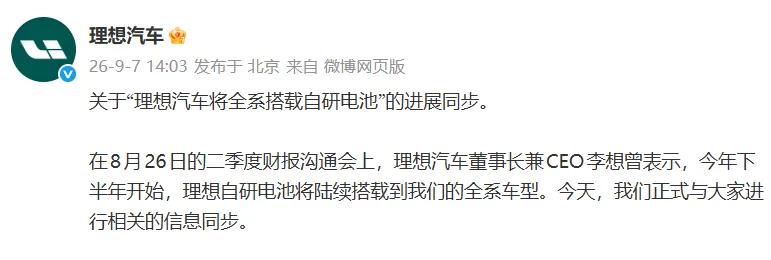
All Li Auto's full lineup of models will be equipped with self-developed batteries.
On September 7, Li Auto officially announced the latest progress of its self-developed batteries, and clarified the launch timeline for the batteries to be installed on various models in the fourth quarter:
The self-developed batteries have already been equipped on the L8, L6 and i8 models;
The first batch of the all-new MEGA will be equipped with 5C ternary lithium batteries from CATL. Users who lock their orders after 15:00 on September 7 will be switched to Li Auto's self-developed 5C ternary lithium batteries, with deliveries expected to start in November;
The Li Auto i9, which hits the market in mid-September, will be first offered with 5C ternary lithium batteries from CATL, and will be switched to the self-developed 5C ternary lithium batteries after the production ramp-up of Li Auto's self-developed batteries is completed;
The 2026 Li Auto i6, to be launched in the fourth quarter, will be fully equipped with Li Auto's self-developed 5C batteries, with pre-orders expected to open at the end of September and deliveries to start in early November.
(Image source: Li Auto)
In other words, within this year, all Li Auto models except the Li Auto L9 will be switched to self-developed 5C batteries. The Li Auto L9 has also filed a new vehicle announcement for the version equipped with self-developed batteries on September 8, and is expected to officially switch the battery type next year.
So what is the origin of Li Auto's 5C battery? Why does Li Auto choose to independently develop core components such as range extenders, intelligent driving chips, and batteries? Has the automotive industry really entered the "era of independent development" now?
Today, EV Insight will talk about these topics with you.
Independent development of core large components: What does Li Auto aim to achieve?
In the official announcement released on September 7, Li Auto also disclosed relevant information about its self-developed batteries.
Li Auto stated that it formulated its technology strategy in 2020, aiming to fully independently develop the two core technologies of smart electric vehicles: batteries (cells) and chips. In the same year, Li Auto started the independent R&D of cells, and the core technologies of Li Auto's self-developed batteries include "complete integrated design of 5C cells, Pack and BMS".
Regarding the quality issues of the self-developed 5C batteries, Li Auto also said: "The self-developed batteries of Li Auto can deliver industry-leading performance in terms of quality, safety, service life and other aspects."
However, in this official announcement, Li Auto only mentioned the independent R&D of batteries, without specifying the specific battery manufacturer. So why is that?
According to public information, Li Auto's batteries adopt the model of self-developed technology + OEM production, which is similar to the model where Apple develops mobile phones and Foxconn manufactures them on a contract basis.
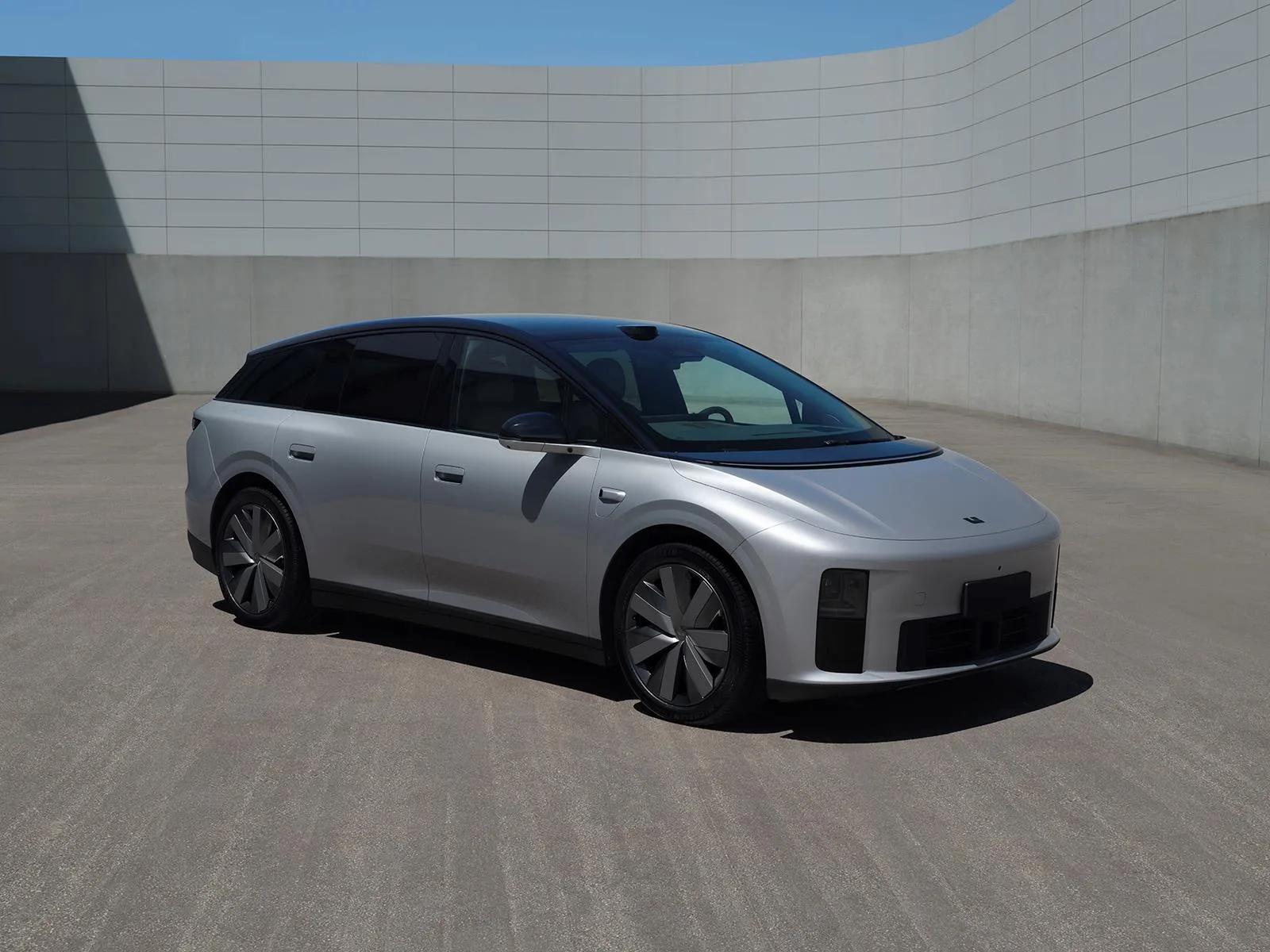
Who is the OEM? According to the latest new vehicle announcement from the Ministry of Industry and Information Technology, the LFP batteries of the 2026 Li Auto i6 have Sunwoda and CALB as the cell suppliers; the ternary lithium batteries of the L9 have Sunwoda as the cell supplier.
(Image source: Ministry of Industry and Information Technology)
In other words, among Li Auto's self-developed batteries, the LFP battery OEMs are likely to be CALB and Sunwoda, and the ternary lithium battery OEM is likely to be Sunwoda.
It is worth noting that on September 4, before Li Auto officially announced the progress of its self-developed batteries, Sunwoda released an announcement stating that it agreed to Li Auto's capital contribution of 2.65 billion yuan to increase the capital of Sunwoda Power, a subsidiary under Sunwoda. After the capital increase is completed, Li Auto will hold 8.79% of the shares of Sunwoda Power and become its second largest shareholder.
It is not difficult to see from this event that Li Auto may make Sunwoda the OEM for its self-developed batteries by investing in Sunwoda.
Previously, Sunwoda has supplied batteries for multiple Li Auto models, such as the full lineup of the old L6, L7/L8 Air and other models. This time Li Auto's equity participation in Sunwoda Power means that the cooperation between the two sides is further deepened.
In addition to self-developed batteries, Li Auto has also independently developed intelligent driving chips, and independently developed and produced the latest generation of range extenders.
In terms of intelligent driving chips, Li Auto started the independent R&D of the Maer chips in 2022. This year, the Maer M100 chip is first installed on the all-new L9 series, and will later be equipped on the all-new L8 series and all-new L6.
The self-developed and self-produced range extender, just like the self-developed Maer chip, was first launched on the all-new L9 series this year, and will later be installed on the L8 series and L6.
But the difference between the range extender and batteries and chips is that Li Auto's range extender is not only independently developed, but also self-produced. That is to say, instead of using external OEM like batteries and chips, Li Auto chooses to produce it on its own.
Why does Li Auto choose to independently develop these core components, instead of adopting external procurement or cooperating with suppliers for customized development like many other car companies? Li Auto's officials and engineers have given the answer to this question.
First of all, as for why to independently develop batteries and intelligent driving chips, Li Auto said: "Batteries and chips are the most core technical barriers. The three-electric technology, intelligent driving model and excellent product power will be the core competitiveness of the company." Li Auto hopes to "grasp the future-oriented core technical barriers in its own hands, which is the strategic determination of Li Auto."
As for the reason for independently developing the range extender, Tang Huayin, Head of Li Auto's Full EV Product Line, said that Li Auto's understanding of range extenders has changed, and it needs to create a range extender dedicated to power generation, rather than modifying a traditional engine to convert it into a range extender.
In short, there are two points: avoid being restricted by others in core technologies, and ensure that the technologies can better match the company's own products.
Of course, Li Auto is not the only brand that independently develops core components now. What aspects are the independent development of other brands focused on? What is the overall trend of independent development in the automotive industry now?
The automotive industry enters the "era of independent development"?
In recent years, the automotive industry has been emphasizing the independent R&D of core components one after another. In the new energy vehicle sector, many car companies have also chosen the path of independent development.
Among them, BYD is a representative that cannot be ignored. From engines, motors, batteries, electronic control systems, chassis, suspensions to many small components, BYD adopts the model of independent R&D + self-production for supply. Even for intelligent driving chips, BYD officially announced this year that its first product, the Xuanji A3, is expected to be officially installed on vehicles in 2027.
In addition to a number of established independent brands such as BYD, new EV startups have also launched their independent development modes, and their independent R&D efforts are mostly concentrated in the field of intelligent driving.
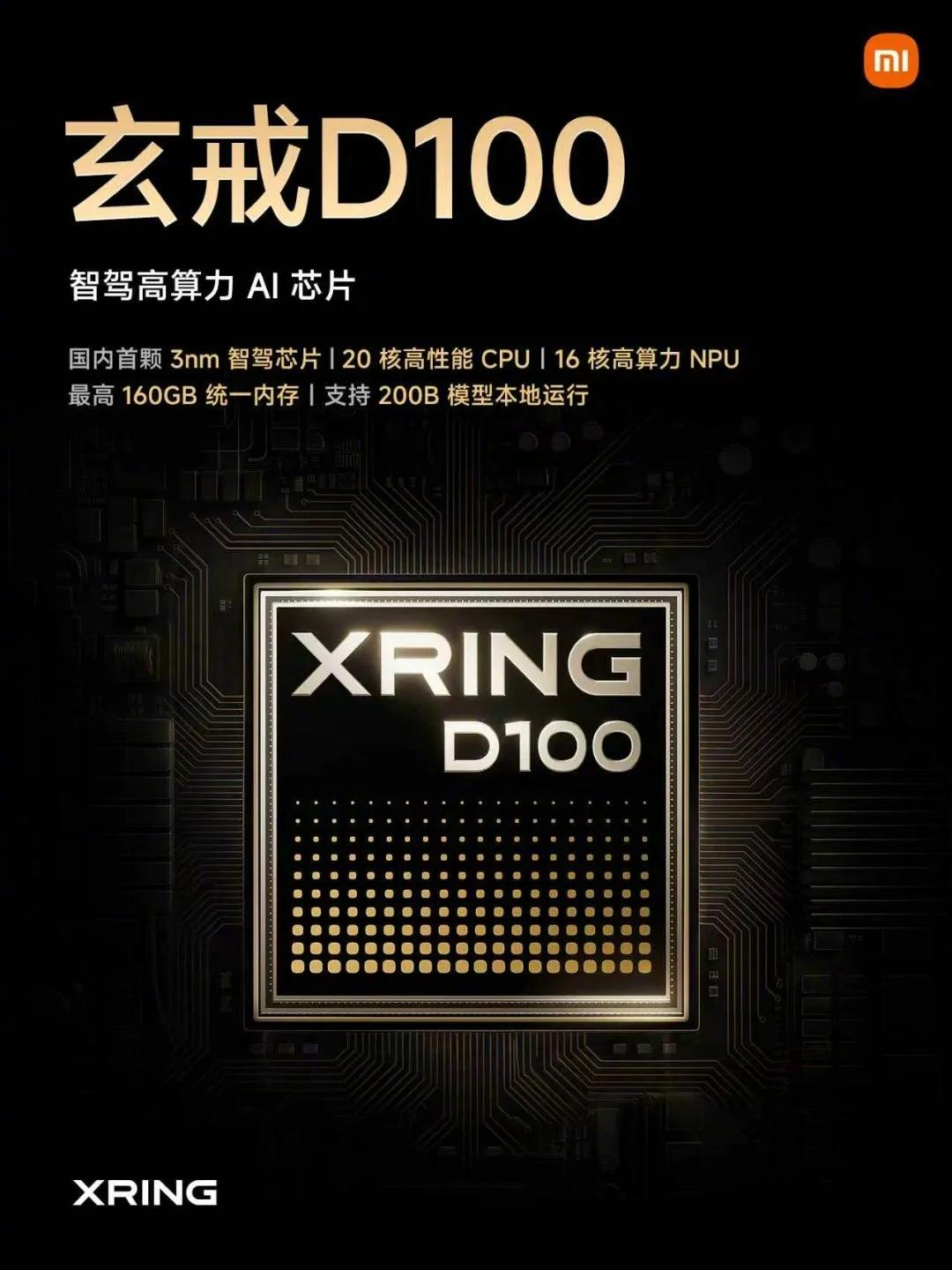
For example, Nio's Shenji NX9031, Xpeng's Turing AI chip, and Li Auto's Maer M100 have all been mass-produced and installed on vehicles, and are compatible with the high-level assisted driving systems of their respective brands. Even Xiaomi, which just entered the automotive industry not long ago, recently announced its first 3nm intelligent driving chip, the Xuanjie D100, which is planned to be officially commercialized in 2027.
(Image source: Xiaomi)
So why are car companies willing to spend huge sums of money to develop intelligent driving chips? In other words, why are intelligent driving chips one of the components with high priority for independent development among car companies?
The reason is simple: the competition in the second half of the new energy vehicle market and the accelerated transformation of the whole society towards AI have prompted leading smart EV brands to develop intelligent driving chips that meet their own needs.
Some people may ask: Nvidia's Thor, with a computing power of 700 TOPS, is more than enough for use, right? If one chip is not enough, you can use two.
But it should be noted that the matching degree of a self-developed model with a self-developed chip is likely to be higher, and the computing power utilization rate is also higher, compared with matching a third-party chip.
In addition, the whole world is now making efforts in the AI industry. As the leading enterprise in the AI industry, Nvidia controls the supply of corresponding chips. If the supply of intelligent driving chips decreases, major car companies may face the situation of "hard to get a single chip", which will have a serious impact on their own sales.
Therefore, whether it is to maximize the utilization rate of computing power or to avoid being "choked on the neck" by core component suppliers, it is very necessary for leading smart EV brands to launch independent chip development projects.
Car companies are collectively developing independently: Who will buy the products of suppliers?
Now, leading automotive brands have chosen to independently develop in fields such as chips one after another. Does that mean that suppliers are having a hard time with their business?
The answer is no. Although leading automotive brands choose to independently develop in fields such as chips, there are always car companies that do not have such strong R&D capabilities, and they will eventually choose supplier solutions.
For example, in the field of intelligent driving assistance, car companies that choose the Momenta solution still have to purchase Nvidia chips, and those that choose the Huawei ADS solution also have to purchase Huawei's intelligent driving chips.
Not to mention the battery field, leading power battery suppliers such as CATL have received overwhelming order volumes.
In fact, this is somewhat similar to the mobile phone industry a few years ago: only Apple and Huawei can independently develop mainstream flagship processors, and other brands can only queue up to buy Qualcomm's products to keep up with the pace of industrial iteration.
So for now, although car companies are in the "independent development boom", it is not a big problem for these suppliers.
Moreover, more and more manufacturers choosing to independently develop can also promote continuous competition in the industry and drive the further overall development of the industry. As the saying goes, "A single flower does not make spring, while a hundred flowers in full bloom bring spring to the garden."
This article is from "EV Insight", authorized for release by 36Kr.